by admin | May 31, 2017 | DTI Updates, Headlines, National News
Micro entrepreneurs around the country will now have access to cheap and easy credit
as the Pondo sa Pagbabago at Pag-asenso (P3) will now be made available nationwide
on May 31, 2017.
DTI Undersecretary for Regional Operations Zenaida Maglaya said the administration’s
brainchild of micro-finance facility encourages micro entrepreneurs to borrow money
from P3 that will help them finance their businesses.
“P3 is intended to help the underprivileged Filipino entrepreneurs who want to grow
their businesses. With this program, they can access cheap and easy credit without any
hassle. After filling out a half-page application and presenting necessary documents,
the money can be released within the day,” Maglaya explained.
With sufficient funds to provide to borrowers, the Department of Trade and Industry
(DTI) and its micro-financing arm Small Business Corporation (SB Corp) will lead the
implementation that will assist micro entrepreneurs financially and enable them to grow
their businesses.
Being the administration’s program to provide an affordable
micro-financing for the country’s micro entrepreneurs, the P3
funding program provides micro enterprises an alternative
source of financing that is easy to access and made
available at a cheapest cost.
“After we’ve launched the P3 in Tacloban, Occidental
Mindoro, and Sarangani in January 2017, P3 is now going
nationwide. We hope this will encourage micro entrepreneurs to patronize the government’s program so we can eliminate loan sharks,”Maglaya said.
National conduits and local Micro-financing Institutions (MFIs) have already been
accredited by the SB Corp to assist in distributing the funds to micro entrepreneurs. The
national level conduits are Radiowealth Finance Company (RFC), Taytay sa
Kauswagan, Inc. (TSKI), and Mindanao Alliance of Self-Help Societies – Southern
Philippines Educational Cooperative Center (MASS-SPECC).
Meanwhile, 18 local (MFIs) are accredited in Luzon, 6 in Visayas and 3 in Mindanao. A
total of P104.9 million have been released to P3 conduits as of today
The Pondo sa Pagbabago at Pag-asenso (P3) is a P1 billion financing program
intended to give MSMEs better access to finance, and to reduce their cost of borrowing.
The fund will also give priority to the country’s 30 poorest provinces.
Following President Rodrigo Duterte’s directive to replace the “5-6” money lending
system, the P3 is also seen to help stabilize supply and cost of commodities in public
markets, encourage small entrepreneurs to grow their businesses, eliminate loan
sharks, and offer employment and generate income for Filipinos.
The P1 billion fund of the P3 program from the Office of the President will be coursed
through the SB Corp. with accredited partner institutions such as non-bank MFIs,
cooperatives, and associations to serve as conduit for the P3 funds. With borrowers
identified through these, collection of repayments will be efficient.
The P3 Program was launched in Tacloban in Leyte on January 25, San Jose,
Occidental Mindoro on January 27, and Alabel, Sarangani last January 30. A total of
P7.7 million have been released to individual borrowers in these pilot areas: P3.5
million in Mindoro, P2.2million in Sarangani, and P1.8 million in Leyte.
The primary beneficiaries of the P3 Program are microenterprises and entrepreneurs
that do not have easy access to credit. These include market vendors, agribusinessmen
and members of cooperatives, and industry associations.
P3 will also make it easy for borrowers since it will only require minimal documentation
requirement; easy to access with only one (1) day processing of application; low cost
interest at 2.5% per month; and easy payment with collection on a weekly or daily
basis, as necessary.
Loan amounts to end-borrowers range between P5,000 and P100,000, with no
collateral requirement.
by admin | May 30, 2017 | DTI Updates, Headlines, National News
Reiterates relevance of innovation in MSME development
MAKATI—Instead of rebellion, an innovative, inclusive entrepreneurial revolution is what the Philippines currently needs, the country’s trade chief said.
Speaking at the launch of the National IP Strategy of the Philippines (NIPS) on 30 May, Department of Trade and Industry (DTI) Secretary Ramon Lopez endorsed the new strategy for intellectual property (IP) protection that can help incentivize existing and aspiring Filipino micro, small and medium entrepreneurs (MSMEs) to contribute in developing a more innovative, creative and economically-dynamic Philippines.
“In today’s knowledge economy, intellectual property is undoubtedly an invisible advantage,” said Sec. Lopez, referring to IP as an important vehicle that spurs economic growth, which can help the government in its thrust to alleviate poverty and to realize shared prosperity for all.
With the new IP protection strategy, the government lays the foundation to address the need to safeguard original, innovative and creative ideas of both MSMEs and bigger stakeholders against different forms of IP theft and piracy.
According to the trade chief, without the protection and recognition of a well-functioning IP system, innovative and creative undertakings may be impeded, slowing down the steady stream of competitive products and services in the market.
IP and innovation
Sec. Lopez said that there is a need to assess research and development initiatives if the Philippines wants to become an active player in the innovation game, adding that innovation is a potential area of improvement where the NIPS strategies would be relevant.
“Innovation should not only be for the big guys. We have to make innovation as a general mindset for our MSMEs,” he said.
The NIPS can help the country focus on improving its ranking as 86th out of 128 countries surveyed by the World Intellectual Property Organization (WIPO) and the World Economic Forum (WEF) for the Global Innovation Index.
“MSMEs only account for 35% of the Gross Domestic Product because value-added is small. Thus, we need to improve value creation process of our MSMEs through innovation,” he added.
IP and the MSME agenda
The trade chief imparted DTI’s current programs on the development of MSMEs, which serve as suppliers and subcontractors to large enterprises, as well as exporters.
The 2017-2022 Philippine Development Plan’s Chapter on Trade and Services identified challenges that hinder MSMEs from growing, including low productivity and competitiveness, lack of access to new technologies, weak technological capability, and failure to engage in innovation and research and development activities.
As a response, DTI, anchoring on the already existing laws on MSME development, continues to harness the business potential of MSMEs by helping them improve their productivity and competitiveness. Current initiatives refer to fostering the right mindset, improving access to money, market, mentoring services, machines, skills training and adopting an inclusive business model.
As of 5 May 2017, 481 Negosyo Centers have been launched all over the country, with 2,035 Shared Service Facilities (SSF) supporting 92,227 users, and 357,383 having undergone SME training. As of April 2017, more than 9,000 barangay micro business enterprises were already registered with DTI.
Making a mark
“With the new joint program of DTI and the Intellectual Property Office of the Philippines (IPOPHIL) known as Juana Make a Mark, the women entrepreneurs will have both the intellectual property knowledge and the assistance to protect their marks, thereby improving the marketability and recall of their products,” Sec. Lopez said.
The trade chief also sees the value of IP protection in another MSME program, Go Lokal!, a retail concept store showcasing quality and innovative local products crafted, designed and produced by MSMEs.
“Branding is an important component of Go Lokal! and with NIPS, I am hopeful that we can better empower participating MSMEs to enable them to leverage on trademarks—perhaps even collective marks to promote their products in the market,” he said.
“With a well-crafted national strategy that clearly maps out how intellectual property can be fully utilized to support economic development, we can regain competitive advantage and surge ahead of our neighbors,” he concluded.
by admin | May 27, 2017 | Headlines
TAGBILARAN CITY, May 26, (PIA)–Former Agriculture Secretary and non Bohol Third District Representative Arthur Yap led local officials in breaking ground and laying the time capsule for the P725 million irrigation facility that would be a new hope for at least 320 poor farmers of Mabini Bohol.
With Yap were Mabini Mayor Juanito Jayoma Jr., Alicia Mayor Marnilou Ayuban’s representative Panfilo Olaguir, National Irrigation Administration (NIA) Regional Manager Modesto Membreve, Abaca barangay Captain Silverio Miano, Engr Glen Doloritos for Gov Edgar Chatto, Cabulao Mabini Irrigators Association Vice President Juan Amores, irrigation association presidents Felipe Tutor, Maria Ayuban, and Exequiel Nudalo.
“After many years of continuous proposals, the government has now funded the Mabini Cayacay Small Reservoir Irrigation Project (SRIP),” beamed Yap who had pushed for the Mabini-Cayacay agri facility while he was still the Department of Agriculture top official.
The project to be completed two years and 2 months from now, benefits farmers of Barangays Abaca, San Roque, Cabidian and Aguipo in Mabini and some barangays in Alicia, according to NIA RM Membreve.
Although a facility that would be built using two water sources: Baujanan and Cawasan creeks, the Mabini-Cayacay SRIP would have a catchment area of around 9.5 square kilometers and is designed to store 3.09 million cubic meters, it is also designed for fish culture, flood control and other related projects, according to the published project design.
Elated over the development, Yap who also helped increase agricultural production in his district pointed out that with the new irrigation facility, he hopes local production can go from 40-50 cavans to 100-120 cavans per hectare yield.
Yap, who has been visiting the vast ricefields in his district especially that of the rainfed areas of Mabini, Alicia and Ubay revealed that with the national budget of three trillions, so much has been set aside to build more infrastructure.
Moreover, he said the new tax reform package presented by the administration even exponentially increases the revenues, which the government can use to fund more irrigation and food production projects.
NIA engineers have shared that the Mabini Cayacay SRIP still has more service areas, should the facility be expanded.
Yap said he has seen the facility expansion to be able to reach 5000 hectares more of service area which can significantly race agriculture yields from the district.
Over this, NIA information Officer Anthony Alonzo said the government is also groundbreaking a few more SRIPs in Bohol.
He reported that in the pipelines are SRIPs in Benliw, Calunasan ang Bobotbonot in Buenavista. (rahc/PIA-7/Bohol)
by admin | May 26, 2017 | Malakanyang Updates, Photo Story
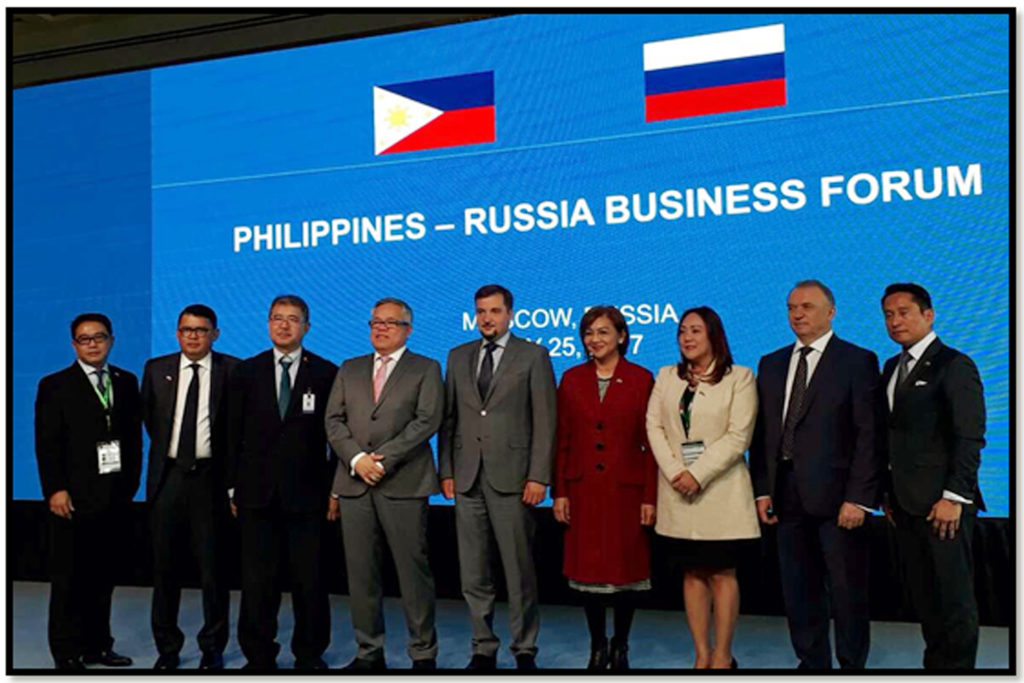
PH-RUSSIA BUSINESS FORUM IN MOSCOW. Philippine (PH) trade officials and the Chamber of Commerce and Industry of the Russian Federation (CCIRF) exchanged views on the ways to strengthen the PH-Russia trade and investment cooperation, in a business forum in Moscow on 25 May, as part of the PH’s official visit to Russia. Trade Secretary Ramon Lopez (4th from L) led the PH delegation with Science & Technology Secretary Fortunato dela Peña (3rd from L), Presidential Adviser for Entrepreneurship Joey Concepcion (2nd from L) and other trade officials. Deputy Minister for Economic Development Alexander Tsybulskiy (center) and CCIRF President Sergey Katyrin (2nd from R) led the Russian delegation. CCIRF represents the interests of small, medium-size, and big enterprises in manufacturing, domestic and foreign trade, agriculture, the finance system, and the services sectors in Russia. Sec. Lopez shared with Russians the Dutertenomics framework for inclusive growth, as well as PH’s current growth story characterized by strong macro-economic fundamentals, strong investors’ confidence and good governance. PH delegation showcased various trade and investment opportunities available to Russian businessmen, as well as key industries, wherein PH has comparative advantage. The trade chief sought Russian businessmen’s involvement in the country’s infrastructure and public-private partnership (PPP) projects. He also reiterated relevance of adopting an inclusive growth model, integrating micro, small and medium enterprises (MSMEs) in the value chain of bigger companies.
by admin | May 26, 2017 | Business, DTI Updates, Headlines
Officials of the Japan Management Association (JMA), a business support organization in Japan, recently met with Philippine Trade Training Center (PTTC) Executive Director Nestor Palabyab to express interest in helping small and medium enterprises in the food industry.
JMA is eyeing partnership with PTTC in training Philippine small and medium enterprises (SMEs) engaged in the processed food industry in further capturing the big market of Japan. Palabyab expressed interest on the training content proposed by JMA pertaining to technical food standards, food safety, packaging and labeling for the Japanese market.
PTTC currently assists the food industry to level up the competitiveness of food exporters in the international market through training programs that focus on conformance to international standards.
“Philippine trainers need to be updated with the trend,” Palabyab said considering the non-tariff requirements strictly imposed to exporters.
PTTC is an attached agency of the Department of Trade and Industry (DTI) mandated to design and implement training programs on export marketing and management, entrepreneurial management, quality management and productivity, and trade exhibition management and participation.

Japan Marketing Association (JMA) officials during a courtesy call with Philippine Trade Training Center (PTTC) Executive Director Nestor Palabyab (2nd from right). Also in photo (L-R): Manager of Asia Co-Evolution Business Division Mr. N Kamioki, Director Mr.A. Yasue, and Trade Advisor to the Philippine Embassy in Tokyo Mr. H. Nonaka. (Photo from PTTC).

