by admin | Oct 12, 2018 | Local News / Bohol Balita
Poor Boholano patients who have refused to go for treatment in a hospital for the confinement payments and medicine, may now find they have a government that helps them in their bills.
To realize a campaign promise to make health facilities accessible to the poor, no less than Special Assistant to the President (SAP) Christopher Lawrence Go led the opening of the country’s 11th one-stop-shop for Filipinos who need medical, financial assistance from various agencies.
Another one center would be opened in Ubay soon.
Called the Malasakit Centers, Bohol’s one-stop-shop opens inside the Governor Celestino Gallares Memorial Hospital (GCGMH) in Tagbilaran October 12, 2018 with SAP Go leading hospital authorities and heads of government agencies pooling their resources to prop up the facility for the poor here.
“Every time we fall sick, we do not know where to run. Now, we can go to this Malasakit Center and get help,” SAP Go said.
Malasakit Center is the office that directs us, SAP Go, who had been entrusted by President Rodrigo Duterte to lead the opening of these centers, one that the president lodged in his office.
At times, when relatives of patients need the help of the Department of Social Welfare and Development, of the Department of Health, or the Philippine Health Insurance Corporation (Philhealth), Philippine Amusement and Gaming Corporation (PAGCOR) or the Philippine Charity Sweepstakes Office (PCSO), they use up all the day running through these offices.
The Malasakit Center puts them all in one place, Go was quoted in news reports.
To acknowledge the help of these agencies, Go said, “Salamat kayo sa inyong tabang kay without you, imposible [nga makabarug] ‘ning atong malasakit center.”
This is the people’s money, we gave it back to you, the trusted aide of the president and the pambansang photo bomber during Dueterte’s campaign sorties turned selfie king when Duterte won.
“Malasakit Center is the project of the office of the President and is implemented under the office of the Special Assistant to the President and without the support and cooperation of the different government agencies, this public service office would not come into existence,” Go, who is the president’s go-to-guy, stressed.
Earlier, SAP Go, turned over to hospital deputy chief Dr. Nonaluz Pizzaras a P5 million checque as initial cash aid for the hospital to jumpstart the operations of the Malasakit Center.
Putting the Malasakit Center in Tagbilaran is a decision that came about because Tagbilaran City is strategic, and patients need not cross the sea [to Cebu] to get treatment.
Malasakit Centers have also opened in Cebu, Dumaguete, Maasin, Bacolod, Iloilo, Tacloban, Palawan, Manila, Davao and Pampanga.
Another Malasakit Center would be opened in Ubay, at the Don Emilio del Valle Memorial Hospital in Ubay, according to sources close to SAP Go. (rahc/PIA-7/Bohol)
by admin | Oct 11, 2018 | DTI Updates, Local News / Bohol Balita
The Philippine Coast Guard (PCG) in Bohol scored plus points when all they rescued 64 passengers and 19 crew from a boat that ran aground early morning of October 9, 2019, in the vicinity seawaters off Danajon Bank.
PCG search and rescue team dispatched to the site also assured that aside from the slight dents in the boat’s hull, the grounding boat did not damage the area, had no damaged propellers and noted no oil spills.
The boat: MV South Pacific operated by Southern Pacific Transport Corporation is a 230.99 gross ton passenger ship and cargo vessel with a capacity of 204 passengers and has Cebu as home port.
MV South Pacific accordingly left Bato, Leyte at 9:00 PM October 8 with 59 passengers and 19 crew members, according to the captain of the ill-fated ship, Arturo Sullano.
While cruising off to Cebu, the boat strayed into the shallow waters and accidentally ran aground at about 1:00 AM, the skipper said in his report.
Good the incident happened in calm seas, otherwise it could be a major problem, observers who learned of the incident commented.
It was about 3:55 AM on October 9 that PCG PO1 Uy relayed to Coast Guard Tagbilaran the information and the exact coordinates of the grounding incident, for proper action.
Coast Guard Station (CGS) Tagbilaran then immediately called CGS Talibon to verify and report.
By about 4:15 of October 9, CGS Talibon established contact with the ill-fated boat captain, who confirmed the incident.
CGS Talibon then dispatched a search and rescue (SAR) team to do visual and surface inspection.
By early morning, the PCG SAR team boarded the boat and conducted an inspection in the engine room and steering room, accompanied by the ship’s crew.
The team also found no water seepage or spillage and noted that the passengers were all in good physical condition and no one was injured during the incident.
To facilitate the extraction of the stuck boat, the PCG them proceeded to transfer the passengers to PCG’s Multi Role Response Vessel (MRRV) and used a rubber boat to ferry the passengers to the PCG boat.
At about 9:00 AM, the PCG MRRV then left the stranded MV South Pacific and carried the 64 passengers and 3 crew members, to their actual destination, which is Cebu. (rahc/PIA-7/Bohol)
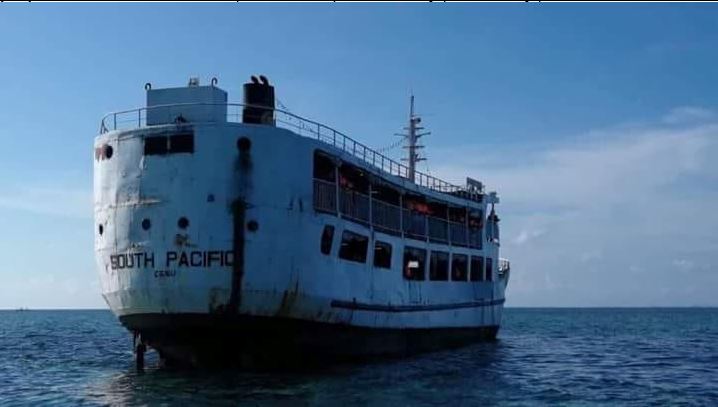
The Ill-fated MV South Pacific got too close to the shallow waters of Danajon Bank that it ran aground early morning of October 9. No one was hurt in the incident, according to the PCG. Passengers and crew were all rescued and brought to Cebu City on board PCG’s Multi-Role-Response Vessel 4404. (Photo grabbed from Anthony Aniscal’s facebook)
by admin | Oct 11, 2018 | Headlines
The faithful here rejoice and gather to thank God for an unexpected blessing: the possible realization of a plan to restore and rehabilitate a church that is one of the two surviving coral stone churches with wooden floorboards that have survived for at least 140 years.
During a thanksgiving mass officiated by Bohol Bishop Emeritus Leonardo Medroso and co-celebrated by Holy Infant Parish priest Rev. Fr. Johnson Inte and vicar Noel Varquez, with Catholic Bishops Conference Chair of the Cultural Heritage of the Church Commission Rev. Fr. Milan Ted Torralba and other co-celebrating priests, National Museum (NM) Assistant Director Angel Bautista read the museum resolution elevating the status of declaration of the Holy Infant Church a notch higher.
It was in 2013 that the NM declared same church of the Holy Infant as Significant Cultural Property (SCP), but the declaration is only as a preparation for further study for it to be enlisted as among the country’s Important Cultural Property (ICP).
The church, being clearly over 50 years is already considered a heritage structure, based on the National Cultural Heritage Act of 2009 (RA 10066).
Former Valencia Vice Mayor Romulo Tagaan shared that the church had organized fund raising anc charity activities to raise funds for the repair of its leaking roof which could damage the church fixtures and the rare floorboards among them.
Built by Rev Fr. Mariano Cornago in the 1870’s, it was Fr. Francisco Arcaya in 1882 who completed the structure and the installation of the designed floorboards.
The floorboards: a witty combination of 5-inch molave and bayong slats placed one after another in wood parquet design has been preserved.
Under the nave to the transepts is a giant flower design with eight pointed petals exquisitely formed from laid woodwork, with the unmistakable direct attribute of exemplary cultural value and gets people nowadays a glimpse or the advancement of the crafts and skills of workers during those times, described NM Bautista who read the declaration immediately after the thanksgiving mass.
Through Museum Resolution No. 20-2017, Architect Manuel Maximo Noche, Professor Regalado Trota Jose, Rev. Frs. Rene Pio Javellana and Milan Ted Torralba stated that the preserved wood flooring of the Holy Infant parish Church is an architectural marvel and a priceless legacy representing the people’s respect of the bygone era od builders and designers.
The flooring woodwork possesses exceptional architectural, engineering, cultural and artistic significance reflective of the nation’s history.
A church that still shows coral stones in its walls and façade, has undergone facelifts in the past, but what remained as the church’s rare treasure it its antique floorboards, according to parish priest Fr. Inte.
While the church still displays the usual cruciform lay-out, it too has a façade that is as tall as a four-storey building, two pyramid towers, with steep roofs and arched ceilings.
Over the above considerations, the NM which is also mandated to declare cultural properties in relation to their unique historical and architectural values in line with the promotion of the protection and preservation of the church as part of the significant built-heritage thus resolved to elevate the protection classification of the church and its complex into an ICP, Bautista told the parishioners.
With the ICP declaration, Valencia Church and its complex gets priority government funding for protection, conservation and restoration; its private support of conservation and restoration can get an incentive from the Commission’s Conservation Incentive Program for national cultural treasures, he explained.
Moreover, the declaration also allows the putting of an official heritage marker indicating that the immovable cultural property has been identified as national cultural treasure, or national historical landmarks, sites or monument.
Finally, in times of armed conflict, natural disasters and other exceptional events that endanger the cultural heritage of the country, the declared ICP can be given priority protection by the government.
Aside from that, all cultural properties declared as ICP like the Valencia Church may receive government funding for its protection, conservation and restoration. (rahc/PIA-7/Bohol)
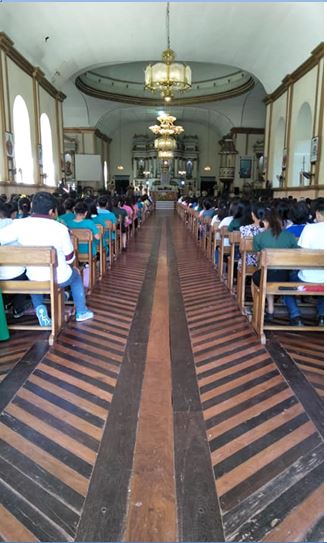
The neat placement of the white molave wood plank interspaced with the black bayong and arranged in a herringbone patter makes an interesting study of the kind or engineering and architecture which has shown an advanced state in the 18th century. Preserved and maintained by the people of Valencia, this floorboard in the Holy Infant Church is now under government protection as an important cultural property. (rahc/PIA-7/Bohol)
by admin | Oct 8, 2018 | Headlines
If it was just like any ordinary convention, many would have called it another government junket.
But, from it, if plans do not miscarry, the Philippine CarabaoCenter(PCC) authorities would be flying off to Siquijor to present the prospect of a cottage dairy program to marginal farmers and possibly improve lives by adding alternative sources of income for the people there.
During the recent Convention of Region 7’s Regional Association of Development Information Officers (RADIO-7CON) held in Panglao, organizers and Bohol hosts adopted a travelling convention concept bringing convention participants to culture and heritage sites and farm tourism destinations in abid to popularizes and mainstream tourism.
Attended by information officers from local government units and national government agencies as well as private establishments and tourism officers across Central Visayas, the RADIOCON visited the PCC in LomangogUbay to learn about the economic viability of carabaos in farm tourism and carabao dairy as a potential source of income for farmers.
PCC Ubay Stock Farm (USF) Center Chief Dr.GondolinoBahinting, in his introduction during the farm visit urged convention participants to help megaphone the good news about carabao dairy farming and tourism options, as a way to allow rural farmers the chance to showcase their farms as tourism destination and interaction areas.
The PCC, according to topic presenter GuillermaAbay-abay, is into animal dispersal programs.
While the government, through the PCC initially disperses carabaos as draft animal, the mechanization that is slowly transforming the local farm scenes is sidling the farm animals into near threatened to non-use.
Over this, the PCC introduced carabao for dairy, which has the potential to cut the country’s dependence on imported dairy from New Zealand and Australia.
The Philippines imports dairy, because we produce only a little less than 10% of our requirements, Abay-abay pointed out.
A native carabao, which would be kept for dairy, can produce 2 liters of milk a day, the rest would be food for its calf. But a good imported breed can give between 6 to 8 liters of milk a day, and at P50 per liter, that would be an additional P400 for a dairy farmer, Abay-abay told information officers and tourism officers gathered at the PCC conference Hall in LomangogUbay, September 20.
And with the farm animal giving birth to a calf every year, a farmer can have an additional P20,000 at least for a fattened calf sold after five months, she added.
A Boholano farmer is now tending to 4 milking carabaos, averaging P1600 a day in income and has since expanded his carabao milking heads.
This same tempting prospect has caught the attention of Maria Siquijor tourism officer and self confessed farmer Roselyn Asoc.
The wife of the town mayor, Asok believes presenting the carabao dairy to her town would greatly improve her people’s livelihood incomes.
She has verbally asked PCC through Dr, Bahinting to help her with their town’s request.
The PCC could be coming to Siquijor anytime soon, or as soon as the formal requests could be facilitated. (rahc/PIA-7/Bohol)

PCC Center Chief Dr. Gondolino Bahinting exchanges banter with Siquijor Tourism Officer Roselyn Asok and DAR Regional Information Officer Gay Visitacion after the PCC caught the attention of farmer tourism officers for the government carabao farm facility’s farm tourism initiatives. (rahc/PIA-7/Bohol)

PCC Dr.GondolinoBahinting explains to information and tourism officers the gist of the PCC mandates and their shift to dairy farming to afford communities alternative livelihood source and income. (rahc/PIA-7/Bohol)
by admin | Oct 7, 2018 | Headlines
CARMEN, Bohol, October 7 (PIA)—Seventy-three year-old Fulgencia Achivida has only faint hopes that the small patch of land she inherited from her parents in Barangay Lataban, Sierra Bullones town can be issued an agricultural patent.
After all, she has almost forgotten that she and her 77 year-old husband Nerio have applied for free patent to a patch of land that she hopes would be finally be under the couple’s name and with a document to prove their ownership.
The 1,300 square meter lot is planted to rice and some banana patches , one that also allows them a modest stockpile of palay after every harvest.
Located in the next barangay, the lot, being not yet under their name, is often left last to be planted, as the couple can’t confidently plant and claim the harvest of they own no documents to prove they own the patch.
Until October 7, 2018.
Both Fulgencia and Nerio could not believe their luck that both had to go to a corner and simultaneously pore at the land title that finally puts the patch of land under their conjugal ownership.
Both were among the 11 lucky farmers of Sierra Bullones and Dagohoy who were finally handed their certificates of titles for either residential or agricultural lots under the Government’s Free Patent program, explained Provincial Environment and Natural Resources Officer (PENRO) Eusalem Quiwag.
That day, the Office of the Cabinet Secretary of President Rodrigo Duterte led by CabSec Leoncio Evasco and the Office of Participatory Governance of the Office of the President brought to Carmen, Bohol its innovative Biyaya ng Pagbabago (BnP).
BnP is the government’s response to the need for the bureaucracy to come out from the offices and bring the services to the grassroots, CabSec Leoncio Evasco said.
Conducted in a typical one-stop-shop setting, the BnP brings over 30 government agencies and offices to one location, to dispense of their services, deliver frontline services and usher in the blessing of change.
That day, the Department of Environment and Natural Resources (DENR) handed out the 11 land patents for both residential and agricultural lots.
The DENR acted in line with Republic Act No. 10023, or the Free Patent Act which aims to ease the requirements and procedures in the titling of residential and agricultural lands by allowing people who have been residents of the lot and have been paying for its taxes to get a facilitated free patent provided these lots are not within forested sites.
The Achivida lot is Fulgencia’s share, being among the heirs of her parents when they died.
Both Fulgencia and Nerio could not believe their luck as they took turns in reading the certificate of land title, not really minding the midday sun.
Also getting similar Certificates of Land Titles for either residential or agricultural were Rufo Cagampang of Magsaysay, Sergio Dagupan of Danicop, Demetrio Caderao of Danicop, Illuminada Auxtero of Magsaysay, Sabina Doyongan of Anibongan, Cherlita Cutamora of Bugsoc.
Bernardino Duyogan of Anibogan, Nelson Cagulao of Anibongan, Aurelio Duyogan of Anibongan, Esmeraldo Dumayac of Poblacion Dagohoy, and Carmen Autentico of Anibongan.
These people who have been finally issued free patents can now rest in the security that they can not be easily evicted from their lots, own the proper documents to put up these lots as loan collaterals, or sell them in the future.
The Residential Free Patent Act also aims to provide economic stimulus to the land market and thus contribute to the country’s overall economy, DENR Bohol sources added.
The registration of these turned over land titles, identify each individual lots and the state in turn confirms that the person named in the register has stated rights.
The land title system registration offers numerous benefits which include: for a government establishment, the land title offers representation of major component of a land information system, it offers an avenue to assist land use planning and development,
it creates basis for land taxation and stimulate investment.
For an individual, it offers a reduced or no boundary disputes, increased market value, greater opportunities and access to credit, it creates an avenue for a simpler and less costly land transactions too.
Beyond that, other benefits include proof of ownership to avoid confusion and commotion, it helps promote peace as it clearly protects the property rights.
Then, prospective buyers can be assured that the registered owner is the legal owner.
Titling also allows the government to possibly earn more from land taxes, which in turn can be used to fund government initiatives and priorities.
With a title for the 1,300 square meters of rice land in Lataban, Nerio would not feel seeding the 7 gantas would now be a waste.
And with rice crisis in Bohol, he thinks he can help in his own little way by supplying some of the harvest for food in the community.
With a title on hand, the Achividas may not really be totally experiencing the real essence of having achieved a major milestone, at least, until today. (rahc/PIA-7/Bohol)
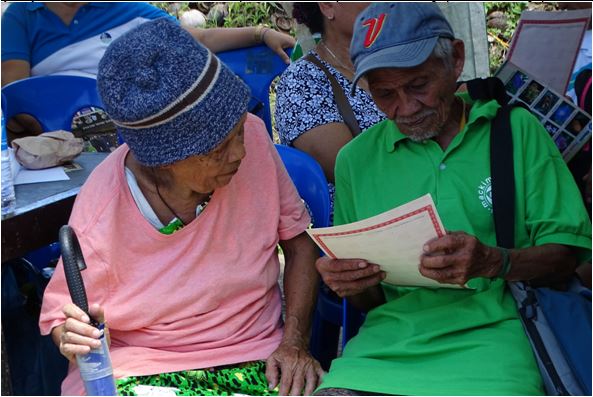
Septuagenarians Fulgencia and Nerio Achivida of Matin-ao Sierra Bullones eagerly pore at the Certificate of Land Titles they received from the government for their 1,300 square meter lot in Lataban, Sierra Bullones. The turn over of the certificates of title was among the Biyaya ng Pagbabago highlights. (rahc/PIA-7/Bohol)

