by admin | Jun 11, 2016 | National News
The Department of Trade and Industry held the Cebu swing of Slingshot Philippines on June 11, 2016 at the Waterfront Hotel in Lahug, Cebu City. Slingshot is a government led initiative to support startups.
Mr. Diosdado P. Banatao of PhilDev Foundation was the keynote speaker of the event. He said that for Philippines to be globally competitive, we need to have more scientists and engineers. Banatao invented one of the critical microelectronic components in use in computing devices.
Participants included the startup community, academe, government sector, investor community coming from Region 7 and the rest of the country. There were foreign attendees as well.
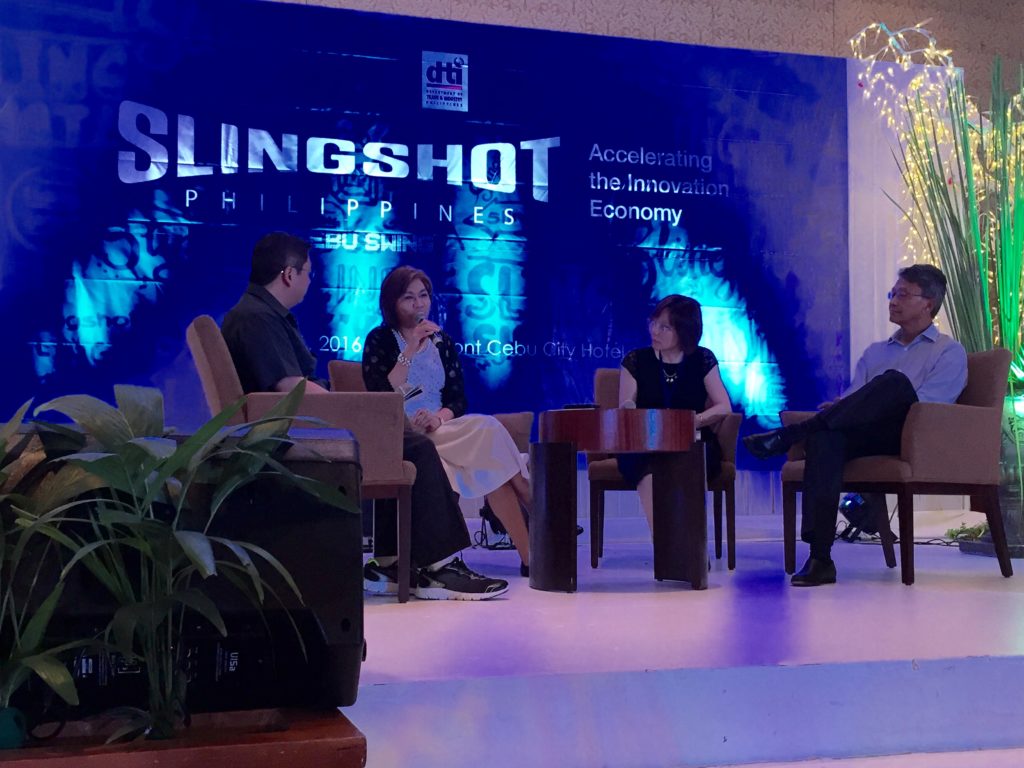
Panel Discussion during the Slingshot Philippines Cebu event
by admin | Jun 11, 2016 | Headlines
The Republic Act 10844 creating the Department of Information and Communications Technology (DICT) takes effect on June 9, 2016. President Benigno Simeon Aquino III approved the bill on on May 24, 2016.
Under RA 10844, the Department of Transportation and Communications will be renamed the Department of Transportation. All of its units associated with communications will be abolished along with the Information and Communications Technology Office (ICTO), National Computer Center (NCC), National Computer Institute (NCI), Telecommunications Office (TELOF) and National Telecommunications Training Institute (NTTI).
The National Telecommunications Commission (NTC), the National Privacy Commission (NPC) and the Cybercrime Investigation and Coordination Center (CICC) will be attached to the DICT.
by admin | Jun 10, 2016 | Editorial
Presidential Communications and Operations Office chief Herminio Coloma recently made an astounding assertion.
In the national news dailies maintained by commercial media whom President-elect Rodrigo Duterte finally chastised for making a mockery of journalism, Coloma jumped on the opportunity to credit-grab.
True to the task assigned to him, communications experts expect Coloma to be the loudspeaker and exact epitome of the president, even in the waning days of the presidency.
On the successive raids and anti drug operations, Duterte has nothing to do with it, Coloma asserted.
Certainly, the raids and operations interestingly happen within the dying days of the administration of President Aquino.
But obviously, something is worth the nose-pinching here.
One, while the Coloma assertion is, in some sense, correct, something doesn’t make full sense here.
Seemingly, Coloma is saying the Aquino Administration was really capable of starting intense anti drug operations but yet it did not. Along this drift, we can tie the loose end and find a dangerous assumption: the recent connection with the DOJ’s Delima and the pictures of the president spending loose time at the country’s meth labs at Bilibid is beyond media hype.
A recent picture of the President, Sec Delima at the Bilibid tells more than Coloma’s lame attempt to save face for the administration. If indeed the
Duterte election did not cause the cowering of police and anti drug operatives, then somebody ordered them not to act against drugs then.
Indeed, if the clear and expressed Duterte warnings spiced with curses and unsubstantiated gory deaths credited to him, then how does Coloma account for clear surrender of drug personalities to police authorities for fear of liquidations.
So, Coloma is also claiming it is the Administration of PNoy doing the summary executions of drug personalities too?
by admin | Jun 9, 2016 | Headlines, National News
CEBU CITY, June 9, (PIA)—Two Boholano groups managing and operating Department of Trade and Industry (DTI) Shared Service Facilities (SSF) grabbed two of the four regional accolades as Best Performing SSF.
At the recent Negosyo, Konsumer at Iba Pa (NKABP) One DTI service showcase running June 9-11, at the Marco Polo Hotel in Lahug, this city, Tubigon Loomweavers Multi Purpose Cooperative Incorporated (TLMPCI), and Bohol Island State University (BISU) romped with the highest recognition for exemplary performance.
No less than DTI Secretary Adrian Cristobal, assistant Secretary Blesila Lantayona, undersecretaries Zenaida Maglaya and Regional Director Asteria Caberte personally handed and witnessed the handling out of trophies and certificates to the awardees during the regions first services showcase through the NKABP.
The other best performing SSFs are Southern Partners and Fair Trade Center (SPFTC) as well as the Responsive and United Bayawan Believers for Economic Recovery Cooperative (RUBBERCO).
Tubigon Loomweavers MPC operates a loomweaving SSF from Pinayagan in Tubigon town, while BISU operates the first fabrication laboratory in the country.
A weaver who works at TLMPCI, Mencina D. Vistal, 29 years old, married and with three kids, averred how the SSF has helped her family.
“I came from a family of loomweavers and I used to worked at home like many of us weavers in the municipality,” she confessed.
Weaving since 7 years old, she said she followed her weaver parents, but her mother has since worked at TLMPCI.
Herself a pantawid pamilya beneficiary, all she gets is P2,800 every two months, the amount clear insufficient for their needs.
When she knew of the Tubigon SSF, she applied.
While weaving for a full week gets her 30 meters and nets P700 a week less expenses from sales.
At TLMPCI, upon introduction of multi fibers and a wider loom, she now averages 6 meters a day producing the 55 inches width fabric.
“I can finish an average of 6 meters per day for a 55” width fabric. We can work overtime because we have lighting facility at the SSF Center,” she shared.
This, to her is way beyond her home weaving production. This gives her an income of P 900.00 on the average a day for 6 days, or P 5,400.00 per week.
Her income at the DTI SSF, including that of her husband, who now also works there, helped the family a lot.
“We can now buy food, the needs of our children who are all in school, simple things we do not have the opportunity to buy before, my husband now has started working on the repairs of our motorcycle unit that we use in commuting from our place to the production center and also we will start repairing our house.”
Mencina is just one of the over a hundred weavers working now at the Tubigon SSF.
Meanwhile, BISU Fabrication Laboratory in Tagbilaran has suddenly created a buzz among young designers who have found new digital tools to tinker with and explore their creativity.
The fablab, which features digital cutters, digital printers, prototyping machine technologies and meeting hub for start-ups has recently produced innovations like a sea-coral propagator, electronic scarecrow, e-bus collection system program, tricycle fare metered collection system and tourism novelty items that are either digitally printed or carved, designed and vectored at the fablab.
Latest and among their promising projects is upcycling and leaf manipulation, as well as heat pressing plastic grocery bags into monobloc raw materials.
A specially manufactured pasalubong booth from the fablab is now becoming another signature presence in the tourism market niches. (rac/PIA-7/Bohol)
by admin | Jun 8, 2016 | Headlines, Local News / Bohol Balita, Major Events, National News
The Department of Trade and Industry is set to launch the third of the seven Negosyo Center Plus at the University of the Philippines (UP) Cebu Campus in Cebu City on June 9, 2016.
The Negosyo Center Plus is a Negosyo Center with Fabrication Laboratory and Co-Working space. It is the second to the Bohol Fablab and first with the Negosyo Center Fablab Co-working Space tag in the Visayas.
DTI Supervising Undersecretary for Regional Operations Group (DTI-ROG) Zenaida Maglaya said that the Negosyo Center with Fablab Co-working Space launching is a milestone for the Department after unveiling the first two in Santiago City and Ilocos Sur. The DTI is also set to open four more Negosyo Center with Fablab Co-working Spaces in Tacloban City (Eastern Visayas State University) on June 21, Bicol (Bicol University Compound) on June 23, National Capital Region (CITC Marikina; University of the Philippines – Diliman) on September 14, and in Zamboanga City (Zamboanga State Ploytechnic College) on October 7.
“The Negosyo Center Plus is a huge lift to our micro, small and medium enterprises (MSMEs). These Negosyo Center with Fablabs and Co-Working Spaces are strategically located for innovation and creativity in the industry, particularly for use by students, start-ups and micro and small enterprises,” Maglaya said.
The Negosyo Center Plus UP Cebu is the first DTI-supported FabLab in Cebu. The DTI funded six (6) equipment worth Php 5.375 million under its Shared Service Facility (SSF) program to provide technical assistance and capacity building for the FabLab’s management and operations.
The Negosyo Center Plus UP Cebu provides a creative space for designers, creatives, entrepreneurs, students and the general public to test out their ideas and turn them into products using digital fabrication equipment. Available equipment at the Negosyo Center Plus UP Cebu are 3D Printer, Laser Cutter, Printer and Cutter, Desktop Vinyl Cutter, CNC Router and Benchtop Milling Machine.
“The Negosyo Center Plus is the window for MSMEs, students, entrepreneurs and creative individuals to avail of new prototyping technologies and software in designing and manufacturing products to match the market competition,” Maglaya added.
The DTI launched the country’s first FabLab Shared Service Facility (SSF) in Bohol in 2014. The Bohol Fablab, located at the Bohol Island State University, has helped the entrepreneurs in the island to produce travel retail products in short runs, prototype furniture and even a working “printed” house as part of the post-earthquake recovery program of the province . The Bohol Fablab is funded by the DTI, Japan International Cooperation Agency (JICA), Bohol Island State University (BISU), and the Department of Science and Technology (DOST).
The Negosyo Center is a salient feature of Republic Act No. 10644, otherwise known as “Go Negosyo Act,” which seeks to strengthen MSMEs to create more job opportunities in the country. On the other hand, a Co-working Space (CWS) is an open space that the public can rent for a very flexible period using common area office fixtures, internet, and other common office services, while the FabLab offers the digital fabrication equipment where people can build, design and engineer ideas into products.

