by admin | May 21, 2016 | Headlines, Tech Talk
The Bohol ICT Council led by Chairperson Ms. Lai Biliran and the Bohol Chamber of Commerce and Industry represented by Vice President Ms. Marietta Gasatan met with reelected City Mayor John Geesnell “Baba” Yap on May 19, 2016 at the city hall. During the meeting, Ms. Biliran highlighted to Mayor Yap that there are at least four brokers of business process outsourcing companies who are interested in locating in Tagbilaran City.
She also spoke about several activities happening in Bohol in the ICT industry and emphasized the opportunity for the city to be known in the international technology scene because an international conference called Geeks on a Beach (www.geeksonabeach.com) will be held in Panglao, Bohol at the Bellevue Hotel on August 25-26, 2016.
On May 24, 2016, one of the biggest brokers for BPOs will visit the city. BICTC and BCCI, together with city and provincial government representatives will meet them and discuss requirements and expectations.
Also present during the meeting with the mayor were Ms. Inday Dominise, from the Bohol Investment Promotions Center, Jerome Auza, the Vice Chairperson of the BICTC and Ben Skelton, a member of the board of trustees of the ICT Council.
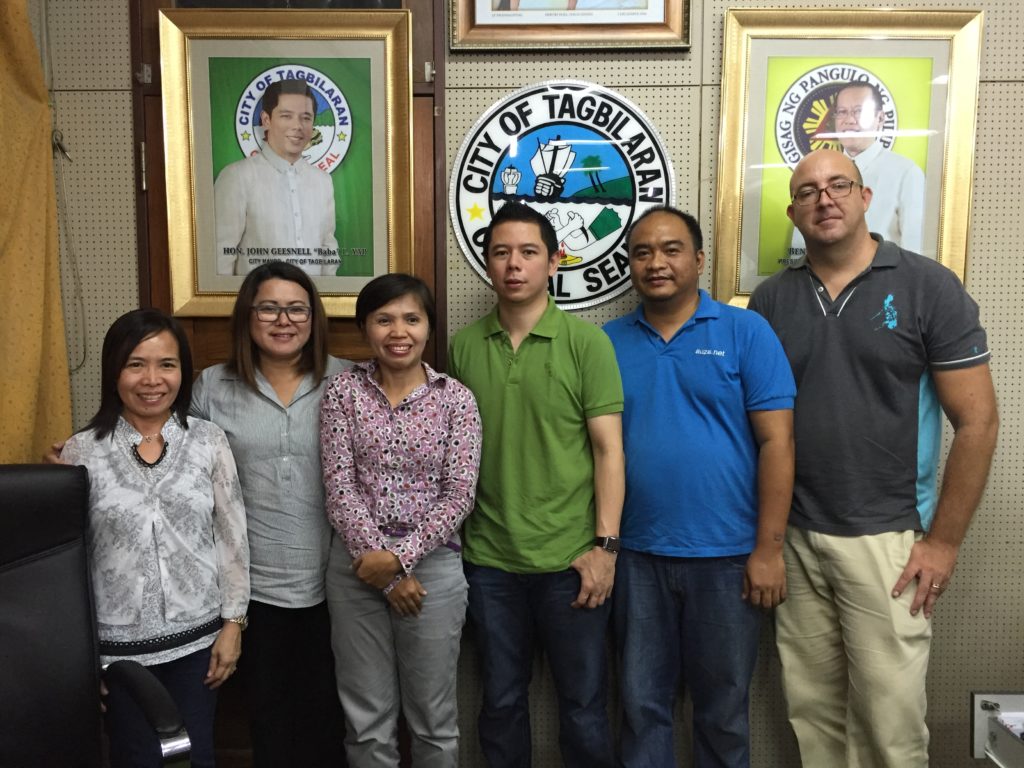
L-R: Ms Inday Dominise of the Bohol Investment Promotions Center, Ms. Marietta Gasatan of the Bohol Chamber of Commerce and Industry, Ms. Lai Biliran of the Bohol ICT Council, City Mayor Baba Yap, Jerome Auza of the BICTC, and Ben Skelton of BICTC.
by admin | May 20, 2016 | Headlines, Major Events, National News
MANILA, May 20 (PIA)–Milambo og 6.9% ang ekonomiya sa nasod sa unang kwarter sa tuig 2016.
Mas taas kini sa 5% niadtong unang kwarter ug 6.5% sa ikaupat nga kwarter niadtong tuig 2015.
Matud pa sa National Economic Development Authority (NEDA), dako ang ambag sa sektor sa industriya ug serbisyo sama sa mga call center industry sa paglambo sa ekonomiya ning unang kwarter.
Samtang ubos ang sector sa agrikultura tungod sa epekto sa El Niño sa mga pananom ug isdaan sa tibuok nasod.
Apan bisan pa niini, nanguna pa gihapon ang ekonomiya sa Pilipinas sa mga silingang nasod nga nagsunod sa China, Vietnam, Indonesia ug Malaysia.
Matud pa ni Presidential Communications Operations Office (PCOO) Kalihim Herminio Coloma Jr., ang padayon nga “upward trend” sa ekonomiya pagmatuod sa maayong pagdumala sa mga macro-economic fundamentals nga gipatuman sa administrasyon.
Dugang pa sa Kalihim, makatabang kini sa pagpadayon sa paglambo sa ekonomiya o high growth trajectory nga maghatag og dalan aron maapil ang Pilipinas sa mga gitawag nga “high income countries.”
Mao nga gitumbok sa Malakanyang ang kamahinungdanon nga ipadayon ang mga social protection ug human development programs aron makab-ot ang tinguhang inclusive growth ug kinatibuk-ang paglambo. (ecb/PIA7-Bohol)
by admin | May 20, 2016 | Headlines, Local News / Bohol Balita
TAGBILARAN CITY, May 20 (PIA)–Nikabat na sa 100.98 milyon ang populasyon sa Pilipinas karong tuig.
Mas taas kini sa 8.64 milyon kun itandi niadtong 2010 diin gipahigayon ang katapusang census sa Philippine Statistics Authority (PSA).
Base sa census sa Population (POPCEN), gikan Agosto niadtong niaaging tuig nisaka ang populasyon sa nasod og 1.72 porsyento gikan sa tuig 2010 hangtud 2015.
Ang Rehiyon IV-A nga gilangkoban sa mga probinsiya sa Cavite, Laguna, Rizal ug Quezon ang may pinakadakong populasyon nga mokabat sa 14.41 milyon niadtong niaging tuig.
Gisundan kini sa National Capital Region (NCR) o Metro Manila nga may 12.88 milyon ug Central Luzon nga may 11.22 milyon.
Sa 81 ka probinsiya sa tibuok nasod, ang Cavite ang may pinakadaghang populasyon nga may 3.68 milyon nga gisundan sa Bulacan, 3.29 milyon ug Laguna, 3.04 milyon.
Samtang ang Batanes nga adunay populasyon lamang nga 17,246 ang may pinakaubos nga populasyon sa nasod.
Nagsunod niini ang Camiguin nga may 88,478 ug Siquijor nga may 95,984 nga populasyon.
May 27 ka uban pang probinsiya usab ang may usa ka milyong population mark.
Apil niini ang Cavite, Bulacan, Laguna, Pangasinan, Cebu, Rizal, Batangas, Negros Occidental, Pampanga, Nueva Ecija, Camarines Sur, Ilolilo, Quezon, Leyte, Isabela, Bukidnon, North Cotabato, Tarlac, Negros Oriental, Albay, Bohol, Cagayan, Maguindanao, Lanao del Sur, Davao del Norte, Zamboanga del Norte ug Zamboanga del Sur. (ecb/PIA7-Bohol)
by admin | May 19, 2016 | Opinion
by Jose Conrado A. Estafia
Election time is over; we move on as a people. There is so much life ahead. Let us move forward. The result, especially in the local level, may still be disappointing, but that is all we have for now. I know it has been difficult and disheartening to those who worked hard to campaign NO TO VOTE BUYING. The problem appears that it is not just about Vote Buying. The problem is so deep that there is yet no simple solution available for us. Our efforts may be wanting, but let us not be discouraged. The fight only begins. I commend the efforts of the Diocese of Talibon, my diocese, to have arduously campaigned against the culture of vote buying. We continue aspiring for change, hoping that one day the Philippine Election may not only be an exercise of democracy but also an expression of human dignity – something money cannot buy and bullets cannot scare.
We believe that election is a democratic exercise, but we fail to ask first what we mean by democracy. Let me share with you a very important political theory I read a few years ago by the French philosopher Jacques Maritain. He outlined this theory in his book Man and the State (Chicago: University of Chicago, 1951). This book is a compilation of a nine-lecture talk delivered in the United States in the Fall of 1938. But since we have a limited space, I will try my best to be brief, with the hope that this can help us analyze where we are as a country and how matured our political life is.
Jacques Maritain defines democracy as a representation of man’s (being a rational animal) highest achievement here below or here on earth (Man and State, p. 59). He champions what he calls the “democratic faith.” True humanism can only happen when one supplants anthropocentric humanism (meaning, the center is man) by theocentric humanism (meaning, the center is God). He also calls this as “democratic charter.” The principal elements of this charter are the following: freedom, the recognition of the full range of rights by all parties concerned, representative government, fraternal charity, and the acknowledgment of the unquestionable supremacy of the moral law. [You may judge if these principal elements of a democratic faith are found in our country or if they are, are they not only in paper?] It is then the conviction of Maritain that democracy finds its roots in Christianity. Democracy is intrinsically rational and this is what impressed Maritain. Politics can only be moral and rational if it is democratic, because democracy can rationally organize human freedom which is founded upon law. Democracy will only survive if what sustains and nurtures it is democratic faith. This faith is not instant. In other words, democracy does not automatically emerge in a people but it must be taught to them from a young age. This is the reason why education is important to establish a democratic society. Our democracy then is not yet true when most of our people are uneducated. That is perhaps the reason why many of us are prone to be manipulated. Maritain even believes that any form of government will do as long as the people are living effectively the democratic faith. He means that any form of government will do as long as it be representative. Sometimes I wonder whether our Congress really represents our people.
Maritain believes that only a fully conscious human person can live up to the democratic faith. That is why for Maritain, democracy and personalism are closely related. Democratic faith can be practically expressed only when the people living in the society are aware of themselves as persons. This may sound ideal for Maritain, but this is what we should aspire. Real democracy is not yet truly in place and perhaps not yet fully implemented in the past. Our country, in my opinion, is yet far from having a real democracy. It is still a long, long way to go.
Most states claim to be democratic but in most cases, according to Maritain, these are democracies of the individual and not of the person and simply a product of bourgeois liberalism. In a simple term, it is a democracy controlled by the ruling elite. See the people who are ruling our country for ages. See the members of the ruling elite winning during elections. See the many political dynasties all over the country. Maritain further claims that “it is through a sound philosophy of the person that the genuine, vital principle of a new Democracy, and at the same time a new Christian civilization, can be rediscovered” (Maritain, Scholasticism and Politics [Garden City, New York: Image Books, 1960, 7]). This kind of democracy and humanism can only come from a “theocentric inspiration” (ibid., 85-86).
Moreover, Maritain mentions that in democracy pluralism exists. He writes: “Thus it is that men possessing quite different, even opposite metaphysical or religious outlooks, can converge, not by any identity of doctrine, but by virtue of an analogical similitude in practical principles, toward the same practical conclusions, and can share in the same practical faith, provided that they similarly revere, perhaps for quite different reasons, truth and intelligence, human dignity, freedom, brotherly love, and the absolute value of the moral good” (Man and State, p. 111).
Indeed, we live in a very pluralistic society, and we observe this in our country. Look at the way we treat many important issues in our country, we are very divided. But for Maritain a pluralistic society can always transcend religious and philosophical differences and come to agree some fundamental truths which govern human conduct. One principle of pluralism, which is also a very important principle in the Catholic Social Teaching, is the principle of subsidiarity. This principle means that whatever task that a smaller unit of society can do, for instance by the family or by a smaller sector in the society, should never be undertaken by a larger unit, for example by the State. I have said at the outset that many politicians, with due respect to them, we have elected are a disappointment to us, but we don’t have any choice for now. We just learn to deal with them. We just apply the principle of subsidiarity that whatever we can do from below as a people then we do it now. Nation building does not really depend solely on our leaders. Let us not just simply leave our fate to our leaders or else we will be going nowhere. The State which consists of our political leaders is there at the uppermost part of the Nation. But nation building should always come from below, from the majority of the people. We are the majority. We have the power to change our country. What is needed most is education. Following Maritain, it is only when we are fully conscious of ourselves as persons that we can live in a truly democratic society. This has always been my position that the exercise of democracy does not only happen during election period. It is indeed a lifelong aspiration, a day to day struggle towards real liberation.
Since I left my book in the Philippines, for my quotations of Maritain’s text, I give credit to this article by D.Q. McInerny, “The Social Thought of Jacques Maritain,” The Catholic Social Science Review 12 (2007): pp. 162-164 [can be accessed online at http://cssronline.org/CSSR/Archival/2007/McInerny.pdf].)
The author is a priest of the Diocese of Talibon. He is presently in Vienna, Austria pursuing his further studies at the University of Vienna.
by admin | May 19, 2016 | Headlines, Major Events, National News
MANILA, May 19 (PIA)–Gihimakak sa Malakanyang ang balita nga 16 porsiyento na lamang sa nasudnong budget ang nahabilin alang sa administrasyon ni Davao City Mayor Rodrigo Duterte.
Matud pa ni Presidential Communications Operations Office (PCOO) Kalihim Herminio Coloma Jr., sayop ang balita nga nagasto na sa administrasyong Aquino ang otsenta porsiyento sa P3.002 trilyon nga national budget.
Pasabot pa sa Kalihim, sa P3.002 trilyong nasudnong budget, P2.5 trilyon na ang na-release o gihatagan og otoridad nga magamit ang pondo, apan wala kini nagpasabot nga na-disburse/napagawas na ang kwarta.
Matud pa nga P464 bilyon pa lamang niini ang na-obligate na o gipangayoan og financial plan nga himuong basehan sa pag-aprubar sa pag-release sa pondo o disbursement.
Giseguro usab ni Coloma nga hapsay nga ibilin sa Aquino administration ang gobyerno kalabot sa fiscal policy.
Giseguro usab sa Kalihim nga maayo ug nisubay sa balaod ang nahimong paggamit sa Presidente alang ning tuig sa iyang intelligence fund ug Presidential Social Fund.
Gipaniguro pa ni Coloma nga mopasar ang administrasyon ni PNoy sa mga pagsusi kun nisunod ba kini sa mga balaod kalabot sa paggunit sa budget. (ecb/PIA7-Bohol)

