by admin | Aug 25, 2018 | Headlines
TAGBILARAN CITY, Bohol, August 25 (PIA)—If you have this luxury of whiling your time in an extended weekend August 27, basking in the holiday sun, frolicking in some unmapped beach of simply in a hammock under the palm-fringed beach, thank a Boholano, who pounded a grand event which would make the first National Heroes Day distinct from a similar holiday in November.
But did you know that this holiday used to be commemorated on a Sunday?
The first celebration of the National Heroes Day had then Secretary of Education Cecilio Putong, a Boholano, taking charge to make the celebration grand, after breaking off from a seemingly similar celebration on November 30.
November 30 then was in the memory of Andres Bonifacio and those who knew how to sacrifice the interests of self and the rich pleasures of living for the sake of the dignity and welfare of the greatest number.”
This then makes it a duplicate with the holiday on the last Sunday of August.
It was accordingly in the American Colonial Period that the celebration of the National Heroes day began, a celebration pegged every last Sunday of August.
By Act 3827, the Philippine Legislature first enacted the holiday into law declaring the last Sunday of August of every year as a national holiday, in honor of unnamed heroes who have braved death, persecution for home, nation, justice and freedom.
The Act however appears to be a duplicate of the holiday in November 30 by virtue of Act 2946 which celebrates Bonifacio Day and of Filipino heroes. This was in 1943.
In fact, to make matters even more confusing, then President Jose P. Laurel signed Executive Order No. 20, which set the National Heroes Day on November 30, placing celebrations in Mount Samat in Bataan, which commemorates the bravery of the Filipinos and the Americans who fought it out with the Japanese Imperial forces in Corregidor and Bataan.
A decade later, President Elpidio Quirino reverted the holiday to the last Sunday of August, and appointed Boholano Education Secretary Cecilio Putong to head the committee to take charge of the National Heroes Da, which at that time fell on August 31, 1952.
And just as the country got used to the holiday falling on the last Sunday of August, President Corazon Aquino’s Executive Order 292 adopted the Administrative Code which lists the national holidays and special days but presented a manner of modifying these by law, order or proclamation.
On July 24, 2007, using the provision to modify the holidays, by President Gloria Macapagal-Arroyo’s holiday economics to reduce work disruptions by moving holidays to the nearest Monday or Friday of the week, allowing for longer weekends and boosting domestic leisure and tourism, Republic Act 9242 amended the Administrative Code and placed the National Heroes Day on the last Monday of August.
The holiday has since then stuck to the last Monday of August.
2019 holidays
Meanwhile, President Rodrigo Duterte has signed Proclamation 555, dated August 15, 2018 which declared the regular and special (non-working) days for 2019.
Regular holidays for 2019 are January 1 (Tuesday) as New year’s Day, April 9 (Tuesday) Araw ng Kagitingan, April 18 (Thurday) Maundy Thursday, April 19 (Friday) Good Friday, May 1 (Wednesday) Labor Day, June 12 (Wednesday) Independence Day, August 26 (Monday) National Heroes Day, November 30 (Saturday) Bonifacio Day, December 25 (Wednesday) Christmas Day and December 30 (Monday) Rizal Day.
Special (Non-Working) Days in 2019 are February 5 (Tuesday) Chinese New Year, February 25 (Monday) EDSA Peoples Power Revolution Anniversary, April 20 (Saturday) Black Saturday, August 21 (Wednesday) Ninoy Aquino Day, November 1 (Friday) All Saints Day, December 8 (Sunday) Feast of the Immaculate Concepcion, December 31 (Tuesday) Last Day of the year, and additional non-working days: November 2 (Saturday) and December 24 (Tuesday).
Also to be declared national holidays are Eid’l Fit’r and Eid’l Adha, which dates can only be determined in accordance with the Islamic calendar and with the recommendation of the National Commission on Muslim Filipinos to the Office of the President. (rahc/PIA-7/Bohol)
by admin | Aug 25, 2018 | Local News / Bohol Balita
TAGBILARAN CITY, Bohol, August 25 (PIA)—A study cited by the national community managed savings and credit associations bared that only very few Filipinos own savings accounts due to the inability of some to present proper identifications top vouch for the depositor.
The same study cited the fact that most people who opts to start a small savings find the documentary requirements in opening an account hard to come by.
Conscious of this, the Bangko Sentral ng Pilipinas (BSP), through a recent Monetary Board resolution, has instructed its supervised banks all over the country to follow a simplified Know Your Customer (KYC) instead of the hard to come by identification documents.
By KYC, instead of forcing depositors to produce IDs, identifying the customer and verifying their true identity can now be based on any document or information reduced in writing, including but not limited to certifications, BSP Information Officer Hazel Cultura bared.
Through Circular 992, series of 2018, BSP through its governor Nestor A. Espenilla Jr., has officially increased access of the country’s unserved and underserved to financial services that also improves financial inclusivity to the poor and the small entrepreneurs, she added.
According to Cultura, the circular which liberalized customer onboarding in the banking world, formally establishes a new system of identifying customers and verifying their true identity.
Previous requirement in opening bank accounts says one must submit at least two (2) valid IDs which could be the new SSS or GSIS ID, driver’s license, a company ID, school ID, Passport, PRC ID, postal ID, or marriage contract, two most recent 1 x 1 ID picture, proof of billing for water and power or a tax identification number.
These requirements discourage a small savings depositor who would most often, change his mind and take his small savings somewhere else.
In 2007, the BSP embraced a more ambitious goal of financial inclusion as a way of bringing the financial system closer to all Filipinos. The overall vision is to build an inclusive financial system where there is effective access to a wide range of appropriate financial products and services.
But with the requirements in place in the Manual of Regulations for Banks (MORB), unless amendments are introduced, financial inclusion remains a distant dream for the poor entrepreneur or depositor, bankers shared the issue.
On this, the Monetary Board, which BSP Gov Espenilla chairs, in its resolution 58, dated January 2018, approved the introduction of the framework for basic deposit accounts, BSP said.
The resolution introduced a new kind of account: the Basic Deposit Account (BDA), one that is designed to promote financial inclusion.
BDA will enable the Filipinos to receive and make payments, own a facility to deposit, using the same basic functionalities that will characterize ease, accessibility, convenience and reasonable cost for banks and customers, BSP through Information Officer Hazel Cultura explained.
The BDA’s minimum key features which the BSP expects banks to adopt, include an opening amount of at least P100.00, does not have any maintaining balance, no reserve requirement, does not have any dormancy charges but with a maximum balance of not more than P50,000, Cultura told members of the Association of United Development Information Officers (AUDIO) during a meeting at Jjs Seafoods Village last week.
For Basic Deposit Accounts which exceed 50,000.00 minimum balance, BSP said the banks should also convert to a regular deposit account.
Even then, banks can still accept normal Savings Deposit Accounts (SDA) that are withdrawable upon demand and through available bank channels.
SDA’s include regular savings account, the interest bearing account withdrawable upon presentation of a properly accomplished withdrawal slip with corresponding passbook or by automated tellering system.
Another kind of SDA is the Kiddie and Teen Savings accounts for children and teens (up to 19) opening with an initial P100.00 deposit and without a maintaining balance.
And then there are other savings accounts that offer tiered interest rates depending on the deposit amount, BSP said. (rahc/PIA-7/Bohol)
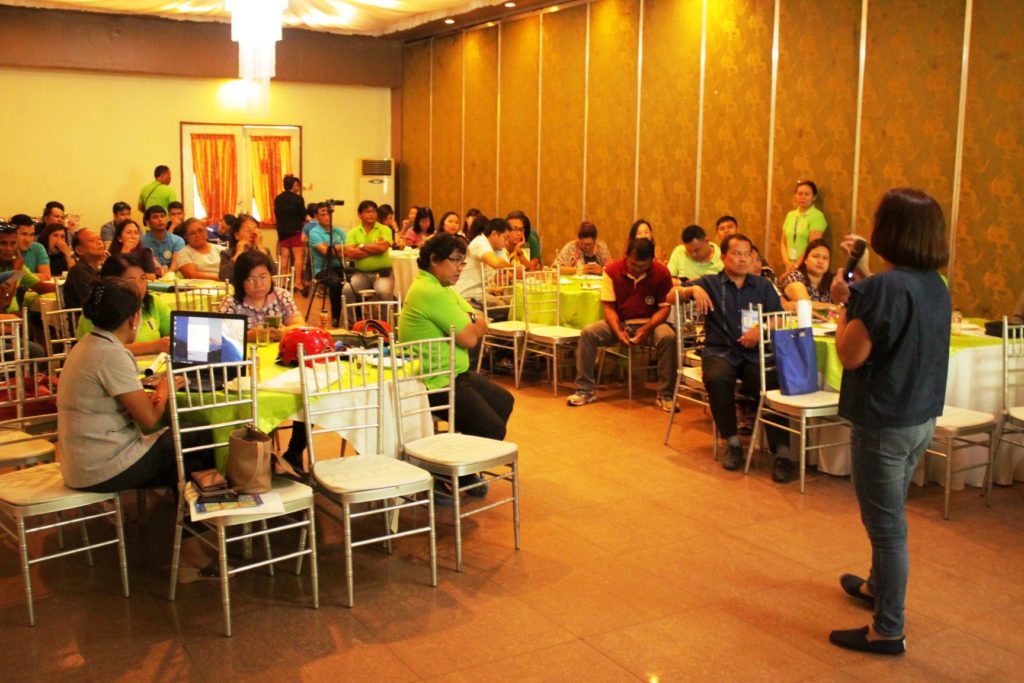
BSP’s Hazel Cultura told information officers that the BSP Monetary Board has ruled that IDs may not anymore be needed to start a Basic Deposit Account, to allow more Filipinos to access financial inclusion and start savings deposits. (rahc/PIA-7/Bohol)
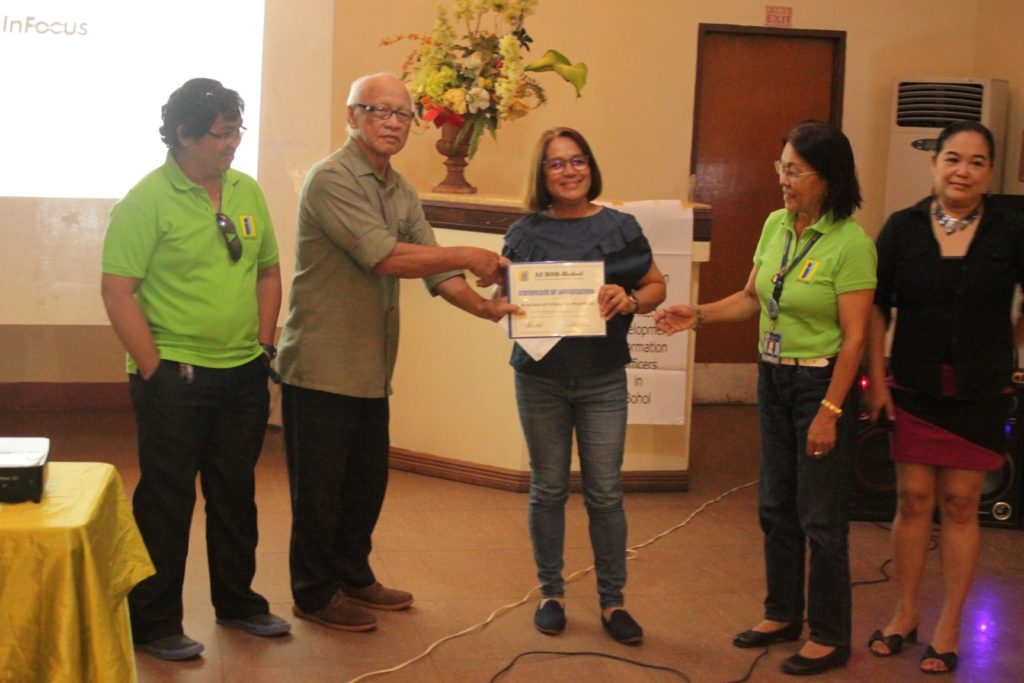
Officers of the Association of United Development Information Officers in Bohol (AUDIO Bohol) hand to BSP Information Officer Hazel Cultura a certificate for sharing the BSP’s amendment on bank rules that now opens the gates for small depositors. (rahc/PIA-7/Bohol)
by admin | Aug 24, 2018 | Features, Tech Talk
TAGBILARAN CITY, Bohol, August 24 (PIA)— She never expected fate to finally be kind to her.
Twenty-one years old Mariel Tocmo of Datag Sur, Balilihan has too many frustrations as a job seeker, she could not stop from thinking today was no different.
A graduate of Corella National High School, Mariel admits her family has only enough to get by, not comfortably.
“My father died, and being the youngest in the family, it is just about time I help,” she timidly shared in a chance casual conversation.
As she was saying this, hundreds of job seekers were also in different processes of proving to the 6 international and 8 local employment agencies present during the Jobs Fair at the Bohol Cultural Center, that they have just the right skills for the job needed.
A job fair offered by Technical Education and Skills Development Authority (TESDA) to commemorate the National Technical Vocational (TechVoc) Week, other government agencies pitched in to elevate the TESDA skills bridging into a full scale employment event.
With the Department of Trade and Industry, Department of Labor and Employment (DOLE) JobStart and the Provincial Government through the Bohol Employment Placement Office (BEPO), the one day Jobs Fair hoped to reduce unemployment and push for economic productivity for people of the employable age, explained BEPO Officer In Charge Ma. Vilma Yorong during the jobs fair.
“We are expecting over 800 job seekers today,” former TESDA information officer Jaminel Damolo said.
Finding a job has become Mariel’s priority. After years of staying at home and helping her 62-year-old mother weave baskets and cope with her quota, the closest she had to getting hired was a promise of a call after every job interview. None came.
“I am the youngest, my elder brother works as a kitchen staff in a city restaurant, the others have married and taken on families,” she added, detailing about her siblings.
While waiting for the lucky job call, she doubles up as a basket weaver helping her mother Flavia come up with the weekly quota of 60 baskets a month. This they would sell at P6.00 each.
“It is a tough work you could easily get hurt as bamboos are sharp and baskets are meticulously done, getting wounded is always a possibility.”
One time, Mariel availed of a Local Government Unit of Balilihan and Antequera-organized TESDA training for work as contact center agent in Tagbilaran.
For two weeks, she thought she had fattened her chances of a job.
TESDA keeps a policy for their accredited Technical Vocational Institutions (TVI) offering the government scholarships to facilitate the hiring of at least 50% of their enrollees.
Still, Mariel did not make the cut, and her Qualfon chance proved to be tough, the work requirements were hard to come by.
So today, August 24 should be like any of those times she kept the hope.
“I did not tell my mother that I would be here to apply for a job, she might expect too much,” she confessed, trying to mask a smile already forming in her face.
The story of Mariel Fe Tocmo, is almost the same as that of Marchelle Comoylao of Cambu-ac Sur Sikatuna.
A graduate of Sikatuna National High School in 2014, at 20 years old, Marchelle, despite being the youngest, has been on the look-out for a job that offers her a better future.
“I have an elder brother who, while waiting for job call, as a seaman, helps my father as carpenter worker. My mother keeps the house,” she noted.
Now working as a boutique attendant in a Tagbilaran City mall, she has doubled up as a babysitter to her sister’s kids, but that is not what she wanted in her life.
“It is never easy, I have to find a job to help my family,” she stressed.
But like Mariel, job seeking in never really easy. To expand her chances, she sought for other skills.
“I took up cookery through a TESDA scholarship for 2 months, buts still job is elusive,” Marchelle said, modest in a rose pink blouse and striped black and while skirt, coming to chance during the job fair.
But in a sudden twist of luck, both Mariel and Marchelle were among the 17 others who were hired on the spot (HOTS) by noon time during the one day Jobs fair.
Both and 10 more were told to report to Mitsumi Danao, an electro mechanics solutions provider combining advanced technologies from a wide range of fields including ultra-precision mechanical components (such as ball bearings), motors, sensors, semi-conductors, wireless communication—and fuse machines and electronics with control technologies.
Along with Mitsumi were 8 local companies scouting for new workers to prop up their work force including Alturas Group of Companies, Bohol Quality, Henan Resort, Prescon Philippines, Sherwood bay Resort, Taytay sa Kauswagan Incorporated and Reynas Garden and Haven.
The Jobs Fair also attracted 6 international companies: East West placement center, FVJ Overseas Placement, Golden Legacy Jobmovers Inc., IUPP Inc., JobsGlobal Employment Services Inc. and Lead Resources Management Corp, bared BEPO OIC Yorong.
TESDA technical education skills development specialist Rosemarie Banol also assured that the placement companies joining the fair were screened by BEPO and found to be legitimate and are permitted to set up manning services.
Having gone through months upon months of trying to land into jobs, Tocmo and Comoylao also learned something about the jobs fair.
Totally strangers from each other, seeing that if both keep off from others, job seeking would even be more daunting.
Both naturally got into each other’s support and it took them less than five minutes to be friends.
And one thing Comoylao realized that at the Jobs Fair, if it is the companies who look for workers, the tendency is to make everything easy, compared to when one is in need and applies for a job which the company has no need at that time.
“Thanks to TESDA, DTI, DOLE Jobstart and PLGU BEPO, we can now be taken off the list of the province’s unemployed,” both quipped, happiness brimming as the eagerness to break the good news home seems hard to overpower. (rahc/PIA-7/Bohol)
WHO are HOTS and who are not? 17 young Boholano job seekers got Hired On The Spot (HOTS) as the TESDA with DTI, DOLE and BEPO offered a Jobs Fair to commemorate the National TechVoc Week. (rahc/PIA-7/Bohol)
by admin | Aug 24, 2018 | Headlines
The Committee on Tariff and Related Matters (CTRM), Chaired by Department of Trade and Industry (DTI) Secretary Ramon Lopez, together with Department of Agriculture (DA) Secretary Emmanuel Piñol and other member-agencies, proposed supply-side interventions to minimize the impact of inflation and lower the prices of agricultural commodities.
“Based on the report of Tariff Commission, modifying the tariff rates will not have a significant impact on the prices of agricultural products because many of these have relatively lower tariff base already, or would have landed costs lower than local prices. After consulting with various stakeholders as well as the current status of tariff rates, there’ll be minimum movement if we bring the tariff to 5 percent. So, this would not be the solution. Instead, we focus on supply-oriented actions and volume enhancements that would have immediate impact,” said Sec. Lopez.
During the CTRM meeting on 15 August, potential solutions to reduce inflation as well as the results of the public hearing on the proposed tariff modification on meat, edible offal, fish, edible vegetables, feed wheat, and corn were discussed.
It was concluded that the reduction on most favored nation (MFN) rates will not significantly reduce prices as the agricultural products are already being sourced from Free Trade Agreement (FTA) partners under lower preferential rates.
“We need to focus our efforts in finding realistic and practical solutions to lower the prices while balancing the interests of both consumers and producers,” Sec. Lopez added.
Meanwhile, the DA had issued a Certificate of Necessity allowing a maximum 17,000 MT of galunggong to be imported by accredited fish importers. The articles will only be unloaded in Bureau of Fisheries and Aquatic Resources (BFAR)-accredited cold storage facilities and will be sold in Navotas Fishport.
“We’re also amending the Fisheries Administrative Order No. 195 to allow the sale of imported fish in wet markets,” said Sec. Piñol.
DA also requested the Bureau of Customs to temporarily suspend of the imposition of Special Safeguard Measures on chicken meat imports.
In the case of pork supply, it was reported that MAV certificate holders utilize 50% only of their allocations. Sec. Piñol directed MAV certificate holders to utilize their allocations, otherwise, these can be cancelled and rebidded to others.
DTI and DA will also be conducting regular inspection of commodity importers’ warehouses to establish level of inventory. Likewise, arrival and distribution of NFA rice imports will also be monitored.
The CTRM meeting was attended by the departments of Finance (DOF), Budget and Management (DBM), Foreign Affairs (DFA), Labor and Employment (DOLE), Agrarian Reform (DAR), and Transportation (DOTr). Representatives of the Office of the Executive Secretary, Bangko Sentral ng Pilipinas (BSP), Tariff Commission, Board of Investments (BOI), and National Economic and Development Authority (NEDA) were also present.
by admin | Aug 17, 2018 | Headlines
The National Competitiveness Council recognizes the most competitive local government units in the Philippines during the 6th edition of the Regional Competitiveness Summit held on August 16 this year at the Philippine International Convention Center, highlighting the results of the Cities and Municipalities Competitiveness Index (CMCI).
Quezon City retained the top spot as most competitive highly-urbanized, a distinction it has held for three consecutive years now. Manila likewise remained on the second spot, while Pasay City obtained the third place.
Completing the top 10 for the most competitive highly-urbanized cities in the country are Cagayan de Oro at fifth place, Makati at sixth, Pasig at seventh, Bacolod at eighth, Cebu at ninth, and Muntinlupa at tenth.
Meanwhile, CMCI 2018 named Rizal as the most competitive province in the country; Legazpi, Albay as most competitive component city; and Cainta as the most competitive municipality
It is worth noting that Bohol managed to capture the 12th spot in survey list of top most competitive provinces in the country this year.
The CMCI measures the competitiveness of a local government in terms of four pillars: economic dynamism, or the activities that create stable expansion of business and industries and higher job creation; government efficiency, or the quality and reliability of government services and support for effective and sustainable productive expansion; infrastructure, or the physical building blocks of a locality that enable the provision of goods and services; and resiliency, or the capacity of a locality to facilitate industries and raise productivity despite the shocks and stresses it encounters.
These pillars are aligned with the competitiveness indicators used by IMD Competitive Survey, International Finance Corporation (IFC) Doing Business Survey, and the World Economic Forum (WEF) Global Competitiveness Index.
The 2018 Central Visayas top performers, based on the four competitiveness pillars, are as follows:
- Most Competitive Province in Central Visayas
Bohol (at 12th place out of 75 qualified provinces in the Philippines)
- Most Improved LGUs
a. Most Improved Highly Urbanized Cities – Cebu City (8thplace)and Mandaue City (2ndplace)
b. Most Improved Component Cities – Talisay City, Cebu (3rd place), Naga City,Cebu (5th place), Dumaguete City (7th place), Tagbilaran City,Bohol( 17th place)
c. Most Improved 3rd & 6th Class Municipalities – Carmen, Cebu (7th place), Bindoy, Negros Oriental (9th place), Pilar, Cebu (18th place)
- Economic Dynamism
a. Top Performing Highly Urbanized Cities – Cebu City(6th place)and Mandaue City(7th place)
b. Top Performing Component City – Tagbilaran City, Bohol (9th place)
c. Top Performing 1st and 2nd Class Municipalities – Talibon (7th place) and Loon, Bohol (9th place)
d. Top Performing 3rd to 6th Class Municipalities – Jagna,Bohol(2nd place), Antequera,Bohol(3rd place), Corella,Bohol(7th place), San Remigio,Cebu(17th place), Carmen.Cebu (18th place).
- Government Efficiency
a. Top Performing Highly Urbanized City – Mandaue City,Cebu(20th place)
b. Top Performing Component Cities – Dumaguete City,Negros Oriental (2nd place), Tagbilaran City, Bohol(6th place)
c. Top Performing 3rd to 6th Class Municipalities – Valencia, Bohol (11th place), Trinidad, Bohol (18th place)
- Infrastructure
a. Top Performing Highly Urbanized Cities – Cebu City(8th place), Lapu-lapu City,Cebu(20th place)
b. Top Performing Component City – Tagbilaran City,Bohol (9th place)
c. Top Performing 3rd to 6th Municipalities – Tabogon,Cebu (5th place), Albuquerqque, Bohol (13th place), San Remigio,Cebu(14th place)
- Resilience
a. Top Performing Highly Urbanized City – Cebu City(5th place)
b. Top Performing 1stand 2nd Class Municipalities – Mabinay, Negros Oriental(12th place), Tuburan, Cebu (14th place)
c. Top Performing 3rd to 6th Class Municipalities – Sierra Bulones,Bohol (2nd place), Batuan,Bohol(8th place), Badian,Cebu(13th place)
6. Overall Competitive Cities and Municipalities
a. Overall Competitive Highly Urbanized Cities – Cebu City (9th place), Mandaue City ,Cebu (13th place)
b. Overall Competitive Component City – Tagbilaran City,Bohol (8th place)
c. Overall Competitive 3rd to 6th Class Municipalities – Jagna,Bohol (4th place), San Remigio,Cebu(8th place), Corella,Bohol(11th place), Antequera,Bohol(12 place), Sierra Bullones,Bohol(16th place)
The Cities and Municipalities Competitiveness Index is an annual ranking of Philippine cities and municipalities developed by the National Competitiveness Council through the Regional Competitiveness Committees (RCCs) with the assistance of the United States Agency for International Development. #



