by admin | Nov 19, 2015 | National News
The Department of Trade and Industry’s Export Marketing Bureau (DTI-EMB) stressed the importance of maintaining the quality and safety of food products exported by Philippine companies during an information session this year held under DTI-EMB’s Philippine Export Competitiveness Program (PECP).
Maria Teresa C. Cerbolles of the Center for Food Regulation and Research under the Food and Drug Administration (FDA) explained, during an info session, the vital changes the FDA is making in supervising the safe manufacture and sale of locally made food products.
Cerbolles said that before a local company can market and export food products, it needs to apply for licenses and register its products with the FDA.
“It is necessary to do so to ensure public safety and the good reputation of the company and the Philippines in the field of international trade,” she said.
For his part, DTI-EMB Director Senen M. Perlada said that globalization and free trade regimes have opened up both vast opportunities as well as challenges for Philippine food exports.
“It’s no longer about protective tariffs, it’s more about meeting quality standards and compliance with market requirements,” Perlada emphasized in an interview.
“That is why the EMB is strongly advocating for the establishment of the National Quality Infrastructure (NQI) which is among the major strategies in the Philippine Export Development Plan,” he added.
He also said that food exports remain a bright spot in Philippine trade with the rest of the world.
“While the prolonged and continuing drought has weighed down on supply of materials and the sector’s exports for the first six months of 2015, which may well spell a flat growth or even a decline for the entire year, it is nevertheless expected that the sector will continue on a growth trajectory over the long haul,” Perlada pointed out.
Latest data from the Philippine Statistics Authority (PSA) showed that the Philippines’ total food exports in 2014 reached $4.178 billion, up 5.91 percent from the $3.945 billion exported in 2013. Of these, processed food accounted for $1.756 billion, or 42.04 percent of total food exports, up 11.49 percent from the $1.575 billion reported in 2013. Total beverage exports were recorded at $40.824 billion last year, 312.87 percent more than the $9.9 million exported in 2013. Fresh food exports amounted to $1.382 billion in 2014, 15.32 percent more than the 2013 exports of $1.209 billion in 2013. Only marine and aquaculture products showed a downtrend, from 2013’s $1.15 billion to last year’s $988.683 million or a change of 14.03 percent.
Cerbolles said the FDA was instituting changes in its supervision of food products marketed for both the domestic and international markets. The changes included raising its licensing and registration fees, and extending the validity of food licenses and registration from one year to three years.
Cerbolles added that aside from the need to comply with domestic regulations on food manufacturing, current exporters and would-be exporters of food products must also be aware of, and comply with, the specific country regulations governing the companies importing their products.
Meanwhile, Joanchris Preau, general manager of Bureau Veritas, a French company considered to be a world leader in testing, inspection, and certification services, including international trade, discussed Bureau Veritas’ experience in supervising international products that enter and leave the French market.
Preau specifically cited during an EMB organized info session the market regulations governing subjected products traded with select countries in the Middle East (Iraq, Lebanon, Saudi Arabia) and Africa (Ghana).
The Philippine Export Competitiveness Program (PECP) was created to help local exporters develop their productivity, improve the quality of their products, and teach them to be innovative and competitive in their field of business.
Aside from exporters and would-be exporters, the PECP of the EMB aims to reach freight forwarders, customs brokers and other export stakeholders as well as business groups and members of the academe through regular info sessions.
A major focus of the information sessions are small and medium enterprises (SMEs) that form the majority of domestic businesses operating in the country.
The PECP holds information sessions in both the DTI International Bldg. along Gil Puyat Ave. in Makati City and in the National Capital Region (NCR) and the provinces at the request of specific companies, government agencies including DTI regional and provincial offices, local government units, and business groups and federations.
For information on DTI services, log-on to http://www.dti.gov.ph/
by admin | Nov 19, 2015 | National News
The Philippines and Korea –two countries with strong copyright sectors and abound in talents— re-affirmed their partnership on copyright protection this year, says the Intellectual Property Office of the Philippines (IPOPHL).
IPOPHL Deputy Director General Atty. Allan Gepty highlighted copyright as a tool for economic development during a copyright forum held in Manila, emphasizing that contrary to the common notion, enforcement of Intellectual Property (IP) is not just about running after infringers; it is also empowering the people in availing of the IP system’s benefits by educating them.
Korean Ambassador to the Philippines His Excellency Jae Shin-Kim, during the same forum, took note of Korean Pop-culture’s popularity in the country which has been made more popular to the public via the internet.
The two countries have been joining forces since 2011 in promulgating copyright awareness and protection in both countries by organizing during this period five fora through the IPOPHL and the Korea Copyright Commission (KCC) with the Korean Ministry of Culture, Sports, and Tourism (MCST).
“Copyright laws are vital in this age of information and we are thankful that the Philippine Government is active in the fight against piracy”, Jae Shin-Kim shares while also citing the country’s removal from the US Piracy Watchlist.
Copyright, the legal protection extended to the owner of the rights in an original work, is one of the Intellectual creations which is key to a successful business, says IPOPHL, since registered intellectual properties effectively allow its owner or creator recognition and control over the commercialization of the creation.
The IPOPHL is the lead agency under the Department of Trade and Industry (DTI) responsible for handling the registration and conflict resolution of intellectual property rights.
For information on IPOPHL services, log-on to http://www.ipophil.gov.ph/
by admin | Nov 18, 2015 | Local News / Bohol Balita
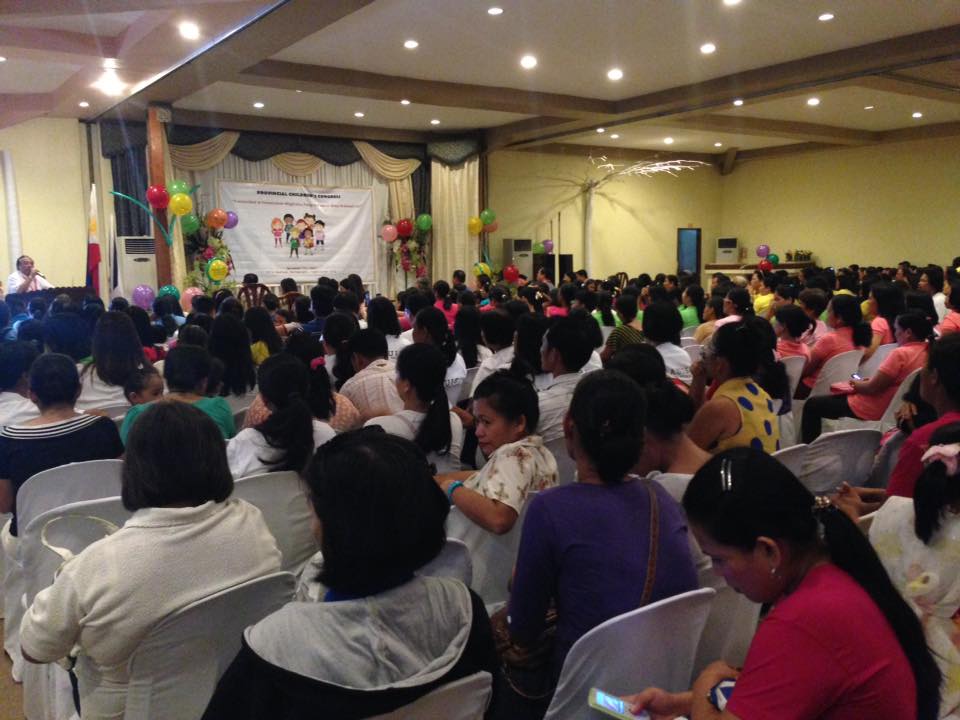
Walay bata nga atong tugotan nga mapasipad-an” – Gov. Edgar Chatto stated at the Provincial Children’s Congress today, advocating upholding laws that protect children and children’s rights. The governor also highlighted the importance of child rearing as foundation for shaping their future character as adults. Bohol joins national and international celebration of children’s month this November which underscores the protection of children and their rights. Children’s month is themed “Komunidad at Pamahalaan Magkaisa, Pang-aabuso sa Bata Wakasan Na”. The children’s congress features contests such as Draw and Tell, Singing, and Folk Dancing competitions.


by admin | Nov 17, 2015 | National News
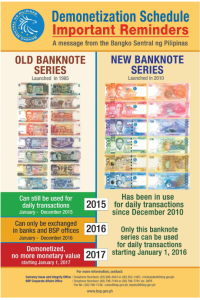
Manila, November 16, 2015—The Bangko Sentral ng Pilipinas (BSP) has issued the final date of demonetizing old bank notes up until December 31, 2015 and in 2016 may only be exchanged in banks or at the BSP. They have already started demonetizing old bank notes series earlier this year, which means that old banknotes can still be used to pay for goods and services up until the said deadline. After which, the old bank notes will be rendered useless and will be stripped from the current values from the Philippine banks and establishments including malls, shops and markets.
In addition, The Bangko Sentral ng ilipinas will also provide briefings on demonetization program and information on how to detect counterfeit money for the staff of DOLE and its attached agencies. They can also be reached by their landline number 708-7140 and by fax at 708-7138 should you need additional information.
by admin | Nov 17, 2015 | Headlines, Local News / Bohol Balita
Lawyer Victor de la Serna continues to sow lies after lies, and the latest of which is the alleged P1 billion which he said, was illegally stashed by the Chatto administration from the coffer of the Provincial Government of Bohol.
De la Serna’s orgy of spreading spurious facts and figures has turned into a circus because of its repetitivenes and transformed into a blatant public nuisance over the airlanes which he used as medium.
According to the records from the Provincial finance department , the province has appropriated P1.6 billion budget for this year and if the allegation of de la Serna is true, that is taking P1 billion from the P1.6 billion budget, the province has to stop operating .
The P1.6 billion annual appropriation will go to, Operating Expenses, capital outlays of the different departments, attached offices and devolved hospitals and the salaries and wages of 1,400 regular, contractual and casual employees under the Personnel Services.
Another direct recipient of the annual budget are the different programs of the Province under the HEAT IT BOHOL HELPS LIFE development framework.
The source said, the Province is still in the process of implementing the different Programs, Projects and Activities (PAP) for calendar year 2015.
It said that every transaction of the Province has to pass through several and different layers of internal control measures, which make sure that all collections are recorded and deposited in the bank with expenditures examined as to accuracy, completeness of supporting documents, its propriety and legality.
Reliable sources also pointed out, that if the allegation is true, the province could not have been awarded with Seal of Good Governance (SGLG) from the Department of Interior and Local Government (DILG).
The source stressed that in order for a local government unit to become a recipient of the said award, the LGU must pass all the three core assessment areas, namely Good Financial Housekeeping, Social Protection and Disaster Preparedness which the province had accomplish with flying colors, hence, the award.
The SGLG award symbolizes integrity and good performance of a local government unit.
The source said, each financial transaction of the Province of Bohol, has to pass through different layers of internal control measures such as availability of an appropriation, completeness of supporting documents and availability of cash.
The procedures are designed to prevent and ensure that the resources of the government are not stolen or wasted. (NPS)