by admin | Oct 13, 2015 | Headlines, Local News / Bohol Balita
TAGBILARAN CITY, October 12 (PIA)–The first local government pushed mountain trail bike (MTB) trail in Bohol is now in the offing, thanks to the vision of Alicia Mayor Marnilou Ayuban and local authorities, who see that beyond the town’s grassy hills are interconnecting opportunities for sports and wellness.
Short of easy to develop tourism spots despite a trove of potentials, the rolling hills and the different high this can give to those who indulge are a better bet against the town’s almost inaccessible caves.
Alicia’s stunning rolling hills and trails leading to sauntering peaks are easy giveaways to trail bikes, shared Godelia Lumugdang, town tourism and information officer during a test run on their 8.6 kilometer circuit Saturday, October 10.
She said Alicia wants to hitch into the tourism bandwagon and its hills also caught the fancy of a tourism product development officer at the Bohol Tourism Office.
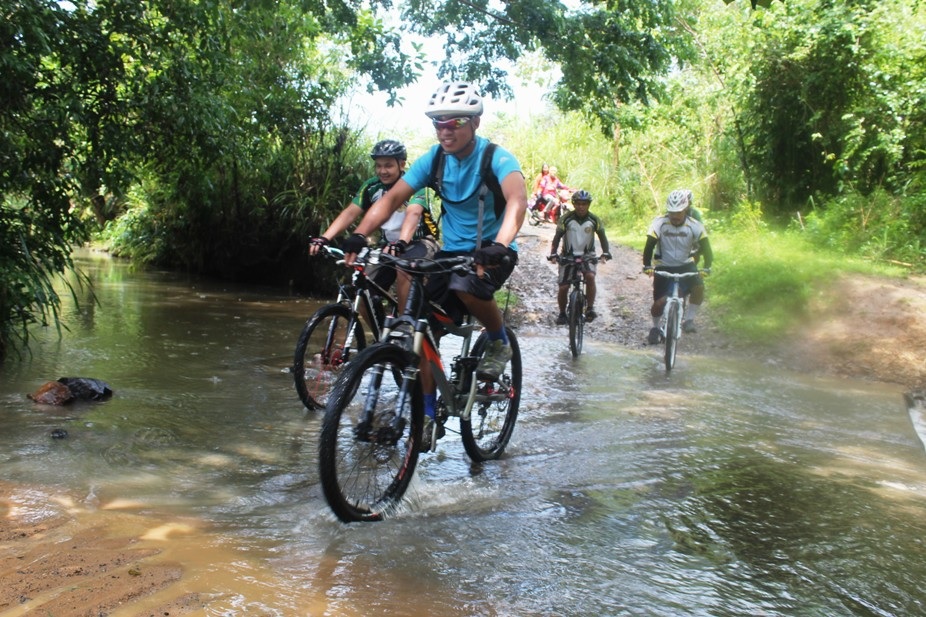
Last Saturday, a team of 21 mountain bikers from Antequera, Alicia and Duero took over two hours of rough single trail conquering ridges through nearly impossible ascents and downhill trails of the rolling hills in Camba-ol, the town’s identified mountain-bike showcase.
“It is a challenge of how one can keep up with the big rings in seemingly endless climb and then the downhill is just wicked,” a biker from Antequera admit. “Dropper seat post is recommended,” he added.
The bike course starts at the Cambaol barangay hall, just below the police camp and follows a barangay road that graduates into an eroded crude carabao cart trail.
Then it builds up on elevation, fording creeks, footbridges and then across tricky sandy loam farm tracks, open country roads and open field cattle pasture grounds to the sauntering three peaks one has to hurdle to complete the circuit.
“When Japan International Cooperation Agency asked us about what the town can offer, we submitted the hills and then we realized the possibility of a dirt bike ride to the ridges,” Lumugdang said.
But owing to the nature of the experience, mountain bike trail was the hands down choice it being environment friendly and impacts less to the community, the tourism officer added.
“This is what we can offer to the Boholano and foreign trail mountain bike enthusiasts,” she said promising to integrate all the comments and suggestion from the 21 trail bikers who went thru the whole circuit.
Alicia intends to open the trail for competition in January, when they celebrate their foundation day. (rac/PIA-7/Bohol)
by admin | Oct 10, 2015 | Opinion
By: Jerome Auza
The Philippines will conduct next year its third national election that uses automated machines to count the ballots. In the past two elections, accusations of electronic cheating abound but such accusations are very hard to prove without a manual count of the ballots. Manual counting, of course, is not feasible due to the massive cost involved and the huge logistics resources required. But is electronic cheating of the PCOS machines possible at all?
Of course, whatever method is used for counting the ballots, there is a way to engage in cheating. The PCOS machines are not excluded. Even if the PCOS machines and the system behind it are somehow built to be 100% cheat-proof, the cheating can happen outside of the system in the form of vote buying, use of government funds for campaigning and other tactics that can be done on election day to reduce or increase the voters able to vote for a certain candidate.
But is the so-called “E-Cheating”, where the numbers are manipulated electronically in the official tally, be possible at all? Republic Act No. 8436, the law covering the automated counting of ballots, does not explicitly specify the means to prevent electronic fraud. While giving copies of the ballot count to different parties and agencies can be deemed as a way to prevent fraud, the process is not protected if the cheating is done prior to the printing of the election returns.
Would the random manual count audit help detect electronic fraud? Unfortunately, in the way it was implemented in the 2013 national election, the answer is no. The reason is that the list of randomly selected precincts where the manual audit will be conducted is published days before the election. This may seem fine because the precincts are randomly selected. However, this process becomes pointless because the precincts to be audited are already known. So what would the cheaters do? Simple, exclude those precincts from ballot count manipulation. So when the audit is done, those precincts will show a very accurate match between actual votes and the machine count.
The selection of precincts for random manual audit should be done AFTER the printing of the ballot counts is done. This will make the work of COMELEC more challenging but this is the right way of doing it. They should just provide resources for this method. This was the way the audit was done in 2010. Why it was changed in 2013 is strange but it could also be intentional so that cheating can be done.
So how can cheating be done if the random manual audit is done the same way as in 2013? The process is a bit complicated but can be done because the PCOS machines are capable of being online to a central system. It can only be done with the participation of people familiar with the system and have access to the PCOS software.
First, the software that runs the PCOS machine checks at the central system if the machine is among those listed for random manual count audit. If it is, then the software will count the ballots without manipulation of the results. Second, if the machine is not for audit, the software will access the central system for the list of manipulated results it will print. Then it will print the manipulated results in several copies. Each group receives their copies which will then match the results tallied at the national level.
Even if the PCOS software source code is reviewed by independent agencies, the actual software loaded on the PCOS machines are not readable to humans so it can be manipulated and programmed to be able to implement the cheating scheme.
With the incorrect random manual count audit procedure in 2013, the process above can be done without a trace. To avoid it, COMELEC should do the selection of precincts for random manual audit after 90%, or some significant percentage, of the PCOS machines have submitted and printed their results. That way, any electronic manipulation can be detected by the audit. Candidates should insist to COMELEC that they do this procedure correctly so that electronic manipulation of votes would be much more difficult to pull off.
The coming national elections in 2016 will be a very significant event in the country, more so with the growing clamor for real change in the way the government is run. Filipinos are tired with election promises that are forgotten until it’s time to make promises again. We’ve been doing the same thing before: electing a popular candidate based only on his popularity and perceived “integrity”. Many voters do not consider the candidate’s track record of performance.
The good thing is that the citizens are now actively participating in scrutinizing our candidates. Social media has exposed politicians with a severe lack of discretion. Candidates who have questionable backgrounds or have participation in corrupt practices are revealed.
Our next president has an insurmountable challenge in running the country, ensuring economic growth, keeping peace and order and protecting the country’s boarders. A candidate with strong credentials, a sensible platform, proven track record and can show actual results of his leadership should be selected. Popularity is never enough of a qualification.
We should be very vigilant in May 2016 to ensure any means of cheating can be eliminated or at least minimized.
by admin | Oct 10, 2015 | Headlines, Tech Talk
The Department of Trade and Industry – Bohol Province held the first Bohol Idea to Contextualized Innovation (BHLi2i) Competition held at the Bohol Cultural Center last October 5-6, 2015. Ten (10) out of the thirty two (32) teams who registered were selected to proceed to the 2nd phase of the competition.
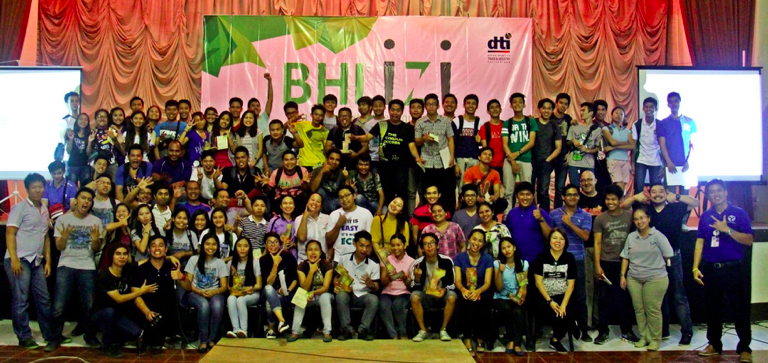
The participants, organizers and guests at the first Bohol Ideas to Contextualized Innovation Boot Camp.
These teams represent the different schools, colleges and universities in the province. The following ideas that qualified for the 2nd phase (prototyping stage) are: Bus Monitoring System (BMS), Bantay Palay “Grain Saver”, ACCRE, eGO, Heat Laptop Charger, e-Gen Light, PleteE, Drainage Inspection Machine (DIM), Rapid Testing Device (RTD), and Cocobot.
In the next stage, DTI will support the teams in the development of their ideas into actual prototypes using the facilities of the Bohol Fabrication Laboratory (FabLab), the first of its kind in the country. This will start on the 3rd week of October until the last week of November. Teams will learn 3D or 2D data preparation and undergo training on the use of digital fabrication equipment available at the Bohol FabLab such as the 3D Printer, Laser Cutter, Large and Small Format CNC Milling Machines, media printers and embroidery machine.
Prior to the pitching of ideas, all 150 individual participants were fortunate enough to be assisted by different mentors during the ideation process. Mentors included Carlo Calimon (CEO of MobKard); Dave del Rosario of Ideaspace Foundation; Prim Paypon of Dream Project PH; Andy Rapista (Founder of Watson Institute Philippines), Raphael Mijeno of SALT; and Artie Lopez (BrainSparks Philippines).
All prototypes developed will again undergo selection process in November. Qualified teams will proceed to the next phase, the co creation stage, wherein teams will have the chance to work on their prototypes with Japanese counterparts.
The BHL i2i Competition, the first of its kind in the province, is a program that promotes innovation and start-ups through digital fabrication. It aims to support the participants in developing technology-based solutions to local problems. This competition is organized by the Department of Trade and Industry – Bohol together with its local partners: Bohol ICT Council, Provincial Government of Bohol, City Government of Tagbilaran, Bohol Island State University and the Japan Internation Cooperation Agency.
by admin | Oct 5, 2015 | Headlines, Local News / Bohol Balita
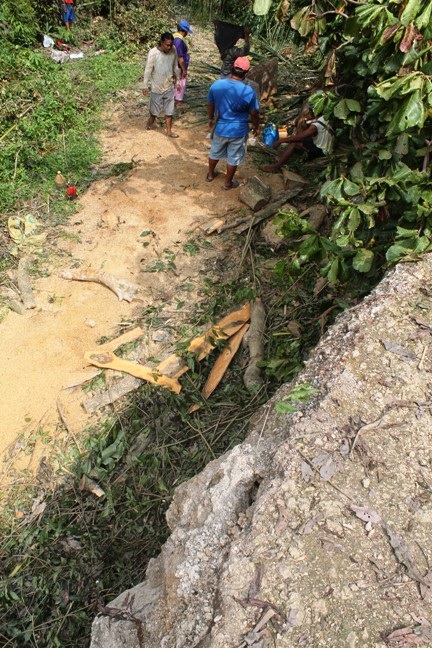
The end of the road from Cantuyoc to Canjulao apparently as the 3 meter dop caused by a land movement renders the road impassable to wheeled traffic. The landslide, which has eroded the road and over a hectare of land over 20 meters in some areas, is overly burdened limestone saturated by rain and large trees. No casualty was reported here. (rac/PIA-7/Bohol)
CANTUYOC, Jagna October 3 (PIA)–A barangay road descending to Canjulao from Barangay Cantuyoc in Jagna town disappears three meters below making the Cantuyoc-Canjulao access impassable to wheeled traffic.
Access is only through foot trail and that is hardly an easy one.
The cut barangay road link, makes travel to Cantuyok circuitous as the only road link open is through Tubod Monte, then to Malbog before skirting again to Cantuyoc, explains Barangay Chairman Geronimo Daguplo.
The new route is about twice longer than the usual over 3 kilometers using the broken barangay road to Canjulao and then to Pagina and Poblacion Jagna.
Last week, Jagna Mayor Fortunato Abrenilla shared the report to local papers, when the landslide pushed down some 3 feet of the road. The consequent report had the mayor telling that the depression has sunk further down to 6 feet.
Continuous rains which fell during the ending days of September has caused the already burdened portion of the barangay road which has a culvert draining into it.
Landslides however is nothing new in Jagna, which had towering cliffs and tall limestone mountains burdened by overgrown trees which also contributes to the strain the already saturated land is carrying.
Years back, a major landslide in Barangay Mayana buried houses, dislocated a basketball court and chapel bringing them across a national road and moving ricefields meters away.
In Sitio Taytay, Cantuyoc, the landslide appears to be a contiguous hectare of land chopped off the hills, but instead of toppling down, it moved sideways as the base gritted under the sheer weight of the chunk chipping off.
The slid portion starts right from where a culvert crosses the road and dumps water from the canals in this rain soaked and soggy soil drenched by springs and forest run-off water.
“We used to have another landslide near the area,” barangay chairman Daguplo pointed out. It accordingly involved cemented roads which buckled when the soil sub base of the road gave in to the loosened dirt road.
Municipal authorities have already been informed about this, Daguplo also added.
This was also confirmed by Municipal authorities who has the Barangay Disaster and Risk Reduction Management Council put up the necessary warning signs to keep people off the danger areas.
The Office of the Civil Defense and the Department of Environment and Natural Resources-Mines and GeoScience Bureau have been notified so proper assessment could be given and community residents be appraised
Residents who have been earlier advised to seek safer shelter at night go back to their homes hear the slide areas which have dislocated an electric post about 20 meters and had toppled hardwood and endemic trees which were aplenty in the area.
The BDRRM is now securing the landslide area if only to keep people off while rains started to pour again Sunday. (rac/PIA-7/Bohol)
by admin | Oct 5, 2015 | Editorial
We have a strong reason to believe that Bohol is lining up in the runway for a lift off.
Its natural resources abound. The fresh water which flows out to the sea each day eloquently talks about the excesses that Bohol has, which other places in the world can only dream of.
The land lavishly spreads Bohol’s bounty and this speaks of how the soil pays back the sweat that waters the diligence of every Boholano farmer.
Boholanos have been known for being warm, hospitable and hardworking: traits that make them assets by investors, who are lured by these other givens.
And the character of the Boholano, although already a deck-ful of aces, is even hyped by the heaping serving of skills, incomparable with similarly trained workers.
What we are telling is that everything, or almost everything has been set: the playing field is ripe with the promise of a good pay-back.
The conditions are almost perfect here, just a minute tweaking can already make a little over-the-break-even thresholds because worksman-ship and craftsmanship is innate in the Boholano.
The outer environment which is way beyond the worker however is still messed.
Other than inefficient government bureaucracy, circuitous business processes, corruption and inadequate infrastructure form the barriers, which keep the province from really taking flight, politics takes its nastiest self out.
While the country relentlessly pushes for competitiveness, we know of government offices and agencies sleeping on the job, taking things cruise through and sit on business proposals like they are cushions or simply butt wipes.
A business permit is easier to get in Dauis over in Tagbilaran, or maybe in some other areas. We also know that if the applicant is a political butterfly, things are a little bit harder.
Here, there are still processes than can be done faster depending on the obesity of one’s grease money.
While in business, a reliable and fast internet is a plus-plus factor, the only speed Boholanos can get is the quickness local officials talks about these plans.
And then, there is a challenge in keeping the peace now in the otherwise underperforming province.
While the internal security operators here stamp their feet to convince people that Bohol is insurgency free, the Commission on Audit hints that the continued presence of the army tells otherwise.
Death by shooting or execution in Bohol is high, at least a couple or people is killed weekly. Drugs have suddenly become alarming some people are now into the propensity that 70% of the crime cases in Bohol are drug related.
So here is everything but political will. Now that elections are looming and nothing has been as tangible from our leaders here today, the future can be defining for Bohol.
But the question remains. Shall we see the will soon?