by admin | Jun 18, 2018 | Headlines
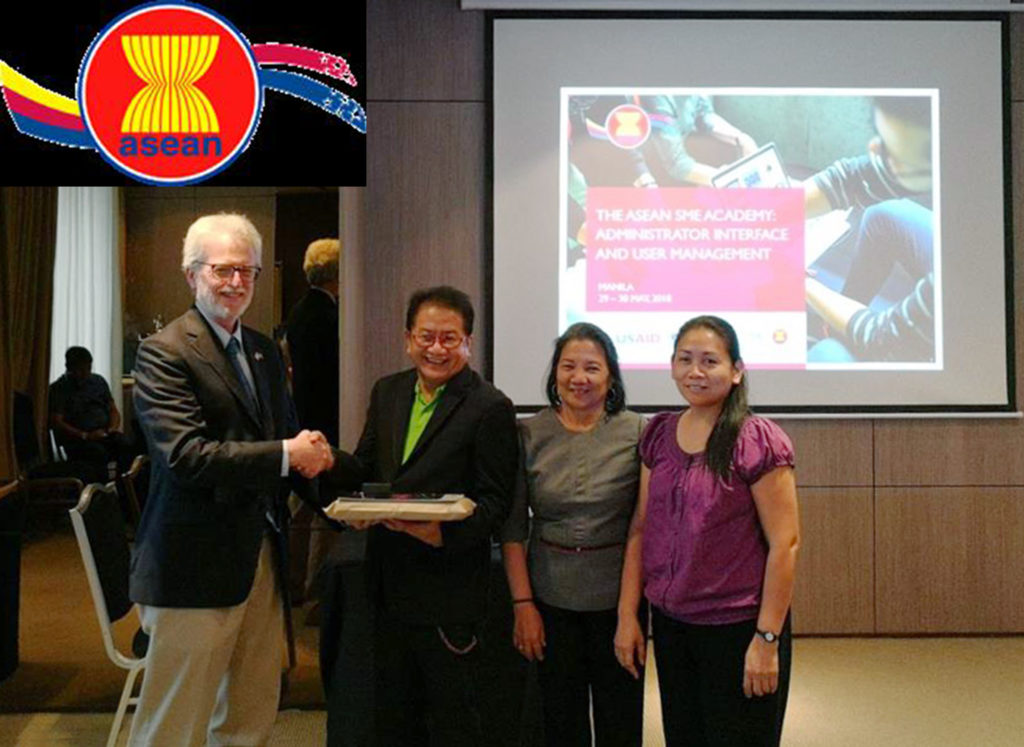
The Philippine Trade Training Center (PTTC) paves the way to a more convenient, wider, and open-access online trainings and resources for the Philippines’ Micro, Small, and Medium Enterprises (MSMEs), as the Center becomes the new administrator of the Association of Southeast Asian Nations (ASEAN) Small and Medium Enterprise (SME) Academy or the ASEAN SME Academy.
The Academy is a one-stop multi-platform online learning and information resource for Southeast Asian SMEs with support from US-AID, ASEAN Coordinating Committee on MSME (ACCMSME) and the US-ASEAN Business Council (US-ABC).
Launched at the 6th Meeting of the SME Advisory Board in Singapore on 31 May 2016, the Academy aims to provide training and mentorship to enhance ASEAN SME’s capabilities to grow and compete regionally and internationally. The Philippines, through the Department of Trade and Industry (DTI), was chosen as the first country to become the Academy’s administrator.
PTTC shall also facilitate online forums that will link MSMEs in the Philippines to SMEs in Southeast Asia for the sharing of experiences on common issues, identifying best practice and replicating excellence to scale.
At present, around 50 training courses on finance/accounting, management, marketing, operation, technology, and trade/logistics from Fortune 500 companies and members of the US-ASEAN Business Alliance for Competitive SMEs are being offered. The core of the Academy is a series of training materials for SMEs contributed by Baker & McKenzie, Facebook, Google, HP Inc., MasterCard, Microsoft, PayPal, P&G, and International Labor Organization.
In addition, the Academy contains around 350 relevant links to business information and access to a directory of service providers to whom SMEs can reach out for financial advice, corporate programs and networking.
The Academy reports that as of January 2018, it has been accessed by 49,034 people, 2,866 of which are registrants, and 658 users are completing courses on the Academy.
At present, there are 191 Academy Facilitators – 29 from the Philippines; 25 from Lao PDR; 30 from Indonesia; 27 from Cambodia; 28 from Malaysia, 19 from Thailand; and 31 from Vietnam.
The Academy can be accessed at www.asean-sme-academy.org, with link at the PTTC’s website, www.pttc.gov.ph.
The core group together with the Academy Facilitators will convene in PTTC Manila on July 27, 2018 to share knowledge, lessons learned, good practices and tools developed to promote the ASEAN SME Academy to SMEs in their networks and to formally handover the communication management to the new administrator of the ASEAN SME Academy – the PTTC.
by admin | Jun 14, 2018 | Headlines
The Department of Trade and Industry-Competitiveness Bureau, as temporary secretariat of the Anti-Red Tape Authority (ARTA), following the enactment of Republic Act 11032 known as the Ease of Doing Business and Efficient Government Service Delivery Act of 2018, is set to implement its first project called Project One. Project One is designed to develop solutions to improve business registration in the Philippines. The main objective of the project is to improve ease of doing business by streamlining the business registration process in the country, one that is focused on creating a pleasant customer experience (easy, not cumbersome nor confusing), addresses bureaucratic singularity (whole of government, one door policy) and promotes governance (data sharing, data accuracy, access to data, privacy issues).
New Zealand’s Creative HQ won the bid to support the country’s efforts aimed at significantly improving the EODB rankings of the Philippines and general ease of doing business for business owners, entrepreneurs and investors. New Zealand presents an attractive partner to the Philippines as NZ ranks 1st in the World Bank Doing Business survey and the Starting a Business indicator of the WB DB 2018 survey.
Project One shall make use of a modern innovation format (“Design Sprints workshops”, a method developed by Google Ventures to solve specific business problems and validate potential solutions in just five days.) The three workshops shall cover the following:
Design Sprint 1 (July 23 – 27, 2018): Creation of a “Wikipedia” of LGU registration process. DILG and DICT to collate and publish the most up to date processes for LGUs in one place. This will increase inter-agency collaboration, and provide highly useful information to business and investors, and increase transparency of LGU related information online. This concept follows the desire expressed by the Philippine Government to create “one portal” for all business-related information held by Government.
Design Sprint 2 (September 3-7, 2018): Develop the implementation framework for a Philippine Business Number to provide a single, unique identifier that can be used by businesses when transacting with any government agency. This concept follows the desire expressed by the Philippine Government to use “one number” for all government transactions.
Design Sprints 3 (October 1-5, 2018): Develop a prototype for an end to end registration application that allows business owners to complete their business registration on one website / application. This was viewed as the ultimate leadership challenge as this is an excellent opportunity for the Philippines to become one of the first countries to adopt a business registration process that can be completed (end to end) on a mobile phone. This concept follows the desire expressed by the Philippine Government to use “one form, one portal” for all business to government transactions.
“Project One is the perfect start as the Anti- Red Tape Authority (ARTA) carries the torch of initiating the GovTech revolution in the Philippines. With the passage of the Ease of Doing Business and Efficient Government Delivery Services Act, DTI’s efforts at pursuing reforms will be further strengthened. The law mandates all government agencies including LGUs to automate business registration procedures, and we are glad that it will be the first time that our government will use the Design Sprints, as innovation” DTI Secretary Ramon Lopez said.
Last year, the New Zealand government provided assistance by conducting a scoping mission to identify hurdles in business registration and showcase New Zealand’s expertise in EODB.
“We are ready to initiate online application, One Form, One Number, One Portal for business registration, and we could realize this by putting technology to work. We do not just automate the process but transform the way government is doing business.” Lopez added.
by admin | Jun 13, 2018 | Headlines
Sec. Lopez calls on gov’t agencies to
“Execute, execute, execute” reform initiatives
The Department of Trade and Industry (DTI) announced during the 6th Ease of Doing Business (EODB) Summit on 13 June 2018 at the PICC in Pasay City that the government has already implemented nineteen reforms that it hopes will have an impact in the 2019 World Bank Doing Business Survey Report.
DTI Secretary Ramon Lopez, chair of the EODB/Anti-Red Tape Advisory Council, enumerated the following reform initiatives undertaken by various agencies that will have an impact on 7 out of 10 indicators of the DB Report.
These indicators include: (1) starting a business, (2) dealing with construction permits (3) getting electricity, (4) registering property, (5) protecting minority investors, (6) trading across borders, and (7) enforcing contracts.
The following reforms have been implemented:
-
- Company Registration System (CRS) implemented by the Securities and Exchange Commission (SEC) on November 2017.
- Executive Order 11 issued by Quezon City creating a One-stop Shop (OSS) for business and building permits. Barangay clearances shall no longer be held as a prior requirement for business and building permit application.
- Single Window Transaction initiated by the Bureau of Internal Revenue (BIR).
- Setting up of Quezon City Construction Permits One-Stop Shop for single, integrated application and approval for building permits, locational clearances, fire safety evaluation clearances, certificates of occupancy, fire safety inspection certificates, tax declarations (new warehouse), certificates of final electrical inspection, and certificates of machinery operation.
- Issuance of a DILG/DPWH/DTI Joint Memorandum Circular on Construction Permits. This sets uniform standards for processing building permits and certificates of occupancy, including application forms, requirements, steps, processing time, one-time assessment, and payment of fees.
- Implementation of the CXE (Customer eXperience Engine) by MERALCO.
- Setting up a MERALCO Booth inside the Quezon City Hall, a channel to receive service applications and to inform contractors and customers on how to apply for electricity and submit requirements online.
- Implementation of Executive Order No. 11 s 2017 where the Certificate of Final Electrical Inspection (CFEI) is now part of the application.
- Implementation of the Land Titling Computerization Project (LTCP) by the Land Registration Authority (LRA).
- Land Registration Systems (LARES) uploaded with LRA’s annual statistics tracking the number of transactions in their website to allow the public access to the data. Majority of the title/ deed records and plans in Quezon City have been converted electronically and are now fully digital. Users are now able to check a specific title’s encumbrance information using its electronic database.
- Implementation of the Supreme Court’s Philippine’s Enterprise Information Systems Plan (EISP) and the roll-out of the e-Court system in Quezon City.
- Implementation of the Electronic Certificate Authorizing Registration (eCAR).
- SEC issued Memorandum Circular No.8, s.2018, which mandates all publicly-listed companies to seek shareholders’ approval on any change/s in the company’s external auditor.
- Issuance of a SEC Memorandum Circular requiring the boards to have a separate audit committee exclusively comprised of board members.
- The Goods Declaration Verification System (GDVS) provides real time updates on entries filed, which lessens face-to-face transactions at the Bureau of Customs (BOC) and its stakeholders.
- The Super Green Lane (SGL) institutes advance cargo clearance for shipments of highly compliant importers. This allow advance processing and clearance of importations from the country’s topmost qualified importers without compromising BOC’s function of assessment and collection of revenue.
- Mandatory 100% x-ray inspection on red lane shipments and removal of redundant scrutiny of cargoes.
- Terminal Appointment Booking System (TABS) is an innovative online system that schedules the withdrawal and delivery of containerized cargoes at the international ports of Manila. It reduces the road congestion in the port vicinity, which will benefit the surrounding communities, other road users, and the environment in general.
- Deployment of electronic case management system through the eCourts project
The reforms implemented have resulted in the reduction in the processing time and steps on applications in Quezon City, the representative city monitored by the World Bank.
Sec. Lopez called all government agencies to implement fully these reforms identified by the EODB Task Force. He said: “Our thrust is to ‘Execute, execute, execute.’ We must continue to implement these reform initiatives and identify the obstacles to our progress.”
.
Lopez noted that the recent passage of the EODB/Efficient Government Law or Republic Act No. 11032, should compel all agencies of government to comply with streamlining and reengineering. This he said, effectively broadens the scope of the interagency task force.
by admin | Jun 13, 2018 | National News
The Department of Trade and Industry, as the chair of Doing Business Task Force, is pleased to highlight the reform initiatives undertaken to improve the ease of doing business and level up the Philippines’ global competitiveness ranking.
Key reforms include Quezon City’s Business One-Stop Shop (BOSS) which streamlines the process registration process into just three steps: file, pay and claim. With this, applicants can complete the whole procedure in just one (1) hour, as long as all the necessary requirements are complete.
Further, applicants do not need to move from different offices which were located in different floors/areas to obtain licenses and permits or make payments on locational clearance and fire safety inspection since the city’s Zoning Administrator and the Bureau of Fire Protection are situated in one location, making it possible to simultaneously evaluate applications for these permits.
Another reform is Securities and Exchange Commission’s Company Registration System which allows the online verification of proposed company name and submission of application for SEC registration and documentary requirements. It also gives the user an option to pay the SEC fees online through the LandBank ePayment.
“These reforms contribute to improved process of obtaining business and other related permits. Before it was tedious, burdensome, took much time, and people needed to comply to drastic amounts of requirements. With the old setup, people would be discouraged to start a business. But now, it’s different. It is more efficient, streamlined, and more customer-friendly. I believe that this could attract more business to invest in our country, and this will lead to more job generation for our fellow men.” DTI Secretary and Doing Business Task Force Chair Ramon Lopez said.
In addition to the reforms stated above, the government recently enacted the Ease of Doing Business Efficient Government Service Delivery Act (EODB-EGSDA) of 2018. The said Act serves as the game-changer in our endeavor to ease doing business in the country.
Important provisions of EODB law include the institutionalization of the prescribed steps and processing time for transactions like issuance of local business licenses, clearances, and permits and mandating the use of the unified business application form, which consolidates all the information of the applicant or request party, in processing new application or business permits and business renewals by various local government departments.
“Improving access to economic opportunities will require us to listen to our customers – the people and investors. We should not burden them with bureaucratic red tape.” Lopez added.
by admin | Jun 9, 2018 | Headlines, Tech Talk
The Department of Trade and Industry through its Philippine Trade and Investment Center (PTIC) in Silicon Valley advances efforts in promoting the Philippine startup ecosystem development through projects that support the growth of the community.
In partnership with the Philippine Consulate General in San Francisco (SF PCG), PTIC Silicon Valley recently launched the Spark447, a co-working space and resource center at the Philippine Center’s building in San Francisco that aims to cater to Filipinos and Fil-Am start-up communities in the Bay Area. Ambassador Jose Miguel Romualdez and Consul General Henry Bensurto Jr. led the soft launch last 22 May 2017.
“SPARK447 provide avenues for bringing the community in San Francisco closer together. But it doesn’t stop there, it will bring the Filipino tech community in San Francisco closer to our ecosystems in Manila and make change happen,” said PTIC Silicon Valley Trade Representative May Niña Celynne Layug.
Spark447 is a shared office space, networking hub, and a place uniquely designed for rising entrepreneurs, freelancers, digital nomads and internet professionals. It is part of the Philippine Consulate in San Francisco’s “Spark, Connect, Empower” (SCE) movement that aims to gather Filipino and Fil-American communities and individuals in the United States in building collaboration and partnerships that promote nation building.
According to DTI Trade and Investments Promotion Group Undersecretary Nora Terrado, the establishment of Spark447 will be instrumental in showcasing the technology and business opportunities in the Philippines.
“This will greatly complement our initiatives in promoting opportunities in the Philippines and the talents that we have particularly in advanced industries including manufacturing and the IT-BPM,” said Terrado.
DTI in close partnership with the Departments of Science and Technology (DOST) and Information and Communications Technology (DICT) has been supporting and enabling the development of the Philippine startup ecosystem. The collaboration caters from various stages of startup development from ideation to commercialization.
According to PTIC-Silicon Valley, several organizations, companies, and individuals, who share in the vision of the SCE movement have pledged their full support of the movement. These include PLDT, Philippine Airlines, The Filipino Channel, National Federation of Filipino American Associations (NaFFAA), One World Institute and Mama Sita’s.
According to the recently released 2018 Global Startup Ecosystem Report, the Philippines startup ecosystem has strong foundations in the areas of Fintech, Enterprise Solutions and AI & Machine Learning.
In 2017, the DTI led Slingshot ASEAN, a business event developed by the ASEAN Committee on Business and Investment Promotion that gathered startups, venture capitalists and key players in the ASEAN startup community through learning hubs, pitching competitions, plenary sessions, and exhibitions.

n photo (L-R seated): Tess Marin, SSS representative; PTIC-Silicon Valley Trade Representative Celynne Layug ; Dir Pura Molintas (DOT-SF); H.E. Ambassador Jose Manuel Romualdez; Consul General Henry S. Bensurto, Jr.; Mrs. Mariz Bensurto, and Deputy Consul General Raquel Solano. Others in photo are Spark, Connect, Empower (SCE) movement partner organizations. Photo from DTI-PTIC Silicon Valley.

