by admin | May 31, 2018 | National News
The Department of Trade and Industry Cebu Provincial Office (DTI Cebu), in coordination with the Cebu Technological University (CTU), will soon launch a “Food Innovation Center” in Tuburan and Daanbantayan, Cebu.
The center is meant to provide micro, small and medium enterprises (MSMEs) a facility to improve food production/ processing and develop new ideas for businesses within the area as well as neighboring towns.
DTI will provide the equipment for the food centers through the department’s Shared Service Facilities (SSF) program. The equipment will be housed at the CTU campus.
The CTU Tuburan Food Innovation Center will be launched next month, while the center at the CTU Daanbantayan is tentatively scheduled in the third quarter of the year.
The SSF project goal is to enable MSMEs to increase their productivity; accelerate MSMEs competitiveness by giving them access to energy efficient technologies and more sophisticated equipment; encourage the graduation of MSMEs to the next level where they could tap a better and wider market share and be integrated in the global supply chain; and address the gaps and bottlenecks in the value chain of priority industry clusters.
MSME development is a key strategy to achieve the government’s goal of inclusive growth and jobs generation. The development aims to improve the competitiveness of MSMEs by providing them with machinery, equipment, tools, systems, skills and knowledge under a shared system.
by admin | May 31, 2018 | Headlines

Pack! Pinas final leg in Cavite attended by hundreds of entrepreneurs from the CALABARZON area. Front Row, From L to R: DTI Quezon OIC-Provincial Director Julieta Tadiosa, Commission on Audit Region IV-A auditor Delia Dojillo, DTI Region IV Regional Director Malou Toledo, Export Marketing Bureau Director Senen Perlada, Packaging Institute of the Philippines President Joseph Jocson, DTI Assistant Secretary Demphna Du Naga, Undersecretary Zenaida Maglaya, Cavite Provincial Director Noly Guevara, Carmona Mayor Dahlia Loyola, DTI Secretary Ramon M. Lopez, Undersecretary Nora Terrado, Assistant Secretary Blesila Lantayona, San Miguel Yamamura Packaging Corporation’s Virginia Robledo, DTI Trade Service Officer Ben Uy; Oryspa founder Sherill Quintana, and Delfa’s Food Products owner Isabel Punzalan.
CAVITE — Department of Trade and Industry (DTI) Secretary Ramon M. Lopez emphasized the importance of well-designed product packaging to Micro, Small, and Medium Enterprises (MSMEs) in the final leg of the Pack! Pinas roadshow last 29 May in Cavite.
“As part of the mandate given by President Rodrigo Duterte to help MSMEs, DTI is applying a 360-degree approach in MSME development,” said Secretary Lopez. “Part of this is levelling up the product packaging, for it to standout in the market place. The packaging serves also as the advertising at the point of sale. MSMEs are not usually exposed to the latest trend, designs, and on how best to present and preserve product quality and they are often hampered by the required Minimum Order Quantity (MOQ) that limits their capability to improve their packaging, and these are the barriers being solved in these fora and expo”, Lopez said.
Cavite is the final stop of the packaging roadshow. The Visayas leg was held in Tacloban last 3 – 4 May and was attended by 508 participants, 317 of them MSMEs. Meanwhile, the Mindanao leg in Cagayan de Oro City was attended by 720 participants, 501 of which were MSMEs.
Though this round of the roadshow draws to a close, Sec. Lopez assured MSMEs that the roadshow will roll out in other regions soon.
With the aim of bringing packaging experts and suppliers closer to MSMEs throughout the Philippines, visitors during the two-day event in Cavite were treated to business matching sessions; seminars on packaging, branding, and design; and workshops and interactive training sessions.
Packaging suppliers who participated also waived their required minimum order quantity during the two-day exhibit to cater to MSMEs.
DTI also invited Oryspa founder Sherill Quintana and Delfa’s Food Products owner Isabel Punzalan to share how branding propelled their business to international success.
Quintana said that after 11 years, they were able to achieve their successes within three years because they decided to build a brand. Meanwhile, Punzalan stressed the need to gain international certifications like ISO, Halal, FDA, and others if they want to make their products world-class.
DTI is already helping select MSMEs improve their packaging through programs like Go Lokal! and One Town One Product (OTOP) Philippines, which guides entrepreneurs to improve their products and gives them market access through OTOP and Go Lokal! stores.
Pack! Pinas is a broader approach to reach hundreds of MSMEs in the different regions of the country.
by admin | May 29, 2018 | National News
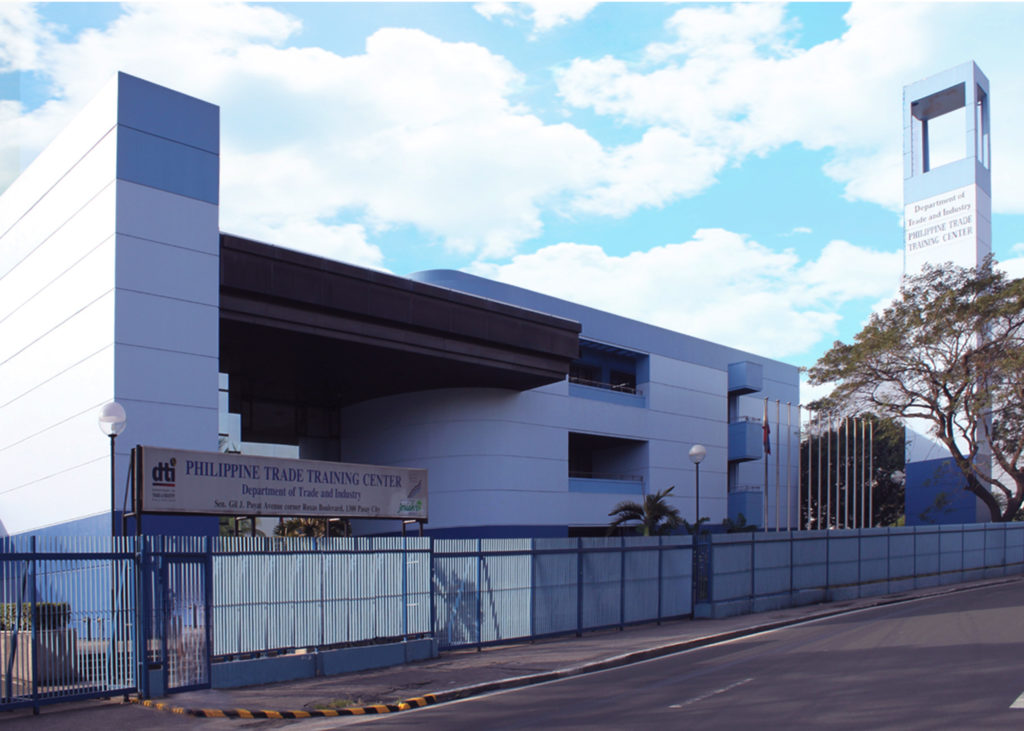
29 May 2018 – The Philippine Trade Training Center (PTTC) takes a leap as it embraces its new role as the Philippines’ Global MSME Academy, by virtue of a Department Order (DO) issued and signed by Department of Trade and Industry (DTI) Secretary Ramon Lopez on April 18, 2018.
The order designates PTTC as a Center dedicated to the administration, development and conduct of trade-related training and management of facilities to support the requirements of globalizing industries and services most especially the micro, small and medium enterprises (MSMEs). Bureaus and offices within the DTI and all its attached agencies are enjoined to integrate their MSME-related training programs and projects with PTTC.
Fully dedicated to this commitment, PTTC created Strategic Business Units (SBUs) and customized its programs on three major industries – processed food, services, and consumer goods, and categorized by MSME levels – foundation, intermediate and advanced courses. From the foundation courses on business management, finance and marketing, and production management, each SBU has a focused training pathway with specialized course modules to address expansion in the domestic market and lead MSMEs to gain access to market compliance and internationalization.
PTTC also aligns its Entrepreneurship training programs for the youth, women and Overseas Filipino Workers (OFWs) in tandem with other institutions providing capacity-building programs for these focused sectors.
“MSMEs need to be inspired then nurtured to cope with the ever-changing environment, where survival somehow depends on knowledge, skills and attitude. Partnerships and collaboration with international content providers as well as homegrown experts shall be maximized to enable PTTC to address a wider range of training needs of MSMEs,” said PTTC Executive Director Nestor P. Palabyab.
Local partners include The Philippine MICE Academy, The Philippine Center on Entrepreneurship Go Negosyo, Bank of the Philippine Islands (BPI) Foundation Inc., World Trade Center, and Center for Future Leadership while International partner institutions are Taipei Economic and Cultural Office (TECO), International Trade Center (ITC) Geneva, Switzerland, Association of Overseas Technical Scholarship (Japan), Leipzig University, Germany’s Hinrich Foundation, and British Council of the Philippines.
Apart from these partnerships, PTTC also collaborates with e-learning institutions such as the ITC-SME Trade Academy, ASEAN SME Academy, and World Intellectual Property Organization (WIPO) Academy for online training courses in finance, human resource, marketing, trade and logistics, management, operations and technology.
New training programs, including regional programs, are also offered by the Center such as the recently launched Food Connect Program, designed to create an alternative environment for experiential learning for food manufacturers. Activities include:
- Food Talks or briefings on International Labeling Requirements of Major Importing Countries such as USA, China, Japan and UAE;
- Mentoring and consultative sessions by key industry practitioners providing practical, innovative tips on processes that can be adopted by MSMEs in food safety, shelf life, food processing technology and innovation, basic labeling requirements, process and product assessment;
- Awareness on the regulatory compliance of Food and Drugs Administration- License to Operate/Certificate of Product Registration (FDA-LTO/CPR), HALAL, and International Food Standards;
Likewise, undergoing major improvements are the Center’s training facilities. The Food Connect Hub is available for activities related to the Food Connect Program, with working spaces available for small group gathering, networking and negotiations. Food Lab, is dedicated for food testing such as Water Activity, Water and pH Content and Metal Detector, intended for initial assessment of food properties for third party laboratory testing; and finally, the DigiFab Training Facility for product packaging prototyping, and the Creative Hub which gathers the young creative entrepreneurs to hone their skills and talents.
As the trade training arm of DTI, mandated under the Administrative Code of 1987 and Executive Order No. 133, Series of 1987, PTTC’s mission is to provide stakeholders with high quality and relevant training programs at par with the best in the world, that transform Philippine MSMEs into global business entrepreneurs.
by admin | May 29, 2018 | DTI Updates, Headlines
The Department of Trade and Industry expressed optimism that the newly-enacted Ease of Doing Business and Efficient Government Service Delivery Act of 2018 will make doing business in our country easier as it promotes efficient government.
“Under the EODB/Efficient Government Act, businesses can expect streamlined processes, reduced processing times from all government agencies, including government-owned and controlled corporations (GOCCs). Government agencies shall be made to comply with the prescribed processing time: three (3) working days for simple transactions, seven (7) working days for complex transactions, and 20 working days for highly technical transactions.” DTI Secretary Ramon Lopez said.
The EODB-EGSDA Act, which amended the Anti-Red Tape Act of 2007, requires all local government units to streamline procedures for the issuance of business permits, clearance and other type of authorizations by implementing unified business application form. LGUs are mandated to setup Business One Stop Shop (BOSS) to facilitate business permits application. The law also provides that barangay clearances and permits must be issued at the city or municipality to speed up transactions.
Apart from streamlining, the law also provides for the creation of a Central Business Portal that will receive and capture application data on business-related transactions, while Philippine Business Databank shall provide LGUs and national government agencies access to information to verify validity and existence of businesses. With this, businesses are not required to submit the same documentary requirement previously submitted.
The DTI Secretary, who now chairs the Ease of Doing Business and Anti Red Tape Advisory Council (EODB/ARTAC) called RA 11032 a landmark legislation that will have a direct impact on all citizens and business sector.
“We realized that for the EODB reforms to be fully implemented and integrated, a whole-of-government approach was necessary. Thus in full support of the President’s vision, Congress enacted a law that will make doing business in the Philippines easier and more importantly, create a more efficient government.” Lopez added.
The EODB-EGSDA law will be implemented by the Anti-Red Tape Authority, an agency under the Office of the President that will monitor compliance of agencies, and implement and oversee national policy on anti-red tape and ease of doing business. The seven-member Ease of Doing Business and Anti-Red Tape Advisory Council will be composed of the Secretaries of DILG, DICT, and DOF, and two members from the private sector. The EODB/ARTAC will serve as the policy and advisory body of ARTA, to be chaired by DTI Secretary, and the Director General of the Anti Red Tape Authority (ARTA) as Vice Chair.
by admin | May 27, 2018 | Local News / Bohol Balita
By JUNE S. BLANCO
RESIDENTS of Buenavista and nearby towns better start to learn welding now.
This after Rep. Erico Aristotle Aumentado (Bohol, 2nd District) met with the top henchman of a company that plans to establish a shipyard in Buenavista town.
The company executive, Aumentado and Buenvavista Mayor Ronald Lowell “Sample” Tirol earlier on discussed possibilities and scouted around the district for the ideal location until the former settled for Buenavista.
Aumentado took the former’s decision as a good omen where employment opportunities for his constituents are concerned.
The solon, however, wants to balance development on one hand, and Bohol’s environment on the other.
After all, he said, the province’s ecological-cultural tourism and agriculture are its two main economic drivers.
As such, as the company started clearing some mangrove patches as part of earthworks in building the shipyard, Aumentado wrote Provincial Environment and Natural Resources Officer Laurentino Bautista to inquire if the former already has complete papers including the Environmental Compliance Certificate (ECC) for the expected big project.
The ECC itself limits a proponent to what he can – and must not – do to the environment as he develops his project site.
Aumentado clarified that he welcomes development, but he is against everything that destroys the environment.
An ECC also states what mitigating actions a proponent can do – like, among others, planting more mangrove propagules than what were sacrificed in the name of development – a shipyard in this case.
To note, the solon even filed a bill banning the establishment of coal-fired power plants in the province and especially the 2nd District.
In case the company has yet to complete its documentary requirements, he expressed willingness to assist them in producing these just so the project will be ECC compliant and therefore, environment friendly.
Unlike the coal plant that continually depletes coal resources and spews pollutants into the air when operational, the bulk of work in a shipyard is the welding together of mostly steel parts to form the ship. Discharges to the air would therefore be lesser, he pointed out.
The ECC likewise sets strict regulations on effluents – the liquid waste – that the company might discharge into the sea.
The shipyard, he said, is expected to attract other investors to the town.
This means job opportunities that will bring in money to increase the buying power or consumer spending of residents and visitors alike.
On top of skilled welders, the shipyard will also need workers for parallel industries and businesses like food preparation for the workers.
Thus, he said, money circulation in the town, the district and the province will expectedly increase.
He vowed to continue looking for similar opportunities for his constituents so that their respective breadwinners need not go to bigger cities or even abroad for the proverbial greener pastures.
It is best, he observed, that families stay together.

