by admin | Apr 4, 2018 | DTI Updates, Headlines
The Department of Trade and Industry (DTI) will tie up with the Department of Science and Technology (DOST) to help micro, small and medium enterprises (MSMEs) expand their market and reach clients online with the OneSTore.ph.
“MSMEs are the backbone of the Philippine economy. And as part of President Rodrigo Duterte’s whole-of-government approach to assist MSMEs, we are teaming up with DOST to impact the lives of more Filipino entrepreneurs,” said DTI Secretary Ramon M. Lopez.
The OneSTore.ph is a first government e-commerce platform (Business–to-Customer and Business-to-Business platform) dedicated to marketing high-quality Filipino products of MSMEs through the worldwide web by “bringing quality products at Filipino doorsteps.”
This comes as DTI intensifies marketing capabilities of MSMEs to help them reach the mainstream market.
Under the OneSTore.ph agreement, DTI will Promote the oneSTore.ph to MSMEs through Negosyo Centers as a platform where they can market their products on-line.
At the same time, DTI will make Negosyo Centers accessible to clients of DOST and allow clients to display and dispatch their products with its payment and logistic partners in One Town One Product (OTOP) Philippines HubStores, subject to availability of space and to DTI priorities and promote oneSTore and provide signage for the spaces provided for oneSTore.ph and oneSTore hub in every OTOP Store identified as co-branded hub, among others.
The One Town, One Product (OTOP) Philippines is DTI’s collaborative program with national government agencies and local government units as a customized intervention to level up the products of various localities and drive inclusive local economic growth.
DOST, on the other hand, will develop and maintain oneSTore.ph where its accredited Regional Hubs and MSMEs may sell products and services to its clients and engage with payment and logistics partners and provide better oneSTore.ph services to its accredited Regional Hubs, MSMEs and its partner agencies.
DOST will also Provide priority to jointly identified OTOP products for product development initiatives including improvements in packaging and labeling, subsidy or discounts in testing fees, equipment support such as the Small Enterprise Technology Upgrading Program (SETUP), and strengthen research and development efforts.
by admin | Apr 3, 2018 | Photo Story
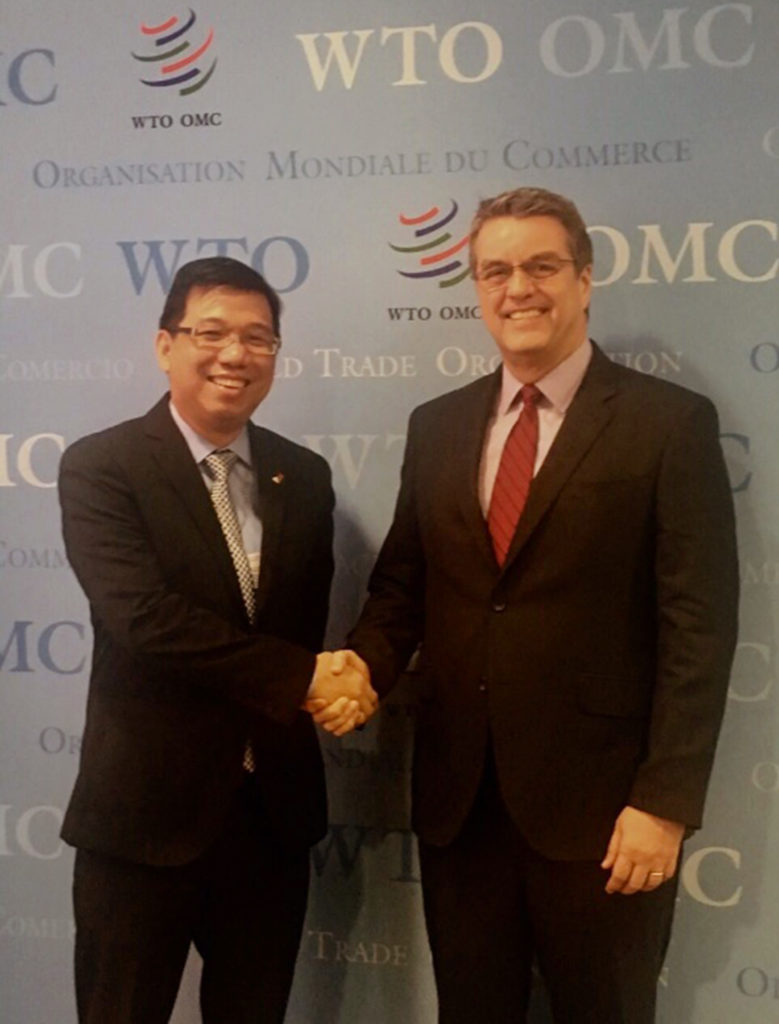
Photo taken March 29, 2018 – At the sidelines of the PH’ TPR, WTO Director General Roberto Azevedo (right) congratulates Philippines Head of Delegation, DTI Undersecretary Ceferino Rodolfo, for the country’s strong economic performance, sustained policy reforms, and valuable contribution as an active member of the WTO.
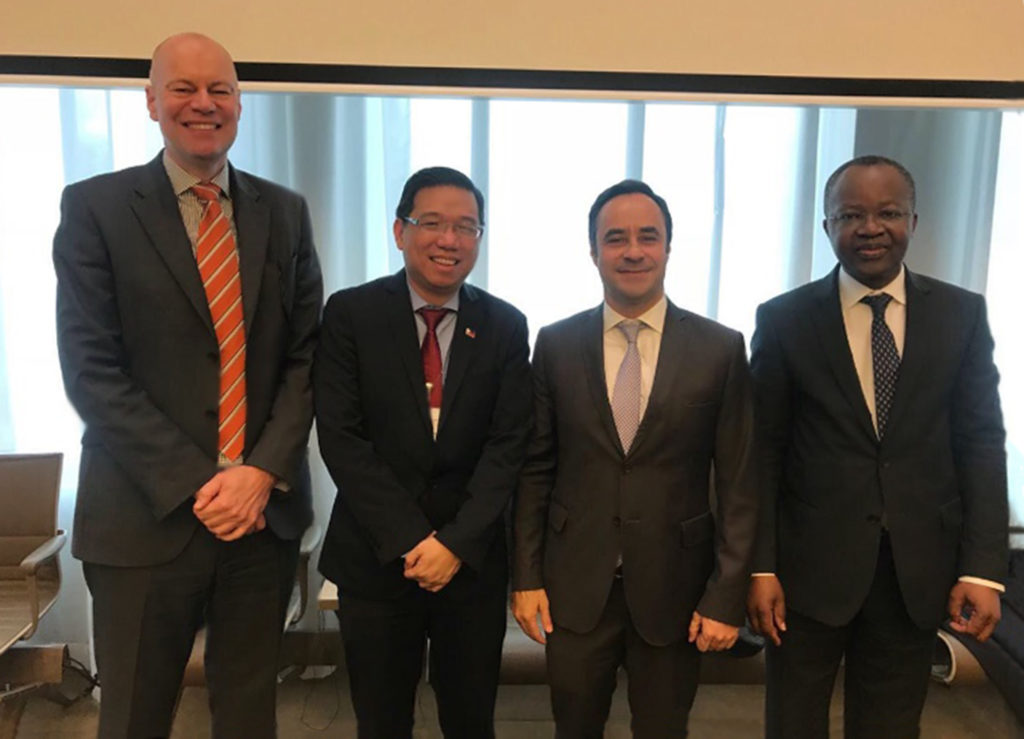
Photo taken March 29, 2018 – At the sidelines of the PH’ TPR, WTO Director General Roberto Azevedo (right) congratulates Philippines Head of Delegation, DTI Undersecretary Ceferino Rodolfo, for the country’s strong economic performance, sustained policy reforms, and valuable contribution as an active member of the WTO.
by admin | Mar 27, 2018 | Business, Headlines
MAKATI – In efforts to enhance trade and investment relations between the Philippines (PH) and Japan (JP), Department of Trade and Industry (DTI) Secretary Ramon Lopez together with officials of the Department of Finance (DOF) addressed the issues and clarified the concerns raised by Japanese investors on the Tax Reform Acceleration and Inclusion (TRAIN) Package 2, which rationalizes tax incentives to investments.
“We would like to highlight the aspects of TRAIN Package 2 that would benefit new and existing investors. While Japan is our number one source of investments, there are still a large number of Japanese investors who have not located in the Philippines. The TRAIN Package 2 provides us with the mechanisms both to encourage existing investors to further expand their business, and to attract new investors into the country,” said Sec. Lopez.
During the discussion, Japanese investors expressed their concerns on the new tax incentives for new and existing investors as well as the preferential corporate income tax.
According to Lopez, the proposed legislation is not meant to remove incentives, but in fact recognizes the important role of incentives and the need to make them more responsive, relevant and effective, i.e. they should conform to the principles of being performance-based, time-bound, focused, and transparent.
Board of Investments (BOI) Managing Head and DTI Undersecretary Ceferino Rodolfo explained further that the second tax reform package will in fact provide better incentives.
“First, investors will no longer be limited to just the Income Tax Holiday (ITH) and the 5% tax on Gross Income Earned (GIE)—but will now be able to choose other incentives that may be more relevant, including long enough Net Operating Loss Carry-over, accelerated depreciation, and double-deduction of certain expenses critical to upgrading competitiveness such as R&D, training, and others,” said Usec. Rodolfo.
“Equally important, the TRAIN Package will remove the nationality bias as well as the export bias of incentives. This means that as long as an activity is listed under the Strategic Investments Priorities Plan (SIPP), this will be eligible for incentives regardless of citizenship of owners or the markets they will serve. For Japanese companies, they can receive incentives even if they will sell to the domestic market,” Usec. Rodolfo added.
Meanwhile, DOF Director Juvy Danofrata noted the concerns of investors on the sunset provisions for existing tax incentives. Danofrata said, “While transition mechanisms will be provided including replacing the 5% GIE with a reduced 15% corporate net income tax, we are open to suggestions on how we can design better transitions, as long as these will comply with the basic principles of being time-bound, performance-based, focused, and transparent.”
The discussion was part of the agenda of the 10th Philippine-Japan Economic Partnership Agreement (PJEPA) Sub-Committee on the Improvement of Business Environment (SC-IBE) Meeting on 22 March co-chaired by Sec. Lopez and Japanese Ambassador Koji Haneda. Officials from the Philippine Board of Investments, Philippine Contractors Accreditation Board, Construction Industry Authority of the Philippines, National Economic Development Authority, Philippine Economic Zone Authority, Bangko Sentral ng Pilipinas, Department of Public Works and Highways, Department of Finance, Department of Labor and Employment, Manila International Airport Authority, Metro Manila Development Authority, Bureau of Internal Revenue, and Subic Bay Metropolitan Authority were also present during the meeting.
by admin | Mar 26, 2018 | Headlines
DTI Secretary Ramon M. Lopez, the Philippines’ Chief Negotiator at the WTO, announced that an inter-agency delegation headed by DTI Undersecretary Ceferino S. Rodolfo will appear before the World Trade Organization (WTO) Trade Policy Review Body in Geneva, Switzerland on 26 and 28 March 2018 for the Philippines Fifth Trade Policy Review.
Undersecretary Rodolfo will be joined by senior officials of the Departments of Trade and Industry, Agriculture, Foreign Affairs, Finance, Labor, Board of Investments, National Food Authority, Food and Drug Administration, Intellectual Property Office and the Government Procurement and Policy, as well as officers of the Philippine Mission to the WTO.
The WTO, of which the Philippines has been a member since 1995, conducts individual trade policy reviews, an exercise in which member countries’ trade and related policies are examined and evaluated at regular intervals. For developing countries like the Philippines, the review is conducted once every six years. Substantial developments that may have an impact on the global trading system are also monitored. The last Philippine review was conducted in 2012.
According to Secretary Lopez, “This fifth trade policy review will be an opportunity not only to highlight the country’s impressive economic growth but also to share critical policy reforms and aggressive infrastructure program being undertaken by the Duterte Administration. It also signals that the Philippine government is actively engaging the international community, self-confident in the policies we are implementing.”
The meeting in Geneva will be a culmination of an intensive process that began last year with the preparation of a Report on Philippine Trade Policy by the WTO Secretariat, which was supplemented by a counterpart Philippine Government Report submitted in December 2017.
Ahead of the meeting in Geneva, 22 countries (including US, China) have submitted questions covering a wide range of trade and economic issues such as the developments in the Philippines’ tariff structure, restrictions on investments, import licensing requirements and the rice tariffication process. Some questions which were not directly related to trade were also received, such as on gender equality and visa availments.
“The review process, while allowing other WTO Members to seek clarification on our domestic policies, presented a good opportunity for national agencies to reflect internally on our trade and investment regime in the context of our commitment to the WTO and more importantly our greater objective to make trade more inclusive so that, as President Rodrigo Duterte has clearly and repeatedly articulated, no one is left behind.” Undersecretary Rodolfo concluded. END
2
US-GSP for Philippines approved for 3 years
Washington, D.C.—The United States Generalized System of Preferences (GSP) was reauthorized on 23 March 2018, after President Donald J. Trump signed the Omnibus Spending Bill which included GSP renewal language.
The renewal authorizes the GSP through 31 December 2020 and includes a mechanism that refunds tariffs paid from 01 January 2018 through the reinstatement date of the program. In addition, USTR will be required to submit an annual report to the relevant congressional trade committees on Beneficiaries’ compliance with country-eligibility criteria.
Trade Secretary Ramon M. Lopez welcomed the reauthorization of the US GSP. “We wish to thank the US Government for the timely renewal of the GSP program, as Philippine exporters will continue to benefit from enhanced market access to the United States under GSP”.
The GSP program covers a total 5,057 products or tariff lines or roughly 47.7% of the 10,600 total US tariff lines: 3,500 of which are open for all Beneficiary Developing Countries (BDC) while an additional 1,500 products are given to the Least-Developed Beneficiary Developing Countries (LDBDC). Effective 1 July 2017, a total of 23 travel goods articles were added to the program.
Lopez said that the Philippines has enjoyed preferential duty-free entry to the US through the GSP program for a number of products. GSP exports account for 18% of Philippines exports to the US, valued at an estimated US$ 1.59 billion. Top GSP exports to the US include telescopic sights for rifles, spectacle lenses other than glass, new pneumatic radial tires of rubber, non-alcoholic beverages not including fruits and vegetables, and electrical machinery and equipment parts.
The recent approval of the GSP is a triple-win for developing countries, US companies, and American consumers, according to Sec. Lopez.
Meanwhile Trade policy Undersecretary Ceferino Rodolfo highlighted the importance of the US GSP in the face of a brewing trade clash among bigger countries. The Philippines utilizes all available tools to maintain—and even improve its preferential access to key markets. This is important not only in ensuring advantage for our exporters but equally critical, to heighten the Philippines’ advantage as location for manufacturing of these products.”
DTI officials cited that in the case of the US, in addition to the DTI’s advocacy for GSP market access, the Philippines stands ready to engage with US authorities to assist our exporters in the face of additional tariffs which the US may impose on certain products. “With respect to the US, the longer term goal is to negotiate and conclude a free trade agreement,” concludes Lopez. It will be recalled that in a recent testimony to the House Ways & Means Committee, US Trade Representative Ambassador Robert Lighthizer confirmed that US is considering an FTA with the Philippines.
by admin | Mar 22, 2018 | Headlines
The Department of Trade and Industry through its Center for International Trade Expositions and Missions (DTI‐CITEM) is keen on attracting more investments for the country’s booming energy sector through export promotion activities in the upcoming Hannover Messe to be held in Hannover, Germany, on April 23 to 27, 2018.
“We are elevating trade and investment promotion to a whole new level as we tap our partners for inclusive growth from the energy sector in a collective participation in this world’s most important industrial tradeshow and the largest capital goods exhibition in Germany,” said DTI Undersecretary for Trade and Investments Promotion Group (TIPG) Nora K. Terrado.
With the theme “Solutions for the New Era of Energy,” the energy sector of Hannover Messe 2018 will focus on innovative technologies for electric power systems to become more flexible, to intelligently connect sectors, and to engage new market participants amid an increasingly decentralized global energy chain.
Hannover Messe covers the world’s five industrial value‐adding chain under one roof, namely (1) energy; (2) integrated automation, motion and drivers (IAMD); (3) industrial supply; (4) research and technology; and (5) digital factory.
“As a global gathering of key industry players, Hannover Messe is the prime platform to drumbeat and build up investor confidence on the Philippines as a global powerhouse of renewable energy and other relevant technologies,” said Terrado.
In 2017, the Germany‐based event gathered 6,500 companies from over 70 nations and was attended by 225,000 visitors and trade buyers across the world, generating around 5.6 million partnerships, business models and other contacts.
Aside from renewable energy, the Philippines through DTI will also seek to secure investments for local stakeholders in energy efficiency, conservation, and transmission in the Philippines.
In preparation for Hannover Messe, Undersecretary Terrado said they are gathering a pool of 15 Philippine companies that represent the nation’s best foot forward in terms of energy systems, technology, services and other industrial goods.
“Through this synergy among stakeholders, we will be able to seal partnerships with foreign investors and mobilize much‐needed funding and infrastructure to our energy players,” explained Terrado.
“It will also give motivation to our local energy stakeholders to fast‐track efforts towards the mainstream use of renewable energy sources in the Philippines as more and more countries have started their industrial shift towards more sustainable power sources,” she added.
Business‐matching meetings between Philippine renewable energy companies to potential investors, technology adapters, developers, suppliers and other local energy stakeholders are also expected to take place in the international tradeshow.
PH shifts to renewable energy
Renewable energy is defined as energy generated from natural processes that are continuously replenished which includes biomass, geothermal, hydro, wind, solar and ocean energy under the PEP 2012‐2030.
It has been identified in the country’s Investment Priority Plan 2017‐2019 as an emerging sector that needs government intervention particularly in export promotion.
Based on a DOE’s Philippine Power Situation Report, the country’s total power capacity in 2016 is at 53.16 million tons of oil equivalent (MTOE) with renewable energy occupying the second largest share at 32.5%, only next to coal at 34.6%.
The top renewable energy sources in the Philippines are hydropower (16.9%) and geothermal (8.9%), followed by biomass, wind, and solar (6.6%).
Interested companies/exhibitor may contact Ms. Alex Lucas at 831-2137, or send an inquiry at alucas@citem.com.ph.

