by admin | Feb 2, 2018 | DTI Updates, National News

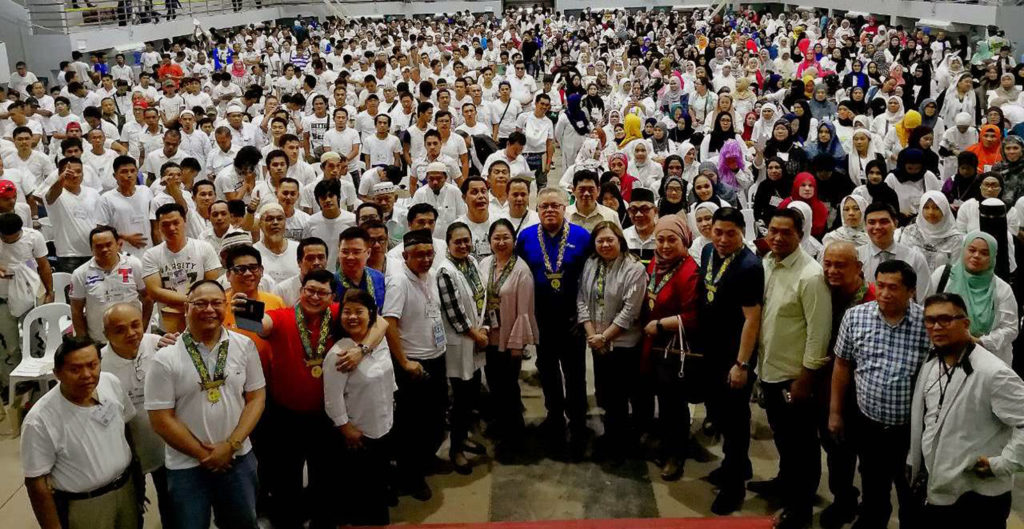
ILIGAN – The Department of Trade and Industry (DTI) awarded 1,500 livelihood packages as well as 0%-interest microfinance loans to the internally displaced people (IDP) of the Marawi siege during the DTI Negosyo Seminar Para sa Marawi on 30 January 2018.
“We want to assure the IDPs that President Duterte’s administration continues to provide more business and livelihood opportunities through the DTI Negosyo Seminars being given to help them recover soon,” said DTI Secretary Ramon Lopez.
There were 1,500 participants and beneficiaries who attended the Negosyo Seminar. One of them was Mr. Alikman Nata, who intends to share the benefits of the livelihood package to his group, the Lanao Muslim Youth Association.
As the head of Bangon Marawi’s Subcommittee in Business and Livelihood, DTI had earlier distributed 588 livelihood packages and conducted Negosyo trainings to 1,963 IDPs as of December 2017. There were also 240 beneficiaries who were linked to financial institutions.
The Department also allocated Php 50 million this year to fund the Shared Service Facilities (SSF), providing Maranao entrepreneurs with facilities and knowledge that match their business needs. This is apart from the budget provision to support other Bangon Marawi programs in providing mobile rice mills, tricycles, vehicles, and the construction of public markets.
DTI flew in different business experts to teach business preparedness, opportunities spotting, product development and marketing, financial literacy, and franchising.
by admin | Feb 1, 2018 | DTI Updates, Headlines

Makati City, Philippines – The Department of Trade and Industry (DTI), through the Construction Industry Authority of the Philippines – Philippine Overseas Construction Board (CIAP-POCB), and the Board of Investments, with the Commercial Section of the Philippine Embassy in Seoul, Korea received a delegation of twelve (12) Korean companies on 29 to 30 January 2018.
The Business Forum held on 30 January 2018 at the Sofitel Philippine Plaza gathered over a hundred distinguished government representatives and movers in the construction, infrastructure, and energy industries, led by DTI Undersecretary for Competitiveness and Ease of Doing Business Rowel S. Barba, Philippine Ambassador to Korea Raul Hernandez, ASEAN-Korea Center Secretary General Ambassador Young-sun Kim, and Republic of Korea Ambassador to the Philippines Dong Han Man.
Presenting opportunities in the Philippines were Board of Investments Director Angelica Cayas on Investments and Build Build Build Committee Chairman Anna Mae Lamentillo and PPP Director Frances Yani Domingo on the Philippine Government’s infrastructure projects. International Contractors Association of Korea (ICAK) Deputy General Tae-wan Kim and counterpart Philippine Overseas Construction Board Member Mr. Michael Robert Reyes were also in attendance. CIAP, though the POCB, endeavors to cultivate strategic ties with South Korea with the end in view of developing the construction industry of both nations.
One-on-One Business Meetings between Korean and Filipino companies followed the forum to discuss areas of collaboration on infrastructure, energy, and construction, both in the Philippines and in Korea.
Over dinner of Pampango cuisine, the Philippine Contractors Accreditation Board (PCAB), one of five implementing boards of the Construction Industry Authority of the Philippines, discussed the licensing and accreditation process for foreign construction companies under the Quadruple A category which allow firms with 100% foreign equity to participate in infrastructure projects in the Philippines. PCAB also discussed how South Korean firms may acquire a special license for singular/specific projects through consortium or joint venture with Filipino companies.
With the recently approved Quadruple A category of PCAB, the agency expects a surge in foreign investments in construction and infrastructure. Construction investments for the first to third quarter of 2017, amounted to PHP627.4B or USD12.5B, a 6.8% increase compared to the same period in 2016. Of this, 25.9% is attributed to Government infrastructure spending equivalent to PHP162.7B or USD3.3B and 74.1% or PHP464.7B(USD9.3B) from private construction activities. Government construction activities increased by 10.0% while private construction activities increased by 5.8% compared to same period in 2016.
by admin | Jan 30, 2018 | Photo Story
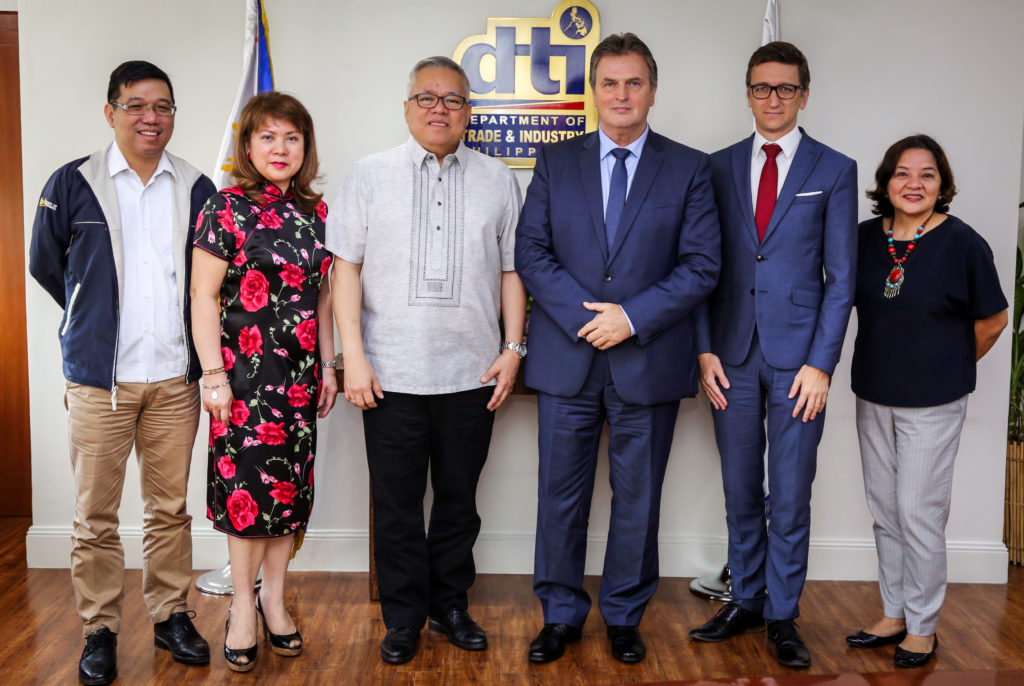
29 January 2018 Manila – The Ambassador of Hungary H.E. Dr. József Bencze, with Hungarian Deputy Chief of Mission Dávid Ambrus, paid Department of Trade and Industry Secretary Ramon M. Lopez, a courtesy visit on January 29, 2018 to discuss the Philippines’ delegation to the upcoming Hungary Roadshow in 2018. In photo L to R: DTI’s Industry Development and Trade Policy Group Undersecretary Ceferino S. Rodolfo, DTI Trade and Investments Promotion Group Assistant Secretary Rosvi Gaetos, Trade Chief Ramon Lopez, Amb. József Bencze, Dep. Chief of Mission Dávid Ambrus and Board of Investments Director Angelica M. Cayas.
by admin | Jan 29, 2018 | Business, Headlines
The Philippine Trade Training Center (PTTC) and Hinrich Foundation, in collaboration with partner-organizations, the Export Marketing Bureau (EMB), German Philippine Chamber of Commerce and Industry (GPCCI/ AHK Philippinen) and the Trade Capability Development Services (TCDSI Inc.) representing Liezpig University – presented the Export Manager Advanced Training (EMAT) Program during an Orientation Briefing attended by twenty-two (22) exporting companies held at the PTTC on January 16, 2018.
EMAT Program is a professional short course developed by Leipzig University, one of the world’s oldest universities and the second-oldest university (by consecutive years of existence) in Germany and the Hinrich Foundation, an independent charitable foundation which promotes economic prosperity and peace, to enable small and medium Asian enterprises (SMEs) to compete in the global market.
The pilot run of EMAT program in the Philippines will be held on 16-18 February 2018 which discusses International Markets and Value Proposition. The next session, focusing on Market Entry Strategies, will be held on 9-13 March 2018.
Participants of the program will earn 5 credit units for Leipzig University’s MBA program and are expected to gain results-focused insights that will enable them to compete in the international arena. Participants who complete the course will also receive a Certificate of Completion from Leipzig University, a Certificate of Attendance validated by GPCCI/ AHK Philippinen, and a Certificate of Achievement from the ITC SME Trade Academy based in Geneva.
The regular course fee of Php40,000.00 with a 75% scholarship borne by private and government institutions, is reduced to Php10,000.00 registration fee per participant for the entire eight-day’s session staggered in two schedules inclusive of in-class lectures, online learning modules, and one-on-one business coaching, course materials, meals, networking cocktails and certificates.
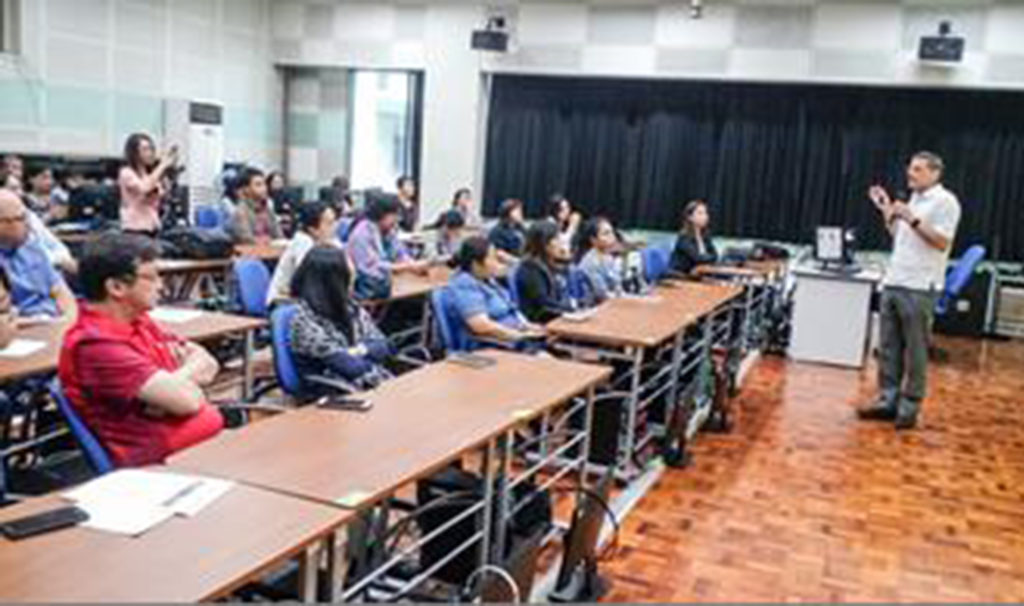
Mr. Alex Boome, Program Director of Hinrich Foundation, during the orientation on EMAT.
by admin | Jan 26, 2018 | ASEAN agenda, Business, Headlines
NEW DELHI – Department of Trade and Industry (DTI) Secretary Ramon Lopez encouraged Indian businessmen and delegates from the Association of Southeast Asian Nations (ASEAN) to ride on the ongoing Philippine (PH) growth story.
During the PH-India Business Forum on 24 January 2018, the country’s trade chief presented Dutertenomics — the socioeconomic policies of President Rodrigo Duterte—to encourage investors to partner with PH, which will help in creating additional value for their businesses and boost income-generation operations.
“The initiatives under Dutertenomics can help support investors by creating an environment where companies can do business swiftly and efficiently,” said Sec. Lopez, stressing that ongoing infrastructure projects strategically link the country’s industries. These, in turn, will further power the growth of an already strong economic base.
“Our ‘Build Build Build’ infrastructure program will facilitate greater trade and investment as it opens up access to new markets, while minimizing trade and logistics cost,” he added.
Under Dutertenomics, the government’s massive ‘Build Build Build’ program aims to develop massive and efficient infrastructure projects to create more opportunities in the countryside by developing more regional growth centers.
The trade chief also highlighted DTI’s Trabaho, Negosyo, Kabuhayan, at Konsyumer initiative as well as the inclusive, innovation-led, industrial strategy (i3s) as support for the socioeconomic agenda of President Duterte. The i3s complements the government’s thrust to promote an innovation ecosystem in PH, with different sectors partnering to generate more jobs and improved business opportunities. This sets up the environment for MSMEs to grow, with full assistance in training, product and market development, equipment and financing from government.
With the significant growth of 6.9% in the country’s GDP and 39% growth in the Board of Investments (BOI) approved investments, Sec. Lopez urged investors to take part in the country’s economic growth.
According to the trade chief, investors can fully recoup their investments as their businesses enjoy the benefits of operating in a fully-industrialized and secure business environment. They can also enjoy PH’s stable macroeconomic fundamentals, the educated English-speaking workforce, the demographic sweet spot that presents an enlarging consumer base, and wider market access thru preferential trade agreements.
Sec. Lopez shared that the Philippines’ greatest asset is its people, highlighting the large pool of highly qualified and educated work force that is strongly customer-oriented, highly trainable with fast learning curve, adaptable to universal cultures and with high level of commitment and loyalty.
“The hallmark of Dutertenomics is to attain growth with equity. That is, addressing inequality while reducing poverty across the regions towards improved quality of life for all,” he added.
Sec. Lopez also shared the potential of the Regional Comprehensive Economic Partnership (RCEP) as key to opening a huge integrated market base of 3.5 billion with ASEAN, plus its six Dialogue Partners (India, South Korea, China, Japan, Australia and New Zealand).

