by admin | Dec 13, 2017 | Business, Headlines
The Department of Trade and Industry through its Export Marketing Bureau sees solid growth for Philippine merchandise exports this year as it continues to expand by 11.68% with total sales of $53.11 billion for the period January-October 2017 compared to the same period last year with total $47.55 billion of export sales.
For ten straight months, the value of merchandise exports in the review period was shared almost evenly by electronics and non-electronics at 50.78% and 49.22%, respectively.

In a preliminary report from the Philippine Statistics Authority (PSA), Year-On-Year (YOY) growth for October 2017 showed the country’s total export sales increased by 6.6% from $5.04 billion last year to $5.37 billion this year supported by the double-digit growths of six out of top ten major Philippine exports including fresh bananas.
Six gainers for October 2017 exports sales include gold (297%), electronic equipment and parts (43.3%), metal components (21.9%), fresh bananas (20.8%), other mineral products (19.6%), and electronic products (13.8%).
Receipts for top ten major exports for October 2017 reached $4.25 billion with a total share of 79.2% of the total export receipts. Electronic products led the top ten commodities with total export sales of $2.86 billion, accounting for 53.2% of the total exports revenue for the month of October 2017.
“Export sector is a big employment generator and we welcome these positive developments as this will translate to more job opportunities,” said DTI Undersecretary for Trade and Investments Promotion Group Nora K. Terrado.
Japan remains as the top export destination for October 2017 with total exports receipt of $871.36 million and a share of 16.2% in total exports.
“Japan is a significant trading partner for the Philippines. We are maximizing good relations that we have with them by introducing and increasing awareness of various design-driven products and services that we can export. We are also seeking new markets while we continue to expand our exports to existing trading partners. DTI continues to apply new approaches and strategies based on trends and changing consumer landscape,” explained Terrado.
Meanwhile, the leading destination of PH merchandise exports for the first ten months of the year was still the combined markets of PROC (China) and HK SAR (Hong Kong). Shipments to this combined markets, with a share of 24.31%, increased by 22.10% in value.
By regional bloc, East Asia remains the top regional export destination for Philippine merchandise exports comprising for 51% share in total exports sales while ASEAN ranked second with 16% share for the month of October 2017. Exports to European Union remain rosy with total sales of $677.94, an increase from $549.20 million in October 2016.
Recently, DTI unveiled the Inclusive Innovation Industrial Strategy or i3s that aims to grow and develop globally competitive and innovative industries. With this, DTI aims to increase production capacity of the country’s industries as well as introduce and develop innovative and creative products and services viable for exports.
by admin | Dec 11, 2017 | National News
11th World Trade Organization (WTO) Ministerial Conference (MC)
Buenos Aires, Argentina
10 December 017
Pre-Ministerial Conference Statement of DTI Secretary Ramon M. Lopez
Chief Negotiator in the WTO and Head of Philippine Delegation in Buenos Aires
The Philippines has benefited from globalization, in particular from the WTO. We have been growing at the fastest rate for the past five years and globally-linked, modern sectors such as BPOs and IT-enabled services, semiconductors and electronics, parts manufacturing for GVCs in auto & aerospace, and shipbuilding (among others) have been major contributors.
Our goal in globalization is not only for the Philippines to grow, but for EACH and EVERY Filipino to participate in (and not just benefit from) economic development. We cannot rely on growth to trickle down; the marginalized should be active participants in economic activities at the outset. Poverty in the Philippines has a sectoral and geographic dimension. One-third (1/3) of rural Filipinos are poor, compared with one-tenth (1/10th) among those living in urban areas. In addition, while more than 99%of our enterprises belong to the Micro and Small categories; they account for only about 35% of total production.
These domestic realities set our Mission’s priorities at the WTO Ministerial Conference (MC) 11—Agriculture and MSMEs. Our international engagements—whether as active participants, or as host and Chair—have all been pursued as an extension of our domestic priorities. Our domestic priorities determine our international agenda and position. In the APEC Summit in Da Nang (Vietnam), President Rodrigo Duterte elevated our domestic focus on Inclusive Growth and Inclusive Business to Inclusive Regional Cooperation. At the ASEAN, our Chairmanship pushed for Inclusive Regional Integration. At the WTO MC 11, we will argue for Inclusive Globalization.
Hence, in Buenos Aires, Philippines’ continuing priorities are, first, the substantial reduction and/or elimination of trade-distorting domestic support by developed countries and developing countries which retain domestic support entitlements as well as the elimination of all forms of export subsidies; second, the improvement of disciplines to protect the domestic agricultural sector through a Special Safeguard Mechanism for agriculture; and third, outcomes that will lead to greater participation in international trade for Micro Small and Medium Enterprises (MSMEs), particularly those based in developing countries.
Why is SSM a Philippine priority in MC11? SSM would allow developing countries to temporarily increase tariffs on agriculture products in cases of import surges or price declines. It prevents irreversible injury to very vulnerable farmers against price volatility. It also serves to balance large subsidies given to agricultural products in rich countries.
In addition, the Philippines places great importance on the role of MSMEs in promoting inclusive growth. However, we believe that even among MSMEs, competition needs to be fair among them—as what may be medium-sized enterprises in a developed country, may already by a large company in a developing country. Thus we are pushing for a discussion on a comparable definition of MSMEs. But even among similarly-sized MSMEs—support system and resources vary from country to country. And, hence, the development level of countries should be considered.
Lastly, in MC 11, the Philippines will argue for the Doha Development Agenda (DDA) to remain as the overall framework for WTO negotiations. The Ministerial Declaration in Doha (2001) recognized that “trade can play a major role in the promotion of economic development and the alleviation of poverty.” In particular, the DDA highlights the need to provide a discipline on the subsidies being given by developed countries to their agriculture; and provide more effective temporary protection from price volatilities to poor, vulnerable farmers.
In summary, the Philippines’ priorities for MC11 are: 1) eliminate trade-distorting domestic support and export subsidies; 2) SSM for agriculture; and 3) a Ministerial decision on an MSME work programme that considers development levels. In addressing these, we will continue to uphold the DDA.
It is time for WTO to deliver on its promise. It should implement a globalization framework that is truly developmental and where no one is left behind.
DA Secretary Emmanuel Piñol will be the co-lead of the PH Delegation in Buenos Aires on 11-13 December 2017. The group includes the representatives of DTI, DA, DFA, NEDA, Tariff Commission, NFA, IPO, PRC, Philippine Mission to the WTO, Philippine Embassy in Buenos Aires and Senate of the Philippines.
MC11 will gather trade ministers, foreign ministers and high-level representatives from the WTO’s 164 member countries. A total of 4,000 delegates are expected to attend. A number of non-governmental civil society organizations (CSOs) and groups will be attending the event as observers. Meetings with Philippine-based CSOs will be arranged in Buenos Aires.
by admin | Dec 11, 2017 | DTI Updates, Headlines
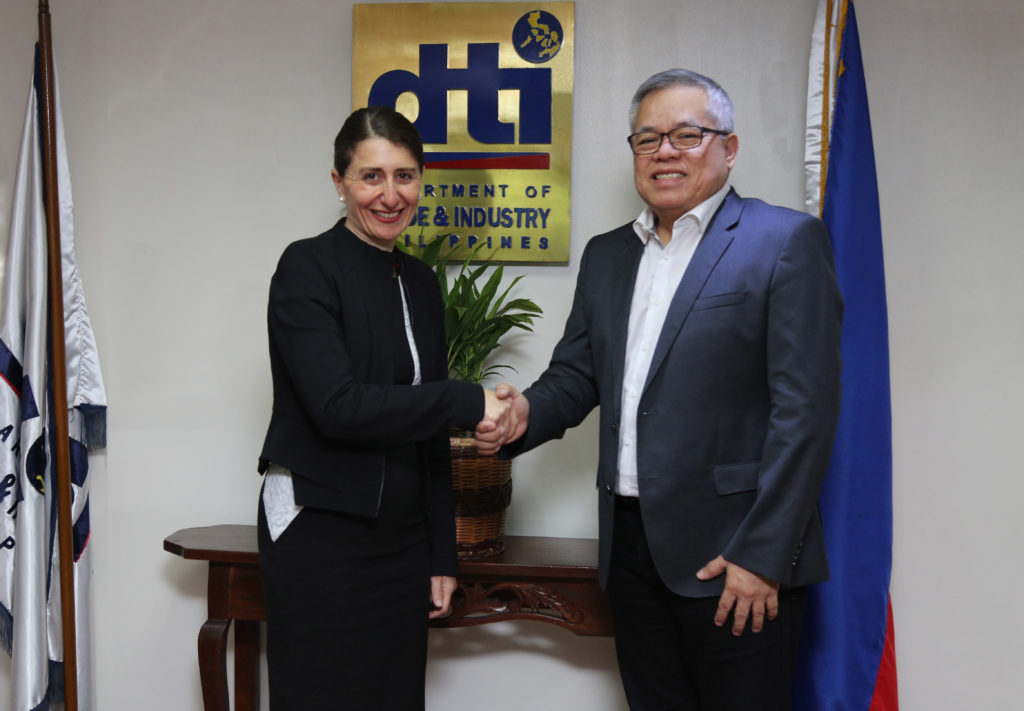
Makati – The government of New South Wales (NSW) expressed its confidence in the Philippine (PH) economy and wants to explore strengthened trade and investment cooperation ties between PH and NSW.
In a meeting with Department of Trade and Industry (DTI) Secretary Ramon Lopez on 7 December 2017, NSW Premier Gladys Berejiklian conveyed their government’s intention to enhance their relationship with PH.
A state located on the east coast of Australia, NSW imports telecommunication equipment and parts, passenger motor vehicles, medicaments, refined petroleum, and computers.
“We welcome Australian investors and businesses that will help us uplift the lives of those at bottom of the pyramid and enable the Philippines to contribute in the global value chain. New South Wales has expressed strong confidence in our economy and the business environment stability under the Duterte Administration and wish to partner with us,” said Sec. Lopez.
The trade chief highlighted the growing manufacturing sector and encouraged NSW to partner with PH in research and development. The trade chief also shared the PH government’s initiatives in streamlining and automating services to improve doing business in the country.
“We will continue to work on opening areas of investment and increase employment and business opportunities for all Filipinos,” Sec. Lopez added.
Meanwhile, Premier Berejiklian shared that many Australian businesses, especially in the Information and Communication Technology (ICT) sector, are attracted to PH’s encouraging economic state and enormous potential. Apart from the impressive 6.9% GDP growth, the NSW premier highlighted the good traits of Filipino workforce and the work culture they have.
With infrastructure-related construction as one of the priority areas for expansion of NSW, Premier Berejiklian also opened the discussion on a possible partnership through the sharing of expertise and technological know-how in the industry
by admin | Dec 9, 2017 | Headlines, Local News / Bohol Balita, Police Reports
TAGBILARAN CITY, December 8 (PIA)–Bohol Police Provincial Office reports a 52% dip in violence against women and children (VAWC) from January to November in 2017.
The downtrend is already considered huge accomplishment and records would also show that in 2016, VAWC cases reached 165 cases, according to a report read by Police Senior Inspector Nida Perocho.
Perocho, who came to the Kapihan sa PIA bringing a summative report on the vawc cases in Bohol also clarified that the cases in their records at Camp Dagohoy reflect only those getting into town blotters that prospered into legal suits.
As to the development, authorities continue to urge women and girls who might be victims of physical, sexual, emotional and psychological or economic abuse to come out where help is available.
It would only be when they come out from hiding that they can be helped, emphasizes Inspector Perocho.
And coming out may mean getting these cases known by legal suits.
One thing good about reporting these cases of abuse is that the perpetrators would have something to think about before committing another atrocity as he can really get to jail, added social worker Desiree Faith Lingo, at the radio forum.
By reporting and filing suits however, many women and girls fear they have nowhere to go.
A facility called Bohol Crisis Intervention Center here responds exactly to cases like that, volunteers BCIC’s Donna Belle Mante.
BCIC is designed as a temporary shelter and safe house for women and children who are victims of violence, where victims get to a support group, avail of stress debriefing, medical, legal and other services from the government while their cases are considered inc ourts.
Among the advocacies adopted for the national observance of the 18 day campaign to end violence against women set November 28-December 12 is the Kapihan sa PIA in Bohol.
Topping crimes which were elevated to the courts were physical abuse which reached 20 cases, psychological abuse at 14, economic abuse at 14 and rape at 5.
Acts of lasciviousness cases reached 4, sexual harassment and incestuous rape each had 2 cases while a single case of bigamy and violation of personal protection order reached Camp Dagohoy.
A high case count of rape in the cases filed was affected by a case where there were 19 counts of rape filed to a perpetrator of a single victim, Inspector Perocho detailed.
As to the decrease, BCIC, a temporary shelter for women and children operated by the Provincial Government said that it entails two considerations.
An increase in cases may mean more and more people know that they can report these to authorities, while a decrease can really mean such, social worker Donna Belle Mante said.
Mante, who sits among the key authorities at the BCIC said since their establishment in 2002, their occupancy rate has always been averaging 30 sheltered victims.
BCIC has now been tagged as a safe house for women and girl victims of gender based abuses, Mante said. (rahc/PIA-7/Bohol)
by admin | Dec 8, 2017 | Headlines, Photo Story

PH gains membership in Int’l Halal Accreditation Forum. Positive developments await for the Philippine Halal industry as the Philippine Accreditation Bureau (PAB) of the Department of Trade and Industry (DTI) formally signed on 6 December 2017 a full membership agreement with the International Halal Accreditation Forum (IHAF). Being a full member of the IHAF gives DTI-PAB voting rights at the General Assembly and committee meetings that could be highly beneficial to Philippine Halal industry. This membership is also seen to further Halal trade between the Philippines and other IHAF member countries. The IHAF is an independent, non-government network of accreditation entities mandated to enforce Halal standards in their respective countries and regions. Empowered by its mandate to protect the growing number of Halal consumers and to facilitate international trade, IHAF establishes a solid ground for the global industry of Halal food and non-food products. In photo is DTI Undersecretary for Trade and Investments Promotion Group Nora K. Terrado (left) with International Halal Accreditation Forum Secretary General Mohamed S. Badri (right) during a courtesy call held at the DTI International Building, Makati City on 7 December 2017.

