by admin | Dec 7, 2017 | DTI Updates, Headlines
Micro entrepreneurs throughout the country will get more aid to fund their businesses as the National Government, through the Small Business Corporation (SB Corp.), the micro-financing arm of the Department of Trade and Industry (DTI), will set aside P1 billion for year 2018 to continue the flagship program that will provide micro enterprises an alternative source of financing that is easy to access and made available at a reasonable cost.
“The President has vowed to provide affordable micro-loans for micro entrepreneurs and we are here to deliver this promise through the Pondo sa Pagbabago at Pag-asenso (P3),” DTI-Regional Operations Group Undersecretary Zenaida Maglaya said.
The Pondo sa Pagbabago at Pag-asenso (P3) program is a P1 billion financing program intended to give MSMEs better access to finance and to reduce their cost of borrowing and battle loan sharks preying on micro entrepreneurs. The fund will also give priority to the country’s 30 poorest provinces.
Initially, the P3 Program was launched in Tacloban in Leyte on January 25, San Jose, Occidental Mindoro on January 27, and Alabel, Sarangani last January 30 and was launched nationwide in April, with an initial funding of P850.0 million, making available lower cost loans to Filipino micro entrepreneurs who are engaged in small business such as sari-sari stores and are vulnerable to usurious lenders in the absence of an alternative source.
Maglaya explained that through the P3, micro entrepreneurs can find relief from overly expensive borrowings and afford cost-efficient and affordable form of loan to add and expand their businesses.
“Through the P3, sectors can find relief from overly expensive borrowings as they pursue their livelihood activities,” Maglaya said.
As of November 24, 2017, a total of 16,210 micro entrepreneurs have been aided by P3 with four national micro finance institutions (MFIs) and 90 local conduits assisting in delivering the micro-loans in the countryside while 45 MFIs are in the pipeline. A total of P485.41 million has been released to partner conduits and P307.80 million released to microfinance borrowers.
Following President Rodrigo Duterte’s directive to replace the “5-6” money lending system, the P3 is also seen to help stabilize supply and cost of commodities in public markets, encourage small entrepreneurs to grow their businesses, and offer employment and generate income for Filipinos.
The P1 billion fund of the P3 program from the Office of the President will be coursed through the SB Corp., which will accredit partner institutions such as non-bank MFIs, cooperatives and associations to serve as conduit for the P3 funds. With borrowers identified through these, collection of repayments will be efficient.
“We’re very grateful that this program has come into fruition, so we can help micro entrepreneurs who are at the bottom of the pyramid and create an entrepreneurial environment in the countryside that will also generate jobs for Filipinos,” Maglaya said.
The primary beneficiaries of the P3 Program are microenterprises and entrepreneurs that do not have easy access to credit. These include market vendors, agri-businessmen and members of cooperatives, and industry associations.
P3 will also make it easy for borrowers since it will only require minimal documentation requirement; easy to access with only one (1) day processing of application; low cost interest at 2.5% per month; and easy payment with collection on a weekly or daily basis, as necessary.
Under the P3 Program, a micro enterprise can borrow between P5,000 up to P100,000 depending on its business need and repayment capacity with no collateral requirement. Interest rate and service fees, all in, do not exceed 2.5% monthly, which is a huge relief from the 20% monthly rate under the 5-6 loan system
by admin | Dec 6, 2017 | DTI Updates, National News
The Department of Trade and Industry (DTI) will continue to provide equipment sharing facilities for micro, small and medium enterprises (MSMEs) as part of the agency’s drive to contribute in the administration’s Trabaho at Negosyo agenda.
“For us to contribute in providing jobs, encourage Filipinos to do business and spur economic activity in the countryside, we will provide more Shared Service Facilities (SSFs) to help MSMEs produce fast and efficient products that are proudly Filipino-made and export quality,” DTI Undersecretary Zenaida Maglaya said during the Shared Service Facilities (SSF) Project Summit on December 5, 2017.

The SSF Project is DTI’s program that provides MSMEs access to technology, machinery, equipment, tools, systems, skills and knowledge under a shared system. With access to better technology and more sophisticated equipment, MSMEs will have higher productivity, better and efficient products, higher levels of innovation and creativity, and improved market access to address the gaps and bottle necks in the global value chain being faced by MSMEs.
The equipment-sharing program also increases capabilities of both manufacturing and agriculture-based MSMEs to enable them to develop capacity and a culture of quality.
“The key to inclusive growth is our MSMEs. With the shared service facility, MSME cooperatives and entrepreneurs are provided with sophisticated equipment and machinery that will double their production and help them come up with export-ready products,” Maglaya explained.
As of October 31, 2017, DTI has provided MSMEs with 2,222 SSFs worth P1.188 billion throughout the country, benefitting 215,628 existing and potential MSMEs and has provided 111,747 jobs to Filipinos. SSF beneficiaries include cooperatives, associations or groups of MSMEs including MSMEs or individual entrepreneurs.
As backbone of the Philippine economic growth, MSMEs has since become a major priority of President Rodrigo Duterte, with DTI placing the sector’s development at the front and center of its Employment and Entrepreneurship (Trabaho at Negosyo) agenda.
Maglaya also emphasized that “aside from keeping the country moving towards a more strategic direction at the backdrop of regional development, the government vows to sustain meaningful growth that is truly inclusive—the one that reaches the bottom of the pyramid.”
Also under the SSF Project, DTI also established Fabrication Laboratories throughout the country which aims to enhance the core competencies of existing manufacturers and emerging entrepreneurs in digitally-enabled manufacturing workflows guided by art and design principles.
Through the Fabrication Laboratory, MSMEs, aspiring entrepreneurs and students are provided with innovation, prototyping technologies and software for their products and design.
Currently, there are 12 Fabrication Laboratories in the country operated by schools, institutions or centers. The Fablabs are located and cooperated by the Bohol State University in Bohol; Philippine Science Highschool Central Luzon Angeles City, Pampanga; Local Government Unit in Santiago City, Isabela; Don Honorio Ventura Technological State University in Bacolor, Pampanga; Philippine Science Highschool – Ilocos Region Campus San Ildefonso, Ilocos Sur; University of the Philippines (UP) Cebu City; Bicol University, Legaspi City Albay; Mindanao State University – Iligan Institute of Technology Iligan City; Philippine Footwear Federation, Inc. Marikina City; University of the Philippines College of Fine Arts, Diliman, Quezon City; Zamboanga Polytechnic College; and Mindanao Trade Expo Foundation, Davao City.
The SSF Program is part of the Philippine MSME Development Plan to encourage the graduation of MSMEs to the next level where they could tap a better and wider market share and be integrated in the global supply chain.
“We will continue to push significant interventions to support the growth of MSMEs and build a climate conducive to business and innovation. We will continue to provide the necessary services to help entrepreneurs thrive and even expand your businesses in an increasingly competitive market. We will continue to implement,” Maglaya said.
by admin | Dec 6, 2017 | Business, Headlines

MAKATI – The Philippines (PH) continues to receive business intentions and expansion projects from large companies based in China (CN).
In a recent meeting between Department of Trade and Industry (DTI) Secretary Ramon Lopez and Handi Group President Hanling Wu, they discussed possibility of investments of the company in a petroleum refining and petrochemical manufacturing facility in the country.
“We welcome business intentions to strengthen our petrochemical industry, which the government actively supports. They expressed strong confidence on the business environment stability during the Duterte administration,” said Sec. Lopez.
Handi Group is one of the largest and advanced private specialty oil producers in China. The conglomerate is based in Hainan Province and engages in multiple industries, including oil refinery, chemical industry, trading, investment, and financing.
The group, through its subsidiaries Hainan Handi Sunshine Petrochemical Co., Ltd. (HDS), Hainan Handi Petrochemical Co., Ltd. (HDP), Handi Lubricant Technology (China) Co., Ltd., Handi Sunshine Trading Co., Ltd., and Handi Investment, has established a full scale and long-term strategic cooperation with large international energy companies such as ExxonMobil, Total, Chevron, and BASF.
Sec. Lopez opened the discussion of putting up a facility in Mindanao, which will be suitable for the company’s power, land, and accessibility requirements.
Mr. Wu conveyed the need of Handi Group for a pool of technical staff, specifically engineers, from PH and the availability of talents in Mindanao.
“There are a lot of universities in Mindanao that produce quality graduates and professionals in the field of engineering. We have good universities present in all parts of PH,” the Sec Lopez said.
by admin | Dec 5, 2017 | Headlines, Photo Story
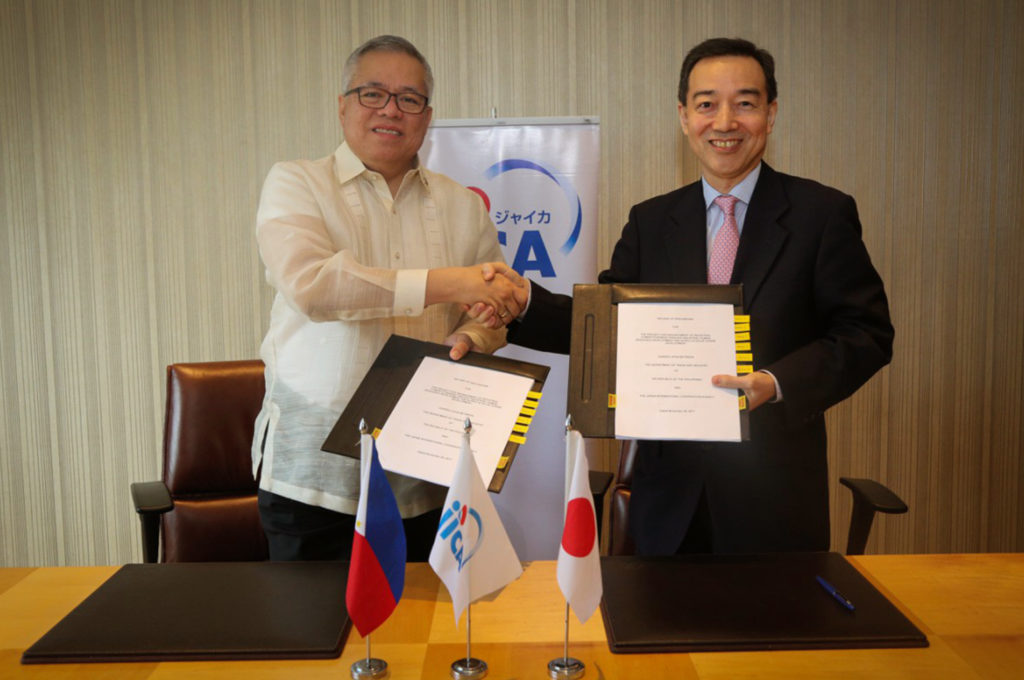
DTI, JICA COLLABORATE ON INDUSTRIAL COMPETITIVENESS PROJECTS. Department of Trade and Industry (DTI) Secretary Ramon Lopez (left) and Japan International Cooperation Agency – Philippines (JICA) Chief Representative Mr. Susumo Ito (right) recently (29 November) signed Records of Discussions for the Enhancement of Industrial Competitiveness through Industrial Human Resource Development (IHRD) and Supply & Value Chains Development (SVCD). The discussion records include agreements in the implementation of projects in industrial development planning and human capacity-building in the Philippines. These projects will push for the growth and development of the manufacturing sector, complimenting the global value chain development of the Philippine automotive industry via skill trainings and through the development of the Industrial Masterplan for Central Luzon and CALABARZON. Mr. Ito said the signing of the document is timely, given the recent holding of the Philippine Manufacturing Summit. He likewise cited the benefits of these projects, with a boost of potential income growth of Filipinos by 13 to 15 percent per capita.
by admin | Dec 4, 2017 | Business, National News
In partnership with the Department of Trade and Industry, Rustan’s Supercenter Inc opens its first Go Lokal! Store in Shopwise Araneta Center today,December 4, 2017 at 4:00 pm to 6:00 pm.
Go Lokal! is a retail concept store initiated by the DTI in collaboration with selected retail partners to showcase Philippine products of quality and unique designs, crafted and manufactured by the country’s MSMEs.
The Go Lokal!@ShopwiseAraneta will feature new blends and tastes of food products of selected Go Lokal! suppliers from various parts of the country in support of Shopwise’s “Flavor of the Philippines, a showcase of familiar native delicacies from the islands of Luzon, Visayas and Mindanao.
More Go Lokal! store outlets @Rustan’sMakati, @SMKultura Makati, @Glorietta2, @Robinson’sPlaceManila, @CityMalls nationwide, @EnchantedKingdom and the GoLokal!ConceptStore@DTI located at the groundfloor of the Trade and Industry Bldg., 361 Sen. Gil Puyat Avenue, Makati City.