by admin | Apr 7, 2019 | Local News / Bohol Balita
By JUNE S. BLANCO
DESIGN giant Arup, with 34 offices worldwide including in Manila, presented April 2 to the Department of Public Works and Highways (DPWH) Bohol 2nd District Engineering Office (DEO) in Ubay town its pre-feasibility study (FS) for the Bohol-Leyte Link Bridge (BLLB).
Rep. Erico Aristotle Aumentado who attended the presentation said once constructed, the “ambitious” bridge from Ubay via President Carlos P. Garcia to Maasin City in Southern Leyte will connect Bohol to the rest of the country by land.
Aumentado said the Asian Development Bank (ADB) funded the pre-FS, and a full-blown study will follow.
“The bridge is part of the dream of my father, [former] Gov. Erico Boyles Aumentado, to put Bohol among the fast developing provinces in the country today”, the solon said. The father is his immediate predecessor in the House of Representatives.
After the funding for pre-FS for the BLLB, Aumentado said up next will be the funding for the FS for Bohol-Cebu Friendship Bridge. He expressed gratitude to President Rodrigo Duterte for pushing these major projects for this province.
The BLLB is part of the Infrastructure Preparation and Innovation Facility (IPIF) for roads and bridges of DPWH.
On the other hand, Arup’s website states that the company has been working in the Philippines since 1986 – and established a permanent office in Manila in 1990. It provides total design services to meet the increasing demand for high quality, international standard projects for the country’s growing economy.
Among the prominent buildings it has designed are the Grand Hyatt Metrocenter, the tallest and biggest mixed-use development in the Philippines, and the St Francis Shangri-la Place, the world’s first building to adopt a damped-outrigger system – Arup’s patented viscous damping system.
Aumentado said the BLLB is planned to accommodate power cables as enticement to Bohol locators for the power generation industry.
Bohol should think of the next 10 to 25 years. The current “imported” power from Leyte will not be enough by then, hence two-way cables must be in place to bring power in and also out because Bohol may not use up all the additional generation right away. This way, the generation industry players here have the option to sell their “overproduction” to the national grid.
A stable power supply in place will also be attractive to Bohol locators who are in businesses other that power generation, Aumentado concluded.
by admin | Apr 6, 2019 | Headlines
Governor Edgar Chatto brings the issue of a tourism area’s carrying capacity anew as Bohol tourism stakeholders gathered for the Forum on Sustainable Tourism: Bridging the gaps between standards, legislation and practices, March 28 at the Reynas Garden, Tagbilaran City.
Carrying capacity, a critical consideration in sustainability, is the maximum number of individuals that can be accommodated in an area without significantly affecting the state of the environment, the level of the visitor’s satisfaction and the local culture.
According to former research and project officer of the Department of Tourism and a professor of the University of the Philippines Institute of Tourism Carlos Libosada Jr., the issue on carrying capacity can even be categorized into environmental and social.
Environmental carrying capacity takes into consideration the impacts tourism brings in an area and may include waste generation, food and water consumption as well as the physical effects of over presence of people in a hiking trail that could cause soil erosion.
Ever since Bohol started to be a known tourism destination, local leaders have been pressing for the agriculture sector to fill in the food production gap considering that, at present, tourism arrivals in Bohol has almost equaled the local population, while the local food production has since been insufficient.
Carrying capacity also considers the wildlife resources that may be affected by the huge groups coming in, like the tarsiers for example. Moreover, certain animals have adverse reactions to human presence, like in birdwatching sites.
On the other hand, social carrying capacity is the actual number of people who can truly enjoy a destination or activity, without having to be rushed because another big group is coming.
Considering the following and the technical know-how needed for the local government units so they can impose carrying capacity limitations in areas considered eco-cultural tourism, and the resources needed to generate these studies, Chatto shared an idea during the forum.
When carrying capacity studies entail huge resources which local governments may not necessarily have, the governor suggested that the DOT, Department of Environment and Natural Resources and the Department of Interior and Local Government to pilot select provinces and destinations and identify tourism areas needing the studies, so that the national government can fund the studies and hopefully present to local stakeholders the figures to maintain a sustainable destination.
Also among the gaps which the stakeholders discussed for potential solutions are the transport accreditation problems, hotel and restaurant accreditations, and tourism workers and stakeholder accreditation in line with the Tourism Code.
Also discussed during the forum was DENR programs on ecotourism and Protected Areas as well as Cave management, Transport Franchising programs, Environmental Laws and the compliance of tourism establishments and updates on maritime safety and Security Programs for Sustainable Tourism.
by admin | Apr 5, 2019 | Headlines
What could be the most salient point of the newly passed Universal Health Care Law (UHCL) which President Rodrigo Duterte signed not too long ago?
Asked this question, Philippine Health Insurance Corporation (PhilHealth) Visayas Vice President Lourdes Diocsonhinted the reorientation of the old health care system.
From the generally post confinement assistance, much of the new health care law steps towards a proactive primary health care system marks the biggest paradigm shifts in the Philippine public health system.
Speaking at the weekly Kapihansa PIA which is aired live over DyTR and on a delayed podcast from PIA Bohol twitter and facebook pages, Diocsonsummed the UHCL as a law that will now provide every Filipino the highest possible quality of health care that is accessible, efficient, equitably distributed, adequately funded, fairly financed, and appropriately used by an informed and empowered public.
This is based on the government mandate to ensure that every Filipino gets affordable and quality health benefits by providing adequate resources: health human resources, health facilities, and health financing, she explained.
As the UHCL expands the right to have access to a health care system that does not just work when one is confined at a health facility, it works not just in financing one’s health risks (which the PhilHealth provides) but also includes providing human health resources in the Department of Health’s (DOH) network of medical practitioners, pharmacies and medical professionals’ organizations to be contracted by the government as well as the string of health facilities and medical specialty institutions where consultations and laboratory tests may be free.
Here, as the new law automatically enrolls everyone eligible for the quality health care via the National Health Insurance Program (NHIP), access to quality hospitals and services is also assured, it also makes sure one is assigned to a primary health care provider.
This way, preventing from getting confined or getting sick is now given focus, unlike then when people only think of health care as a patient of on his way to a hospital or to discharge from confinement.
And as this entails financial risk protection, the government infuses funds to the NHIP via appropriation, revenues and shares from games and amusements and the sweepstakes, PhilHealth puts in two kinds of members: direct contributory members and those indirect contributory members, or those who do not have the capacity to pay but are subsidized by the government.
When you talk of health care before, the first thing that comes to your mind is, PhilHealth, now Philhealth shares the responsibility with the DOH, the Department of Education in educating members, the Department of Social Welfare and Development in determining the non contributory members, and the Department of Interior and Local Government, in the facilitation of the attainment of the country’s goals towards the achievement of the Millennium Development Goals, summed up Dina Cinchez, PhilHealth 7 Press Relations Officer at the Kapihan. (PIA-7/Bohol)
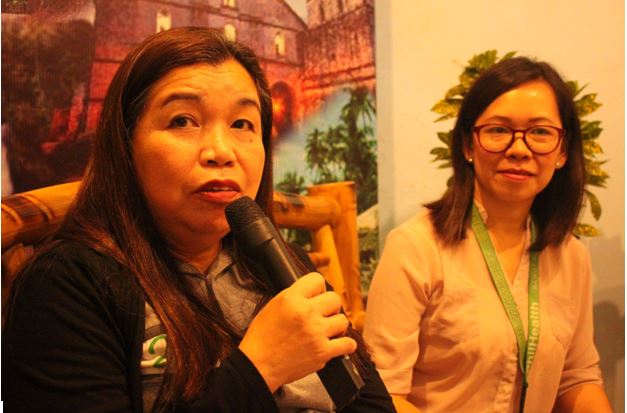
The Universal Health Care Law intends to shift the paradigms of health care in the country and focus on the proactive side of health than on the curative side, which may become too costly for the patient and his family, explains PhilHealthVisayas Vice President Lourdes Diocson at the Kapihansa PIA last week. With her is Philhealth 7 PRO Dina Cinchez. (rahc/PIA-7/Bohol)
by admin | Mar 16, 2019 | Headlines
The Department of Environment and Natural Resources in Region 7 shares the ultimate plan to deputize people in the communities to help enforce environmental laws especially on the Clean Water and the Ecological Solid Waste Management along the premise of better water quality and sustainable rivers in Bohol.
In the ongoing struggle to effect the necessary upgrade in the water quality of the Abatan River as the Provincial Environment and Natural Resources Office entry into the Rivers for Life 2019 award, DENR Regional Executive Director Gilbert Gonzales leaked the plan that would advance community and stakeholder empowerment in the environment advocacy.
Rivers for Life or Recognizing Individuals and Institutions towards Vibrant and Enhanced Rivers (RIVERS) for Life (RFL) Awards, is a regional and national competition among ten rivers in Central Visayas which the regional committee has picked owing to their being under the same category.
Ten Central Visayas rivers: Batuanon River in Mandaue, Bulacao River in Bulacao and Luyang River in Luyang Carmen, in Cebu, Abatan River in Cortes, Wahig River in Inabanga and Manaba River in Garcia Hernandez in Bohol, Banica River in Valencia, Panam-angan River in Bais and Sicopong River in Santa Catalina in Negros Oriental as well as Señora River in Siqiijor have shown their waters contain coliform contamination but these are below 100 most probable number.
The goal is for the stakeholders in the region to help work to upgrade the water quality of these rivers in six months to make them safe for swimming, explains Bohol PENRO Charlie Fabre.
And as Bohol prepares for the second round of river clean ups this Friday, March 22, 2019, over 600 volunteers then collected some 2.5 tons of garbage from the stretch of the Abatan River to its estuaries in Cortes.
About 10 private organizations have also signed a memorandum of agreement with the DENR formalizing the adoption of several portions of the river where the collected garbage could have come from.
But for the volunteers to come and clean up the river in regular intervals is not sustainable, so that the DENR sees deputizing communities to enforce environmental laws as a better alternative.
Out to realize what DENR Secretary Roy Cimatu committed during the River Summit that the country would clean up all its rivers, the DENR uses the water quality as a parameter in testing the environment.
“All barangays along these rivers will be trained and deputized to enforce all environmental laws, or those which are applicable to the river,” DENR -7 RED Gonzales told the media in a press conference at the MetroCenter Hotel.
The move, according to Gonzales is because sustaining the clean-up can be a lot easier if communities help in managing solid waste, regulate the control of effluent discharge, put up the necessary and appropriate treatment of household sewage and the preferential option for fertilers that are less destructive.
All of these however entail communities joining in the work as since the solid waste management has been devolved to local governments, several LGUs have failed to set up their own facilities that could contain all the garbage.
Here, LGUs may put up anti-single use plastic ordinances, but the communities, when deputized can be a very effective factor in the ban on indiscriminate throwing of solid wastes that would woon get to the rivers and then to the seas. (rahc/PIA-7/Bohol)

INVOLVING STAKEHOLDERS. DENR led the unveiling of the Adopt a River Program for Abatan where Cortes Mayor Ivenn Lynn Lim, RED Gonzales, Catigbian Mayor Virgilio Lurot, San Isidro mayor Jacnto Naraga, Calape mayor Nelso Yu and river community residents including private organizations adopting the river concretize the plan through an agreement. These people could soon be deputized to help enforce environmental laws. (rahc/PIA-7/Bohol)
by admin | Mar 15, 2019 | Headlines
In these times where information plays a critical role in disaster resilience, Tagbilaran City innovates with its unique integrated disaster and anti-crime reporting and monitoring system: enter the Communications Line for Emergency Alarms and Response System (CLEAR).
An information hub that banners a highly visible light emitting diode (LED) board that has the capacity to broadcast announcements and disaster mitigation tips, the CLEAR announcement board which is remotely controlled from the Tagbilaran City Disaster and Risk Reduction Management Office Command Center, can even remotely broadcast localized specific information, like localized disaster mitigation drills, explains City DRRMO chief Gerard Lavadia.
For high priority information, like possibly some evacuation or those needing community mobilization, the CLEAR board installation comes with a siren which can also broadcast loud audio warnings via a public address system and a highly visible flasher for maximum reach.
Things like barangay meetings, events, fire drills, earthquake drills and mass casualty incident simulations to better acquaint the communities of the simulations, these can be pre announced to douse out the panic that could result.
And each CLEAR hub also packs a host of high definition tilt-able closed circuit television cameras than remotely transmits real-time images to the command center.
The cameras can be zoomed and panned to follow through an action, a person in a crime situation and when it is stored in a huge databank or live feeds from nearly a hundred more remote cameras, there is a playback capacity for a better reckoning and crime reenactment to help police investigators determine culpability, Lavadia hinted during this month’s Association of United Development Information Officers (AUDIO) in Bohol on their famed Bisita Opisina into the city Hall’s CDRRMO.
And for emergency situations and where there is a need to call for police, firemen or emergency medical services, in the CLEAR information hub is a yellow phone that directly connects the caller to the emergency hotline inside the CLEAR Command nerve center.
It is as easy as opening the yellow phone’s swing box and picking the phone up. This immediately rings the command center and the hotline phone operator can immediately talk to the caller, Lavadia, who keeps the nerve center with a wall filled with live camera feeds remotely transmitted from the CCTVs, informed the visiting information officers.
And for prank callers?
They won’t simply get away.
According to the CDRRMO, as soon as one picks up the yellow phone, the CCTV camera automatically zooms in on the caller so that the operator can have a direct view of the caller and would know if such were just prank call.
The live camera feeds from the 12 CLEAR disaster information hubs all help prop up the city’s anti-crime and disaster resilience capability, Lavadia said.
In fact, on lost items inadvertently left on tricycles, even if the commuters do not memorize the body numbers, by simply reporting it to the CDRRMO, the duty officers can pull out specific time-stamped video feeds for playback recording the time the tricycle passed a specific CCTV for facilitated tracking.
When a caller requests for any kind of assistance, the CDRRMC can send in law enforcers, vector in emergency responders, or simply direct the caller to the nearest source of help, if only to avail of the service.
Over this, the local PIA in Bohol said, “As local governments are fast putting up measures to make communities disaster resilient, we intend to make sure innovations like this that could be templates for replication of technologies are shared and known to the communities.” (rahc/PIA-7/Bohol)
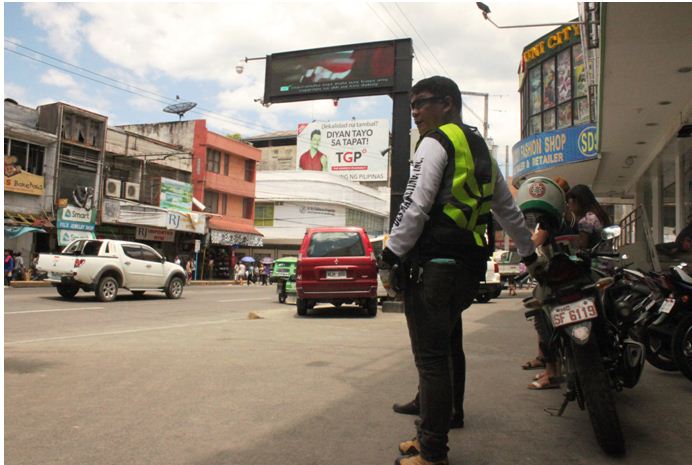
HELP FROM ABOVE. Traffic enforcers station themselves near the CLEAR information hub: a disaster warning system that broadcasts information, one equipped with a flasher, a siren and a public address system, CCTV cameras and a yellow phone that links the caller immediately to the command center in Tagbilaran City. (rahc/PIA-7/Bohol)

