by admin | Aug 12, 2017 | DOH Updates, Smoking Ban
In support of Executive Order No. 26 issued by Pres. Rodrigo R. Duterte, Gov. Edgar M. Chatto issued a Memorandum to all Mayors in the Province of Bohol enjoining them to observe the smoking ban in their respective LGUs.
EO No. 26 entitled “Providing for the establishment of smoke-free environments in public and enclosed spaces.
The Order applies to all persons whether residents or not,
However, Designated Smoking Areas (DSA) are barred in schools, hospitals, clinics, food preparation areas, and locations in which fire hazards are present.
The establishment of the DSA shall comply with the standards set forth under the said Order.
Further, the EO also prohibits the placing of tobacco advertisements and other promotional materials within 100 meters from the perimeter of a school, public playground, and other facilities frequented by minors.
On the other hand, Local government units particularly the City/Municipal Health Officer in coordination with the Department of Health are enjoined to develop, promote and implement their respective Local Smoking Cessation Programs consistent with the National Cessation Programs established pursuant to RA 9211.
Moreover, all cities and municipalities are enjoined to form a Local Smoke Free Task Force to help carry out the provisions of the Order.
Those who are found violating the EO shall be punished in accordance with the applicable penalties provided under Sec 32 of Republic Act 9211 and other applicable laws.
by admin | Aug 12, 2017 | Headlines, Local News / Bohol Balita, Tech Talk
PANGLAO, Bohol, August 7 (PIA) –Clean energy revolution in small amperage light rolls off from here and it is a wolf in sheep’s cloak.
An ordinary dirty energy kerosene lantern which otherwise would have given a warm flickering incandescent glow now gets a new light source: clean Light Emitting Diode (LED) powered by solar energy.
“Thanks to Liter of Light and MyShelter Foundation who taught us how to do it,” confesses Jane Heberly Bompat, Grade VI pupil at Lourdes Elementary School (LES) in Panglao.
Assembled by LES kids, the repackaged lantern would soon be among the innovations the Liter of Light and its 34 Bohol children ambassadors would be using to spread light into the country’s communities still darkened by energy poverty.
“How could we help 20 million Filipinos without access to light? Do we give them light from patented sources which is expensive and hard to repair or do we think of innovations?” asked Liter of Light and MyShelter founder Ilac Diaz.
Asked how his mission came about, Diaz was more willing to share.
It all started with one bottle, one carpenter, one inspiration and an empty liter bottle of soda.
Diaz said they had to come up with a solution in providing light to help communities wiped out by Haiyan, and Filipino bayanihan was a good concept to start with.
Liter of Light filled the PET bottle with water and bleach and stuck it in house roofs to produce refracted illumination indoors.
But for Haiyan victims, “buying was an option but shipping cost would eat up about 70% of our budget, we need to come up with something unique not top down imported, patented and expensive , but bottom up and local so it can be fixed,” Diaz added.
“Why import when we could just overhaul what is there?” he pointed out citing the kerosene lamps which were given to communities after the disaster.
In these areas too, kerosene lamps caused other problems: they burned children and women and houses, he noted.
“In kerosene lamps, we thought of converting it to solar powered lamps using LED,” Diaz who presided over a workshop at the Asian Cooperation Dialog (ACD) in Panglao intoned.
“We want local materials, done by local skills and fixible so the community can build and rebuild or fix it again as we go,” he excitedly narrated his soon-to-be mainstreamed clean energy.
Operating on empowering people to do more to uplift them instead of doling out, Liter of Light saw that transforming a dirty energy into sun power is most sustainable.
“The country has this south-south orientation which provides us maximum exposure to the sun,” he commented on why solar of all low cost and renewable energy sources.
The lanterns they asked children to build is 1 ampere LED mounted on a printed circuit board and getting solar energy packed in a battery inserted inside the lamp.
At the ACD, 34 children: 17 boys and 17 girls patiently showed to the representatives of the 34 country energy bloc how to build and rebuild the solar lanterns.
The ACD gathered Asian energy leaders and think-tanks to share and exchange expertise and ideas about making energy sustainable and affordable to energy deprived areas.
This is transforming a dirty energy to a clean energy solution and the government is keen in its support because solar energy is the right energy because it preserves our resources, Diaz summed. (rahc/PIA7/Bohol)
Carabao dairy: Bohol farmers
option for additional income
TAGBILARAN CITY, August 11 (PIA)–Then thought of only as a farm animal and meat source, the Philippine water buffalo now proves is also a source of extra income in high quality milk and cheese, says experts at the Philippine Carabao Center (PCC).
A potential source of additional income for farm families who have to sideline farm work to allow a birthing carabao the respite to nurture the young, carabao milk has been proven to be a good income source, according to PCC veterinarian Dr. Gondolino Bahinting.
To highlight on the viability of carabao as milk source, the PCC at the Ubay Stock Farm (USF) says other than giving off a calf, a mother carabao can also be a good source of high protein, low cholesterol, mineral and calcium rich milk that could be suitable for mozzarella.
Compared to other milk, a 200 milliliter glass of carabao milk contains about 9 grams of heat resistant protein.
“Because it doesnt break down easilly, the body tends to get more from it,” explains a dietician when asked about heat resistant proteins.
And carabao milk contains low cholesterol and is ideal milk for persons with diabetes, dyslipidermia, hypertension, kidney diseases, polycystic ovarian disease and obesity, PCC claimed.
Known to have high fat percentage and is thicker than other kinds of milk, the heavy carabao milk has been identified as good for healthy weight gain and is excellent for cheese and ice cream making, says PCC information officer Leniefe Libres.
In Bohol schools now, carabao milk supplemental feeding program supports the province’s goals of wiping malnutrition.
Besides, carabao milk is extremely rich in calcium and is a great source of minerals like potassium, magnessium and phosphorus which is great for building bone and bofy strength, Libres added to highlight its nutritional prowess.
“Experiments showed that carabao milk has very good stretching and melting characteristics that make it ideal for mozzarella,” PCC claimed.
“The native carabao however could only produce about 6 liters in two milking sessions a day compared to 12 liters from foreign breeds, but with a calf to add to the profit, it should be just okay,” a PCC carabao loan porgram beneficiary posed in comparison.
A farmer with a milking carabao however has to wean the calf early and induce the milking to harvest enough to feed the calf and process more milk.
With the provision of carabao milk as alternative, the PCC nears in its mission to make available locally produced affordable and high quality fresh dairy products while uplifting the socioeconomic status of dairy farmers as well ad improve nutrition and lives of Boholanos.
Along this line, the PCC has been tending a carabao ranch, a milking shed and has produced 200 liters of milk a day to prove milking can be viable for farmers.
“We do not do this for profit. We are doing this for farmers to imbibe as livelihood,” Dr. Bahinting claimed as he explained to tourists at the PCC farm tour.
From its processed milk, PCC and its supervised Bohol Dairy Cooperative makes pasteurized fresh milk, chocomilk, mango flavored milk, yoghurt, banana loaves, milk cakes, torta, pastillas de leche, vinegar-based white cheese, caramilk ice cream and its nutri packaged milk bars. (rahc/PIA7/Bohol)
Good health keeps
body off from “TB”TAGBILARAN CITY, Bohol, August 12 (PIA)–Always get a good rest, eat the right food and exercise, that in itself can be a great defense against tuberculosis.
A nurse at the Provincial Health Office and the Provincial Coordinator for the National Tuberculosis Program (NTP) dished out this advice amidst the reality that there are still a good number of undetected cases of microbacterium tuberculosis (TB) in Bohol.
While the PHO noted a high curing rate for people treated with TB, the case detection rate in Bohol is still a low 62%, Rances reported at Kapihan sa PIA for Lung Month in August.
The NTP pegs a target of 90% TB case detection rate but PHO cited problems with finding these people afflicted with the contagious bacteria.
Communities are supposed to help us seek these people who may have cough for the past three weeks, have unintentionally lost weight, has fevers, chest and back pains, said PHO nurse and NTP Bohol coordinator Polizena Rances.
Once reported, these people vould undergo confirmatory tests through gathering of sputum samples and when found positive, be placed under the free Directly Observed Treatment System for TB (TB DOTS).
Unreported, these people put their family members at high risk of infection, Rances added.
TB bacteria is spread with the air as the TB positive coughs or sneezes and the air is inhaled.
Although most healthy people have antibodies that naturally fight off the infection, those with low immunity tend to contract the disease.
About 95% of healthy people with strong resistance can self-cure TB, Rances revealed.
In fact she added that the usual habit of detaining patients in a closed room exacerbates the possibility of infection.
You close the room, you contain the bacteria which can degrade when exposed to sun and thins into insignificant numbers in open air, she explained.
In addition, as soon as the patient has been placed under TB treatment regimen, the possibility of him spreading the bacteria stops.
She however cautions.
A patient ho has started medication has to religiously obey the fixed dose or he could develop a Multi Drug Resistant TB, a much tougher bacteria to beat, PHO said. (rahc/PIA7/Bohol)
DoE works for “LNG”
powerbarge to BoholTAGBILARAN CITY, August 9 (PIA)–Consistent with Bohols green development agenda, the Department of Energy (DOE) unwittingly leaked its plan to bring to Bohol a cleaner source of power in a barge.
During a press conference at the BE Grand Hotel in Panglao, no less than DOE Secretary Alfonso G. Cusi timidly confirmed the plan after a slip of the tongue when he exposed the plan to send in a liquified natural gas (LNG) floating power plant to Bohol.
The press conference of the First East Asia Energy Forum which also had Japanese professor president of the Economic Research Institute for ASEAN and East Asia Hidetoshi Nishimura, Shigeru Kimura of ERIA, Energy Research Institute Network Chair and associate professor Romeo Pacudan, Sec. Alfonso G. Cusi tackled the directions East Asia and the Philippines is taking in its energy development in response to the pressing industrialization needs of the times.
While the DOE admitted its direction towards an establishment of an energy source that is attainable in the shortest term to keep up to the countrys development pace, the Philippine direction towards clean coal became apparent.
“The Philippine direction is building up more coal fired plants, which should comprise 50% of the 80% energy supplied by conventional energy,” he said.
The rest of the 20% should be from renewables.
The downside for renewables however is that these are dependent on the times.
When the sun is out for example, less energy is gathered or hydropower is dependent on the water supply, energy sources said.
The move for coal considers that the Philippines has coal while it is also available from Indonesia, Australia and Russia, its import price affected by economics of supply and demand, Sec. Cusi who led the host nation in the Asian Cooperation Dialog in Panglao.
As to the environmental concerns of coal, the energy bigwig was quick to the follow-through: 50% is from green-coal technology, he stressed.
“Technology has done great lengths to reduce coal carbon emissions,” the secretary said even as he assured that the government is also looking at socio economic as well as the ecological impacts of coal.
But with Malampaya in the Philippines producing natural gas, the DOE is eyeing these as source of back up power for Bohol.
This is also considering that the only time Bohol could have a redundant power supply system is when the National Grid Corporation of the Philippines completes its Cebu-Bohol interconnection by 2020.
An earthquake that shut down the geothermal plants in Leyte last July disrupted Bohols power supply blanketing the island in darkness for a few nights.
A few landbased plants later supplied 20 megawatts of the 69 megawatts the entire island needed.
Weeks later, NGCP tapped Bohol to the Cebu-Negros-Panay grid which supplied some of its power requirements.
Bohol officials who have yet to accept bids for more landbased power, has arranged for a diesel power barge to complement the supply, but none has arrived yet.
The DOE did not also say when the clean barge is coming and from where would this come from. (rahc/PIA7/Bohol)
by admin | Aug 11, 2017 | DTI Updates, National News
As part of the agency’s thrust to increase awareness on the positive gains of entrepreneurship, the Department of Trade and Industry (DTI) and Technical Education and Skills Development Authority (TESDA) link up to provide TESDA graduates with access to trainings on entrepreneurship to help generate to equip them with the necessary skills on entrepreneurship and employment.
According to DTI Sec. Ramon Lopez, acquired business skills by TESDA trainees from the Skills Training for Employment/Entrepreneurship Program (STEEP) can be used in effectively running their businesses in the future.
“This partnership not only complements our objective to equip our people with the right mindset and basic skills, it also contributes to our national goal to realize inclusive growth towards shared prosperity, powered by smarter Filipino entrepreneurs,” Sec. Lopez said.
STEEP aims provide interventions through skills development by providing access to training on entrepreneurship to graduates of TESDA program for self or wage employment to uplift their economic status.
“Through this partnership, we are glad to help TESDA graduates acquire more skills and development which can give them more opportunities to improve their lives by engaging in vibrant entrepreneurial activities,” said DTI Regional Operations Group Undersecretary Zenaida Maglaya.
Under the agreement, TESDA will provide its list of graduates to DTI from the Special Training for Employment Program (STEP) and other similar scholarship program, assist in the conduct of the entrepreneurship training, and monitor and evaluate the implementation of the project.
Upon assessment and selection of TESDA’s certified STEP graduates, DTI, in turn, will provide entrepreneurship training, assist in availment of the microfinancing facilities, provide them access to start-up capital for micro enterprises, and even facilitate business registration of those who wish to engage in business/sole proprietorship.
“This is the service that we will provide to them,” Maglaya explained, adding that “from giving them the right mindset, to ensuring that they will have assistance until they decided to put up their own business, we will make sure that we are with them every step of their entrepreneurial journey.”
The STEEP agreement with TESDA is one of the Department’s initiatives to sustainably generate employment and further promote entrepreneurship in the country as DTI pushes for its “Trabaho at Negosyo” agenda.
by admin | Aug 11, 2017 | National News
MAKATI—“Partner Philippines and Build Value Together” sums up the latest government campaign to encourage investors to ride on the ongoing Philippine (PH) growth story.
Speaking in a Dutertenomics forum, which includes the country’s economic managers, on 10 August, Department of Trade and Industry (DTI) Secretary Ramon Lopez encouraged investors to partner with PH, which will help in creating additional value for their businesses that will boost income-generation operations.
“The initiatives under Dutertenomics can help support investors by creating an environment where companies can do business swiftly and efficiently,” said Sec. Lopez, stressing that ongoing infrastructure projects strategically link the country’s industries, which will further power the growth of an already strong economic base.
“Build Build Build will facilitate greater trade and investment as it opens up access to new markets, while minimizing trade and logistics cost,” he added.
According to the trade chief, investors can fully recoup their investments as their businesses enjoy the benefits of operating in a fully-industrialized and secure business environment. They can also enjoy PH’s stable macroeconomic fundamentals, the educated English-speaking workforce, the demographic sweet spot that presents an enlarging consumer base, and wider market access thru preferential trade agreements.
“The hallmark of Dutertenomics is to attain growth with equity, that is, addressing inequality while reducing poverty across the regions towards improved quality of life for all,” he added.
Dutertenomics sums up President Rodrigo Duterte’s key 10-point socio-economic commitment to widen the gains of development, to address income gap and to uplift the quality of life of Filipinos.
Under Dutertenomics is the Build Build Build program that aims to develop massive and efficient infrastructure projects to create more opportunities in the countryside by developing more regional growth centers.
According to Sec. Lopez, PH has its greatest asset in its people: a large pool of highly qualified and educated work force that are strongly customer-oriented, highly trainable with fast learning curve, adaptable to universal cultures and with high level of commitment and loyalty.
He also shared with the audience, which includes British businessmen, that the country’s independent foreign policy strengthens Philippine ties with its partners and has opened new market prospects.
Major players Japan, China, Russia, and the Middle East have been involved in various cooperation projects with PH that translated to increased investments and more job and income opportunities. Sec. Lopez also shared the potential of the Regional Comprehensive Economic Partnership (RCEP) as key to open a huge integrated market base of 3.5 billion with ASEAN plus six Dialogue Partners China, Korea, China, Japan, Australia and New Zealand.
“To simplify, we convert trade and investment gains into employment opportunities for Filipinos, helping them move up in life. At the same time, we develop innovative, competitive, job-generating industries where PH has competitive edge,” said Sec. Lopez.
“Manufacturing, agriculture, infrastructure, services and tourism are the country’s critical industries,” he concluded
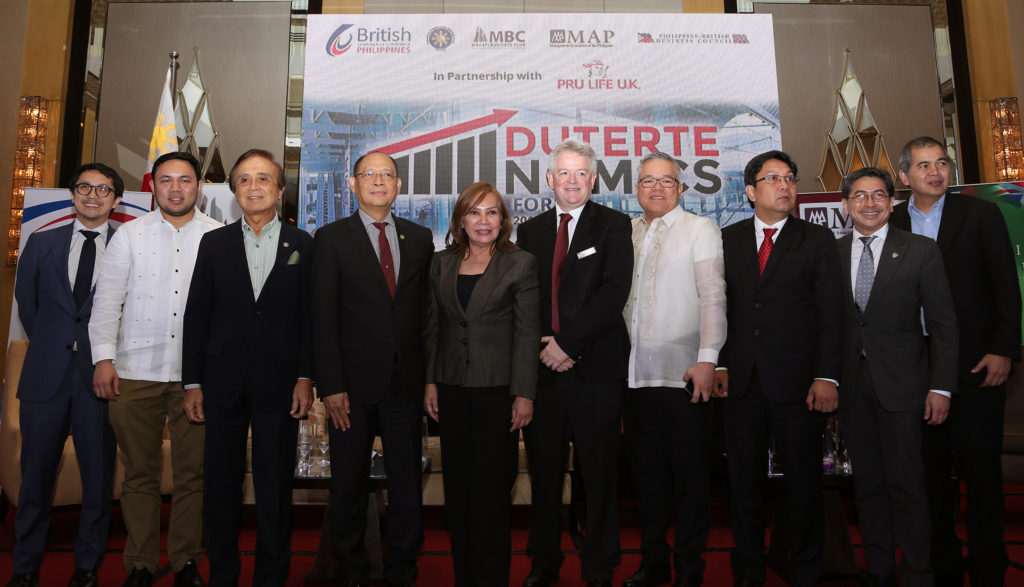
DUTERTENOMICS. The Dutertenomics forum once again gathered the country’s economic managers, including Public Works Secretary Mark Villar (2nd from L), Economic Development Secretary Ernesto Pernia (3rd from L), Budget Secretary Benjamin Diokno (4th from L), Trade Secretary Ramon Lopez (4th from R), Transportation Undersecretary Cesar Chavez (3rd from R), Bases Conversion and Development Authority President Vince Dizon (leftmost) with British Chamber of Commerce Philippines Executive Chairman Chris Nelson (6th from L) and members.
by admin | Aug 10, 2017 | National News, Negosyo Center Updates

The Department of Trade and Industry (DTI) welcomed the growing interest of the public in entrepreneurship as more Filipinos turn to Negosyo Centers for assistance for micro, small and medium enterprises (MSMEs) and aspiring entrepreneurs.
DTI Regional Operations Group (DTI-ROG) Undersecretary Zenaida Maglaya noted that since the inception of Negosyo Centers in 2014, the Department’s assistance to MSMEs spiked a total of 595,573 clients.
Maglaya attributed the “entrepreneurship fever” in the countryside to the agency’s continuing drive to introduce entrepreneurship as a steady source of income, partnerships with other national government agencies, and non-government organizations (NGOs), local government units, and MSMEs.
“This is a very welcome news for us that interest in entrepreneurship among Filipinos is growing. We highly encourage Filipinos, especially our Overseas Filipino Workers (OFWs) to engage in business so we can help our fellow Filipinos and the country’s economy,” Maglaya explained, adding that at least 3,041 OFWs were assisted by Negosyo Centers.
A total of 562 Negosyo Centers have been established since its inception in 2014, 297 of which were launched under the current administration.
Guided by Secretary Ramon Lopez’s 7Ms framework for a successful entrepreneur, the agency has provided assistance in the following areas: mindset, market access, mastery, machines, money, mentoring, and models.
“These programs for our MSMEs, being the backbone of the country’s economy, are surely beneficial. We would like to create more entrepreneurs and more jobs to help alleviate poverty in the country,” Maglaya said.
“At the start of 2017, we’ve targetted to open 200 more Negosyo Centers. But to be able to reach far-flung areas, we would open more so we expect to surpass the 200 centers target,” she added.
The Republic Act No. 10644 or the Go Negosyo Act aims to help micro, small and medium enterprises (MSMEs), promote ease of doing business, facilitate access to grants and other forms of financial assistance, Shared Service Facilities (SSF) and other equipment, and other support for MSMEs through national government agencies (NGAs), ensure management guidance, assistance and improvement of the working conditions of MSMEs; and facilitate market access and linkaging services for entrepreneurs.

