by admin | Aug 5, 2017 | Local News / Bohol Balita
Anytime soon, we would be reading legal questions about why Vice Governor Dionisio Balite still clings on to his seat despite a suspension order which he and a good number of former provincial government officials have been meted with.
For allowing then Governor Erico Aumentado to purchase heavy equipment by greenlighting a letter of credit to a bank, Balite, along with several officials have been given a slap on the wrist and a 3 month work suspension without benefits.
Suspended, Balite and the concerned officials had a legal recourse: file a temporary restraining order (TRO) so implementing the order can be held in abeyance enough for the Ombudsman to decide on the propriety of the move to temporarily suspend perceived erring officials.
Of course, while others just decided to wait out for the suspension, Balite, through his counsel filed for a TRO, which the courts also granted.
Filing the TRO is just a statement that Balite thinks suspension was unjustified.
Those who did not file for the temporary reprieve, might think a TRO is useless.
So, those who just sat out for the suspension order, shamefully chastised, could also be an admission that they did know they were wrong.
But Balite will have none of that. He, who felt there was nothing wrong with allowing the governor to get a letter of credit, questioned and got a temporary reprieve. From the courts, and from the people whose doubts have been expunged for Balite’s fighting for justice.
Seemingly, by some kind of reckoning, Balite’s TRO may have expired already and the Ombudsman still has to blow the whistle and make a decision. This now sparked the legal question.
This week, we already see the social media trolls identified by the local Administration question Balite’s “callousness.”
What made Balite tenaciously cling keep to the vice governor’s seat when the suspension order could already be implemented?
Had it come from Balite’s supporters, we would hail the whistle blowers.
But, when it would emanate from the same mouths who remain zipped about the blatant abuse of discretion of the governor in personally designating the Provincial Administrator and other lower ranking officials to be the governor’s alter ego, even with the vice governor obviously alive and present, would their clanging raucous be worth listening?
By delicadeza, the Vice Governor must be allowed to sit over. But he was never given the confidence.
When the Governor flew out of the country, shouldn’t delicadeza of the disente’ng officails of the best managed province deny the chance for the vice to sit in?
And in utter disregard to delicadeza, we see the Capitol paid barkdogs, or lapdogs praise and announce to all and sundry the presence of a suspended provincial official clearly present and calling the shots.
Why is a suspended provincial official be prominently present on high stakes meetings especially when it entails Capitol dealing with money?
Of course we know what draws these people into these anti-Balite frenzy: the scent of money is like blood in the water for these predators on the prowl.
This, incidentally too, is just the micro picture of a macroscopic reality which only the yellow toes as their script, followed to the dot.
And with these bashing that Balite gets, would looking away from these mentioned excesses not be yellowed hypocrisy?
by admin | Aug 4, 2017 | DTI Updates, Major Events
KUALA LUMPUR—As ASEAN celebrates its 50th founding anniversary, 2017 marks an opportune time to reflect on what ASEAN has achieved over the past five decades and what it seeks to accomplish ahead.
Speaking at the ASEAN@50 Conference in Kuala Lumpur on 4 August before an assembly of audience representing various stakeholders, ASEAN 2017 Economic Ministers chairman and Philippine Trade Secretary Ramon Lopez said that collaboration and communication are two essential elements to keep ASEAN moving.
“The region has to focus on two Cs, Collaboration and Communication. By engaging multi-stakeholders, ASEAN develops a win-win solution in ensuring that economic opportunities will be equitably felt by all ASEAN citizens,” he said.
Since its inception in 1967, the 10-member regional organization has transformed into a global economic powerhouse, with a population of 622 million and has become one of the world’s fastest growing investment destinations.
ASEAN’s total trade increased by USD 700 billion between 2007 and 2015, with intra-ASEAN trade comprising the largest share. In 2015, ASEAN attracted USD 121 billion of FDI with intra-ASEAN constituting the largest share of inflows. .
Sec. Lopez said that ASEAN should aim to communicate its programs and priorities to the ASEAN citizens, providing them with the right platform to know how they can contribute to the region’s growth story.
“Our communication must be sustained and intensified if we want to reap the benefits of the ASEAN Economic Community (AEC), working towards a deeper regional integration in 2025,” he added.
The trade chief made reference to the ASEAN 2025: Forging Ahead Together as a forward-looking roadmap to prepare the region in the next phase of evolvement, and which charts the pathway for strengthening the ASEAN Community over the next 10 years.
As one of the three pillars of the ASEAN Community, the AEC is a realization of ASEAN’s goal to have an integrated and prosperous economic region with a single market–where there is free movement of goods, services and investments.
“ASEAN’s continuing economic transformation remains an example of how regional integration and cooperation is plausible despite challenges and diversity in size, geography, political background, and culture,” the trade chief said.
AEC reflects connectedness and translates diversity into strength as ASEAN’s variety becomes a source of attraction to global investors, mindful of the region’s stake in open global markets.
According to Sec. Lopez, promoting complementation and cooperation is at the heart of ASEAN integration efforts. Closer trade and enhanced economic cooperation, combined with continued engagement with Dialogue Partners, provides the region with a solid platform to continuously bolster the region’s growth and promote complementation of domestic reforms among Member States.
ASEAN has also become a significant link to the international community because of the dynamism and the huge potential it offers to the world.
“We have engaged our major trading partners namely Australia, China, India, Japan, Korea, and New Zealand in free trade agreements, negotiating as a single ASEAN entity rather than as individual economies discussing bilateral trade arrangements,” Sec. Lopez added.
In 2013, ASEAN initiated negotiations for a Regional Comprehensive Economic Partnership (RCEP), which aims to expand the current ASEAN market to a huge integrated market of 3.5 billion with its six Dialogue Partners China, Korea, Japan, Australia, New Zealand and India.
Sec. Lopez also took the opportunity to present the Philippine agenda as the current ASEAN chair. Under the inclusive, innovation-led growth theme, the country is poised to champion the development and internationalization of micro, small, and medium enterprises (MSMEs) with key strategic measures to increase trade and investment, integrate MSMEs in global value chains and pursue an innovation-led economy.
“ASEAN continues to develop into a pivotal marketplace with its relatively young, growing labor force and emerging middle class,” he said, adding that ASEAN has transformed into a community of dramatic diversity and manifold opportunities.
by admin | Aug 3, 2017 | DTI Updates, Photo Story
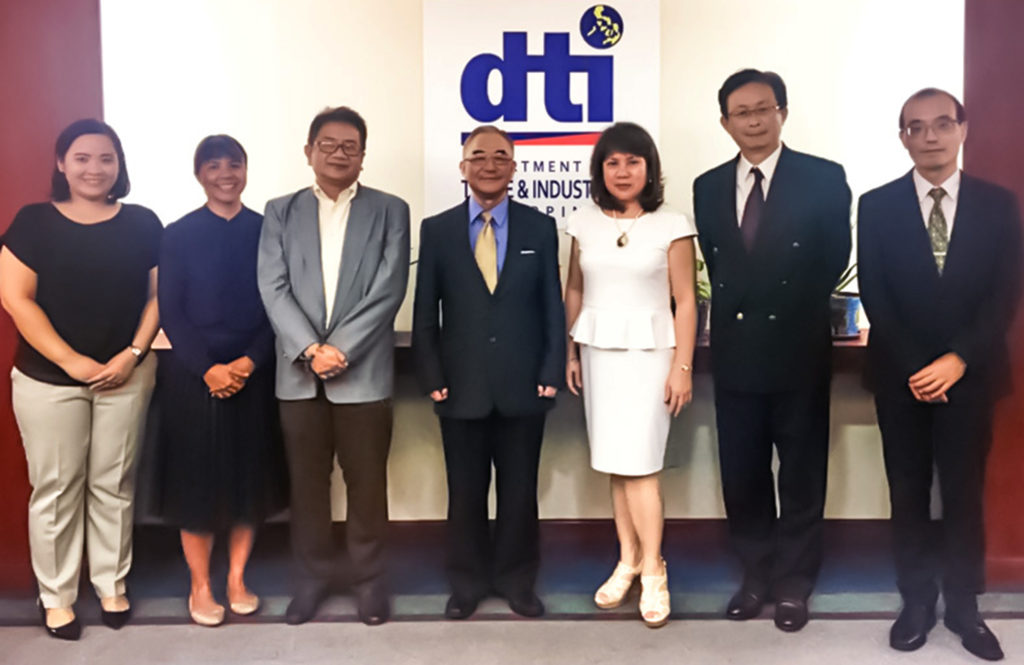
01 August 2017, Makati – The Taipei Economic and Cultural Office in the Philippines offers a partnership with the Philippine Training Trade Center and Design Center of the Philippines as co-developers of its Capacity Building Training programs. The PTTC and DCP are agencies of the Department of Trade and Industry. In the photo: (L-R) Foreign Trade Service Corps Trade Service Officer Charmaine Yalong, Design Center of the Philippines Executive Director Rhea Matute, Philippine Trade Training Center Executive Director Nestor Palabyab, Representative (Ambassador) of Taiwan/ROC Dr. Gary Song-Huann LIN, DTI Trade and Investment Promotions Group Assistant Secretary Rosvi C. Gaetos, TECO Director of Political Affairs Chiang-hwa (Tony) Tsai, and TECO Deputy Director Winsdon J. H. Hsiao
by admin | Aug 1, 2017 | DTI Updates
“Lucent Objects,” is featured in the Craft Trend Book 2018 released by the SUPPORT Arts and Crafts International Center of Thailand (SACICT)
The Design Center of the Philippines continuously explores the potential of indigenous raw materials, its design strengths and assets, to support new product development, especially products crafted and manufactured by the country’s MSMEs to make Philippine products more competitive in the international market in terms of quality and innovation.
DCP’s Materials and Design Research and Development collaborated with multi-awarded and internationally-acclaimed designer and concurrent Head of Product Development for Go Lokal! Stanley Ruiz on “Lucent Objects”, a lamps and lighting special setting shown in last year’s 64th Manila FAME. The materials used for the special settings were developed through a series of experimentation with anabo fiber, corn husk, bakong scrunch, palm husk,pandan leaves, peanut shell, and peepal leaves among others. These materials and Ruiz’ innovative design approach, landed Lucent Objects a spot in the Craft Trend Book 2018 recently released by the SUPPORT Arts and Crafts International Center of Thailand (SACICT).
The Craft Trend Book 2018 gathers information on art, crafts, and design to give insight on future trends on handicrafts and craftsmanship. The 2018 Craft Trend Book gives focus on the concepts of social craft networking, mass exclusivity, and digital detoxing.
The Design Center of the Philippines, an attached agency of the DTI, is committed to the promotion and use of design as a tool for improving the quality and competitiveness of Philippine products.
For more information on Design Center and its programs and services, please log on towww.designcenter.ph. You can also visit the Design Center at the DCP Bldg., CCP Complex, Roxas Blvd., Pasay City or contact them at 832-1112 to 18.

Stanley Ruiz collaborated with the Design Center of the Philippines to give new life to indigenous raw materials.
by admin | Aug 1, 2017 | National News
MAKATI—The Philippines (PH) and the Czech Republic (CZ) forged a joint agreement to boost economic cooperation in trade and investment between the two sides.
Trade Secretary Ramon Lopez and CZ Ambassador to PH Jaroslav Olša, Jr. signed on 31 July the PH-CZ Agreement on Economic Cooperation, which is set to strengthen trade and investment relations between the two countries. Both sides also exchanged views on the concrete ways to lead the relations toward a more strategic direction.
“What we are having here is a milestone between our two countries. The strengths and resources complementarities have long been untapped. It is our desire to be with alternative markets and forge new partnership,” said Sec. Lopez, emphasizing that the industry complementarities of both countries bring increased potential to cooperate on technology-oriented industries, auto and aerospace parts, electronics, agri-based, energy, transportation, and tourism.
“Tourism is the beginning of trade, I say that all the time, because when people come and see how beautiful and interesting things are, they return back and say why don’t you come and do business,” said Ambassador Olša.
Sec. Lopez also encouraged the other side to explore possible cooperation on the development of micro, small, and medium enterprises (MSMEs). He also mentioned other prospects including food and beverage, agriculture and agri-processing, energy, and defense and security solutions.
“I am optimistic that Czech’s industry strengths can be a good start in identifying areas of mutual cooperation,” he added, noting that aerospace development is a viable cooperation area.
The signed agreement means providing PH and CZ to strategically discuss joint initiatives on the mentioned areas of cooperation. In a meeting, it was noted that PH can capitalize on CZ’s industry strengths to implement PH’s Manufacturing Resurgence Program (MRP) and complement activities to address the existing gaps in the implementation of different industry roadmaps.
Specifically, on trade in goods, PH may be able to increase exports of mid-priced apparel to CZ’s rising demand on the product. There is also potential for frozen marine products, dried fruits, and vegetables in the CZ market. These products are eligible under the European Union Generalized Scheme of Preferences Plus (EU GSP+) that allows entry of goods at zero percent tariffs.
Meanwhile, on investments, opportunities for promotion are in the areas of information technology-business processing management (IT-BPM), knowledge process outsourcing (KPO), processed and specialty food, energy, design-driven products and aerospace/aeronautics.
While the PH is pursuing a free trade agreement (FTA) with the EU, PH’s engagement with CZ aligns with the government’s strategy of rebalancing trade relations with non-traditional partners with an independent foreign policy.
Trade Undersecretary Ceferino Rodolfo said that the PH Europe Strategy touches on three pillars: maximizing the utilization of the EU GSP+, negotiating a PH-EU FTA, as well as a PH-European Free Trade Association FTA, which was signed in April 2016 in Switzerland.
Said agreement will also pave the way to the creation of a PH-CZ Joint Economic Cooperation (JEC).
Meeting on an annual basis as a platform to discuss PH-CZ economic cooperation, the JEC will serve as an additional dimension to the trade ties given the ongoing PH-EU FTA negotiations. The 2nd round of negotiations was held in February 2017 in Cebu.
The JEC will also be a venue for the private sector of both countries to be connected and develop a beneficial partnership through business-to-business meetings.
Usec. Rodolfo also noted that the “PH and CZ are two fastest growing economies in their respective regions.”
In 2016, CZ was PH’s 31st trading partner (out of 226); 28th export market (out of 213); and 33rd import supplier (out of 207), with total bilateral trade amounting to USD 283 million.
“More than trade, the longstanding relations between PH and CZ is anchored on shared values and history,” said Trade Undersecretary Nora Terrado, referring to countries’ colonial experience and the shared commitment in upholding the values of freedom and human rights in respective societies.

