by admin | Jul 12, 2017 | DTI Updates, Headlines
United Coconut Association of the Philippines (UCAP) recently issued a statement clarifying the American Heart Association’s (AHA) advisory against the consumption of coconut oil.
In the statement, UCAP mentioned that the advisory has gone viral with adverse effect on the coconut oil since it is considered a saturated fat. UCAP called on readers and users of coconut oil to be discerning of the said advisory and news articles drawing conclusion that coconut oil is unhealthy.
According to Dr. Fabian M. Dayrit of the Ateneo De Manila University, the AHA adopted a position that ignores the distinction between medium-chain fatty acid (MCFA) and long-chain fatty acid (LCFA) despite the numerous advances in this certain field of science. Coconut oil is mostly medium-chain saturated fats, the healthy type of fat. Detailed comparison of the fatty acid composition shows that coconut oil is very different from animal fat. Hence, studies that assume they are similar are consequently in error.
Furthermore, Asian and Pacific Coconut Community also highlighted in their recent statement the words of Dr. Bruce Fife, a USA Certified Nutritionist and Doctor of Naturopathy Medicine, “You cannot say LDL is bad and HDL is good.” He explained the two types of LDL: one small and dense, while the other is large and soft. The large LDL is the type that is used in making bile, hormones, and Vitamin D, which are all good for one’s health. Dr. Fife further concluded that, “Eating coconut oil (and other saturated fats) increases both HDL and the “good” LDL, thus, lowering the risk of heart disease. This is one of the reasons why populations that eat a lot of coconut oil have the lowest heart disease rates in the world.”
Department of Trade and Industry’s Export Marketing Bureau (DTI-EMB) concurs with the stand of industry associations such as United Coconut Associations of the Philippines, Inc. and the Asian and Pacific Coconut Community that the advisory is misleading as AHA based its findings on limited studies on saturated fats.
“This is not the first time this kind of negative publicity against coconut oil has happened. If we will look closer to historical accounts, this has happened before. It was magnified this time due to social media and technology,” said DTI Export Marketing Bureau Director Senen M. Perlada.
By and large, DTI will continue to support the industry in sharing the good news about coconut and its economic contribution to millions of Filipino farmers and exporters.
Backed by recent studies and firsthand experiences of its consumers around the globe, DTI will help sustain the impressive health and economic contribution of coconut products such as coconut oil, virgin coconut oil, coconut water, coconut sugar, among others, by continued promotion through roadshows in various markets which will eventually bring additional jobs and income opportunities for Filipinos especially in the countryside.
American Heart Association (AHA) issued a Presidential Advisory on Dietary Fats and Cardiovascular Disease (CVD) on 15 June 2017 which recommended a decrease in consumption of products high in saturated fat such as dairy fat (butter), lard (pork), beef tallow, palm oil, palm kernel oil, and coconut oil.
by admin | Jul 11, 2017 | Headlines, National News
Emphasizes complementation in integration
HONG KONG—In the midst of calls for protectionism and global economic developments, ASEAN stands ready to respond to issues affecting trade and investment, drawing strength from its integrated economies.
Speaking at the Hong-Kong East Asia Summit on 11 July, ASEAN Economic Ministers chairman and Philippine Trade Secretary Ramon Lopez discussed current integration efforts in ASEAN and how these would eventually translate to regional complementation.
“Each economy will be differentiating its products to complement those of other economies. Economies may not necessarily compete, but they may complement each other through product specialization and market segmentation,” explained Sec. Lopez.
The trade chief emphasized that regional integration has resulted to a wider array and selection of products and services offered to ASEAN consumers.
“Regional integration will end up to regional complementation. ASEAN can lead the way and believes in the benefits of regional collaboration. It may work slowly but surely,” he said.
‘Unity in diversity’
“ASEAN shows how integration becomes plausible despite differences in background, culture and stages of development. With all these, we believe there is unity in diversity,” Sec. Lopez added.
As one of the fastest growing regions, ASEAN is the 7th largest economy in the world with a population of over 622 million people. It is also a marketplace with a relatively young, growing labor force and an emerging middle class.
On the benefits of economic integration, Sec. Lopez said that the ASEAN Economic Community (AEC) affords ASEAN a bigger role and a more prominent voice in dealing with fellow global economic players.
According to him, with the AEC, the region’s connectedness combined with its diversity becomes strength as the variety in ASEAN pulls investors in, mindful of the region’s stake in open global markets.
Inclusive growth agenda
The ASEAN Community 2025 Blueprint guides ASEAN with measures to address emerging challenges and to attain region-wide inclusive growth. Sec. Lopez recognized the role played by the micro, small, and medium enterprises (MSMEs) in the region’s integration efforts.
According to him, to attain inclusive economic growth that leads to shared prosperity, MSMEs need to take on a stronger role in boosting the region’s economies as creators of wealth and providers of jobs and livelihoods for the people.
He added that by heightening innovation, technology research, and human resource development, ASEAN MSMEs can also move up the global value chains.
“The big challenge really is how big companies can integrate MSMEs in their value chains—to empower them and make them more competitive and part of the equation, because it is only then we can really talk about inclusive growth,” he said.
The trade chief also cited need for MSMEs to embrace the digital economy through e-commerce, which provides an innovative platform to market, sell and research. In this respect, technology becomes an equalizer.
Concluding RCEP; FTAs
Citing US’ withdrawal from the Trans-Pacific Partnership and the Brexit, Sec. Lopez reiterated the benefits of substantially concluding the ASEAN-led Regional Comprehensive Economic Partnership (RCEP) agreement by end of 2017.
The move towards RCEP means looking at a mega-trade deal, wherein ASEAN ties up with its dialogue partners Australia, China, India, Japan, Korea and New Zealand, unlocking a huge integrated market base of 3.2 billion people or “one half of the world’s population and one third of the world’s economy.”
“The ASEAN-Hong Kong FTA definitely will be a major FTA, too that will allow us to use Hong Kong as gateway to China. This will be a huge benefit for ASEAN,” he said.
The ASEAN-Hong Kong Free Trade Agreement and the ASEAN-Hong Kong Investment Agreement are expected to be signed in November 2017 in Manila
by admin | Jul 5, 2017 | Headlines, Local News / Bohol Balita
The Philippines, through Department of Trade and Industry’s Board of Investments (BOI) Governor Lucita Reyes, Semiconductor and Electronics Industries in the Philippines (SEIPI) President Danilo Lachica and Ionics Vice-President for Operations Mr. Jay Chavez, recently participated at the celebration of World Trade Organization’s 20th Information Technology Agreement (ITA) Symposium held on 27-28 June in Geneva, Switzerland.
According to Magnolia Uy, DTI Philippine Trade and Investment Center in Geneva (PTIC-Geneva), the event allowed for the member countries to highlight ITA’s role of providing households and domestic businesses access to more affordable and higher-quality Information and Communication Technologies (ICTs) through tariffs elimination on hundreds of ICT products.
The Philippines, as one of the 82 signatories of ITA, has benefited from the initial ITA signed in 1996 and its expansion of list in 2015. According to the Philippines’ chief ITA negotiator and Board of Investment Governor Lucita Reyes, the country’s ITA membership helped lower prices for key ICT hardware inputs that the BPO industry depends upon. At present, the country’s ICT services exports account for roughly 70% of total services exports while the ICT goods exports account for more than 35% of total exported goods.
In terms of ICT goods exports, Lachica added that the Philippine semiconductor and electronics industry continues to grow at a steady rate, ranking as the 17th largest exporter of ICT products in the world valued at approximately USD 24 billion (out of USD 29 billion total electronics exports).
However, according to Ionics Vice-President for Operations Jay Chavez, to sustain the demand of ICT services enterprises for ICT products, it is imperative for the Philippines to move up the value chain for ICT products by engaging in products and systems design and by taking manufacturing to the next level through the implementation of smart factory and Industry 4.0 technologies.
The ITA was finalized during the 1996 WTO Ministerial Conference in Hong Kong while the Philippines became a signatory to the Agreement in 1997. In 2012, members recognized that technological innovation had advanced to such an extent that many new categories of IT products were not covered by the existing agreement. As negotiations to expand the coverage of the Agreement began in 2012, the ITA expansion agreement (ITA-2) was concluded during the 2015 WTO Ministerial Conference in Nairobi. The Philippines availed of the flexibilities of extended staging of tariff reductions of the Agreement. Executive Order (EO) 21 that mandates the Philippines ITA commitment will enter into force on 1 July 2017.
WTO Director General Roberto Azevedo opened the Symposium and noted how exports in the products covered by the original Agreement tripled from USD 549 billion in 1996 to approximately USD 1.7 trillion in 2015 representing an annual growth rate of 6%.
At present, ITA products account for a remarkable 15% of all global manufacturing exports. ITA membership also increased from 29 WTO members in 1996 to 82 today, accounting for over 97% of global ICT trade.
by admin | Jul 4, 2017 | Tech Talk

JCentre Convention Hall was fully booked and action packed as more than 1000 students, developers, tech enthusiasts attended this year’s Google I/O Extended.
Remembering Google I/O Extended 2015 with 50 attendees and Google I/O Extended 2016 that multiplied to 500 participants, this year’s Google I/O Extended did not just match its previous count but also doubled the population with a total of 1036 participants.
The whole day event was composed of a series of keynotes, talks, breakout sessions, and workshops on topics such as Internet of Things, Firebase, Progressive Web Apps, AR and VR, Machine Learning and TensorFlow, Android: Kotlin, Accelerated Mobile Pages, Polymer and 2017’s Web Trends.
The event was organized by Google Developers Group Cebu (GDG Cebu), a non-profit group of amateurs and professionals in Cebu’s developer community who are passionate about Google technologies. The I/O Extended Roadshow is made possible by its General Sponsor: Google, Event Partners: ASUS & ZenFone AR and Accenture, In-Cooperation with Kyocera Document Solutions Development Philippines Inc., with support from Symph, event’s Official Internet Provider, Globe – GoWiFi, and its Official Media Partner, PR Works.
There was also a part of the program where the sponsors also had a chance to share their latest products and company culture with the participants such as ASUS introducing ZenFone AR and Accenture talking about opportunities at their company. Sponsors also setted up a booth for attendees to get to see and try their exhibits.
The I/O Extended Roadshow kicked off in Cebu, while there is a plan for GDG Cebu to go to other areas such as Bohol, Dumagete and Tacloban. For more information about I/O Extended Cebu 2017 and other upcoming events of GDG Cebu, you can go to their website at gdgcebu.org or the event site at ioextended.gdgcebu.org. You may also follow their social media accounts on Facebook, Twitter, and Google+ under GDGCebu.
by admin | Jul 3, 2017 | Business, DTI Updates, Photo Story
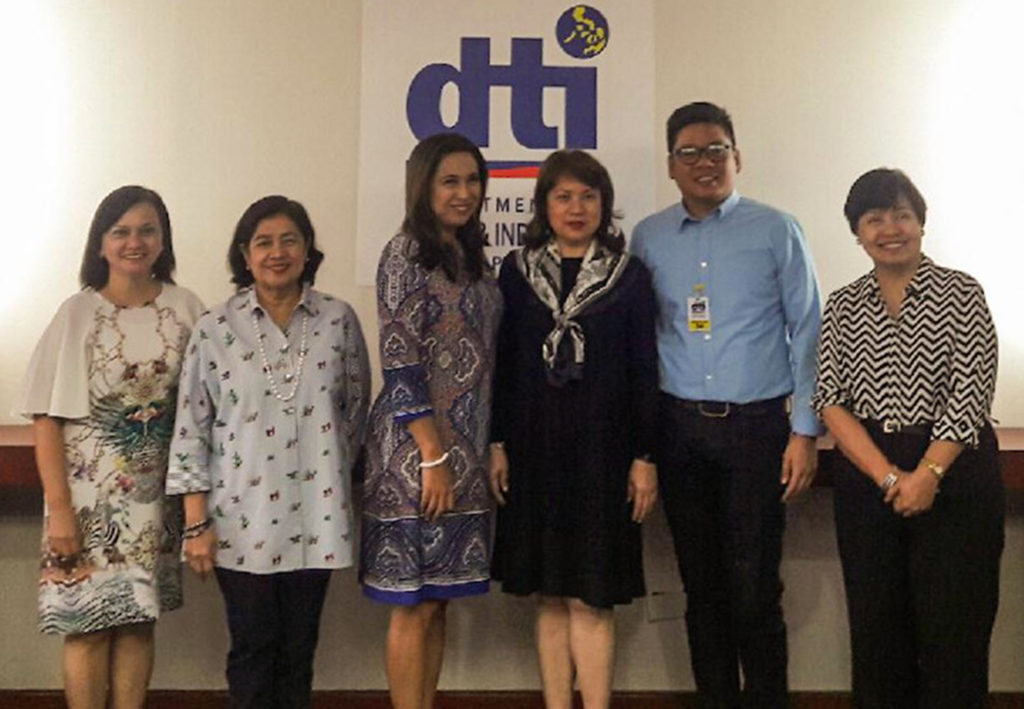
27 June 2017 Manila – The Go Lokal! team led by Department of Trade and Industry Assistant Secretary Rosvi C. Gaetos initiates discussions with Philippine Airlines Inc. on a partnership to promote Go Lokal! products, a Filipino concept store which carries quality and innovative products crafted, designed and manufactured by the country’s micro, small and medium enterprises (MSMEs).
(In photo: L-R) Office of TIPG Assistant Secretary Coordinating Officer Rosario T. Liwanag, Bureau of Domestic Trade and Promotions Director Rhodora Leano, Philippine Airlines Inc. Vice President for Marketing Ria Domingo, DTI-Trade and Investment Promotions Group Assistant Secretary Rosvi Gaetos, (PAL) Romeo “Kit” Javier, and BDTP Assistant Director Marievic Bonoan.

