by jeyzsonic | Jul 17, 2008 | National News
President Gloria Macapagal-Arroyo announced that the government is now ready to shift into high gear its bio-fuel energy program as the first step to end the country’s dependency to imported crude oil.
The President said she will inspect starting July 21 the 1,800 hectares in different parts of the country planted to jatropha under the government’s jatropha propagation program.
To date, 900 hectares have been planted to jatropha in Tamlang Valley in Negros Oriental, 500 hectares in Fort Magsasay, Nueva Ecija, 200 hectares in Camarines Sur, 100 hectares in General Santos City, 60 hectares in Ara, Palawan, 40 hectares in Cagayan de Oro City, 14 hectares in Bohol, and five hectares in Cadiz City, Negros Occidental.
The President said that because of the energy efficiency programs initiated by her administration, the country is now 56 percent energy self-sufficient, the highest energy self-sufficiency rating in its history.
She said that aside from alternative sources of fuel, the government will continue to promote the use of natural gas for transport; geothermal steam, wind mills like those already operational in Batanes and Bangui, Ilocos Sur, and solar power for electricity. (PIA/Bohol)
by jeyzsonic | Jul 17, 2008 | National News
President Gloria Macapagal-Arroyo directed all government-owned and controlled corporations (GOCCs) and government financial institutions (GFIs) to draw up a P500-million special, easily accessible loan program for the livelihood projects of the families and relatives of drivers and conductors of public utility vehicles (PUVs).
The P.5-billion micro-financing assistance will be sourced from the value added tax (VAT) collected by the national government, she said.
The President also tasked Presidential Management Staff (PMS) Director General and Secretary Cerge Remonde to encourage private market financing institutions to draw up a similar market financing program for the families and relatives of the transport workers.
The President told the transport groups that once the guidelines for the special loan package are drawn by the GOCCs and GFIs, the wives and immediate family members of the PUB drivers and conductors can start filing their request for their loan.
She said the special accessible loan package is envisioned to uplift the living conditions of drivers and conductors of PUVs such as jeepneys, taxis, buses and FX; as an alternative way to increase their income to enable them to meet the daily needs of their families. (PIA/Bohol)
by jeyzsonic | Jul 16, 2008 | Local News / Bohol Balita
TOWN mayors of Carmen, Batuan and Sagbayan ask Capitol to look into an executive order implementing a total quarry ban in their towns and possibly rescind or amend it so they could pursue development work using local natural resources.
Unlike some other towns in Bohol, these 3 towns host the famed Chocolate Hills and lost their privileges to enjoy gratuitous quarry permits from government. This, most perceived disadvantageous to their cash deprived local governments wanting to do road network maintenance projects.
Taking the cudgels for other towns, Carmen Mayor Manuel Molina has asked the Capitol, through its newly formed Task Force Kabukiran and the League of Municipalities of the Philippines (LMP) led by Jagna Mayor Exuperio Lloren to intercede and exempt their towns from the ban issued by Governor Erico Aumentado.
Governor Aumentado in 2007 issued a quarry ban within the area designated as the Chocolate Hills National Geological Monument in a bid to stop activities that would result to the defacement of the national landmark.
However, Molina argued that the quarry site that they intend to source out materials from lie in barangay Villafuerte; and not a Chocolate Hill is noted nearby. He added the source is an existing quarry site operated by a private company.
The quarry, according to him, temporarily stopped operating due to the Capitol executive order.
If the Capitol accedes, he said the town does not need to look farther to buy for its materials source.
In protecting Bohol’s amazing hills, Senate Bill 534 of the Chocolate Hills Protection Act of 1997 specifically protects the hills located in 32 barangays in Carmen and Sagbayan, but does not mention Villafuerte.
Batuan Mayor Gregoria Pepito added she too faces the same predicament. Cash-deprived Batuan, she said wished to be granted by Capitol gratuitous quarry permits so they can start rebuilding their road networks now bearing the brunt of the long rainy days.
Sagbayan Mayor Jimmy Torrefranca on his part shares the same sentiment.
The chocolate hills areas have also excellent sources of lime stones, rocks, soils for road surfacing and back filling materials.
Over this, Bohol Environment Management Office (BEMO) Chief advised the mayors concerned to meet with the governor so they could appraise Capitol officials of the problem and possibly patch the infirmity of the executive order.
BEMO’s Engr. Renato Villaber agreed that the Task Force Kabukiran would still apprehend illegal quarry activities unless the executive order is rescinded or amended. (rachiu/PIA)
by jeyzsonic | Jul 12, 2008 | Local News / Bohol Balita
LOWERING the price of commercial rice is beyond the small stall owners who source out their stocks at already high prices.
This also sums up the reactions from local market stall owners in Tagbilaran City’s main market who still continue to sell commercial panda and pearl rice at P38-39 and P40-43, while their bukid rice still sells between P37-38.
This is despite the fact that commercial rice in Metro Manila has gone down to P35 due to the continued government intervention such as flooding the markets with cheap rice and going tough on hoarders and scrupulous businessmen.
“We can not go lower because we will already lose,” a stall owner who refused to be identified shared.
“As much as we wish we could do it to compete with the P25 NFA rice, we also have to consider getting our money back,” she stressed in Cebuano. Her stall sits at close proximity to a Tindahan Natin outlet that sells the NFA rice at P25 a kilo twice a week.
“We buy our stocks at already a high price and so we can not just absorb the losses because we also wish to earn a living here,” she explained.
Admitting that she has noted the price of commercial rice go down from P40 two weeks ago to P38 now, she added that is the lowest they can offer to the consumers.
That time, ‘bukid” rice sells at P1900 per bag, now it has gone down to P1700, she admits, referring to the traders price two weeks ago.
She also speculated that the price may have been brought down by the cheaper NFA rice which at times can be better than the broken bukid rice.
“If we buy commercial rice at P1,800 per sack, we could not sell it in retail at P38, we would lose by then.”
If there is a need to lower the prices in the markets, then the traders have to sell their stocks at a much lower price.
She however did not name her trader source, but hinted it has cornered the biggest rice market in Bohol.
Asked what could be the effect if the National Food Authority makes the weekly ration to its outlets at 100 bags, she said she would have to reduce her commercial rice stocks.
She shared that before the rice crunch, her stall of 4 meters by 8 meters could sell between 4-5 sacks a day. Mow, selling a sack a day is already a feat.
Over this, consumers here have also wished the NFA has a better and more efficient distribution system.
This as several people have pointed out that some of those people queuing for the cheap rice are better off.
A freelance government consultant also stressed that the government-subsidized rice must reach its intended beneficiaries, the dirt poor.
Dr. Fermin Adriano, a Doctor of Philosophy on Political Economy from the City University of London, said the government is losing about P15 for every kilo of rice its subsidizes.
“The good news is that the government has the funds, for now, from the implementation of the expanded value added tax (EVAT) law.”
He said “it should really go to the dirt poor” to which it was intended for—the poor and not the rich, who buy the subsidized rice for their helpers while they eat the pricey variety of rice.”
This must be done because the government cannot “go against the market forces” forever.
He then suggested that the Department of Social Welfare and Development (DSWD) and the local government units (LGUs) must work together to improve on the delivery of NFA rice.
“We have to make them accountable and the people must be informed that this much NFA rice has been delivered for their community,” he said.
He stressed though that the NFA will never earn from the subsidized rice as it is a “social welfare function and that the government exists to help the poor.”
“No way NFA will earn back the P250 billion it uses to subsidize rice,” he said. (rachiu/PIA)
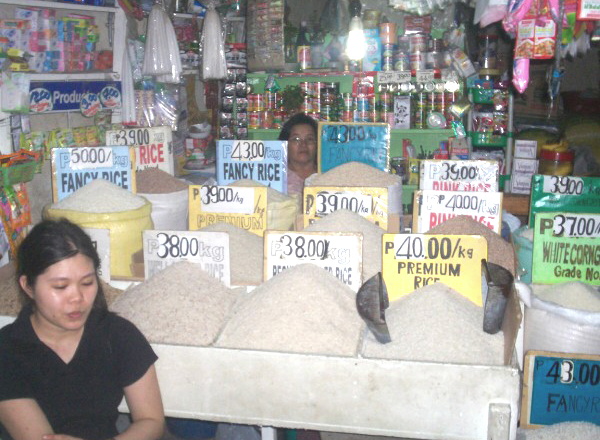
FANCY INDEED. For rice producing provinces like Bohol, it may seem fancy for a stall trader to sell fancy rice at P50.00 per kilo. But, that is how it is. (PIA)
by jeyzsonic | Jul 9, 2008 | Local News / Bohol Balita
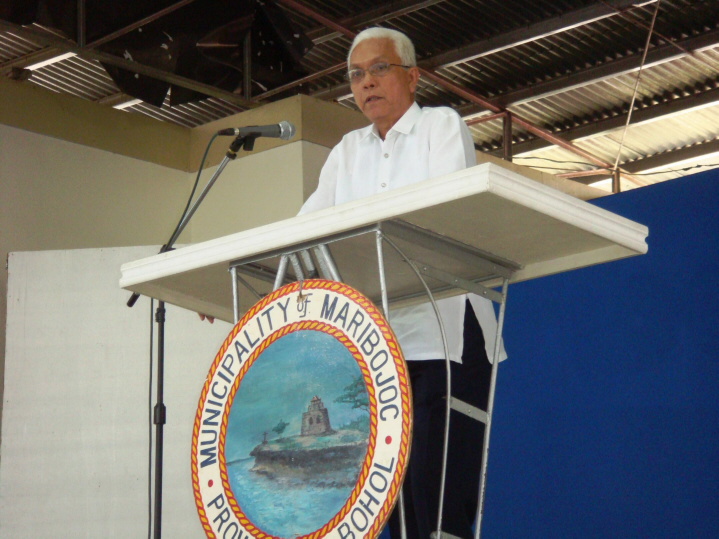
STEERING Maribojoc into an eco-cultural dragon. Mayor Leoncio Evasco delivers the State of the local Governance Address at the municipal gymnasium. (contributed photo)

