
Former OFW uplifts Cordillera farmers into exporters

GDME Fruits and Vegetables leads PH highland farmers to global market

Overlooking a carrot and romaine fields in one of the highland vegetable terraces of Maria’s Farm, situated on over 2,000 above sea level (ASL) in the town of Kibungan, Benguet.


The province of Benguet has been making a mark in the international market as a sourcing hub for premium agricultural products, such as fruits, vegetables, coffee, and other highland crops.

With more than half of its residents or 100,000 farmers toiling on more than 30,000-hectare farms scattered in vegetable-producing towns, Benguet is living up to its moniker as the “Salad Bowl of the Philippines.”

But the farmers from the province, including most areas in the Cordillera, has yet to realize their full market potential in the lucrative export industry. This difficulty contributes to the economic disadvantage of Cordilleran farmers as the region’s agriculture sector records the least contribution to their economy, despite employing 46 percent of the labor force or 348,000 of its total 766,000 abled bodies.

“The lack of drive from our farmers to export much of it has got to do with their local and limited mindset,” said Maricel Hernaez. “Many of our farmers in the Cordillera are producing crops with the idea of harvesting it only either for their own household consumption or for selling at the local vegetable trading post.”

Taking Philippine fruits and vegetables from highlands to overseas

Ms. Maricel Hernaez, owner of GDME Fruits and Vegetable Trading

A former overseas filipino worker (OFW), Hernaez came back to the Philippines with a dream: to abolish the domestic-centric mindset of the Cordillera farmers and help them penetrate the international market.

Born and raised in a farming family in Cordillera, her life-mission sprung during her service as a domestic helper for five years in Singapore, where she has keenly followed the sky-rocketing prices and huge demand for highland fruits and vegetables.

Grabe ang taas ng presyo ng gulay sa Singapore, for example nalang ‘yung isang malaking patatas minsan umaabot ng two dollars at pati ‘yung cabbage nasa mahigit one dollar ang 250 grams. Dito sa Pilipinas, nasa limang piso lang ang patatas na malalaki at yung cabbage, isang kilo na katumbas ng one dollar mo,” she shared. “Kung produkto lang naman ang paguusapan, competitive ang galing sa Pilipinas pagdating sa laki at kalidad.

In her last working year as a domestic helper, Hernaez met up with the Philippine Trade and Investment Centre (PTIC) in Singapore to seek guidance on her plan to become a vegetable and fruit exporter. In March 2015, she came back to the Philippines and immediately established her company, GDME Fruits and Vegetables Trading, naming it after her parents: Gilbert Domerez (father) and Mercy Espara (mother).

“My parents who made a living through farming have inspired me to pursue this agenda,” she elated. “They are the foundation of my goal of nurture the country’s agri-export market by tapping the promising farming communities in Cordillera.”


A tall order

Having no land to call her own, Hernaez has been operating GDME Fruits and Vegetable Trading for the past two years as its sole networking, monitoring, and marketing officer for grassroots farmers across the Cordillera region.

In her networking initiatives with the local farmers, it has always been a challenge for her to explain, innovate, and change some of their farming methods and even their products to suit the demand of the global market.

“Going one by one with the farmers, I always explain that we have the tools to compete with other countries. We are situated at a higher elevation with the perfect soil and climate. Most importantly, our farmers are hard-working,” she stressed. “But, I tell them we should comply with food standards and certifications. I also encourage them to plant the crops that are in-demand because if we plant crops that no one wants to buy then it will just go to waste.”

Without a formal academic background in agriculture, she has always been looking for fresh ideas and new ways on how to improve her technical know-how on the export industry by attending seminars and partnering with government agencies, such as the Department of Agriculture (DA) and the Department of Trade and Industry (DTI).

“I never missed opportunities where I can learn new things. Last May, I joined IFEX Philippines, together with our farmers, where we encountered people who are willing to help us grow,” Hernaez said. “We were also glad to meet foreign buyers that are really interested in our fruits and vegetable products.”

Hernaez points to one of the field of Marie’s Farm where a variety of crops are planted all year round, such as potatoes, cabbages, carrots, romaine, and radish.

Now GDME Fruits and Vegetables Trading has partnered and has been consolidating the yield of more than 60 farmers in communities located in the municipalities of Kibungan, which is considered the “Little Alaska of the Philippines,” as well as in Mankayan, and Kabayan.

Among her community partners are the Bosingan Multi-Purpose Cooperative, Mankayan Young Farmers, Maria’s Farm, and the Bashoy Kabayan Multi-Purpose Cooperative.


Fresh from the highlands, they offer different varieties

Patches of sugarloaf Cabbages at Maria’s Farm

 and cultivars of potato, radish, carrot, chayote, cucumber, cabbage, Chinese cabbage, tomato, romaine zucchini, sugar beets, bell pepper, broccoli, cauliflower, onion leeks, snow peas, and green beans.

Fresh, newly uprooted potatoes

“In our farm, we are able to grow fruits in huge sizes. For instance, in our cabbages, we are cultivating the scorpio F1 hybrid and sugarloaf varieties. When fully grown, these varieties can reach an average net weight of 2 kilograms each, while your regular lowland cabbage varieties only reach 1 kilograms each. Our is twice the size,” she said.

Her partner farmers are also cultivating strawberry, lemon, parsley, cilantro, kale, mint, basil, alfalfa, arugula, red radish, young corn, fennel leaves, and okra.

They also have some of the iconic Cordillera processed goods, such as sweet and sour chili sauce, strawberry jam, peanut butter, and kimchi.  

Hernaez said an exporting farmer will be able to earn at least 15 pesos more per kilo of their harvest. She added: “Some might even go double the price when depending on their reception on our quality and demand.”

“With these many products, we are targeting the demand in Singapore and other nearby ASEAN countries, as well as those in the Middle East,” she added. “We are also open to offers from other buyers across the globe that can be beneficial to the livelihood of our farmers.”

Cordillera farmers moving forward

While the high elevation augments the harvest, it also makes highland fruits and vegetables prone to risks of climate change, making its price highly volatile.

“We know that there is a demand for our agricultural products, but the next step is how we can corner that demand? With our talks with people that we met on IFEX Philippines, we should be able to do it if we set our fruits and vegetables at stable prices and produce them at a sustainable rate. It’s a challenge for us here in the highland considering the ever-changing weather conditions,” said Hernaez.

Faced with this predicament, Hernaez is trying to hit two birds with one stone in creating a viable year-round crop rotation system: working on identifying the in-demand varieties crops that are a tolerant to extreme weather and are resistant to pests and diseases.

“With this method, we also can minimize the use of synthetic chemicals and inputs, or apply good farming practices which involve the balanced application of organic and chemical inputs,” she explained.

The former OFW also continues to widen her network to increase their agriculture supply and product selection, allowing small-scale farming communities to accommodate bulk orders from foreign buyers.

At the same time, she is helping Cordillera farmers secure the Good Agricultural Practices (GAP) certification—an accreditation promoted by the ASEAN community and is unanimously recognized in the international market.

Fifty-nine-year old farmer, Dolores Igme, shows their jumbo-sized winter melon or ash gourd. Igme is one of the farmers supported under the export initiative of GDME Fruits and Vegetable Trading

Out of the 78 GAP-certified farms in the Philippines, only 4 farms are from Cordillera.

According to the Department of Agriculture – Bureau of Agriculture and Fisheries Standards (DA-BAFS), GAP Certification ensures that a farm is not only in the quality of his crops, but in all aspects of farming.

The GAP standard requires a scrutiny of the history of the farm site and its prior use; the type of soil, and its compatibility with crops and seed sources; the judicious use of pesticides and fertilizers, whether chemical or organic; the sources of potable water for irrigation and washing of crops; the harvest and post-handling procedures; the health and hygiene of the farmer and handlers, and other factors.

“Gusto kong makita sa mga farmers if they can eat their products raw and fresh, ‘yun na kasi uso din because there are a lot of vegetarians. ‘Yung iba kasi they have a lot of pesticide to the point na hindi na pwede makain kasi maamoy or matapang yung chemicals. At least with GAP [certification], we can be one stop closer to this goal,” she said.

Aside from GAP certifications, GDME Fruits and Vegetable Trading is also working to secure Halal certifications for the community farmers as they are targeting the demand for halal fruits and vegetables in the Middle East, particularly in Dubai and U.A.E.

Though the Philippine National Standards for Halal (PNS 2067: 2008), Halal products are at par with international standards to enhance the competitiveness of local industries, and to ensure product quality and safety for the consumers.

“GDME Fruits and Vegetable Trading is committed to prime Cordilleran farmers to become export-ready in the global market so that they would grow together with the company and the booming Philippine food industry,” she said.

If you are interested on premium fruits and vegetables from the Cordillera, please contact Ms. Maricel Hernaez (Owner of GDME Fruits and Vegetable Trading) at 0950-525-1170 or e-mail her at gdmetrading@gmail.com.


“Every published story helps PH companies and brands gain local exposure that will boost the country’s exports. Thank you in advance.”
Trade chief on artificial intelligence: let’s make it work for BPO

MAKATI—There is a way to make artificial intelligence (AI) work for the sector of the business process outsourcing (BPO), amidst threats that this technology posts on our major services industry, the country’s trade chief said.

A product of the fast pace changes in technology, AI has presented itself more than just a new technology but as a threat to the current employees servicing the service export industry and the BPO, including the contact centers.

“Let us retool and reposition the nature of the current jobs in the industry,” said Department of Trade and Industry (DTI) Secretary Ramon Lopez, in the course of pessimistic prediction that AI could potentially diminish 45 to 50% of the approximately 1.2 million Filipino employees of the BPO industry.

Sec. Lopez cited these possible solutions coming from his recent collaboration with Dr. Dado Banatao, a renowned Filipino technology entrepreneur based in Silicon Valley, in order to minimize the impact of AI on job displacements. Together with the Department of Science and Technology (DOST), the Commission on Higher Education (CHED), the Philippine Association of State Universities and Colleges (PASUC) and the Unite States Agency for International Development (USAID), the group is currently working on building an inclusive, innovation ecosystem (government-academe-industry network) that will infuse science and technology, and innovation in industries including agriculture and services.

The AI technology enables computers to provide answers or solutions to problems raised in contact center transactions. Through programming, and deep learning technology, several databases are processed at faster speed and the computer processors are able to respond and recommend actions to callers.

“We need to train affected BPO employees and strategically orient them on the emerging technology requirements of the industry that will enable them to continuously improve job performance. In other words, making use of technology in their jobs rather than being displaced by it,” said Sec. Lopez.

“In simpler terms, we will endeavor to make this new technology work for them,” he added.

The trade chief said that intensive education and training programs for those in the industry should be developed soon by the academe, government and industry innovation ecosystem to ensure least manpower displacement.

He also underscored the need to develop an inclusive, innovation-led industrial ecosystem that will upgrade the competitiveness of the Philippine core sectors, including the services sector, in a bid to improve productivity, output generation. This is in line with President Rodrigo Duterte’s agenda to build competitive industries that will generate more jobs and income, reduce inequality and give a more comfortable life for every Filipino, according to Sec. Lopez.

DTI and DOST will lead the convening of all enablers in the innovation ecosystem to map out the overall framework and programs to be implemented.

“There is a need to strengthen curriculum towards computer science, engineering, data science and AI application design, among others. This effort is also deemed to be inclusive as disqualified BPO applicants and retrenched agents will be retrained for AI application development that will eventually enable them to get jobs,” Sec. Lopez concluded.

DTI conducts public consultation on the Business Name Law

The Department of Trade and Industry (DTI) will conduct a Public Consultation on the proposed Department Administrative Order (DAO) on the Revised Rules and Regulations Implementing the Business Name Law this coming September 14 from 8:00 to 11:30 in the morning at the Marco Polo Hotel, Nivel Hills, Apas, Cebu City.

According to DTI, the said DAO aims to further streamline and simplify procedures on business name registration to make DTI frontline service truly efficient and business-friendly.

In view of recent developments, particularly the government’s Ease of Doing Business Program, revision of Rules and Regulations on the Business Name Law has been made to keep it aligned with the said program, by consolidating several DTI issuances relevant to Act No. 3883.

A copy of the draft DAO may be downloaded from the DTI (www.dti.gov.ph) and PBR (business.gov.ph) websites for your information.

Considering that participation to the public consultation is on a first come-first-serve basis, those interested are encouraged to confirm attendance with Regina Verame at MaReginaVerame@dti.gov.ph or call telephone number (032) 255-0036/ 37 local 302 not later than September 12, 2017.#
Attachments area

DTI partners with PAL to promote Go Lokal! products


27 June 2017 Manila – The Go Lokal! team led by Department of Trade and Industry Assistant Secretary Rosvi C. Gaetos initiates discussions with Philippine Airlines Inc. on a partnership to promote Go Lokal! products, a Filipino concept store which carries quality and innovative products crafted, designed and manufactured by the country’s micro, small and medium enterprises (MSMEs).

(In photo: L-R) Office of TIPG Assistant Secretary Coordinating Officer Rosario T. Liwanag, Bureau of Domestic Trade and Promotions Director Rhodora Leano, Philippine Airlines Inc. Vice President for Marketing Ria Domingo, DTI-Trade and Investment Promotions Group Assistant Secretary Rosvi Gaetos, (PAL) Romeo “Kit” Javier, and BDTP Assistant Director Marievic Bonoan.

Strengthening the Marikina shoe industry

MARIKINA—Following President Rodrigo Duterte’s instruction to revive and to strengthen the country’s footwear industry, Department of Trade and Industry (DTI) Secretary Ramon Lopez and the members of the Philippine Footwear Federation Inc. (PFFI) identified possible solutions to existing obstacles that hamper the shoe industry’s growth.


“Technological improvement remains an industry concern. While there are patrons who prefer manually-produced shoes citing their durability, still, innovation is crucial for the shoe industry to flourish and expand,” Sec. Lopez said.


In a series of site visits recently (8 June), Sec. Lopez and DTI officials explored ways to level-up current industry practices with PFFI. For one, DTI already has a sustainable Shared Service Facilities (SSF) Project with PFFI that houses machines and equipment that serve as common service facilities for efficient, quality and innovative production.


Among the SSF projects is the High Value Custom-Made Footwear, which intends to capture market that prefers custom-made shoes, featuring new methodologies in shoe engineering, footwear design and manufacturing. It also uses state-of-the-art scanner that automatically produces a 3D model of the foot in seconds for measuring and size estimation.


“Small shoemakers take turn in using the equipment. They need to expand the capacity and add more and newer machines,” Sec. Lopez added.


Within the compound where the SSF is located is DTI’s Negosyo Center-Marikina and the Philippine Footwear Academy that aims to produce job-ready workers for the Marikina footwear industry. The Academy is considered the first and only footwear school in ASEAN.


Meanwhile, the trade chief guaranteed PFFI that DTI remains committed in supporting the Marikina shoe industry from the policy and program level that will improve access to raw materials and supply chain, as well as enjoin government and private sectors to give preference in buying locally-made shoes.


Assistance on design creation through the Design Center of the Philippines up to provision of market access and promotion through the Go Lokal! stores in malls, national and international trade fairs and exhibitions, and the internationally-recognized Manila FAME will also be provided.


Headed by its president Roger Py, PFFI is composed of footwear manufacturers, retailers, cooperatives and allied industries from Marikina, Laguna, Bulacan, San Mateo and Cebu, whose members belong to the sector of micro, small and medium enterprises (MSMEs).


On the same day, Sec. Lopez visited production facilities of Gibi Shoes Manufacturing, Bristol Shoes and micro-enterprises like Ruperta Enterprises, all of which are Marikina-based. He called on industry leaders to initiate the kind of entrepreneurship that is idea-based, demand-driven and innovation-led.


He also visited Marikina’s pride Rolando “Tatay Oly” Santos, the shoemaker, who gave President Duterte a pair of shoes as a gift, which the president wore during his international meetings with heads of state. Sec. Lopez learned the common sentiments of small Marina shoemakers in terms of machines, shoe molds and working capital.


Tatay Oly, who is currently borrowing from 5-6 loan sharks, got emotional when he was assured of working capital assistance from President Duterte’s Pondo para sa Pagbabago at Pag-asenso or the P3 micro-financing program.


The trade chief also talked to some of Marikina’s talented and hardworking designers and artisans, who also serve as trainers in DTI’s SSF project for MSMEs aspiring to take part in reviving Marikina’s shoe industry.


“The Filipino artisanship and craftsmanship in designs, plus the highly-skilled, highly-trainable workforce that showcase ingenuity despite stiffer market competition will help bring back the glory of Marikina as the country’s shoe capital,” he concluded.

ABAC Philippines to focus on MSMEs in pursuing inclusive growth agenda

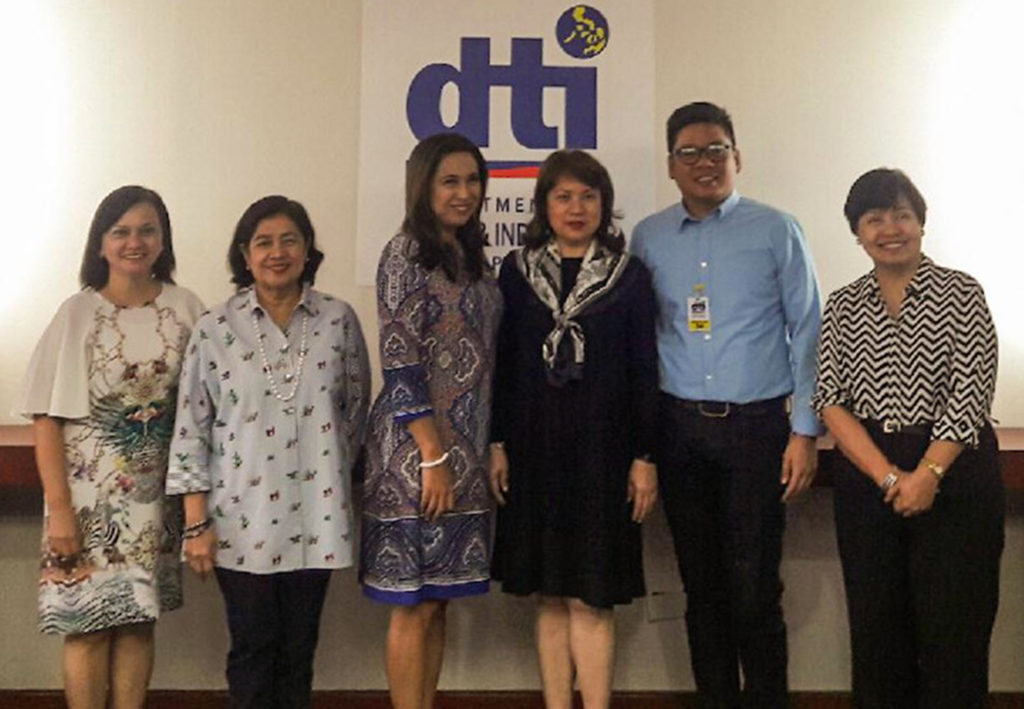
7 June 2017 – MSME Development. This is the main thrust of the APEC Business Advisory Council (ABAC) Philippines as itpresented the priority work areas in the meeting with Department of Trade and Industry (DTI) Secretary Ramon Lopez following the second ABAC meeting for 2017 last 25-29 April in Seoul, Korea.
“This is a very welcome development and a boost to the MSMEs that comprise 99.5% of the establishments in the country,” said Sec. Lopez. “The DTI has already been laying the ground work for strengthening MSMEs, especially with the participation of the youth and women. Now as we chair ASEAN this 2017, we likewise put the spotlight on MSMEs and entrepreneurship, as well as the sector’s integration in the global value chains.”
APEC Philippines, through DTI, is working on the development of an APEC SME Marketplace as a one-stop shop for SMEs in the region. This online portal is envisioned to provide useful information such as the MSME policies and regimes in different economies. Ultimately, the project aims to serve as a platform for SMEs to access and tap into global markets and transact with other players in the region.
According to ABAC Philippines Chair Tomas Alcantara, it is important to take advantage of this opportunity and ensure that SMEs in the country will optimize use and benefit from the system.
“ABAC PH’s first project will help advance MSMEs interests by developing a pilot Philippine SME Marketplace. We are trying to make concrete outcomes by facilitating linkages between SMEs and domestic market first, then to two or more international markets. After that to ASEAN, eventually to
APEC, and then finally, the global market.”
With the very broad and varying interests of the 21 APEC economies, the Philippine team will be keen in realizing its key priority areas.Aside from MSMEs, the group has also expressed interest in Infrastructure Investment. A specific initiative being discussed in ABAC is related to the Islamic
Infrastructure Investment Platform (I3P).

ABAC Philippines will look into how the Philippines can tap into the available funds from the Islamic banks in the region. Mr. Alcantara added, “With guidance and support from the DOF, ABAC Philippines will help develop a viable Islamic financial regime to benefit Islamic banks and investments in the country, ultimately to contribute to the development of Mindanao.”
“ABAC Philippines will work on identifying and enhancing the country’s comparative advantage and unique proposition so we can optimize and at the same time add value to our participation in APEC — now and on a continuing basis for the long term,” the chair concluded.