by admin | May 11, 2017 | DTI Updates, Headlines, Negosyo Center Updates
TAGBILARAN CITY, May 11, (PIA)–Eighteen Bohol micro, small medium enterprises (MSME) signed a pledge of commitment with the Department of Trade and Industry’s (DTI) Go Negosyo with its Kapatid Mentor Me Program (KMMP) and the Philippine Center for Entrepreneurship (PCE) through the Bohol Chamber of Commerce and Industry (BCCI) during an orientation May 11 at the Belian Hotel.
KMMP intends to help micro, small and medium enterprises upgrade their businesses through coaching and mentoring activities by big brother business owners and practitioners.
The coaching would be on the various aspects and different stages of entrepreneurships, offered through the Go Negosyo Centers, explains Virgilio Espeleta, Boholano dean of the PCE and who talked about the mentoring program set in Bohol this May.
He said there are just a few interventions for entrepreneurs to up-scale their businesses.
While he cited the concept of Shared Service Facilities (SSF) that allows machineries and facilities through government intervention, the business expert picks mentoring as crucial in providing the business know-how to budding entrepreneurs ready to enlarge their businesses.
He also said mentoring can also come in the form of giving management tips if only to allow them to gain a good business sense especially on the fundamentals of entrepreneurship.
The DTI believes that a way to assist MSMES scale up and sustain their business enterprises by equipping them and empowering them with the skills needed for such.
Here, mentoring happens care of business aces in their same fields who would act as big brothers to the budding businessmen through theoretical lectures and mentoring or coaching sessions.
As to how an MSME gets to be matched to a big brother mentor, it is the Go Negosyo Centers, which the DTI puts up by law, explains DTI Bohol chief Marisol Balistoy.
Republic Act 10644, or the Go Negosyo Act, aims to promote ease of doing business through business facilitation and consultations as well as help create jobs and livelihood.
Acting as coordinating centers, the Go Negosyo Centers send out partners and partner organizations like private corporations, leading entrepreneurs, micro-finance institutions, academes, non government organizations, government agencies and industry leaders to the MSMEs needing advice and egging to scale up.
The DTI and the Negosyo Centers which have started sprouting in Bohol since two years ago, have pre-identified entrepreneur clients which comprise the long list of businesses needing mentoring interventions.
The 18 entrepreneurs signing up for the KMMP this May 17 all agree after the Orientation that the program would allow them to improve their current enterprises through lectures, coaching and mentoring sessions and as such pledge to attend scheduled sessions.
They also pledge to comply with assigned tasks, participate during discussions, share experiences, challenges and best practices with mentees, regularly report weekly business performance during the mentorship duration, make available to Negosyo Centers updates of their business performances and develop further through DTI follow up programs.
Signing in for the KMMP in Bohol are Laina’s Furniture, Dango’s Furniture, Reinlitz’s Furniture, Suyman’s Furniture, Ifugao in Bohol Furniture, Buenaventurada Farms, Paeng’s Fried Chicken, Estrella’s Bakery.
Masimo Pizzeria Ristorante Italiano, Gelateria Milano, Bayonas Motors, Prime of Asia Handicrafts, Virtucio Designs, Co-Nature Handicrafts, Tiburcio’s Place, Tubigon Loomweavers Multi-Purpose Cooperative, Egay’s Farm and GK3 Handicrafts.
Other MSMEDs are now lined up for the next batch of KMMP in Bohol, assured Balistoy who assured that the office is now processing the funding for a new batch of mentoring. (rahc/PIA-7/Bohol)

Bohol MSMEs show the thumbs up sign as the DTI and PCE through the BCCI bring to Bohol the Kapatid Mentor Me Program to help small entrepreneurs up-scale their businesses and sustain through coaching by industry leaders. (rahc/PIA-7/Bohol)
by admin | May 11, 2017 | DTI Updates, Headlines, National News
The Department of Trade and Industry (DTI) recently conducted a public consultation/ on the “Draft Department Administrative Order (DAO) on the “Implementing Guidelines on the grant of BAGWIS AWARD to business establishments that uphold consumers’ rights“ at the Bayfront Hotel in Cebu City.
The public hearing was participated by retailers and representatives of business establishments in the Visayas (Regions 6, 7, 8 and 9).
Bagwis Award is a recognition program for business establishments that engage in fair trade business ethics and uphold consumers’ interest by embedding consumer protection at the core of their business operations.
The award covers business establishments under the following categories: Supermarkets, Department Stores, Appliance Centers and DTI Accredited Service and Repair Shops.
With the Bagwis program, DTI aims to foster balance between engaging in business and safeguarding the welfare of consumers and promotes a healthy competition among establishments to ensure that the welfare of consumers is constantly safeguarded.
DTI has placed considerable effort to campaign for more establishments to be accredited in this program to apply as this promotes business while protecting the welfare of consumers.
Business establishments have been encouraged by the department to improve their services to clients and consumers each year. DTI has encouraged the Bronze awardees to upgrade to silver or gold awards and urged more establishments to strictly comply with consumer laws and improve on their customer care to qualify for the awards.
A draft of the DAO can be downloaded at the DTI website, www.dti.gov.ph.
Written endorsement/ position/ comments on the DAO may be submitted to the Consumer Protection and Advocacy Bureau (CPAB) c/o Assistant Director Lilian G. Salonga at the Trade and Industry Building, 361 Sen. Gil J. Puyat Avenue, 1200 Makati City or through email address CPAB@dti.gov.ph at any time before the date of hearing indicated.
For more information on the services of the DTI, log-on to http://www.dti.gov.ph
by admin | May 10, 2017 | DTI Updates, Photo Story
by admin | May 9, 2017 | DTI Updates, Headlines, Sports
TAGBILARAN CITY, May 9, (PIA)–It may have happened before, but the recent Bike for Peace activities organized by the Philippine National Police Regional Office 7 in Bohol is the first among the upcoming events, announced Police regional Chief PCSuperintendent Noli Taliño in Panglao.
General Taliño, who did not fail to mention the beautiful and scenic 18 kilometer route from Camp Dagohoy to Panglao passing through the Dauis causeway, said the Police Regional Office thought of the ride as the police little help to assure tourists that it is safe to live, roam around and do business in Bohol.
Taliño led the PRO Officials including deputy regional director for administration PCSupt Franklin Moises Mabanag, PSupt Clarito Baja, Bohol Police Chief PSSupt Felipe Natividad, and his officials in the 20 kilometer ride that pedaled off from Camp Dagohoy, to Panglao Plaza, then to Alona before going back to the Plaza for a short program.
From here, we might do the same to other nearby provinces, he added.
The group arrived to a zumba dance session with Panglao local officials leading the early morning stretch.
Later, PCSupt Talino moved off and led the police bikers in the zumba until the program started.
Also in the ride pack were police officers and men from the regional office, police officer bikers from the towns, bike groups from Baclayon, Alburquerque, Bike Kings, Bike ta Bai, Bol-anon Cyclists, Cortes bikers, Antequera BeerBogs, Maribojoc, Bureau of Fire Protection, the Philippine Information Agency, Bureau of Jail Management and Penology, Capitol Bikers, Dauis and Panglao bikers.
“We wanted to get to Alona because we want to show to the tourists that it is completely safe to go to Panglao, and to Anda,” Taliño who earlier talked to the national media with his Met bike helmet still on, said.
We are picking Panglao and Anda, two of Bohol’s famous beach destinations frequented by foreigners, he said even as 10 of the 12 members of the Abu Sayyaf bandits that stealthily arrived in Bohol have been killed in relentless government operations since April 11.
The arrival of the bandits and their notorious ways of kidnapping for ransom and bombing soft targets have forced foreign embassies to issue travel advisories in the Visayas and southern Philippines.
By May 10, the Bike groups move to Jagna for another round of bike rides for peace, Taliño appraised everyone, which included bike groups and healthy lifestyle enthusiasts gathered at the plaza.
The second bike ride for peace in Bohol pushes off from the Insular plaza in Jagna and takes the Bohol belt highway to Guindulman before turning right to the tourism destination called Anda, 36 kilometers away.
The PRO and the Bohol Provincial Police Office has invited nearby police stations and the community in Anda to gather at the Quinale to be there at the briefings that happen as the bikers arrive.
In the menu are briefings on terrorism, anti crime and other relevant topics that would affect that part of Bohol, according to SPO1 Jennifer Atanacio.
Atanacio, former Camp Dagohoy Information Officer said they have prepared a transport for bikers and bikes from Camp Dagohoy to Jagna and back to Tagbilaran, for those joining the events. (rahc/PIA-7/Bohol)
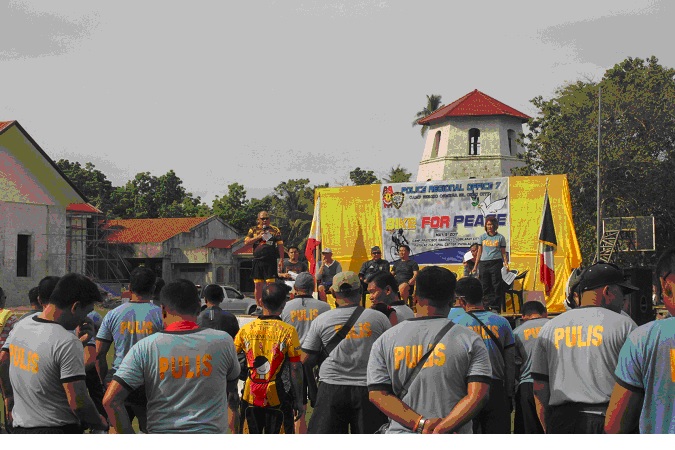
General Taliño explains the rationale behind the Bike for Peace which the PRO brings to Panglao and Anda in Bohol May 9-10. The first ride for peace under his term, the Bike for Peace would also be done in other Central Visayan provinces, Taliño said. (rahc/PIA-7/Bohol)
by admin | May 9, 2017 | ASEAN agenda, DTI Updates, Headlines
Calls on negotiators to find ways to solve pending issues
MANILA—All 10 ASEAN Member States (AMS) and the six Free Trade Agreement (FTA) partners should show “political willingness to move the Regional Comprehensive Economic Partnership (RCEP) forward,” the country’s trade chief asserted.
Trade Secretary Ramon Lopez said that political determination of all 16 RCEP participating countries is most crucial in pushing for the substantial conclusion of RCEP, following 17 rounds of negotiations since 2012.
China, Korea, Japan, Australia, New Zealand and India are the six FTA partners of the 10 AMS Brunei Darussalam, Cambodia, Indonesia, Lao PDR, Malaysia, Myanmar, Singapore, Thailand, Viet Nam and the Philippines.
Speaking at the opening of the 18th RCEP Trade Negotiating Committee (TNC) Meeting and Related Meetings on 8 May, Sec. Lopez, as chair of ASEAN Economic Ministers (AEM) Meeting, enjoined lead negotiators to “find solutions to all remaining challenges” that hinder RCEP conclusion.
“We want to find solutions as soon as possible because I think we are nearing substantial conclusion. Let us find ways to solve remaining issues,” he said, hoping that related meetings in the future will not be pressed by the same challenges of today.
The potential 3.5 billion market
Being negotiated to bring about positive and beneficial outcomes, RCEP is seen to intensify trade and investments, lower trade barriers, facilitate trade, and galvanize the gains from regional economic integration—among the most dynamic economies in the Asia-Pacific region.
Now on its 18th round in Manila, RCEP is armed with the momentum of having thus far concluded chapters on Small and Medium Enterprises (SME), Economic and Technical Cooperation, and, in principle, the Competition Chapter.
“With our markets integrated, we will be more attractive and competitive in partnering for change and in engaging the world. As host, the Philippines is keen on opening up opportunities for SMEs to play an integral role in the global value chains,” Sec. Lopez said.
The full and effective implementation of RCEP can expand the current 620 million ASEAN market to a greater integrated market of 3.5 billion with the six FTA partners, accounting for almost half of the world’s population and almost 30 percent of global Gross Domestic Product (GDP).
For ASEAN, RCEP is a reflection of the organization’s thoughtful and deliberate process of integrating the region into the global economy, building on the ASEAN + 1 FTAs with ASEAN Dialogue Partners.
Sec. Lopez reiterated that RCEP should translate to generation of more jobs and creation of more business opportunities for ASEAN citizens.
Call for an expedited negotiation
“RCEP is indispensable as it is designed to be pragmatic, paying heed to the levels of development and sensitivities of each negotiating country,” explained Sec. Lopez, adding that despite the more uncertain geopolitical and economic climate, ASEAN remains resilient and progressive, inclusive and forward-looking, as evidenced by “the continued increase in trade and investments towards achieving shared economic prosperity.”
The trade chief encouraged RCEP lead negotiators to expedite negotiations without sacrificing quality and long-term economic gains to achieve a substantial conclusion of a high quality and credible RCEP by year-end.
The 18th RCEP TNC Meeting and Related Meetings ends 12 May.
“I look forward to hearing good outcomes when I meet fellow ministers at the 3rd Inter-sessional RCEP Ministerial Meeting in Hanoi a few days from now,” he concluded.
by admin | May 8, 2017 | DTI Updates, Headlines, National News
MANILA—Trade officials from 10 ASEAN Members States (AMS) and six free trade agreement (FTA) partners China, Korea, Japan, Australia, New Zealand and India are all set for the 18th Regional Comprehensive Economic Partnership (RCEP) Trade Negotiating Committee (TNC) Meeting and Related Meetings from 8 to 12 May 2017.
“RCEP should be able to demonstrate that we continue to underscore the developmental function of international trade that benefits ultimately the broader base of the economy,” said Department of Trade and Industry (DTI) Secretary Ramon Lopez, who also serves as chairperson of the ASEAN Economic Ministers (AEM) Meetings 2017.
To keep the momentum going, it becomes all the more important that the overall RCEP package will suit the developmental needs of the RCEP Parties.
“For the Philippines, RCEP should translate to more jobs and more business opportunities leading to higher incomes for many Filipinos,” the trade chief added.
Deeper ‘integration’ through RCEP
The ASEAN-centric and ASEAN-led RCEP is considered the new tailwind for global growth as it heads towards a more substantive phase following 17 rounds.
The Manila Round will entail redoubling of efforts in order to deliver the broader and deeper commitments being called for goods, services and investment liberalization given the mandate of Leaders to substantially conclude RCEP this year.
RCEP aims to achieve a modern, comprehensive, high-quality and mutually beneficial economic partnership agreement. Once concluded, this will further contribute in deepening ASEAN’s economic integration and heighten its role in global trade and investment.
RCEP is poised to boost global growth by expanding the ASEAN consumer base of 620 million to 3.5 billion, integrating the major economic player markets, which will account for almost half of the world’s population and almost 30 per cent of global Gross Domestic Product (GDP).
PH pushes interests in RCEP
As host, the Philippines joins the rest of AMS in finding creative solutions to outstanding issues, as Parties try to reconcile differing views and achieve a balance among the interests of the developed, developing and least developed economies, as well as to address these in the most efficient and equitable manner.
The bid to move RCEP forward requires political willingness, especially at the moment where return to economic protectionism is being considered in some parts of the world.
As one of the key players, the Philippines continues to push sectors, wherein the country has trade and export interests such as canned tuna, fresh pineapples, mangoes, garments of synthetic fibers, raw cane sugar, crude coconut oil, cut tobacco, bananas and coconut copra oil, among others.
The Philippines supports the streamlining of certification procedures for RCEP originating goods taking into consideration latest business practices.
RCEP also aims at streamlining customs procedures that go beyond some areas of the World Trade Organization (WTO) Agreement on Trade Facilitation. Parties are exploring setting a 48-hour release time for imported goods.
In the area of trade and services, RCEP is expected to bring freer movement of Filipino skilled labor in professional services such as accountancy, engineering, architecture, computer-related services and other business services across 16 RCEP participating countries.
Concrete achievements of the Manila Round will further contribute to the Philippine hosting of ASEAN 2017 as a milestone year. The 18th RCEP TNC Meeting and Related Meetings places the Philippines at the core of the region’s continuing work with its economic partners in further integrating ASEAN into the global economy.

