by admin | May 10, 2010 | Election 2010, Headlines
A few more visits around more precincts led to the conclusion that the speed of the queue at the clustered precincts depended on the creativity of the Board of Election Inspectors assigned. There were precincts that were practically done by 1PM, mostly “cruising” smoothly to around 400 voters by 3:30PM. Some precincts have dismal progress of only 200 by 4PM.
If you were lucky to have creative BEIs, you were given priority numbers when you got to the precinct, and they would call the next number every time a voter finishes.
Unlucky voters had to contend with “batch” processing where about 20 people are allowed inside the precinct and nobody is allowed to come in until all the 20 people are finished.
Minor PCOS glitches observed were caused by paper jam or ballots not accepted at first try. However, this did not cause a bottleneck because the PCOS machines needed only about 5 to 10 seconds to process each ballot so once the machine is ready again, the queue behind it is gone is a few minutes.
The bottle neck is the queue. The COMELEC forgot about issueing priority numbers which should have helped calm down the crowd and allow others to decide to go home first and come back later. With five precincts clustered, it is obviously going to cause longer lines.
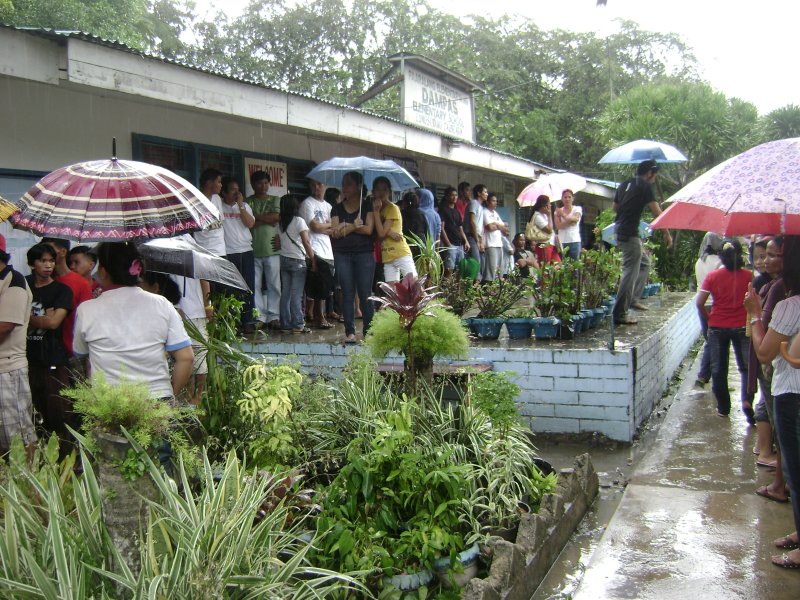
Voters in Dampas, Tagbilaran City waiting for their numbers to be called. Because these voters were given priority numbers from 1 to 1000, they simply have to wait for their numbers to be called.
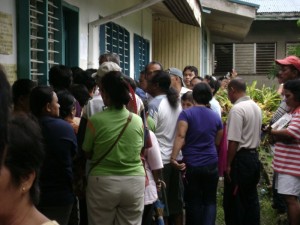
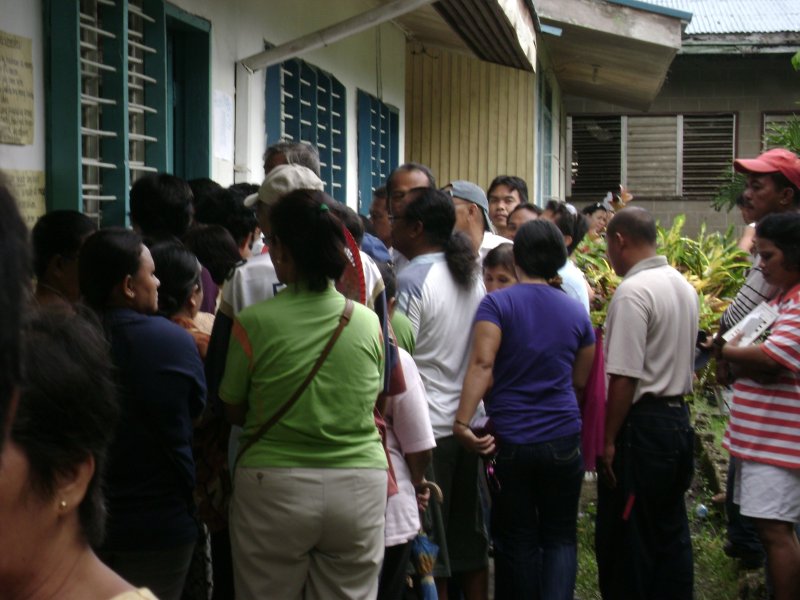
Impatient voters waiting for their batch at a precinct in Dampas, Tagbilaran City.
by admin | May 10, 2010 | Election 2010
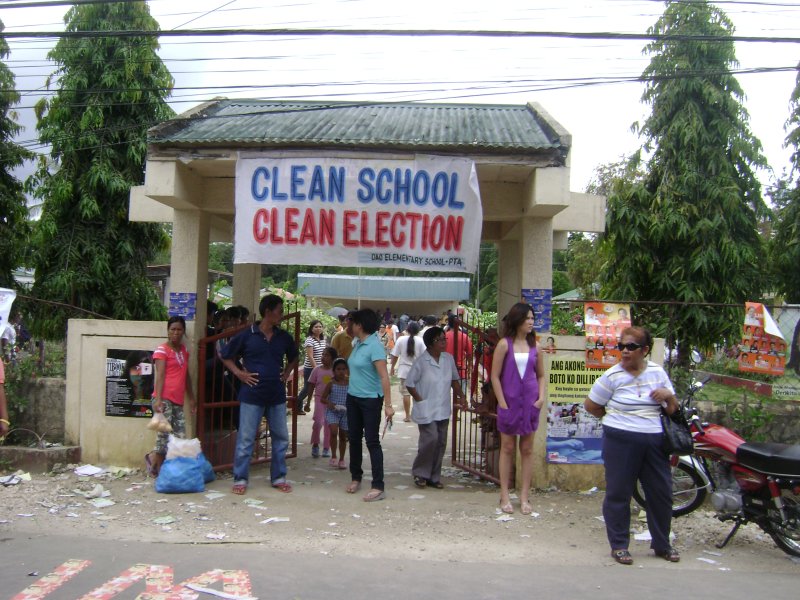
It is the hope of all Filipinos that this year’s eletion will be clean or at least much cleaner that past elections. The school’s banner in Dao Elementar says it all.
However, littered around are sample ballots and campaign materials. We hope this does not reflect what the elections would become as the day ends.

by admin | May 10, 2010 | Election 2010, Headlines
As of 10AM, May 10, 2010, no reports of election related violence or anomalies. Observations so far include longer lines than usual and elderly people needing assistance with ballot shading and feeding into PCOS machines. However, progress of voting si proceeding smoothly with the non-elderly people quickly filling up votes feeding into the PCOS machines without problems.
by magnolia_eic | May 8, 2010 | Announcements, Election 2010, Features, National News
The automation of counting of ballots at the precinct level on the May 10 national elections is hounded by a lot of controversy of malfunction and other issues. The latest and embarassing mistake made by COMELEC and Smartmatic involved a relatively simple program issue: single space vs. double space. It is something that is easily tested and fixed before they came out to the public. However, it is also possible to be an honest human error and nothing more. The machine just follows whatever instruction it is given and an erroneous instruction would lead to erroneous results. But this error is already fixed and should not be used a basis for calling the coming elections a failure.
In the last several weeks, so much misunderstanding, either due to lack of information or misinformation that has confused all of us and has created a cloud of doubt on the capability of COMELEC to succeed in the coming elections. Auza.Net has compiled 10 Myths About the May 10 Elections. This serves as a guide to all voters and hopefully everyone can vote according to their concience and free will rather than be influenced otherwise because of some of these myths.
1. We can’t verify the results of the counting and therefore it is easier to cheat in this election.
— Of course we can. The ballots will not be destroyed after counting. In the worst case scenario, we can always do a manual count. But let’s do an automated count first because the machines are definitely faster and more accurate and consistent than humans. And we can repeat the counting as many times as needed if we have to. We just need to be vigilant that the counts are real and this can be verified by the random manual count audit. COMELEC is going to be capable of publishing results much quicker than in previous elections so it is easier to verify results because we can immediately see the counts right after close of election time.
2. The candidates will know who voted or did not vote for them. — This is not possible unless you show your ballot to them or the COMELEC will give them copies of the ballots, the ballot number assigned to you and your name. So what if they know whom you voted for? It is your right to vote whoever is your choice.
3. If the PCOS machines fail, there will be failure of elections. — Not true. This is a doomsday scenario possible only if the Filipino people are not able to count. The ballots are still there. That’s what the election is all about. If the PCOS machines can’t count the results, the BEI can count them.
4. Transmission of the results to COMELEC central database is easily to disrupt. — Not true. With good signal from mobile service providers in most areas in the Philippines, there should be no issue in transmitting most of the results. In areas where mobile service is not available, COMELEC can use satellite service or they can bring the PCOS machines to areas with signal so it can transmit the data after the official tally has been printed and accepted by the BEI and other authorized parties. Also, the amount of data transmitted is very small so the opportunity to disrupt transmission is very short plus you can retransmit as many times as needed.
5. All processes of the election will be automated. Not true. Only the counting of the ballots at the precinct level is automated. The rest of the process of aggregating the results still goes through the manual process. Only this time, the manual process of aggregation is assisted by the availability of the results data in electronic form.
6. Current survey results must match the election results. Not true. The survey results reflect only the sentiment of the sample population at the time of the survey. And it is possible that the sample for the survey happens to be biased. Surveys have been proven wrong many times before. The real survey is the election itself.
7. On election day, it is easy to reprogram the PCOS machine to favor a local or national candidate. Not true. Once the machines are tested and sealed, it will be close to impossible to change the program. Even if the PCOS machines are programmed to cheat before sealing, this can be detected by the random manual audit. It is important for organizations like NAMFREL, PPCRV and others to make sure that the random selection of the precincts for manual audit is truly random and is selected only during election day. They also need to make sure that all precincts are eligible to be selected. COMELEC Resolution 8837 covers the selection process. If this is done as stated in the resolution, it is very difficult, if not impossible, to cover up any cheating.
8. The failure rate of the PCOS machines in Hongkong is 10%. PCOS machines will have problems dealing with humid conditions in the Philippines. Not true. The failure rate of the PCOS machine in Hongkong as reported by some groups is exaggerated. Their calculation was only based on the initial failure and not on the fact that the machine worked after it was allowed dry up because of moisture build up. That is also the reason why there are backup PCOS machines and technicians to ensure that any failing machine can be fixed or replaced. Any electronic equipment stored in an airconditioned room with low temperature and then brought out to a humid environment may have moisture build up as the water in the air condenses on the equipment. The user simply has to allow the moisture to evaporate again and the equipment to stabilize to room temperature. Once the equipment is turned on, the heat from the electronics will prevent any further moisture build up. We have been using computers in this country for decades without much problems due to moisture.
9. Manual count is better than machine count. Not true. Machines would have lesser error assuming it is not intentionally programmed to count otherwise. The PCOS machine would be faster, repeatable and cheaper in terms of labor cost. There is much lesser opportunity to implement dagdag-bawas. Let’s give COMELEC a chance to implement an election process with automation on the counting. Even with the glitch in the first attempt to test and seal the machines, there’s no reason to panic yet, especially now that the glitch was solved and replacement compact flash cards have been shipped and most should arrive before May 10.
10. If I don’t get elected , there will be people power. This is a myth. People power is not an automatic response by the Filipino people. It is only needed in extreme circumstances like that in 1986. Any candidate who says something like this are not fit to hold public office because it is the Filipino people who will elect a candidate and the candidates should bow to the will of the people. The Filipino people have the right to choose their leader and candidates should not threaten the voters with people power if they don’t get elected. Refer to #6.
by magnolia_eic | May 8, 2010 | Announcements, Election 2010, Headlines, National News
The Commission on Elections has announced that the 90-day campaign period ends at midnight, and the liquor ban will move in.
The end of the campaign period signals the implementation of various prohibited acts tomorrow and on election day (Monday) aas provided for by the Omnibus Election Code.
James Jimenez, Comelec spokesperson assured the people that preparations for the automated polls has reached 98% and that the main concern which the Comelec is watching now is the delivery of the compact flash cards.
Click here for full article from the Philippine Star
by magnolia_eic | May 7, 2010 | Election 2010, Headlines, National News
Manila, Philippines – Automated elections nationwide will push through this Monday, the Commission on Elections (Comelec) said yesterday with renewed optimism after the machine passed a second round of tests.
The results of testing PCOS machines in Metro Manila, showed a 100 percent match of manual and machine counts of votes.
Melo added however that manual counting should be held only in small municipalities where in case of a malfunction, a spare one is not immediately available.
Click here for full article from Philippine Star