by admin | Nov 11, 2018 | Headlines
Bohol could be leading all other provinces in the country for coming up with a new hatchery for giant clams.
Socio Economic and Environment Management Cluster Liza Quirog, who also sits as the Provincial Agriculturist claimed this in front of the gathering of fish wardens, police environmental officers, coastal law enforcement council (CLEC) members and local officials gathered for the 2018 Annual CLEC General Assembly inside the Pavillion of the Panda Tea Gardens and Suites, Dao, Tagbilaran City.
Quirog, who took over in presiding the gathering in lieu of CLEC provincial chairman Governor Edgar Chatto, added it would not however be something new, as Bohol has consistently led the pack in innovations among local governments.
CLEC has been Bohol’s response to coastal law enforcement as it remains one of the most daunting challenges of resource management for local government units (LGUs) depleting valuable resources and making campaigners lose steam.
Decades back however, the campaign against illegal fishing in Bohol is made more efficient at lass costs with LGUs sharing resources and information through an inter-LGU, multi-agency, multi-sectoral CLEC.
After the national government empowered LGUs to manage their own resources, illegal fishers here have always evaded apprehension simply by moving from one town to another.
As their activities hold enormous negative impacts on the coastal environment including lessening fish catch, destruction of marine habitats, loss of income of small-scale fishers, expensive fish prices and fewer marine products, the Provincial Government of Bohol, supported by CRMP, called all fishery stakeholders to a Coastal Law Enforcement Summit in 2000.
This was to discuss and identify solutions to the illegal fishing problem.
The common conclusion: illegal fishing can be more effectively addressed through coordination and an integrated approach to coastal law enforcement.
This pushed for the creation of CLEC in each of Bohol’s three congressional districts, a move which now expanded to cluster of contiguous coastal towns.
And just as the collaboration between municipal governments improved in terms of resource sharing, the annual training and sharing of information allowed law enforcers and prosecutors and judges to be more technically equipped to handle cases involving violations of coastal laws.
This year, the CLECs, summoned by Executive Order No. 1, series of 2015 which strengthened and sustained monitoring and protection of Bohol coastal resources by institutionalizing CLEC, as part of its sustaining mechanisms for effective implementation, members gather to discuss accomplishments and challenges.
CLEC members also shared initiatives and best practices, especially in enriching coastal ecosystems and increasing fish stocks.
Just as local communities adopted marine protected areas assess their fishing areas in a bid to fast track rehabilitation of the depleted resources, the idea of seeding the MPAs with giant clams came naturally.
Giant clams or the Hippopus and Tridacnagigasspecies are believed to play a wide range of ecological roles in coral reef ecosystems, according to then Bohol CRM coordinator AdelfaSalutan.
Marine biologists have seen how giant clams’ tissues become food for a wide array of predators and scavengers, while their discharges of live zooxanthellae and gametes are eaten by opportunistic feeders.
Their shells provide substrate for colonization by organisms that live on its surface while other organisms and ectoparasitic organisms thrive within their mantle cavities, increasing the topographic heterogeneity of the reefs, as they act as reservoirs of zooxanthellae (Symbiodinium spp.), and those that potentially counteract eutrophication via water filtering.
Scientists also stress that dense populations of giant clams produce large quantities of calcium carbonate shell material that are eventually incorporated into the reef framework.
Found to be endemic to Bohol waters as proven by the presence of giant clam shells, these clams were over harvested to extinction in these waters, Salutan added.
First seeded in five marine sanctuaries: Bingag in Dauis, Basdio in Guinduman, Badiang in Anda, Sinandigan in Ubay and Lipata in Carlos P. Garcia, the giant clams sourced out from a facility in BolinaoPangasinan, is now being hatched at the Bureau of Fisheries and Aquatic Resources Multi-speciaes Hatchery in Sinandigan.
Quirog told CLEC members that the Provincial Government has sourced out a giant clam hatchery spawning tank and larval rearing, phycology laboratory for algal feed to the clams, and water pumps with aeration and filtration systems.
Said to be operational soon at the multi-species hatchery that also hatches grouper, pompano, siganids, prawn, mussels, abalones and blue swimming crabs, the giant clams to be produced here would be seeded in well managed marine protected areas all over Bohol.
Bohol aims to provide incentives and livelihood to communities managing their MPAs well by giving them earning potentials from the export of these exotic meat and novelty shells, Bohol Environment Management Officer JovenciaGanub said. (rahc/PIA-7/Bohol)
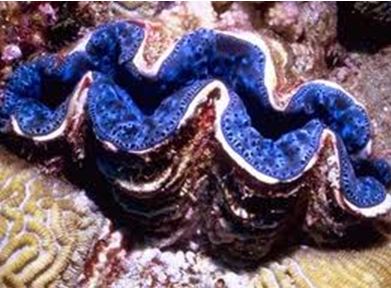
Tridacnagigas or giant clams used to be common in Bohol seas but overharvesting has made these marine resource extinct. With the help of science and a boost from research, Bohol now sets up a hatchery for giant clams, for future seeding in Bohol waters to hasten the restoration of the ruined and overfished marine ecosystem. (PIABOhol)
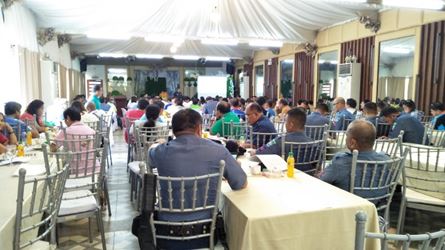
CLEC members gathered last week to share experiences and discuss common issues and concerns in keeping Bohol’s coastal resources at its peak to be able to feed its people. (rahc/PIA-7/Bohol)
by admin | Nov 10, 2018 | Headlines
A lone fast boat has been spotted by equipment watching the coasts of Central Visayas, the only one unidentified among a fleet of commercial fishers, passenger ships and fastcrafts in the area.
A tiny blip in the vast seas occupied by a screen full of codes for each blip except one, moving from to the north.
Scramble in the Philippine Coast Guard (MRRV) Multi-role and rescue vessel to hail the suspect.
One more potential threat off the water, but thanks mostly to a technology that the law enforcement and the PCG have at their disposal.
Enter the Vessel Identification Network Tracking Application (VINTA) and Intensified Community Assistance Awareness Response and Enforcement (I-CARE), two web-based application and webpage that helps the PCG better serve the sea-faring public.
According to PGC District for Central Visayas Commander, Captain Ronnie Gil Gavan, “VINTA and I CARE were developed by the PCG to use the tech-savvy young generation of coast guards the facility of online tracking departing and arriving vessels digitally.”
VINTA and ICARE also allows the PCG to gain electronic records of all sea-going vessels, track them wherever they may be in high seas and send in help if they happen to be in distress.
An enhancement of the usual pre-departure and clearing operations by the coast guard elements, instead of just visual checking of the ships logs and voyage documents, coast guard elements take digital snaps of these documents, and send them to the nearest station.
In the station, an office personnel who keeps logs on violations, boat conditions, papers and documents compares these digitally snapped documents and fits them according to the checklist for a legal voyage. If the boat’s papers are in order, the station then sends the clearing message to release the boat for the trip.
A previous violation or a non-compliance to sea-worthiness tests, franchise infarctions which has remained unsettled, can easily be seen and holds the boat to anchorage.
These digital files are then kept, and a copy of such is passed to the port of destination where a similar coast guard personnel keeps logs.
The clearing official sends to the corresponding personnel at the port of call the boat’s departure time, estimated time of travel, estimated time of arrival and trip details like ship captain, crew, passengers and cargo.
Any delay in the trip can raise a red flag in the ICARE system, which allows the coast guard at port of destination to immediately dispatch rescue boats and the blinking image only stops as soon as the responding PCG team spots the boat, and leads it to port.
Captain Gavan, however sees something more to this facilitated safety measure.
“This allows us to have the big data which would help us in the dynamic analysis of all available information in our maritime domain,” the commander who came in after a decorated coast guard service in Zamboanga, his previous assignment.
The launching of the VINTA and ICARE were just among the highlights of the 51st founding anniversary of the Philippine Coast Guard, November 7, 2018.
Also opened to the public especially for their stakeholders was the Lapulapu Hall in the third floor of the District Headquarters at Pier 3 in Arellano Street, Cebu City.
From sea rescue in their areas of responsibility in Central Visayas, the PCG has also been instrumental in keeping coastline security and maritime patrol operations, vessel fire rescue to search for survivors in the Naga landslide.
True to its mandates, the PCG has led in the enforcing of laws within Philippine waters, conducting maritime security operations, safeguarding life and property at sea, and protecting marine environment.
The coast guard also had Deputy Commandant Rear Admiral Rolando Legaspi as keynote speaker leading the guests that included agency partners and maritime stakeholders and its most active coast guard auxiliary units across the region.
A formal awarding ceremony for pinning of bronze cross medals to exemplary personnel who saved and rescued sea mishap victims also happened during the day. (rahc/PIA-7/Bohol)
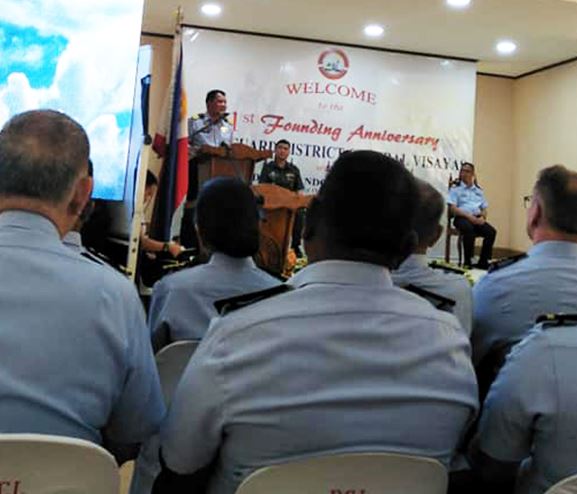
PCG Captain Gavan briefs everyone of the new apps called VINTA and web page called ICARE during the 51st founding anniversary of the Philippine Coast Guard, inside the newly opened HawananniLapulapu at the District Office in Cebu. (rahc/PIA-7/Bohol)
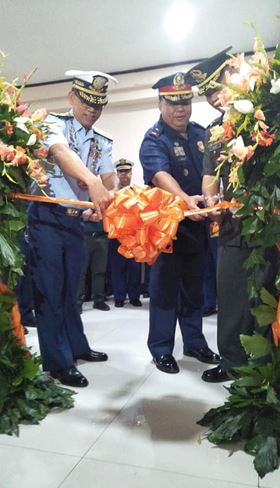
PCG Deputy Commandant Rear Admiral Rolando Legazpi and PCSuptDeboldSinas lead the guests in cutting the ceremonial ribbon opening HawananniLapulapu, to provide the venue for stakeholder interaction among maritime clients. (rahc/PIA-7/Bohol)
by admin | Nov 10, 2018 | Headlines, Tech Talk
The Provincial Science and Technology Center (PSTC) of the Department of Science and Technology (DOST) in Bohol brings in an interactive exhibit of science and technology innovations, technical fora to present to students and the science and community a chance to see how science concepts work and how these are applied to bring in technological development, at the Island City Mall, Tagbilaran City November 14-16, 2018.
The events also coincide with the 2018 Central Visayas Regional Science and Technology Week (RSTW) celebration carrying the theme: “Science and technology for the People: Innovation for Collective Prosperity,” according to Bohol PSTC Provincial Director VinaAntopina.
The celebration also brings to Bohol DOST Secretary Fortunato dela Peña, who together with DOST undersecretary for research and development Rowena Cristina Guevara, DOST 7 Regional Director EdilbertoParadela and local officials led by Governor Edgar Chatto, House Committee for Science and Technology Representative Erico Aristotle Aumentado, and Congressmen Rene Relampagos, Arthur Yap and City Mayor John Geesnell Yap II to witness the proclamation of DOST 7 Science and Technology Ambassadors, launching of newly approved SET-UP Bohol Projects and the opening of science and technology exhibits.
DOST RD Paradela said this year’s “RSTW highlights how science, technology and innovations (STI) play a major role in achieving national development.”
PD Antopina, in an interview earlier said they haggled to bring the exhibits in Bohol, considering that other regions are also pulling for the exhibits in their areas.
The exhibit in Bohol for this year will simulate an ecosystem of how STI work together for the progress of a community, Paradela added.
“Here, technologies developed by the DOST and its attached agencies, as well as its partners, will be displayed for the first time via interactive displays in four clusters namely: STI at Home, STI in School, STI in the Workplace and STI in the Marketplace,” Antopina revealed.
Aside from the STI main exhibits, DOST also brings in corollary technical for a set at the Atrium of the Island City Mall, from November 15 to 16.
The DOST technical forum is also grouped in a thematic presentation of harnessing STI for Education and STI for Enterprise Development.
For the academe, included in the technical fora is Boholano educator Dr. Christopher Bernido and President of the Central Visayan Institute in Jagna as well as academician of the National Academy of Science and Technology, who will speak about “Harnessing STI in the Academe Sector.
Science Education Institute’s Director, Dr. Josette Biyo would talk about Building the Science Culture and reintroduce the DOST Scholarship Program.
For Value Creation from S and T Innovations, is Office of the Director Advance Science and Technology Institute Acting Director, Dr. Joel Joseph Mariano Jr., while Dr. Joseph Malalu-an, Graduate Officer of the Mindanao State University will talk about Academe Based Innovations for Enterprise Development.
As to harnessing STI for Enterprise Development, DOST’s Philippine Textile Research Institute’s director Dr. Cecilia Elumba would talk about Promoting Inclusive Innovation and Circular Economythrough DOST’s PTRI’s TELA program.
Also in is a topic on Innovations in Food Product Development with DOST Cebu PSTC Science Research Specialist Dr. Bryan Ybañez.
Taking the center stage are documentaries of Bohol Small Enterprise Technology Upgrading Program (SETUP) in the Bohol Experience of Harnessing STI in Enterprise Development.
Finally, the chief of the Packaging Technology Division of the Industrial Technology and Development Institute Daily Tañafranca would talk about Creating Competitive Advantage through packaging Innovations.
The day-long for a would also feature open forum where resource persons and the general audience can interact. (rahc/PIA-7/Bohol)

OFF FOREVER. Imagine your kids being spared from mosquito bites, not because they had a perpetual supply of insect repellant lotion, but because they are wearing an innovative technology of mosquito-repellant baby clothes developed by the Philippine Textile Research Institute of the Department of Science and Technology. Dr Cecile Elumba is expected to share this technology this week at the RSTW STI exhibits at the ICM. (PIABohol)
by admin | Nov 5, 2018 | Headlines
Across time, Boholano attitude towards rice and its consumption has apparently changed.
Rice, to Boholanos is as sacred as ubi, its ethno-religious root crop.
Such is so, that when farmer’s child trips and accidentally drops an ubi, the ubi gets a kiss, the child gets a whack in the butt.
When farmers dry the palay in pavements all over Bohol, people would make sure they do not step on it, or drive over it. Traffic accidents have happened because of this.
Such is the respect that when one spills rice on dirt, somebody has to scoop it, winnow and make sure dirt separates from the grains, and the salvaged rice is still good for another meal.
Which makes us wonder why across Central Visayas, data from the Philippine Statistics Authority said, Bohol consumes the biggest share of rice per capita at 103.37 kilos.
Here, where families are overly extended: the grandparents, aunts and uncles and their families sometimes live with a full family under one roof, and elders make it their mission to instil in the kids ways of saving rice.
When it comes as no surprise that these extended families sometimes find it hard to make both ends meet, teaching the kids to be content with what is on the table is good enough. No complaints. Just steamed rice or porridge dunked with asintibuok. That is fair fare.
So they would say, “suwaanba’yhumay,” if only to pound the truth in it.
Humay after all, is that new harvest which if often from the palihi patch: a small test planting patch which is harvested ahead in time for the dogmak. And that is another story.
Dogmak is a thanksgiving feast, or single table spread featuring the first harvest, for the spirits, the souls of the former tillers of the patch or the gods of the farm.
The thanksgiving roots from the quaint belief that among those
invited for the banquet who would be protecting the rice farm from pests infestation, weeds and calamities and a thanksgiving for a good harvest.
From this palihi patch comes the pilit (glutinous rice) for the suman, biko, putohumay, malagkit, all common fare for the padogmaksakalag-kalag.
It would then be no wonder why another expression comes to mind.
“Dilinakakan-on ogwakwakbastamakakaonkaog bag-ongani.” (witcheswont be after you if you’ve had the new harvest).
But that again is another whole new new story.
From that palihi patch, parents would make sure that the children get to know the farm work. So they have to join in the harvest, pile the kalero, thresh rice by hapos (smashing grain laden bundles of rice stalks against a makeshift bamboo slatted floor) or gi-ok (on bare feet, one twists over the piled grain laden stalks) to separate the grains from the chaff. The works, we would say.
Children have to be on it. For a full day or days even. For the itch and all, including tungaw.
Then towards early afternoon, it’smagpapalid: one scoops heaps of palay from the pile, place it on a nigo (winnower), face the wind and gradually pour the grains out to a hapag or an unrolled banigbuli, pinukpok or saguran.
Those that are carried by the wind are the empty grains, the ones that fall nearby are then collected to be dried.
When the grains have dried enough to be pounded, another laborious job awaits the kids: lobok.
Farm families here make it a habit to have wooden pestles weighted for kids, some even craft small pestles for the kids to train.
It is usually in the pinsa, or under some shade where you hit nothing when you raise the pestle.
To keep every grain safe, one unrolls a mat, places the mortar in the middle and there in that hub, is the pounding and grounding. Well, sort of.
Scooping dried palay with a paja (spoke-shaved coconut shell), the kids fill the pestle halfway and the pounding starts.
And that’s play-work.
With two or three kids to one mortar, they take turns lifting their own pestles to a rhythm. This is asud. No, you do not stop from pounding the middle of the palay inside the mortal, and you do not slow down on the rhythm or you hit another one’s pestle. Until the grains come out from the husk.Lug-as.Backbreaking.
And if they think, they’re off it after that, they’re wrong.
Tahop and alig-ig comes next. Here, kids need to multi-task. Manipulate the winnower and at the same time, drive the chicken off the pounded rice.
Not a grain should be lost. Generally.
Tahop is basically to separate the grain from the husk. All one needs to do is to throw the pounded rice into the air and catch it back with the winnower. Over 50 times.
ANd the step is done over and over until one gets all the polished rice from all the nilobok.
Alig-ig is when, from this already huskless load, one shakes the winnower into a rhythm and tilting it to one side: the polished rice tends to stick to the bamboo winnower and goes up while the unpolished tipasi slide down the bottom.
When the islagan comes out, this goes back to the mortar for another round of pounding, the polished rice, now ready for the pot.
When kids complain, elders would say, “daghan pa mo’gbugaskan-on,” although the truth is just right there, in hard work and saving for the family’s future.
And the dogmak.
So, when elders declare to the kids why they do not waste a grain, it never needs an explanation.
To nail it on, elders would say, “sausausiklugaskan-on, usakatuigsaempernoagwantahon.”
No, Boholanos do not want to over-produce. After filling the bandi (buri bag basket) or bakat (bamboo basket) with the year-long supply of palay, they stop.
“I-asa man na’ngdaghan, mabahay.” (What do you do with too much, you’ll just stale them.)
Boholanos are just that. Simple.Never complicated.
But, with rice abundantly growing here, Boholanos generally do not eat corn, unlike Cebuanos who have this as among its staples.
For Cebu’s per capita rice consumption, it is about 25 kilos less than what each Boholano consumes in a year. Beat that. But did we really waste rice?
Food and Nutrition Research Institute of the Philippines says the average wastage is about three spoonful every day. That is across the country.
So where does the 25 kilos more of rice Boholanos cook go?
Boholanos are not so much fond of root crops as rice substitute. Unlike other areas.
There are few who use sinaksakan (boiled rice with sweet potato, cassava, gabi, ube or any rice extender), but farmers always complain they easily get hungry. Towards lunch time, magkutoyangtijan is a usual comment, when the breakfast fare is with a rice extender.
The usual remedy is to cook more. For mid-morning pamahaw-bahaw.An there topo is a mid afternoonpamahaw-bahaw.
It is now wonder why, per capita, Boholanos consume 109 kilos of rice a year, a figure which is 25 kilos more compared to Cebuanos.
That did not did not even include one serving for the dogs. And the cats. In one radio program when people were complaining about the NFA rice, one caller even said the government is inconsiderate for his dogs.
In recent years in fact, that 3 spoons or 16 grams of rice wastage in Bohol, considering that the one who cooks puts in mid-morning and mid-afternoon snacks, and a serving for the pets, is no wonder.
And then, there is that old teaching that resounds in every Boholano mind. Etiquette.
Anything served, it would be damn ill-mannered for you if you take all of it. Leave something for etiquette. Oftentimes, it is a spoon-ful. Or more.Wasted.
Dinner cooking is never as illustrative of a people than in Bohol then.
Reasoning that when one is asleep, one needs no energy, so that is the basis for how much to cook.
They cook, all right, just barely enough, if only, maybe to save. “Igoragudigujodhabol?” That, to them is a measure. Cook just enough to have the energy to pull up the blanket.
At 6:00 PM oracion, everyone must be in, because if one misses it, dinner is served right after and there is not much of anything to be left, even for the cats.
In Bohol then, (and maybe even now) dinner is that worst time to gate crash.
Hospitable as they are, Boholanos know that even when you are not part of the count for dinner, you would be invited to eat, of course.
But you are not expected to eat. Good manners dictate that.
Because, when you indulge with the invitation, you would be depriving a family member of his blanket-pulling energy.
Now, you, who did not inform beforehand that you are coming to dinner, would just be like the one carried by the bad winds from wherever they may come, to their dinner table.
And they have a term for that: hinampak. Do not ever be one. (rahc/PIA-7/Bohol)