by admin | Jun 24, 2016 | Headlines, Local News / Bohol Balita
DTI Bohol, through TESDA conducts a 2 ½ month training on Basic Cookery in Duero, Bohol. The training which ran from March 18 to May 21 this year, was one of the activities under the Bottom Up Budgeting (BUB) Program of the municipality, which is implemented by DTI. Some twenty nine (29) out-of-school youth, teachers and working mothers were trained on the preparation of different dishes and desserts, as well as on the proper use of kitchen utensils and equipment.
TESDA Certificates were issued to the graduates during the culmination exercises last June 23 at the Duero Function Hall.
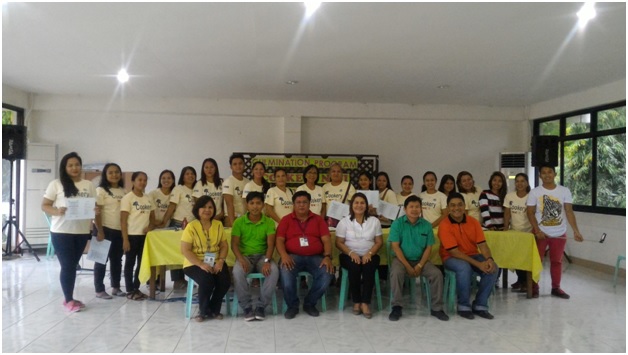
Photo:Culmination Program for the Skills Training on Cookery (TESDA NC-II)held at the Duero Function Hall on June 23, 2016. The activity was conducted by TESDA funded under the BUB funds from the Department of Trade and Industry. (seated from left Ms. AvelinaSabandal, Mr. Albert Garsuta, Mr. Rey Anthony Regis, Mayor Conrada Amparo, Engr. ApolinarCadeliña and Mr. JomarLectana)
by admin | Jun 24, 2016 | Headlines, National News
The Department of Trade and Industry’s Industry Promotion Group (DTI-IPG) urged micro, small and medium enterprises (MSMEs) to follow international product standards to break into the global market – in a seminar conducted at the Waterfront Hotel, Cebu City last June 11 under the Negosyo, Konsyumer, at iba pa (NKATBP) service caravan of DTI.
Participated in by over 200 MSMEs, exporters, would-be exporters, entrepreneurs including local startups and innovators, government trade promotions and business development officers, the seminar dubbed as “Catapulting New Business for the Global Market” held various discussions on how to drive businesses into the growing global market and how government programs and initiatives can assist in finding the right market for their products and services.
The IPG, composed of the Export Marketing Bureau (EMB), Foreign Trade Service Corps (FTSC), Philippine Trade and Investment Center (PTIC), Center for International Trade Expositions and Missions (CITEM), and the Design Center of the Philippines (DCP), takes the lead in developing and implementing programs and activities that promote the Philippines and local entrepreneurs’ products and services in the domestic and international market.
“Our entrepreneurs should go beyond the local market. Most economies today have been aggressive in providing the global market of products and services that provide unique and personalized experiences. The challenge for our exporters now is to expand their market reach by improving the quality of their products and services and explore innovative opportunities for their offerings,” said DTI Industry Promotion Group Undersecretary Nora K. Terrado.
Majority of the participants of the said event are budding entrepreneurs that seek opportunities in the international market. Challenges and obstacles in doing business abroad were also discussed during the said event.
Among the opportunities being tapped today to penetrate mainstream markets is the increasing Filipino communities around the world. At present, in Singapore alone, there are about 180,000 overseas Filipino workers and migrants.
Also dubbed as the “One DTI Services”, the Negosyo, Konsyumer, at Iba Pa (NKATBP) is an initiative of the DTI Regional Operations Group that brings together all services provided by the DTI under one event. The event aims to heighten the awareness of the localities especially micro, small, and medium entrepreneurs (MSMEs) and consumers, about the services offered by the Department.
IPG-led seminars will run through several regions from April to December 2016 under the NKATBP event.
For more information on the services of the DTI, log-on to http://www.dti.gov.ph
by admin | Jun 23, 2016 | Headlines, Local News / Bohol Balita, Major Events
TAGBILARAN CITY, June 23, (PIA) – Bohol pushes forward some P96.973 million worth of projects in support of peace, security and development and proposes for the Regional Development Council (RDC) in Central Visayas to endorse the lump of projects for funding to at last four concerned national agencies.
The lump of projects, 17 of them came out during various consultations with communities from the different towns in Bohol as facilitated by the Community Development Project (CDP) teams Purok Power Movement (PPM) or Prosperity Teams.
It may be recalled that the concerted efforts of Local Government Units, national government, civil society organizations, peoples’ organizations successfully mounted a unified effort to oust the hounding problem of insurgency, not much by the military force, but by directing the fight to alleviating poverty and creating jobs.
To maintain Bohol status as conflict and insurgency-free province, the Provincial Government ensured open lines of dialog between government and the populace through the deployment of CDP PPM teams, especially to distressed areas.
From these dialogs, consulted communities identified priority development projects that they believe could end the resorting to armed conflicts by opening up the tables for talks and negotiations.
After a series of validation and community workshops, development authorities identified four potential government agencies which Bohol could tap for funding support and have endorsed them to the Provincial development Council, according to Provincial Planning and Development Officer Atty John Titus Vistal.
Identified for Department of Public Works and Highways (DPWH) funding are the construction of concrete rubble and masonry with apron river dike to solve the flooding problems of Barangay Casbu, Guindulman town, the construction of a box culvert in Kauswagan Trinidad, construction of concrete water tank reservoir in Purok 7 proper and Purok 7 Annex in Barangay san Vicente, Bongbong and Kauswagan, also in Trinidad, as well as the contruction of a one-storey evacuation center cum multi-purpose building in Tambongan Candijay towns.
The four projects cost as much as P9.364 million, the request for RDC endorsement proposal states.
For the Department of Agriculture, proposed by Bohol for RDC endorsement are the improvement of 8.44 kilometers farm to market road in Pangpang, Ubay, the opening of a new 2-kilometer San Jose Mabini road and the opening and improvement of 2.43 kilometer Sua FMR in Inabanga as well as improvement of the 3 kilometer Montesuerte Carmen barangay road.
Also asking for DA funding are the improvement of a 2.73 FMR in San Jose Mabini, concreting and improvement of the 8.05 kilometer Sto Nino barangay road in Sto Nino, Talibon, another 6 km concreting of Sto Nino FMR and the improvement of the 2.5 barangay road in Villafuerte Carmen.
Still proposed for RDC endorsement to DA funding are 2.7 km concreting project for Faraon, Jagna FMR and the construction of a solar drier and pavement in Kauswagan (Purok 7 Matin-ao and Purok 6 Buenasuerte as well as Purok 1 in Tambongan Candijay.
These 10 projects rack up a total of P74.759 million.
For the Department of Education, Bohol peace team proposes for funding the construction of 3 classroom buildings for Panaghiusa, San Vicente and Bongbong all in Trinidad, and another 2 classroom 1 storey building in San Vicente of the same town.
All of these totals P11.650 million, according to the proposal presented during the second quarter RDC held at the Bohol Tropics Resort here.
From the Department of Social Welfare and Development, Bohol intends to tap assistance for the construction of a P1.2 million Day Care Center in Kauswagan, Trinidad.
According to the Bohol PDC which endorsed the projects, these are necessary to support and sustain the peace and socio-economic development in these vulnerable areas, by preventing the resurgence of arm conflict and insurgency.
The RDC on the other hand indulged in the move and successfully endorsed as proposed, the project for funding from the respective agencies. (rac/PIA-7/Bohol)
by admin | Jun 23, 2016 | Headlines, Local News / Bohol Balita
TAGBILARAN CITY, June 23, (PIA) –Responding to the effects of the long dry season and the searing heat brought about by the El Nino, the Department of Social Welfare and Development (DSWD) mobilized its resources to bring crucial relief to distressed communities in the island barangays of Bohol.
And, for its initial mobilization, DSWD Bohol reports the delivery of relief food and water packs to 22,771 individuals in 14 towns, most of them from the deprived sectors.
DSWD Bohol Chief Papiasa Bustrillos said with local resources, they are constrained to prioritize the distribution of rice, canned goods and water to families of farmers and fishermen of Bohol’s island barangays and towns, them being severely affected by the long dry season.
The drought brought about by the El Nino has not just damaged millions of pesos worth of agriculture, its searing and persistent heat ruined the multi-million seaweeds industry feeding thousands of seaweed farmers in the island barangays of northern Bohol, Bustillos revealed over at Kapihan sa PIA.
Right now, we are again continuing to pack more relief to be delivered to other areas in Bohol needing such, she said, adding that the delivery however depends on the availability of trucks from Bohol Provincial Disaster and Risk Reduction Council (PDRRMC).
We also intend to ask the Congressman from the Second District, Congressman Aristotle Aumentado to lend us his boat so we could deliver the goods to other islets, she said, as she hinted that the office continues with the relief despite the sudden change in climate from drought to a possible extremely wet.
The repacking, she added, is based on validated reports emanating from town teams.
The team, comprised of the town Social Welfare and Development Officer, Municipal Agriculture Officer, a representative from the DSWD Kalahi, 4Ps and the Sustainable Livelihood Programs, gather and shortlist the data of calamity-affected individuals from the barangays.
The data is the validated form the submitted list from the MAO, MSWDO and civil society organizations.
People who are severely affected may go to these teams and get into the list, but Bohol welfare officials also explained why not everyone can be given relief packs.
We are operating on a limited budget, so we make sure that only those who have no other means can get [the relief packs], Bustrillos explained.
Beyond that, by operational protocol, the local office has to keep a buffer stock of 10,000 relief packs which can be withdrawn any given time that an emergency strikes, she asserted.
The relief is just among the many interventions the DSWD is extending to communities and 4Ps beneficiaries who are severely distressed by the El Nino.
By July, the 4Ps Family Development Session, where a must attendance for 4Ps beneficiaries is exacted, would be tackling Disaster Preparedness, according to Phoebe Jen Indino, 4PS Information Officer.
The program, to be implemented in coordination with the Office of the Civil Defense, Philippine National Red Cross and the Bureau of Fire Protection would grant to communities the proper disaster preparedness to mitigate the often disastrous effects of the rain-carrying La Nina, Indino bared. (rac/PIA-7/Bohol)
by admin | Jun 23, 2016 | Headlines, National News
Technological advancement continues to improve the lives of millions of people around the world. Work gets done faster and resources are utilized more efficiently. These innovations are guided by standards that provide the framework needed to ensure constant growth and improvement. These standards form the backbone of technologies that contribute to the overall reliability and effectiveness of goods and services.
The International Organization for Standardization (ISO) /International Electrotechnical Commission (IEC) define a standard as a document, established by consensus and approved by a recognized body that provides, for common and repeated use, rules, guidelines or characteristics for activities or their results, aimed at the achievement of the optimum degree of order in a given context.
Under the Republic Act No. 4109 also known as the Standardization Law of the Philippines, the Department of Trade and Industry’s Bureau of Philippine Standards (DTI-BPS) supports industries and protects consumers’ welfare through the development and promulgation, implementation and coordination of standardization activities in the Philippines.
The development of these standards are guided by the Directives Part 1, Part 2 and Part 3 issued by DTI-BPS on the principles of standardization, the organization and responsibilities of technical committees, the procedures of technical work, and the structure and drafting of Philippine National Standard. These directives are issued as guides in the development of these standards.
Standards not only provide numerous benefits to individuals by ensuring that the products in the market are safe and reliable, it also promotes business and economic growth as it saves companies’ production time and money, enhances customer satisfaction and increases productivity and competitive advantages. The presence of standards in international market means countries can facilitate in trading goods and eliminate unnecessary barriers to trade. Standards also serve as vehicles for the transfer and application of technology from one country to another.
Standards are prepared either through the Technical Committee (TC) Method or the Fast Track method. Standards prepared through the Technical Committee method undergo a series of deliberations and consultations from concerned stakeholders. In order to achieve the purpose of standardization, transparency and consensus, a technical committee is composed of representatives from several sectors including academe, trade/industry, consumer association, professional, association, research institution, Government agencies and testing institution.
The development process for Philippine National Standards (PNS) follows a sequence of stages with corresponding document associated in each of the stages. Proposal stage (New Work Item Proposal), Committee stage (Committee Draft PNS), Circulation/Enquiry Stage (Draft PNS), Finalization/ Approval Stage (Final Draft PNS), Publication Stage (PNS).
Standards may also be prepared through the Fast Track method. In this process, International Standards shall be given priority. Fast Track procedure for standards development may be applied to international standards which are basic and can be used in standards development such as Guide, Terminology, Vocabulary, Classification and Symbol. This procedure may also be applied for International Standards which at the time of development has been circulated for comments to all sectors concerned. Similarly, this procedure applies to standards developed by other Standards Developing Organizations (SDOs) whose procedures follow the DTI-BPS Directives.
Consistent with its mandated roles and functions, the DTI-BPS shall prioritize standards of national significance such as life, health, safety, national economy and property, environment and efficient use of local resources. With that in mind, the BPS has listed priority areas for standards development and are guided by the Philippine Development Plan (2011-2016); Investment Priorities Plan (IPP); international commitments in the World Trade Organization and WTO Technical Barriers to Trade (TBT) and the ASEAN priorities and work programs under APEC; and standards for products affecting safety for consumer protection.
As of May 2016, there are 9,678 Philippine National Standards developed or adopted, 7,704 (79.60%) of which are already aligned to International Standards.
As the National Standards Body of the Philippines, the DTI-BPS is tasked to develop/adopt, implement and promote Philippine National Standards (PNS) as mandated in the Republic Act (RA) 4109 Series of 1964.
The DTI-BPS is the Philippines’ member to the International Organization for Standardization (ISO) and International Electrotechnical Commission (IEC).
For more info on standards and standardization activities, call the DTI-BPS at 751.4730 or visit the Standards and Conformance Portal – www.bps.dti.gov.ph.
For more information on the services of the DTI, log-on to http://www.dti.gov.ph
by admin | Jun 23, 2016 | Headlines, National News
The Department of Trade & Industry (DTI) DTI Secretary Adrian S. Cristobal, Jr recently signed a Memorandum of Agreement (MOA) with Department of Agriculture Secretary Proceso J. Alcala for the two agencies to jointly facilitate business permits, licenses, and endorsements involving investors applying for registration with the Board of Investments (BOI).
DTI Undersecretary and BOI Managing Head Ceferino S. Rodolfo said that the MOA is expected to improve ease of doing business in the country. “To benefit fully from the ASEAN Economic Community (AEC) and global market access, it is important that we offer a conducive environment to investors, a place where they could quickly set up their business. An important first step is to make it easy for them to comply with government requirements,” he said.
According to Rodolfo, simplifying business processes, coupled with the implementation of the Comprehensive National Industrial Strategy (CNIS), is keyto the development of the agriculture sectorwhich needs to modernize for it to be globally competitive. The CNIS links the manufacturing sector with agriculture and services sectors to mutually reinforce a virtuous cycle of growth.
Figures from the Philippine Statistics Authority show that investments in the agriculture sector slowed down to 4.4 percent in the first four months of 2016, weighed down primarily by the persistent El Niño phenomenon and the need to upgrade from traditional farming to a globally competitive agribusiness sector. Meanwhile, the manufacturing sector retained its momentum, growing by 8.1% during the same period due to improved business and consumer sentiments.
Under the MOA, a BOI representative is now authorized to assist a client to submit and follow up the application for endorsements, certifications, and/or permits with the DA up to the extent permissible by law. The MOA also provides for BOI to assist the DA in disseminating information regarding all relevant rules, guidelines, and standards on matters covering public investments, agricultural development and support services for domestic and export-oriented business enterprises and other related matters.
The MOA also provides for the DA to regularly provide BOI with copies of all relevant rules, guidelines, and standards on matters covering public investments, agriculture development and support services for domestic and export-oriented business enterprises. DA is also expected to provide BOI with a checklist of all requirements on application for accreditation, endorsements, certifications, and permits issued by the concerned bureaus and offices under the agency. DA will also regularly coordinate and cooperate with BOI drafting relevant policies relating to IPP, and other relevant rules, guidelines, and standards affecting investors and investment promotion activities.
Since 2014, the BOI, through the Investment Assistance Service (IAS) has signed five (5) other MOAs with Department of Environment and Natural Resources (DENR), the Securities and Exchange Commission (SEC), Department of Tourism (DOT), Bureau of Food and Drug Administration (FDA), Department of Health (DOH)-Health Facilities Regulatory and Services Bureau (HFRSB) to help businesses set up businesses in the Philippines.
“Clearly, the sustained economic growth of the country benefitted from policy reforms and increased collaboration to improve the ease of doing business in the country. The country’s current investment climate should benefit not only firms – whether foreign and domestic, large or small – but society at large,” Rodolfo concluded.
For more information on the services of the DTI, log-on to http://www.dti.gov.ph

