by admin | May 24, 2018 | Business, E-news Bulletin, Headlines
Ralf Rivas
MANILA, Philippines – The sharp fall of the Philippines in the 2018 World Competitiveness Yearbook (WCY) should serve as a “wake-up call,” business leaders said on Thursday, May 24.
Philippine Chamber of Commerce and Industry (PCCI) President Alegria Sibal-Limjoco said the dip in the Philippines’ competitive ranking by 9 notches in the 2018 WCY – to 50th place from 41st place last year – is a “wake up call for government and for business.”
Guillermo Luz, Private Sector Co-Chairperson of the National Competitiveness Council, reiterated that the government should pay attention to the numbers of the WCY, as well as other studies.
He explained that results of the study is a snapshot of how the Philippines is performing compared to its peers in Asia Pacific.
“We compete for FDIs, trade, tourists, branding. It is a competition, we need to look at what other countries are doing,” Luz said.
“In the ASEAN region, competition never sleeps. Respondents of these surveys look how we keep up with competition, how government implements regulation, and the measurability in terms of impact in the economy,” he added.
The WCY study rereleased on Thursday revealed that the Philippines is 50th out of 63 economies in terms of overall competitiveness. This is the country’s worst year-on-year decline over the last decade and the steepest drop in Asia Pacific.
The ranking is measured according to 340 indicators, about two-thirds of which are based on data and statistics, and the rest on the perceptions of over 6,300 executives worldwide.
Where it all went wrong
Despite having the fifth strongest real gross domestic product (GDP) growth in Asia Pacific in 2017 at 6.7%, the Philippines’ economic performance saw its biggest drop to 50th from 26th in 2017.
The report noted that the country’s current account deficit fand oreign direct investments (FDIs) were not impressive as compared to 2016. The peso was also dubbed as the most unloved currency in 2017, even posting 11-year lows against the US dollar.
Inflation also accelerated towards the end of 2017. As a result, the domestic economy, one of the sub-factors measured, declined to 24th from 12th place in 2017.
Jamil Francisco, executive director of the Asian Institute of Management’s Rizalino Navarro Policy Center for Competitiveness also noted the disappointing employment figures.
“The economy is resilient. But if you look at the employment of the regular [Filipino], this is where you see the problem because many have come in and out of unemployment,” Francisco said.
Employment in the WCY survey plummeted to 32nd place in 2018 from 4th in 2017. The drop was due to a slight increase of unemployment and a slight decrease in the number of employed as compared to other countries ranked in the survey.
The factor with the second largest drop in rank was business efficiency, now at 38th place from 28th place last year.
The report stated that the decline in business efficiency was caused by the dip in the following sub-factors: labor sector (5th to 19th), finance (33rd to 39th), management practices (28th to 33rd), and attitudes and values (18th to 34th).
The Philippines ranked near bottom the – 62nd place from 59th last year – in overall productivity in labor, agriculture, industry, and services.
Meanwhile, government efficiency experienced a 7-notch drop, now at 44th place from 37th. The decline was driven by dips in public finance (25th to 34th), institutional framework (41st to 46th), business legislation (58th to 60th) and societal framework (51st to 54th).
The country’s infrastructure, ranked at 60th place from 54th in 2017, continued to disappoint. The report noted that the government should also pay attention to basic, education, and scientific infrastructure and not just physical infrastructure.
“Good infrastructure promotes competitiveness by connecting markets and production sites, improving the flow of information and technology, and reducing the costs of production,” the report said.
Despite the gloomy figures, Limjoco said that investors are still interested to do business in the country and recognized the government’s efforts.
“Despite our competitiveness going down, there is something also that they like in our country. The tax reform will help our country move forward,” the PCCI president said.
Management Association of the Philippines President Ramoncito Fernandez also rallied support for the tax reform program of the government.
“We also support the necessary amendments of certain economic provisions of the 1987 Constitution,” Fernandez said.
The report recommended that the government invest in quality infrastructure, increase human capital, and strengthen institutions.
“In the digital era, workers must learn how to learn fast. Lifelong learning must be founded on quality basic and secondary education,” the report said.
It also stated the need to increase digital competitiveness, as “many jobs are at high risk of automation.”
WCY also recommended the need to manage the recent spike in inflation due to the effects of the tax reform program. – Rappler.com
Read more: https://www.rappler.com/nation/203290-philippines-ranking-2018-world-competitiveness-yearbook-wake-up-call
by admin | May 24, 2018 | Business, Headlines
By Jun Aguirre – May 24, 2018
KALIBO, Aklan—The local chapter of the Philippine Chamber of Commerce and Industry (PCCI-Aklan) urges government, especially the Civil Aviation Authority of the Philippines, to review the cancellation of several plane flights at the Kalibo International Airport (KIA).
PCCI-Aklan Secretary-General Guidon de la Cruz said several flights to and from Metro Manila and Cebu have been canceled after nearby Boracay Island was ordered closed for six months starting on April 26.
The closure also saw airline companies doubling ticket prices bound for the KIA.
“Because of this, businessmen, students and balikbayans have to travel to other nearby airports, such as the Caticlan Airport and the Roxas City Airport, to go to Manila. Direct flights to Cebu have also been canceled,” de la Cruz said.
“The reduction of commercial flights at the KIA created economic difficulties for both passengers and cargo traffic,” he added. Meanwhile, the roll-on, roll-off service from Caticlan to Batangas port is also full, brought about by summer travel and strong basic trade between Luzon and the Visayas region, he added.
The PCCI-Aklan board has filed a resolution to engage airline firms in consultation, thereby encouraging them to provide additional flight for Manila-Kalibo and restore the Kalibo-Cebu route even on limited basis.
“The reduction of plane flights also does not help promote local tourism, trade and commerce, which are supposed to be increasing due to expansion of e-commerce, resulting into convenience in the movement of people and goods across our islands,” de la Cruz further said.
Read more: https://businessmirror.com.ph/pcci-aklan-wants-review-of-cancellation-of-flights/
by admin | May 24, 2018 | Headlines
By Roderick Abad – May 24, 2018
FOLLOWING its recent success for ranking high in the region’s security index, the local government of Valenzuela received another citation—this time from the Philippine Chamber of Commerce and Industry (PCCI) as one of the “Most Peaceful and Safest Spots in Southeast Asia.”
The award was bestowed to the city for “exemplifying commendable initiatives toward good governance reforms and promote trade and investments, and significantly contribute to local economic development.”
In a presentation rite held at the Centennial Hall of The Manila Hotel on Wednesday, Mayor Rexlon T. Gatchalian was conferred a Plaque of Recognition for his efforts in maintaining peace and order in his area of jurisdiction.
PCCI President Alegria S. Limjoco led the awarding ceremony as one of the highlights of the chamber and associate business organization’s Second Joint General Membership Meeting.
Online database Numbeo recently cited Valenzuela as the second-safest city in Southeast Asia, next only to Singapore.
This is not the first time for the city, as it also figured on the site’s ranking back in 2015, placing third.
Aside from peace-and-order programs, the local government also implements initiatives on economic development.
Valenzuela is in the Hall of Fame of the PCCI’s Most Business Friendly City Award after bagging the accolade three times in a span of four years.
For the years 2014 and 2015, Valenzuela garnered the Hall of Fame trophy under Gatchalian’s leadership.
Read more: https://businessmirror.com.ph/local-biz-lauds-valenzuela-for-peace-and-order/
by admin | May 22, 2018 | Headlines, Photo Story
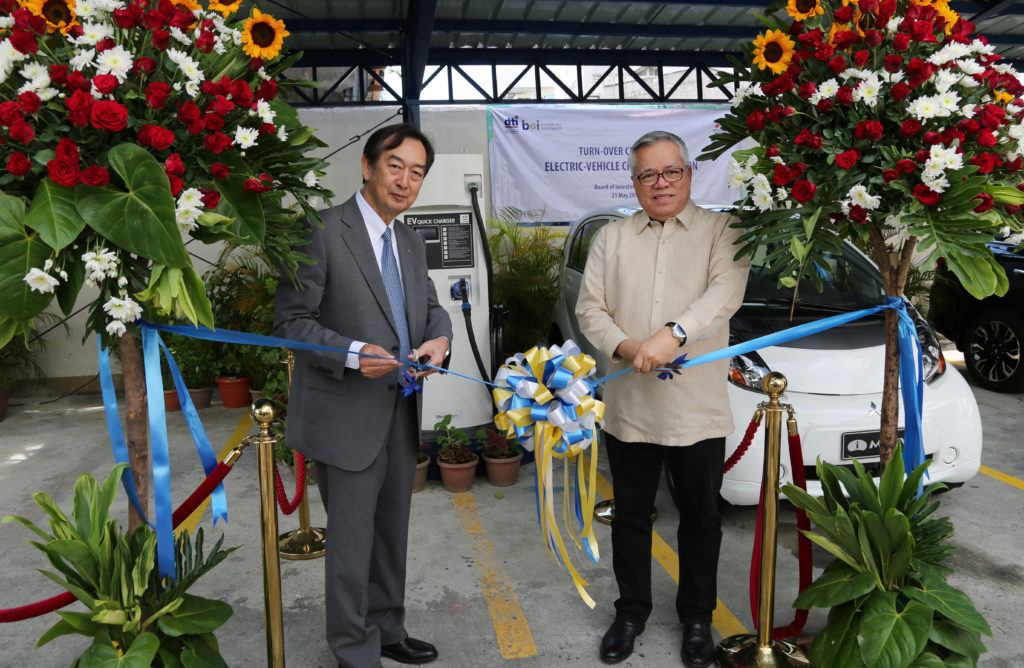
DTI RECEIVES QUICK CHARGING STATION TO PROMOTE E-VEHICLES IN PH. Department of Trade and Industry (DTI) Secretary Ramon Lopez (right) and Mitsubishi Motors Philippines Corporation (MMPC) President and CEO Mutsuhiro Oshikiri (left) unveiled an electric vehicle (EV) quick charging station at the Board of Investments (BOI) compound in Makati City on 21 May 2018. In line with the government’s push to create an EV ecosystem in the Philippines, MMPC donated the quick charging facility to DTI to complement their two Mitsubishi EVs, the I-Miev and the Outlander. This is part of the EV Research Study initiative being done by DTI-BOI, MMPC, and a consortium of universities composed of De La Salle University, University of the Philippines, Technological University of the Philippines, Mapua University, and Ateneo de Manila University. “We know that the future automobile is going to be transformed and driven by forces such as autonomous drive, electrification, diverse mobility, and connectivity. The cars of the future are going to be greener, electric, connected, and autonomous,” said Sec. Lopez. The results of the EV Research Study will serve as important inputs for the formulation of EV policies and programs. These cover environment, transportation, energy, and industrial policies necessary for environmental protection and the development of the EV industry.
by admin | May 16, 2018 | Headlines
Pasay – The Department of Trade and Industry (DTI) organized a Roundtable Meeting with top Philippine business executives to welcome Papua New Guinea (PNG) Prime Minister Peter O’Neill and Ministry of Finance James Marape last 16 May 2018. The meeting was organized to spur trade relations between PNG and the Philippines (PH).
“We are committed in having Papua New Guinea as a strategic economic partner through greater bilateral trade and investment ties, as well as substantive engagements in APEC. We are optimistic that even as we develop broader links of friendship between our two countries, we can expand opportunities for trade and investment,” said DTI Secretary Ramon M. Lopez.
According to the trade chief, PNG can look into investment opportunities in agricultural products as well as oil and gas exploration in PH.
Likewise, PH can export more processed food, electronics, machineries and equipment, packaging materials and appliances to PNG. To strengthen trade relations between the two countries, DTI is also proposing a bilateral economic cooperation through a Joint Economic Commission (JEC).
Meanwhile, Prime Minister O’Neill said: “Our relationship with the Philippines is very strong. We believe in the same principles.”
The Prime Minister also opened the discussion on an agricultural partnership. He highlighted the vast agricultural land in PNG and their small population, which is an opportunity for PH to produce rice in PNG. “We want to promote rice in Papua New Guinea, and we want it be a Filipino partnership, rather than anyone else.”
Department of Agriculture (DA) Secretary Emmanuel Piñol agreed in getting Filipinos to invest and plant rice in PNG. “We can help them produce their requirements and export to us the surplus. We can be assured of a steady rice supply,” the Agriculture Secretary said. He further explained that, “Philippine land resources are finite, but the population is growing too rapidly, the offer to use PNG land for our rice makes sense.”
“Our relationship with Papua New Guinea in terms of agriculture will be simple: we will train their people, help them develop their areas. And in return, they will assure that we will have enough rice for our people,” said Sec. Piñol.
There were 24 top business executives invited to the forum, like International Container Terminal Services’ Ricky Razon and Christian Gonzalez; First Pacific Company’s Manuel Pangilinan; LT Group of Companies’ Dr. Lucio and Michael Tan; SL Agritech’s Henry Lim Bon Liong; Jollibee’s Ernest Tanmantiong; Double Dragon’s Injap Sia; DMCI Sid Consunji; Century Canning’s Chris Po; Frabelle’s Francis Tiu Laurel; and SM Holdings Inc.’s Jeffrey Lim.
The event was also attended by PH Ambassador to PNG Bienvenido Tejano and PNG APEC Authority CEO Christopher Hawkins.
PH-PNG trade has also covered areas in training and assistance in Airline and Health & Medical Services. There are also Filipino businesses located PNG like the LT Group, and the RD Fishing PNG Ltd and Frabelle (PNG) Ltd., which are both involved in fishing.
On November 2018, President Rodrigo Roa Duterte is set to visit PNG along with a group of business delegates
by admin | May 15, 2018 | Headlines
The Department of Trade and Industry (DTI) has unrolled programs and projects to assist Boracay residents, especially the micro, small, and medium entrepreneurs (MSMEs), following the island’s closure last April.
“We had taken measures and interventions to assess and address the needs of the residents, especially our micro entrepreneurs and local workers, even before the actual closure of the island,” said DTI Secretary Ramon Lopez.
DTI started a series of consultations on 3 April 2018 with provincial and local government units, as well as business counselors, and conducted surveys among local business owners and workers in Boracay.
The respondents identified and requested assistance in online marketing, accessing new markets for their products, and help in relocating their businesses. Various skills training such as cooking, baking, food processing, and handling were also raised. Some respondents also inquired about the government’s loan programs and financial assistance.
On 23-28 April 2018, DTI participated in the Aklan Piña and Fiber Festival by mounting a trade fair at the Provincial Capitol Grounds of Kalibo, which featured products of MSMEs affected by the closure of Boracay. The trade fair gathered 121 exhibitors comprising of 104 MSMEs and 17 Local Government Units One Town, One Product (OTOP). The trade fair generated total sales of Php 15.206 million, which covers Php 1.564 million-worth of cash sales and Php 13.642 million-worth of booked orders.
DTI also brought to Manila the products of eight affected MSMEs from Caticlan and Kalibo. The items were promoted and sold at the Boracay Store of DTI’s Bureau of Domestic Trade and Promotions Showroom. The products featured include banana chips, crispy shrimps, biscocho, cinnamon toast, toasted crunch, ampao, ugoy-ugoy, butter toast, otap, assorted bags, wallets, coin purses, eyeglass cases, pencil holders, cell phone holders, wood and crochet ball bracelets, abaca envelope packaging material, and piña silk shawl.
“We are on the lookout for more ways to assist our MSMEs and those affected by the closure. We are also planning more trade fairs and allocating spaces to promote Boracay products not just in other provinces but also in big cities and tourist destinations. We will be carrying deserving products in our Go Lokal stores and showrooms,” Sec. Lopez said.
Meanwhile, the Department opened a One-Stop Operations Center in the island where other government agencies– including the departments of Labor and Employment (DOLE), Social Works and Welfare (DSWD), Tourism (DOT), as well as the Technical Education and Skills Development Authority (TESDA) and the Malay, Aklan Public Employment Service Office (PESO)– are present to address the needs of the residents and local MSMEs.
“There are still a lot of training programs in our calendar that we can conduct in the coming days for the Boracay residents and our MSMEs,” said DTI Undersecretary Zenaida Maglaya.
Various skills training were offered to the residents such as screen printing and siomai making. There were also Online Marketing Awareness Seminars and consultations on the government’s Pondo sa Pagbabago at Pag-Asenso (P3) Financing Program, as well as Trademark Registration.

Boracay products featured during the Aklan Piña and Fiber Festival Trade Fair last April 23-28, 2018.

