by admin | Mar 19, 2018 | Business, Headlines
The Department of Trade and Industry (DTI) welcomed a letter from the head office of Daikin Industries, Ltd. — a Japanese air conditioning manufacturer present in the Philippines (PH) since 2009 – clarifying their position to strengthen and expand their business operations in the country.
Trade and Industry Secretary Ramon Lopez expressed optimism over Daikin Industries’ intention and added they look forward to its expansion projects.
“We welcome investors who wish to join the country’s growth story, and contribute in our mission to provide jobs to Filipinos and share the prosperity to all,” shared Lopez.
Daikin’s Industries’ Senior Executive Officer Yoshihiro Mineno had conveyed to DTI the company’s official position through a letter, stating, “We really regret to see the article of Inquirer Business on 3rd March. And we apologize and feel very sorry for causing misunderstanding in the press conference conducted by our subordinate sales company.”
“We do not have any complaint about investment climate in the Philippines nor do not have any intention to criticize the policy of the government. Our real intension is to do our best to expand our business in the Philippines,” Mineno said.
The letter aimed to clarify the statement and comment of Daikin Airconditioning Philippines Inc. in a press conference on the investment climate in the country.
DTI has been consistent in its programs and projects to attract investments and revitalize PH’s manufacturing sector. This has been evident as manufacturing sector has gone up by 8.6% and its investments surged by 244% in 2017.
“The Philippines is a very important market for Daikin and has a big room for further expansion. [We] will continue and strengthen our action to expand business in the Philippines,” Mineno’s letter concluded
by admin | Mar 16, 2018 | DTI Updates, Headlines
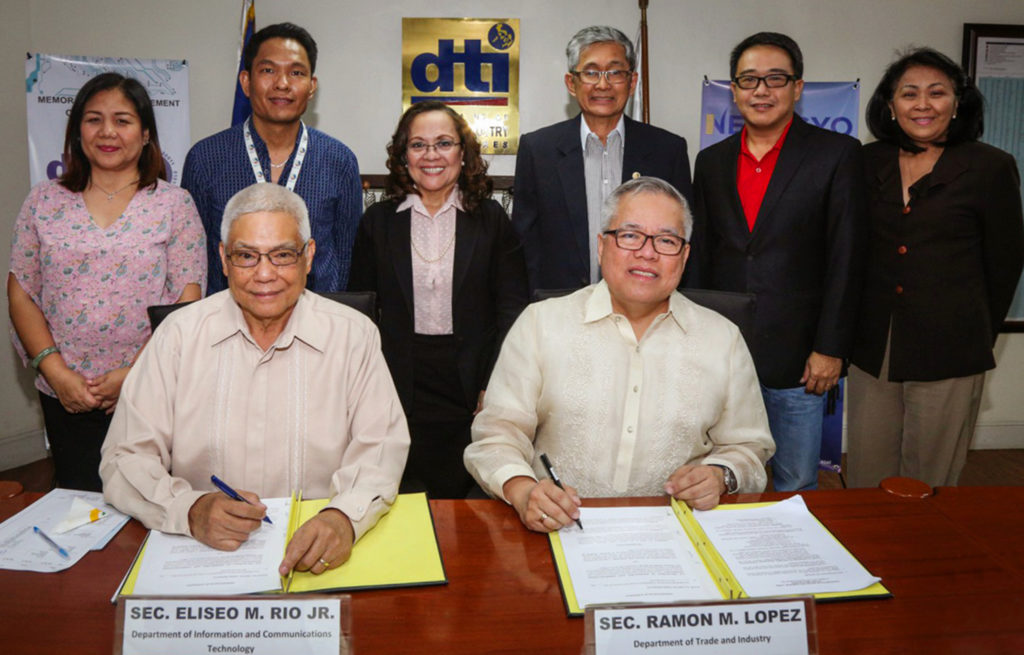
DTI Secretary Ramon M. Lopez and DICT Secretary Eliseo M. Rio Jr sign a Memorandum of Agreement for free internet access and Tech4Ed in Negosyo Centers. Also in attendance were (from L to R): Tech4ED Assistant Project Manager Engr. Amelia S. Dean; DICT Assistant Secretary Alan A. Silor; DTI Undersecretary Zenaida C. Maglaya; DICT Undersecretary Monchito B. Ibrahim; DTI Undersecretary Rowel S. Barba; and DTI Assistant Regional Director Dorecita T. Delima.
Makati – Department of Trade and Industry (DTI) Secretary Ramon M. Lopez and Department of Information and Communications Technology (DICT) Secretary Eliseo M. Rio Jr signed a Memorandum of Agreement on 15 March 2018 to provide free wi-fi and learning modules to DTI’s Negosyo Centers.
Through the agreement, DICT will provide selected DTI Negosyo Centers with free internet access, ICT equipment, and access to its Tech4ED Project.
DICT’s PipolKonek Project gives free internet access to public places such as public schools, libraries, and local government units. To date, PipolKonek has already provided internet access to 44 out of the current 805 Negosyo Centers.
Negosyo Centers will also carry DICT’s Tech4ED Project, a platform that offers digital literacy and other skills training; an eMarketplace; and a one-stop-shop for government applications, among others.
The two agencies see digital literacy as a potential catalyst for the growth of MSMEs. Tech4ED offers “ICT for Entrepreneurs”—where micro entrepreneurs are trained to create their own website and use the internet to increase their market reach.
“This convergence of the DICT and DTI will arm the entrepreneurs, especially in the regions, with the tools they need to develop and innovate on their products and conduct their business online. Connectivity and digital literacy are the future-proof ways to help those at the bottom of the pyramid,” said Secretary Lopez.
Further plans include merging existing Tech4ED Centers and Negosyo Centers since some of them are housed in the same local government units. The DICT is also open to host DTI’s educational materials in the Tech4ED platform.
“The DICT’s main objective is to facilitate connectivity. We are thus counting on our partner agencies like the DTI to provide tools and content that will benefit the public,” said Secretary Rio
by admin | Mar 15, 2018 | Headlines
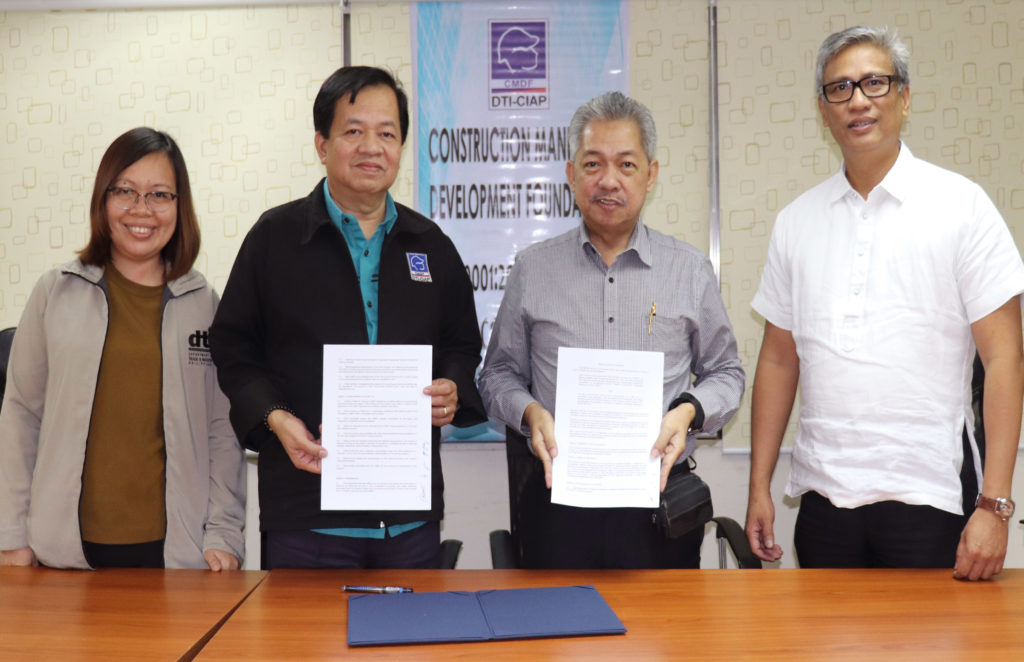
(L-R: ADC Ofelia Usigan, CMDF-CACD; Exec. Dir. Rene Fajardo, CMDF; President Florigo Varona, ESCA Knowledge Academy; and Head of Business Development Anthony Mariano, ESCA Knowledge Academy)

(L-R: Exec. Dir. Barry Paulino, PCA; Pres/CEO Ernesto de Castro, PhD, ESCA Incorporated; President Florigo Varona, ESCA Knowledge Academy; and Head of Business Development Anthony Mariano, ESCA Knowledge Academy)
The Construction Manpower Development Foundation recently signed a Memorandum of Agreement (MOA) on 7 February 2018 with ESCA Knowledge Academy (Multi-disciplinary Institute of Technology Inc.), a recognized training provider of CMDF. The MOA aims to accelerate and expand training delivery of the Enhanced Construction Managers Training and Certification Program (ECOMTCP) by recognizing certificates issued by ESCA Knowledge Academy as completion of an elective module for ECOMTCP.
As a part of this MOA, CMDF recognized its first ECOMTCP elective through ESCA Knowledge Academy’s BIM 100: Digitizing the Built Environment which was conducted in partnership with the PCA Technical and Education Foundation on 23-24 February 2018 in the PCA Training room.
ESCA Knowledge Academy, a recognized training provider of CMDF, conducts trainings on Building Information Modeling (BIM). BIM is one of the elective modules under ECOMTCP, it is a digital process encompassing geometrical dimensions, time management and scheduling, cost management and estimates, sustainability, and facility management. As the Philippines enters a new era of infrastructure boom, this technological advancement in the construction industry digitizes the process from pre-construction to maintenance which can improve productivity and efficiency, help contractors meet timelines and assist government in ensuring quality and transparency in projects.
Since BIM builds a structure virtually before physical construction, this allows stakeholders to work in a collaborative digital environment where changes will be less costly and less time consuming. The partnership demonstrates the government’s drive for technological advancement in the field of construction for a globally competitive Philippines.
by admin | Mar 15, 2018 | Headlines, Negosyo Center Updates
The Department of Trade and Industry Region 7 conducted the Small Business Counselors Course 101 (Diagnosing an Enterprise) for its 30 new negosyo center business counselors last March 5-9, 2018 at MJ Hotel and Suites, Cebu City.
The Association of Development Facilitation and Enterprise Counselors (ADFEC Inc.) facilitated the training through discussions and simulation exercises to equip participants with the basic knowledge on counselling MSMEs in their area.
In this course, the business counselors were taught the basic concepts on understanding the nature of an enterprise and how it operates in a business environment.
In pursuit of improving public service, the Department of Trade and Industry regional office 7 continues to develop the capabilities of its personnel by training them to become more efficient and effective in the delivery of their tasks.
Negosyo Centers are places where people can register business names and where the DTI can offer advice to aspiring entrepreneurs as well as help existing ones to link their products to potential markets, among others. The centers aim to increase the number of registered businesses in a city or town where it is located
by admin | Mar 13, 2018 | Headlines
TAGBILARAN CITY, March 13 (PIA)–Right on track into making sure local government units here raise their competitiveness indices, local leaders and business counselors witnessed the swearing into office a team that would facilitate the positioning of Bohol towns into the countries top cities and municipalities based on their competitive index.
An innovation in itself, the Bohol Competitiveness Council is an inter-agency team of government and non government agencies and organizations who would be at the disposal of Bohol LGUs so they could keep up with the competitiveness standards.
The local council, possibly a first in the country, according to investment promotions chief Maria Fe Dominese, is an interagency team who will assist local government units in complying and elevating its compliance to the competitiveness standards to come out with more efficient governance.
By competitiveness, it is the ability of an LGU to rise above its rivals and achieve sustainable levels of success in its specific categories, based on established parameters, explains Trade and Industry Development Specialist of the local department of Trade and Industry Jude Guieb.
Guieb presented anew the National Competitiveness Council (NCC) Survey and its 2017 Results for DTI 7 Regional Director Asteria Caberte, to at least 14 Bohol local chief executives and technical staff taking care of their compliance to the NCC indices of all towns in Bohol, March 13 at the Jjs Seafoods Village.
As a town’s competitiveness is now seen compared with how other local government units fare, one can easily see in figures measures of the LGU’s level and growth in the areas of standard of living, aggregate productivity and their ability to increase employment, trade and investments.
The competitiveness measure also determines how an LGU uses its resources to improve its standards of living, its schools, roads, financial markets, the consumer and in the end, offer better lives and prosperity to its constituents, DTI explained.
In the 2017 survey, Bohol rose from 54 in 2015, to 36 in 2016 and 23 in 2017. Tagbilaran City on the other hand completed a positive slate of 34, 25 and 21 in the last 3 years.
Governor Chatto emphasized the use of the competitiveness results as a guide for local leaders, as he urged local governments to look at their performances and work on weaknesses and bolster their strengths.
The governor also shared that it is Bohol’s aim of getting more towns into the list of the country’s most competitive.
The competitiveness parameters include economic dynamism or its activities that an environment conducive to business and employment, efficiency in government as measured in compliance to national directives, investment promotions, efficient business registration, local resource generation, health, school services, recognitions of performances, compliance to business permits and licensing system standards, peace and order and social protection.
Also in the parameters are infrastructure support which includes roads, ports, basic utilities, public transport vehicles, education infrastructure, LGU infra investments, accommodation capacity, information technology capacity and financial technology capacity.
Finally, a town’s competitiveness is also measured on its resiliency to disasters and challenges.
Its indicators include a workable land use plan, Disaster Risk Reduction Plan, Annual Disaster Drill, Early Warning System, Resiliency Financing as in putting up budgets for disaster and risk reduction, Local Risk Assessments, Emergency Infrastructure, Utilities, Employed Population and a sanitary system.
And for LGUs to be in the top list, newly instituted Bohol Competitiveness Council can assist and mentor LGUs in their compliance.
The new council includes the Department of Interior and Local Government, League of Municipalities of the Philippines, Department of Trade and Industry, Bohol Information and Communications Technology Unit, Sangguniang Panlalawigan, Vice Mayor’s League of the Philippines, Philippine Councilors League, Provincial Engineer’s, Health, Disaster and Risk Reduction Management, Planning and Development.
The Department of Education, Technical Education and Skills Development Authority, Social security System, Home Development Mutual Fund, PhilHealth, Bohol Chamber of Commerce and Industry, Alliance of on Government organizations, Public Works and Highways, Information and Communication Technology, Higher Education and the Holy Name University Research Center.(rahc/PIA-7/Bohol)

by admin | Mar 13, 2018 | Headlines, Tech Talk
Dandreb James Arro
Freelancing has been a viable option for many Filipinos. In fact, there are more than 2 million Filipino freelancers despite slower internet in the country, with these freelancers earning an estimated $10 to $50 per hour, depending on the job. Apart from having to earn above daily minimum wage, freelancers are not tied to a desk in a clock in-clock out, eight-to-five corporate setup. This gives them more time to pursue other passions.
While most freelancers opt to work in the comforts of their own home, oftentimes, the cabin fever kicks in and a new working environment becomes a necessity. This is when other go-to work options come in handy, like coffee shops. But expenses can balloon with every fill of coffee and there will be days when a barkada conversation can be loud and distracting.
This is when co-working space came to the scene. A co-working space is a shared workplace where freelancers and startup entrepreneurs can rent a table or room for a fee. These digital nomads can bank on the high-speed internet provided by co-working space while enjoying a new scenery and free coffee. Moreover, these co-working space provide avenues for these individuals to build a community where they can share ideas and collaborate on projects.
Co-working spaces have sprouted in some of the country’s busiest business hotbeds like Makati and Cebu City. Recently, a co-working space venture has found its way into the thriving Tagbilaran City.
D’ Courtyard Technology Hub is a co-working space located at CPG North Avenue fronting Dr. Cecilio Putong National High School (affectionately called Bohol High). It provides a private workstation amidst the bustling Tagbilaran City business scene where teams and individuals can transform ideas into realities.
D’ Courtyard Technology Hub workspaces can accommodate teams of up to 20 members. There are workspaces within glass walls surrounded by garden views, stimulating the senses for the free flow of ideas. The meeting room can accommodate groups to discuss, analyze, and synthesize ideas, the first step in creating a new innovative venture.
Apart from that, D’ Courtyard Technology Hub provides fast and reliable internet up to 200 mbps that allow businesses, freelances, and other players to thrive in the digital economy. Food and beverages are made readily available for a quick bite or refreshment, making sure that the flow of ideas will be uninterrupted by hunger or thirst. The best part is that D’ Courtyard Technology Hub aims to help build communities that explore possibilities through sharing and collaboration.
For those who wish to work in a warm collaborative space that thrives on inspiration and imagination,
D’ Courtyard Technology Hub can be their home. With amenities that suit the life of anyone whose opportunities are sought in freelancing, going online has just been much more enticing.
For more information visit our website www.courtyardtechhub.com or you may contact us directly:
Smart – 09292497628
Globe – 09456047258
Pldt Landline – (038) 427 – 1907
Email – contact@courtyardtechhub.com



