by admin | Feb 16, 2019 | Headlines
To have substantial improvements in the rivers’ water quality by June 2019: this fairly sums up the mission the Department of Environment and Natural Resources (DENR) and its horde of community volunteers in embarking on the simultaneous River Clean-Up this Friday, February 22.
And according to the new Provincial Environment and Natural Resources Officer (PENRO) Charlie Fabre, the task may not be that tough a challenge for Bohol than in other Central Visayan provinces.
Fabre, who had a long stint as PENRO of Negros Oriental and an even longer stint as Regional Director for Caraga, said he has seen all the 10 rivers which DENR 7 identified for the February 22 simultaneous clean-up, and the three Bohol rivers are better than the 7 others in the region.
While the DENR monitored higher coliform levels at the lower banks of these Bohol rivers, its headwaters are still mostly category A, meaning, these can be sources of drinking water, or at least safe for swimming.
Should Bohol succeed in elevating the water quality of its identified rivers, then the clean-up picks another location based on the current local inventory and the need to get these rivers into shape again, according to Fabre.
It may be recalled that after the DENR led governments and the civil society in successfully cleaning up Manila Bay in what media would call as Battle of Manila Bay, DENR secretary also looked at the implementation of the Clean Waters Act of 2004 or the Republic Act 9275.
The law basically applies to water quality management in the country’s body of water by control of pollution from land based sources.
Here, the DENR spearheads and institutionalizes activities that would affect the water quality of a certain body of water.
Speaking at the Kapihan sa PIA, PENRO Fabre, citing the DENR appeal for greater public participation in the Simultaneous River Clean-Up set this February 22, admitted that the community mobilization towards cleaner rivers is the kick off activity of the river rehabilitation program in Central Visayas.
“We have witnessed in the Manila Bay Clean-up how public participation made a lot of difference. In Central Visayas the state of our rivers is not a hopeless case, let us come together and prove that we can also make it happen,” said DENR 7 Regional Executive Director Gilbert C. Gonzales as cited by DENR 7 social media accounts.
DENR 7 has organized a simultaneous river clean-up in ten (10) identified priority rivers in the region, these are the 20 kilometer Batuanon River that empties into Mandaue City, Bulacao River which empties into the Cebu South Road properties, and Luyang River from its headwaters of Cantumog to Barangay Luyang in Carmen, all in Cebu.
In Negros Oriental, the DENR also identified Banica River from spills of Casaroro Falls in Valencia and which empties to Dumaguete City, the Panamang-an River from Cabanlutan to the shorelines of Bais City and the Sicopong River which runs from Tanjay to Santa Catalina.
In Bohol, identified rivers for the simultaneous river clean-up are Wahig River in the Inabanga basin, Abatan River from Kawasan Balilihan Section to Cortes and Manaba River which empties into Bohol sea in Garcia Hernandez.
For Siquijor, the environment agency has identified Señora River from Cambugahay to Lazi.
These rivers, according to Fabre have been under category C: those which have below 100 most probable number coliform levels from animals and human wastes.
Bohol Rivers are crucial especially Abatan which is being used for eco-tourism activities, Fabre asserted.
This is not just a one shot deal. The clean up would be made sustainable, thus the kick-off, he added.
While several regions have already started their river clean ups, three of the DENR offices in Bohol coordinate with groups and individuals volunteering for the river clean up, according to Marcia Ugay of the DENR.
CENRO Talibon coordinates for the clean-up activities in Inabanga’s Wahig, CENTO Tagbilaran picks the coordination for Manaba River while PENRO Tagbilaran takes care of Abatan River.
Any individual or groups joining the volunteer work on Friday can call PENRO Bohol at (038) 416 0151. (rahc/PIA-7/Bohol)
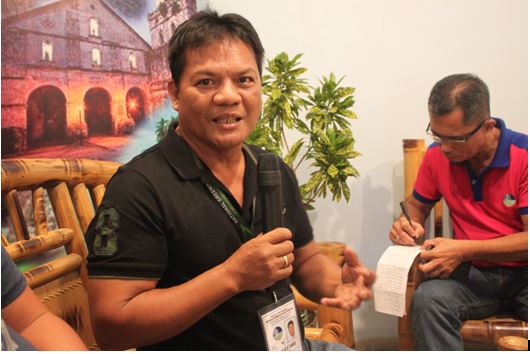
Conduct of the clean-up activities would be sustained for the next months as the DENR monitors the water quality to attain the desired clean-up goals, said PENRO Charlie Fabre at Kapihan sa PIA. (rahc/PIA-7/Bohol)
by admin | Feb 7, 2019 | Headlines
That ubiquitous ubi solemnly embellishing the popular Pinoy halo-halo, may soon be lost, thanks to a culture that looks down on the hardwork and perseverance of ubi-farmers, being low class, dirty nailed slaves of the land.
Bohol has gained over 200,000 kilos of ubi in the past year, according to data cited by the Office of the Provincial Agriculturist.
The figure however is yet to be shown in the local markets as there have not been much of the 200,000 kilos, enough to flood the markets with the purple or the white yam.
On the 18thUbi Festival here, there is enough reason to believe that ubi could possibly vanish in the next generation.
Here for generations immemorial, ubi has endeared itself to Boholanos, that the crop sits on a pedestal along with some faint objects associated with the pagan animist faith. It is so defined in some family altars during the padogmak (harvest thanksgiving) which also coincides with the All Saints and All Souls day.
But how did the ubi get there?
According to scientific research, ubi(DioscoreaAlatasp) was said to be brought in by THE Austranesian cultures. But the natives have another story for this.
A drought which lasted for months practically killed almost all the food plants. The natives found vines with traces of green or purple towards the roots, and they started digging it up.
Out came the ubi, a food natives believed was provided by the gods of the forest and the gods of the land.
And true enough, it is seasonal and survives towards the last months of the year.
As it is, farmers who have not really been into the industry said the crop is just too delicate to be gambled in. But more importantly, a crop that has attained an ethno-religious elevation is not something to gamble on.
So why is this so?
Domesticated by the natives as a crop which they also introduced to the Spaniards and no sooner, the first ubi made its transatlantic crossing for Europe, to the galleon trades as a exotic product for Europe.
Extensively cultivated from generations, over time, farm families tried to uncover the secrets to a successful pamanlin, anything that adds up to the efforts during harvest they secretly bequeath the folk knowledge on the manner of nurturing the crop, all also knowing that not all farmers are gifted with the hardwork, patience and the perseverance of a saint.
Guarding the secrets like family heirlooms is understandable;with each family picking their own set of perceived beliefs and the resulting harvest.
Cultivated in kaingin patches, ubi is grown from diced tubers, laid in especially dug hutok (holes) laid with a weave of dried leaves, rice straw, banana leaves and sometimes dried sargassum and burning refuse.
And that is getting ahead of the story.
This year, while the OPA reported 200,000 kilos more, farm technicians agree that young farmers, which are fewer, do not put the ubi among their typical options, for several reasons.
Ubi farming is courting failure more than mastering the art of the unknown. And it entails a whole lot of sacrifice, which unfortunately is on bankruptcy levels among younger farmers.
For how could one be as careless when even picking the ubi patch from a secondary growth forest or thick bushes has to be meticulously weighed.
The slope must be considered, ubi thrives in areas where theire is sufficient drainage and water does not gather, this will rot the tubers, a plant disease farmers call as bonggak.
Another consideration is that the patch must have tall bushes that can support the harug (trellis) where the ubi vines can crawl and hang. Primary among the consideration is an abandoned bamboo patch, as the bamboo roots age great aerators. Some also pick abandoned dwellings.
Having selected this, the farmer leaves the area and comes back a few days later to bring an offering to the ‘owners of the land,” one that may be a whole boiled chicken without salt, a roll of tobacco, or anything that may endear him to the spirits so they would allow him to use the land.
Days later, the farmer starts to clean up the undergrowth, carefully leaving some tall shrubs that can be the support for the katayan.
Then he starts digging hutok (planting mounds), carefully digging out the rocks and stones that can wound the ubi. Each hutokcan be a foot in diameter and a foot deep. Mounds cango as much as over a thousand, or a few hundreds.
After completing this, he leaves the farm to gather dried coconut leaves for the hampas. Each coconut leaf, he piles one on top of the other over the entire patch, making sure each mound is covered. This can mean hundreds of dried coconut leaves.
And in one late afternoon after completing laying the dried leaves, he starts burning the coconut leaves from the lowest point of the patch. The fire crawls up and eventually consumes all the dried coconut, leaving some shrubs standing but dead. Burning assured all pests are killed and the ash helps treat the soil.
By the next week, he starts the arduous task of digging out the soil from each mound, replacing it with a good amount of dried banana leaves, a weave of coconut husk, ash, sea weeds, and more dried leaves falling from the burnt bushes.
Meanwhile, in his pinsa or kamalig where he keeps the aerated binhi, he picks the best kinds and uses the sharpest knife to cut diced sitt, about two fingers in width, which would go to each of the hutok. A sharp knife, accordingly would be less harmful as this does not bruise the seedling.
A kilo of guha (diced sitt) can produce over ten kilos of ubi harvest, but that in fact is no stunning motivation to young farmers who would rather dream of some office over the toiling backbreaking and laborious ubi farming.
On one late afternoon, the farmer, sometimes accompanied by the wife, treks to the patch and selects three mounds forming a tripod. He may or ask the wife to plant the first three mounds, carefully invoking the spirits to bless the seedlings, make it as big and possibly one that cracks when cooked. These that cracked are accordingly the sweetest. This is palihi.
A week later, sometime in early May to early June, gathering all these diced sitts to the farm, he, along with a good number of neighbors who join the communal planting called hungos, trek to the ubi patches, this would be timed when the moon is full, and on the waning side and not just anytime.
Some families forbid the farmers from talking too much during the planting, careful not to offend the wounded ubi, carefully laying two sits on the woven coconut husk, or dried banana leaves and then putting in the dug soil back, making sure it forms a mound to drain the rain and keep the sitt from rotting.
When everything is planted, it is now the sole responsibility of the farmer to visit his ubihan and check if the seedlings start to germinate. The moment the green shoots emerge from the mounds, he starts putting up the trellis, which he leans upon the remaining bushes. When this is done, he makes it his daily mid-afternoon to late afternoon ritual to produce some smoke from burning grasses to drive away grasshoppers and pests that feed on the shoots.
Ubi patches during these stages must not be approached, as soon as the shoots are touched, they sulk and won’t grow anymore. The same is true when it is raining or in the early mornings. As the ubi vines start to climb the katayan, care must be exercised so as not to touch them. If in case a harug falls, the farmer must slowly fix the trellis, careful not to wound the vine or affect other plants. Especially by August to September when the ubi would be at its fastest growth rate.
By the last week of November, the farmer goes back to the palihi mound, digs the first three mounds using a wooden panlin, (stake used to dig the ubi)nadthen goes to the last mound planted and also digs the tuber.
These make up the first harvest, and would be forming part of the altar offering, the rest goes to the padogmak, cooked into nilunaw, boiled or simply inanag and displayed uncovered in the padogmak table and left.
Eating these can only happen after each family member returns after visiting their dead. There is the belief that the spirits and the souls of the departed, especially the elder farmers would partake of the food prepared on the padogmak table spread.
The farmer gain returns to the ubi patch as soon as the vine’s leaves start to wilt and dry. This signals the pamanlin season.
This is again another time for the hungos, a communal help scheme where every available farmer helps in the harvest.
The harvesters also make sure they do not just stab the mound and wound or bruise the ubi, each harvest piled and the kids, carrying small bukag (bamboo baskets) gather these to a clearing where the owner keeps tabs of the harvest, an ash bowl on hand and immediately applying a thin paste of ash over the ubi woundor where there is skinning: this cauterizes the wound and stops the karma from the ubi. This also allows the ubi to be stored despite a would that could start the rotting, when unattended, This also goes as payment to the farmers joining the hungos.
When all else is done, the farmer then picks the best harvest, this would comprise the next cropping’s sitt.
And the cycle of life of the ubi starts again.
And this is what the young farmers do not want to be engaged in.
If you now relish on the kinampay and baligonhon, the iniling, binanag, kabus-ok, gimnay, tam-isan and still several other varieties, savor it for it may be getting harder to look for that same homey Bol-anon taste in the next generation. (rahc/PIA-7/Bohol)

Farm technician Guillermo Lupas, 56, of LibjoSikatuna Bohol agree that there is a diminishing number of ubiadoptors, which could drastically reduce the harvest and contribute to the sad fate of the ubi. (rahc/PIA-7/Bohol)
by admin | Feb 4, 2019 | Headlines
Culture bearer icons of the seven arts: Music, Dance, Drama, Literature, Visual Arts, Architecture, and Film from all over the country descent to Bohol for the National Arts Month in February.
These cultural icons would be joined by Boholanos who have trained in the styes of artistic luminaries as National Artist Napoleon Abueva, poet statesman Pres. Carlos P. Garcia, the Loboc Children’s Choir, the Loboc Youth Ambassadors Band, the Dimiao Children’s Rondalla, Film Director Maryo J. de los Reyes, actor Cesar Montano, Luke Mijares, painters Nene Lungay and RicRamasola, poetess MarjEvasco, composer Joseph Gara, the Diwanag Dance Theater, HNU Chorale, the Tagbilaran City Choir, Alicia Children Bamboo Ensemble, BAJI, KAKA, Noel Tuason, the DepEd Special Program for the Arts, MarianitoLuspo, ReighMonreal, Cocoy Ponte, Henri Cainglet, Sam Penaso, Leo Abaya, Orlando Pabotoy Jr., the KASING SINING TeatroBol-anon Ensemble who are now blazing a trail for others to witness and for dreamers to follow.
It may be recalled that these disciplines blossomed in Bohol since the past decades through a long-stretches of programs of activities that help locals actualize their potentials and using the arts as a form of expression of a nation.
The artistic wealth of Bohol and the creative ingenuity of its people and communities have been proverbial and legendary, according toBohol cultural icopn and multi awarded film director and composer Lutgardoilabad.
It is not a hyperbole to say that seeds of creative genius lie ingrained in many a Boholano’s veins and heart. It was in the mid-90s however that the seedbed of a programmatic progress to empower Boholano artistry was installed, germinating from the Relampagos-Chatto administration, continuing in the Aumentado governance reaching a major summit in the current Chatto administration, he recalled as he pointed out the Bohol cultural renaissance.
As tribute to this singular achievement, the Provincial Government of Bohol, through its Center for Culture and Arts Development (CCAD), in cooperation with the City Government of Tagbilaran, the National Museum Branch of Bohol, and the Bohol Arts Culture and Heritage Council (BACH), is paying tribute to the Seven (7) Arts in February.
Movie icons, Liza Dino-Seguerra, Chairperson of the Film Development Council of the Philippines and award-winning Theater Actor and Drama and Film Director Joel Lamangan(MIFF 2019 Best Film Director for Rainbow Sunset) will grace the opening of the Bohol Arts Month on February 6, at 9:00 AM at the Bohol Cultural Center. They will speak on the Art of Film and its potential in expanding the creative industries of Bohol, Labad said.
In the afternoon, Dino-Seguerra will conduct a seminar on the Programs of the FDCP to enrich the direction of the Bohol Film Commission, followed by a special screening of an award-winning movie.
For the arts of Dance, Music, and Literature: a Creative Movement EURYTHMY Workshop with Switzerland-based PETA artist JOSE PURISIMA; a Musical Showcase at the Meridian Hotel on February 16; A Dance Showcase on February 21; a Music Theater Voice Workshop with American artist Allison Englanc and a Yoga Training Workshop with Guillaume Morgan from France from February 24-March 2; Heritage and Arts TALKS at the National Museum Branch of Bohol.
For the arts of Theater and Drama: An International Playwriting Workshop with playwright –teachers from Europe and USA from February 25-27; and a Visayan-wide Theater Festival and Congress with 7 theater groups from all over the region, with performances and demonstrations towards the establishing of a Philippine Theater Academy.
The City Government of Tagbilaran will also hold the following activities: Arts Contests in the morning of February 28 at the Island City Mall Activity Center in the following fields: Balak, Kuradang de Saulog, Fruit Carving, Saulog Head Dress Making. In the afternoon, activities at the Salazar Monument in Ubujan are scheduled, namely: Awarding of Contest Winners, Turn Over of City Cultural Mapping Results, Ribbon Cutting of Capt. Salazar Monument and excerpts from the Capt. Salazar Musical. (PIA)
by admin | Feb 2, 2019 | Headlines
Not only is Tuesday February 5 a red letter day because it is a special non-working day being the Chinese New Year, but also a real red letter day with Chinese giving out the traditional red envelops, donning on red dresses and putting up red decorations; red being a symbol of happiness and good luck.
Other than red decorations in lanterns, posters, red-wrapped gifts, envelops and dragon and lion dances, the celebrations actually start on the ever with a reunion dinner where families partake on tikoy, masi, dumpling and fireworks, lots of it.
Already declared a special non-working holiday in the Philippine through Proclamation 555 issued by President Rodrigo Duterte August 15, 2018, the Chinese New Year is also called the Chinese Spring Festival and is revered and celebrated with festive events not only in China but in the Philippines as well, thus the non-working declaration.
The holiday declaration is also based on Republic Act 9492 which declared specific and movable dates as special or regular holidays.
Another similar holiday: a special non-working holiday comes again on the 25th of February, Monday, the day being the 33rd Anniversary of the EDSA People’s Power Revolution.
According to the declaration, the EDSA People Power declaration restored and ushered political, economic and social reforms in the country, thus the declaration.
For these special non-working days, a “no work, no pay” rule applies, according to the Department of labor and Employment (DOLE).
However, if, on the day of the holiday, a company forces an employee to report for work, or in the case of the employee opting to report for work, he gets a full pay plus 30% of his basic pay for the day, DOLE explained through its compensation guidelines for regular and special non-working holidays.
If the worker renders overtime, anything in excess of the 8 hour work, the worker gets 30% of the hourly rate for his rendered time of duty. (rahc/PIA-7/Bohol)
by admin | Feb 1, 2019 | Headlines
Enthused by the successes of the massive volunteer clean-up of the polluted bay in Metro Manila, the Department of Environment and Natural Resources (DENR) in Central Visayas spearheads the simultaneous clean-up activity to kick off the river rehabilitation program in Central Visayas this month.
Set this February 22, Friday, the DENR has identified ten rivers in Central Visayas as venue for the envisioned massive volunteer clean-up activity, according to DENR Regional Executive Director Gilbert Gonzales.
The DENR has identified Category B classified rivers in Cebu, Bohol, Negros and Siquijor for this.
Bohol Provincial Environment and Natural Resources Officer (PENRO) Charlie Fabre, during the Capitol paid radio program Kita ug Ang Gobernador Friday, explained that category B rivers are those which have been identified with a certain degree of pollution where the coliform level is below the 100 most probable number (MPN) as determined by laboratory tests.
These include Bautanon River in Mandaue, Bulacao River in Bulacao and Luyang River in Luyang Carmen, in Cebu, Abatan River in Cortes, Wahig River in Inabanga and Manaba River in Garcia Hernandez in Bohol, Banica River in Valencia, Panam-angan River in Bais and Sicopong River in Santa Catalina in Negros Oriental as well as Señora River in Siqiijor.
In Central Visayas the state of our rivers is not a hopeless case, [but still] let us come together and prove that we can also make it happen,” said DENR 7 Regional Executive Director Gilbert C. Gonzales.
And while most river clean up events are initiated by government agencies, the DENR intends to gather as much volunteers and mobilize communities for the Visayas-wide events this time.
The activity is also in line with the Presidential directive to the DENR, which the secretary Roy Cimatu also followed up with a department order to strictly enforce Republic Act 9272 or the Philippine Clean Water Act of 2004.
The activity kicks off the region-wide river rehabilitation and would involve community stakeholders, national government agencies, local government units, barangay officials, the academe, people’s organizations, environmental groups and other well-meaning groups with DENR as the lead agency.
In Bohol, interested groups can contact the PENRO at (038) 416-0151.
While in the past clean-ups, the DENR has not been as strict, this time, Gonzales said they are discouraging volunteer participants who use single use surgical gloves, black garbage bags and other clean-up materials that turn to be additional trash after each event.
The environment agency however suggest that volunteers wear appropriate personal protection: boots or shoes, gloves, hats, caps or headgear for sun protection and, tongs and used sacks as trash container.
Along with this, local officials including barangay officials where these mentioned rivers snake through are now asked to help coordinate volunteers for areas of assignment and future rehabilitation activities which they can implement, DENR sources said. (rahcPIA-7/Bohol)
Aerial View of the Abatan River from Over Bato, Cabawan, Maribojoc. The factory in the cackground has long ceased its operations but with communities now settled along the river, issues of cleanliness of the river have recently resurfaced. (PIABohol)

Aerial View of the Abatan River from Over Bato, Cabawan, Maribojoc. The factory in the cackground has long ceased its operations but with communities now settled along the river, issues of cleanliness of the river have recently resurfaced. (PIABohol)
by admin | Jan 29, 2019 | Headlines

Bohol tourism stakeholders expect more tourism arrivals here as a fascraft service that promises to take people to destinations fast and easy, opens up five daily routes at an introductory promotional fare to Bohol at P250.00.
Leading fast craft service provider in Bohol, Ocean Jet (OceanJet) Ferries Corporation made true its tagline of “taking you there, fast and easy,” as it opened its five daily boat trips from Pier 1 in Cebu City to Getafe Wharf in Bohol, January 24, vespers of the feast day of the town.
The newly opened fast craft route bodes well to the tourism and economic stakeholders in northeast Bohol as this establishes a new fast connection between Cebu and the sleepy towns here.
Already coming up with their own tourism products but are hard up with the facility of bringing in guests with the closest port in Tubigon, over 30 kilometers away, the new trip cuts the travel time from Cebu to Getafe by slow boat by half and adds up five trips to the 10 already established trips served by Clemer Shipping and another fast craft service: Star Craft.
With its inaugural trip January 24, Ocean Jet offers no business class only tourist class for P250.00, some P40 more than the slow boats serving the route.
Ocean jet trips to Cebu’s pier 1 from Getafe wharf starts at 6:30 AM, 9:30 AM, 12:30 PM, 3:15 PM and 6:15 PM, all trips to Cebu in an hour-long of comfort and style.
Pier 1 to Getafe starts at 8:15 AM, 11:00 AM, 2:00 PM, 5:00 PM and 8:00 PM for the last trip, sleeping Getafe.
Meanwhile, the newly opened Oceanjet routes complement the already present conncetion between Getafe and Cebu.
Boat trips from Getafe to Pier 1 therefore are the following: 5:00 Am (Clemer), 6:15 AM (Clemer), 6:30 (OceanJet), 7:00 AM (Clemer), 7:30 (StarCrafts), 9:30 (Oceanjet and Clemer), 10:30 (StarCrafts and Clemer), 12:00 noon (Clemer), 12:30 (OceanJet), 3:00 PM (Clemer), 3:15 (OceanJet), 5:00 PM (Starcrafts) and 6:15 (OceanJet).
From Cebu’s Pier 1, trips to Getafe are the following: 6:00 Am (StarCrafts), 6:30 AM (Clemer), 7:30 AM (Clemer), 8:15 AM, (OceanJet), 9:00 AM (StarfCrafts and Clemer), 10:30 AM (Clemer), 11:00 AM, (OceanJet), 12:00 noon Clemer, 1:30 PM (Clemer), 2:00 PM (OceanJet), 3:00 PM (Clemer), 3:30 PM (StarCrafts), 5:00 PM (OceanJet and 8:00 PM (OceanJet).
The new trips place tourists in close proximity to Danao, about 20 kilometers away, where legendary hero Francisco Dagohoy put up his defenses against the Spaniards in his century led revolt in Danao.
Danao Bohol’s Eco Extreme Adventure Tour (EAT) packages in the Suislide, notably the country’s highest and longest zipline, the Plunge, yet the Philippine’s tallest and only canyon swing, spelunking, rubber tubing, whitewater kayak, cliff climbing and rappel, wall climbing and buggy rides.
It also opens up to Getafe’s Banacon Island, Asia’s largest mangrove reforestation project, Handumon’s seahorse reserves, premier bird watching sites and tropical island get-aways.
About 10 kilometers from Getafe port is Buenavista’sCambuhat River Community tours which feature the oysters, green crabs, blue crabs, shrimps, and the buri traditional products,
About 20 kilometers to the southwest is Inabanga and its interesting loom-weaving traditions, souvenir baskets, river tours, gardens, and island hopping destinations.
About 20 kilometers to the east is Talibon with its notable sandbars, island hopping destinations, sustainable marine and coastal law enforcement practices, seafoods markets, and agricultural tours.
The new route also opens possibilities for the tourism destinations in Trinidad Batongay Caves, Kawasan Falls, Dive Bien Unido’s underwater grotto, island hopping, Ubay’sAgri tourism Parks and Alicia’s Panoramic Park.
A new tourism product: East Bohol, is now on the test run and features eco-treks, glamorous camping, sunrise-sunsets, falls, lakes, rivers and community immersion tours. (rahc/PIA-7/Bohol)

NEW ROUTE TO ADVENTURE TOURS.OceanJet opens up the possibility of extreme eco-adventure tours in Danao, Bohol’s extreme adventure capital.

GETAFE’S BANACON ISLAND TOURSfeature mangrove planting, kayaking, birdwatching, island hopping and seafoods feasts.

