by admin | Nov 28, 2016 | DTI Updates, Headlines, National News
MAKATI—To create globally competitive, value adding, innovative and inclusive industries is the main objective of the country’s new industrial strategy, the trade and industry chief declared.
Speaking on the first day of the Manufacturing Summit 2016 yesterday (28 November), Department of Trade and Industry (DTI) Secretary Ramon Lopez emphasized that the new strategy focuses on industries where the Philippines has existing and potential comparative advantage to generate employment and promote entrepreneurship.
The new strategy’s top five industry priorities include manufacturing, agribusiness, information technology-business process management (IT-BPM), tourism and infrastructure and logistics.
“This industrial strategy is the best way to uplift the lives of Filipinos towards the goal of sustainable inclusive growth and shared prosperity for all. This is needed not only to generate jobs and reduce poverty but also to take advantage of market opportunities,” said Sec. Lopez.
Citing the country’s positive economic outlook as the fastest growing economy in Asia with sustained strong macroeconomic position at 7.1% recorded growth in the third quarter of 2016, the trade chief shared that the Philippines outpaced other countries like China (6.7%) and Viet Nam (6.4%) and fared above average consensus forecast of 6.8%.
While services industry was the main driver of the country’s growth in past decades, the manufacturing industry has been playing an important role, and has been contributing substantially to economic growth since 2013, according to him. In the third quarter of 2016, manufacturing grew by 6.9% or more than one percent point higher that the rate posted in 2015 at 5.8%.
He also said that the manufacturing sector presents opportunities to provide productive jobs to low-skilled, medium-skilled and highly-skilled workers, and further emphasized the need to shift from traditional agriculture to more modern agribusinesses, as well as the relevance of tourism as source of income and jobs.
The new industrial strategy is DTI’s key response to sustain today’s high level growth, while addressing the issue of unemployment, where the bulk are young with ages ranging from 15 to 24 years old, 61% are male and 40% have high school education, while 36% have college education.
“Given these characteristics of our workforce, our industrial strategy focuses on labor intensive industries such as food and resource-based manufacturing, tourism, garments and construction,” said Sec. Lopez, adding that it will also focus on high-tech industries like electronics, aerospace, automotive and chemicals.
Consistent with DTI’s Trabaho at Negosyo agenda, the strategy also focuses on strengthening linkages between micro, small and medium enterprises (MSMEs) and large domestic and multinational enterprises to make growth more inclusive.
Meanwhile, Sec. Lopez also called on stakeholders to take advantage of preferential free trade agreements, where the country may benefit. Specifically, he referred to those with ASEAN, as having over 100 million population, a growing middle class, rising consumer and business confidence.
“Huge export markets could be tapped in the ASEAN Economic Community with a population of over 600 million, and as we forge the Regional Comprehensive Economic Partnership (RCEP), this grows further to over three billion people representing 45% of the world’s population,” he added.
Taking into account external factors such as economic slowdown in US, Japan, Europe and China, opportunities from participating in global value chains and emerging new business models, the DTI chief said that the current strategy would require “climbing the industrial ladder and moving into higher value added activities” in specific sectors.
These sectors include electronic manufacturing services, semiconductor manufacturing services, auto manufacturing, aerospace, chemicals, furniture, garments, shipbuilding, food and resource-based processing and IT-BPM.
“As an enabler, the government pursues an industrial policy strengthening our industrial base and removing the most binding constraints, but to be strategic, we are focusing our efforts by identifying and prioritizing the most binding constraints,” explained Sec. Lopez.
The summit participants, composed by representatives from the private and the public sector, labor, civil society, the academe and some international development partners, were divided into groups to identify such constraints, formulate recommendations to address them and determine the most appropriate intervention.
Sec. Lopez called on the participants to ensure that the recommended policy measures bring “the most significant impacts on and benefits for the development of globally competitive, value adding, innovative and inclusive manufacturing linked with agriculture and services industries.”
The two-day Manufacturing Summit is in partnership with the DTI and the Board of Investments (BOI), in cooperation with the United States Agency for International Development (USAID) and the Japan International Cooperation Agency (JICA).
by admin | Nov 26, 2016 | Headlines, Tech Talk
The Province of Bohol hosted the Open Collaboration of East Asia New Champions 2016 Summit (OCEAN 16) on November 24-26, 2016 at the Be Grand Resort in Panglao, Bohol. Thought leaders and movers from the Philippines, the ASEAN, the US and the UK joined the summit which tackled breakthroughs in technology that are fundamentally transforming whole systems of production, management, and governance. These transformations aid societies overcome challenges from business and energy, to transportation and climate change.
The so called “Fourth Industrial Revolution” or “Industry 4.0,” was the main theme of the summit and this presents an opportunity for the Philippines not only to keep up with more advanced nations, but also solve urgent problems plaguing the country. This revolution is the fusion of electrical and digital systems with physical and biological systems and is made possible by the proliferation of the Internet and mobile devices.
In various panels during the summit, the topic of the startup ecosystem in the Philippines was discussed. The issues on connectivity and access to funding was also tackled. Winston Damarillo, chief organizer of the event, said that the Philippines should not try to become the next Silicon Valley but instead tackle the unique issues in the country and create businesses that solve these issues.
The event kicked off with a discussion on “Understanding the Future of Cybersecurity” and a Sunset Welcome Cocktail Event on November 24. On the second day, November 25, Damarillo delivered the opening keynote and facilitated teh opening plenary session with the moderators of the various panels. There were two tracks of the panels and the topics include “Sustainability at the Heart of Business”, “Powering Small Businesses”, “The Future of Talent”, “The Disruption of Industries”, “Innovation for All” and “Data is the New Oil”. The second day closed with the panel on Collaborative Governance and the Next Economic Power which covers the ASEAN and the state of collaboration between nations, between the government and private sector. A case study for collaboration in Bohol where multi-sectoral participation in various initiatives is common and has reaped important results in prioritization of infrastructure investment and in the relief effort immediately after the October 2013 earthquake and in the rehabilitation programs.
The participants were entertained during the gala dinner hosted by the province of Bohol. Gov. Edgar Chatto and the First Lady of the province, Mayor Maria Pureza Chatto graced the event. Tagbilaran City Mayor John Geesnell Yap and the First Lady of the City, Ms. Jane Yap also graced the event.
The last day of the event included a plenary session on “Preparing for the Digital Future”. This was followed by a Closing Plenary with the Summit Co-Chairs Winston Damarillo, Karen Davilla, Sen. Bam Aquino, Richard Dacalos and Analisa Balares. In the afternoon, a workshop about the “Deep Globality” and the Youth was held. This was followed by a public filming of the new TV show for Indiepreneurs called “I’m In”. The show features entrepreneurs pitching in front of angel investors with the goal of getting investment commitments from the investors.
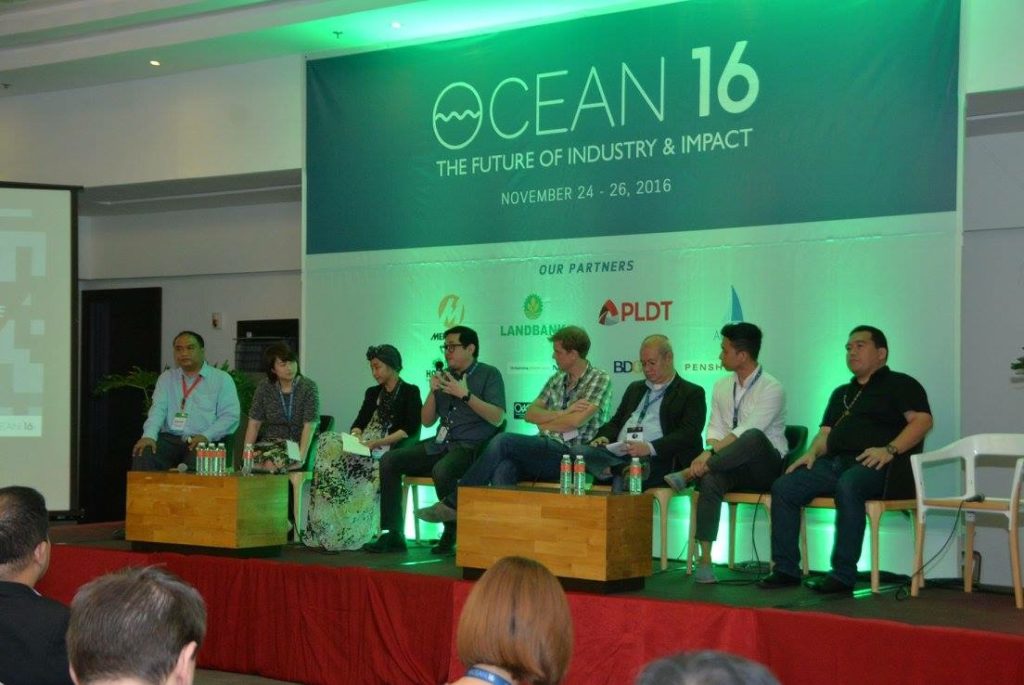
The plenary session on Collaborative Governance and the Next Economic Power. L-R: Jerome Auza, Auza.Net and BCCI, Yeen Seen Ng, COO of ASLI, Iim Fahima Jachja of QueenRides.com, Sen. Bam Aquino, Former Sec. Bon Moya
Dep. of Budget & Management, Bohol Provincial Administrator Alfonso A. Damalerio.
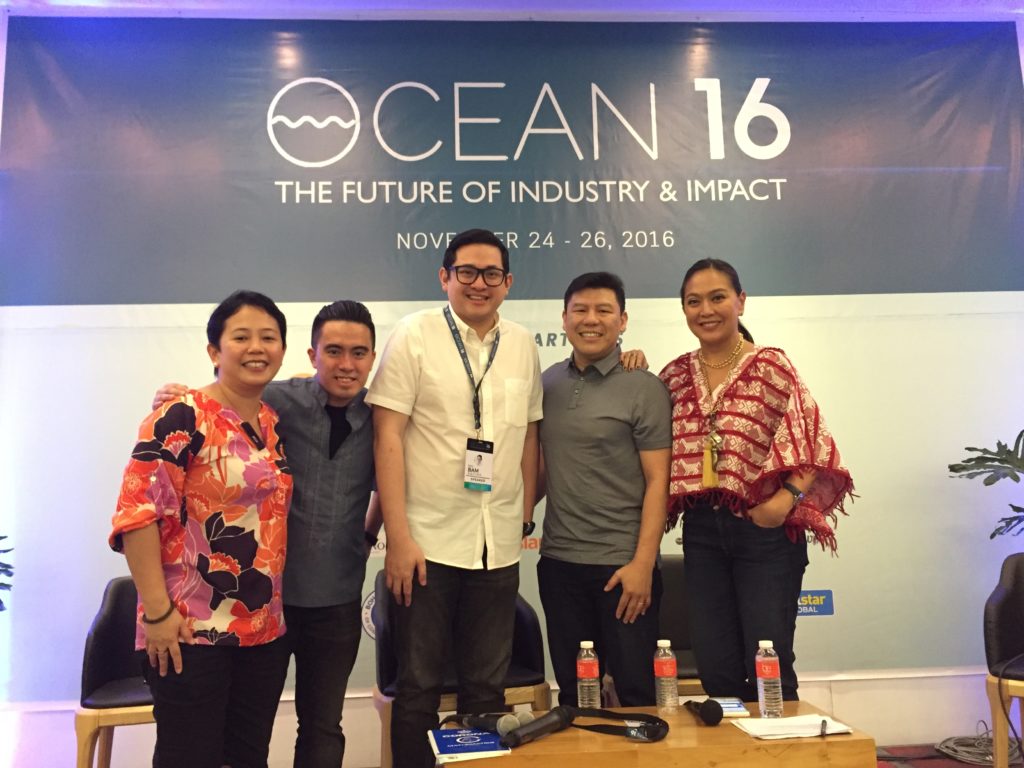
The OCEAN 16 Summit Co-chairs after the closing plenary: Analisa Balares
CEO, Womensphere, Richard Dacalos
Creator & Co-Founder, Upstart, Bam Aquino
Senator, Republic of the Philippines, Winston Damarillo
Founder & CEO – Amihan, Exist Software, Karen Davila
Journalist, ABS-CBN

One of the products featured in the I’m In TV Show for Indiepreneurs. The shoe craftsman who made the shoe is a retired shoemaker and after his pitch to the angel investors, he got an offer to have a gallery of his designs to be presented to a VIP audience.
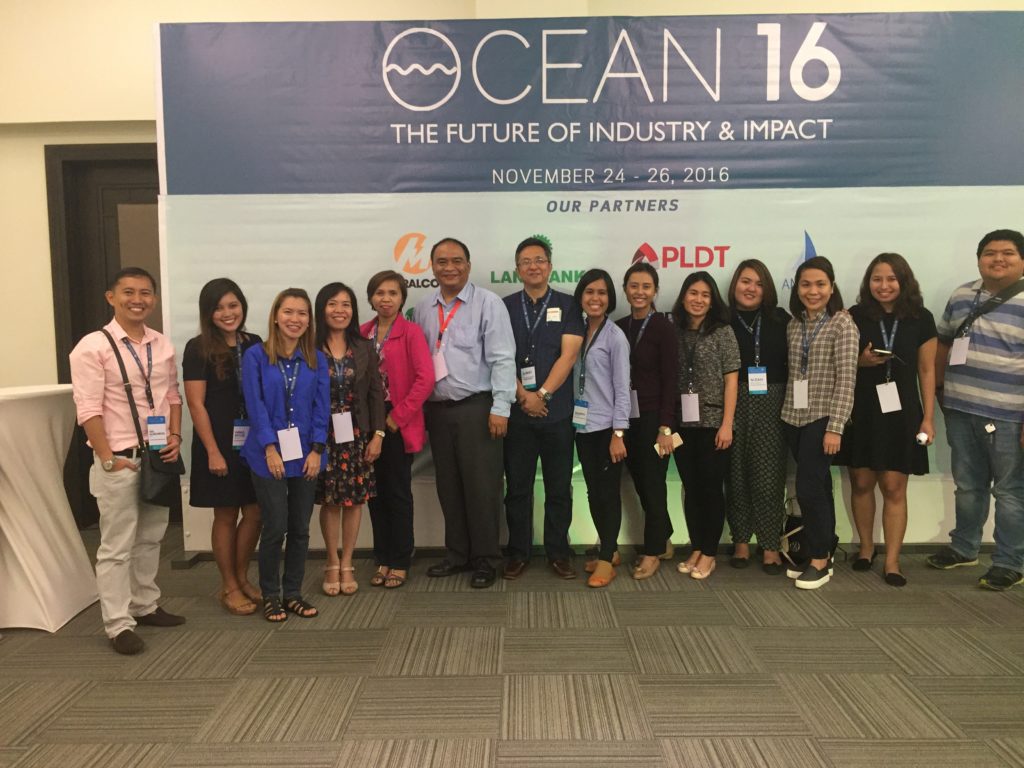
Some members of the Boholano delegation that joined the summit led by Bohol Chamber of Commerce and Industry President Engr. Al Uy (center). The group is composed of the representatives of the provincial government, young entrepreneurs, BCCI board of trustees and BICTC officers.
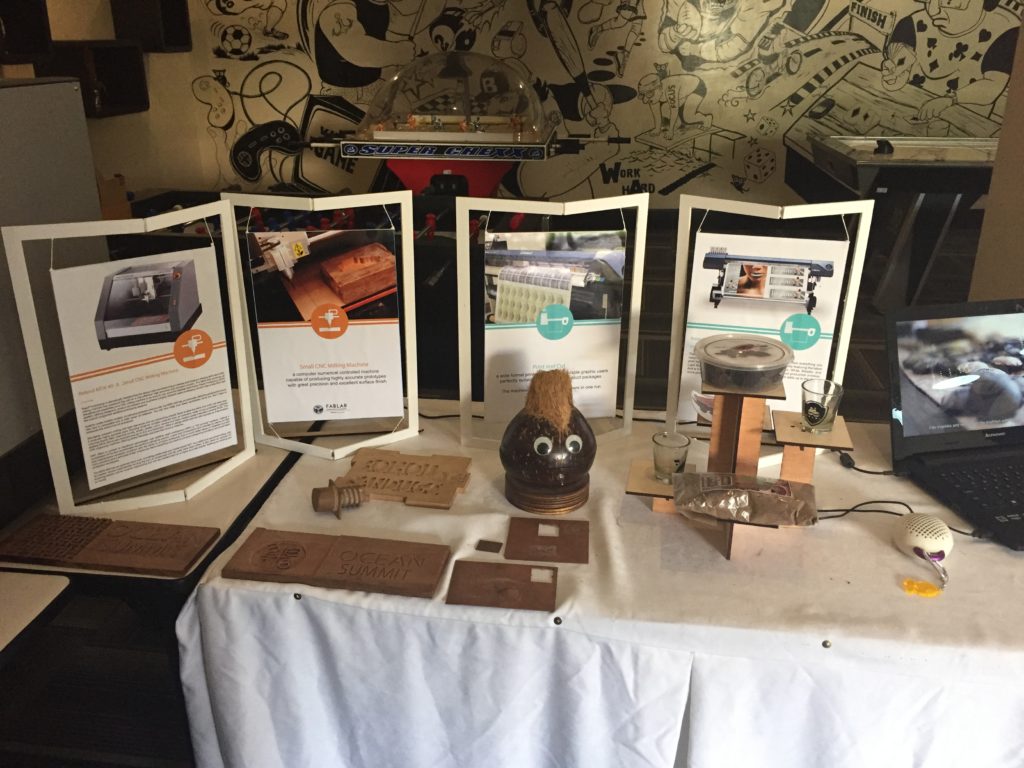
Fablab featured various examples of products that were fabricated by various makers and maker organizations. Some of these products are already commercially sold.
by admin | Nov 24, 2016 | DTI Updates, Headlines, Local News / Bohol Balita
TAGUIG CITY—DTI’s shared service facilities (SSF) beneficiaries on coffee processing, native bag making, and fiber marketing were the recipients of the first-ever Kapatid Awards at PLDT’s MVP Bossing Awards 2016 on 23 November.
SSFs on coffee processing from Mountain Province, Cordillera Administrative Region (CAR), on pandan and bariw bag making from Leyte, Region VIII and on fiber marketing expansion from Agusan del Norte, CARAGA received awards for exhibiting sustainable and inclusive growth models that contribute to the improvement of the quality of lives in said communities.
Receiving the awards were representatives from SSF cooperators Dangdang-ay di Ibila Cooperative from CAR, Sto. Niño de Plaridel Parish Multi-Purpose Cooperative from Region VIII and San Isidro Upland Farmers Multi-purpose Cooperative from CARAGA.
The SSF Project is a key component of the Department of Trade and Industry (DTI)’s initiative to capacitate micro, small and medium enterprises (MSMEs) by providing them appropriate machinery, equipment, tools, systems, skills and knowledge under a shared system.
As backbone of the Philippine economic growth, composed of 99.6% of locally registered businesses, generating over one million job a year, MSMEs have become the government’s current priority, with the DTI placing MSME development at the forefront of regional development and at the front and center of the trade agenda.
“Aside from keeping the country moving towards a more strategic direction at the backdrop of regional development, the government, through the DTI, vows to pursue meaningful growth that is truly inclusive, the one that reaches the bottom of the pyramid,” said DTI Secretary Ramon Lopez, who was also one of the recipient of the MVP Bossing Awards in government service.
DTI’s thrust towards MSME development is anchored on President Rodrigo Duterte’s 10-point socio-economic agenda to attain a quality of growth that will result in shared prosperity among Filipinos, according to the trade chief.
As of October 2016, a total of 2,099 SSFs have already been established across the country.
In partnership with Go Negosyo and DTI, the Kapatid Awards is an offshoot of the Kapatid Program, which has advocated MSME development through training and partnering with big businesses to mainstream and integrate MSMEs and their products and services into the bigger value chains.
“Across the country, there are already successful micro, small and medium scale players who, even in advance of the Government’s call, have created sustainable growth models that bring employment to the sectors of society that need it,” PLDT Vice President Mitch Locsin was quoted in a statement. (END)
by admin | Nov 22, 2016 | Headlines, Local News / Bohol Balita
TAGBILARAN CITY, November 22 (PIA)–Gipasidan-an sa Food and Drug Administration (FDA) ang publiko sa pagpalit sa pipila ka branded nga mga tambal tungod sa pagkatap sa mga pekeng produkto.
Base sa FDA advisory, apil sa mga nakuha nilang sample nga nadiskobrehang peke nga nikatap sa kamerkadohan mao ang Dolfenal, Tuseran Forte, Diatabs, Alaxan ug Neozep.
Susama ra gayud ang peke sa tinuod nga produkto mao nga lisod alang sa usa ka konsumidor nga mahibaw-an kun tinuod ba o peke ang tambal.
Mao nga tambag sa FDA, mopalit lamang og tambal sa mga botikang otorisado sa ahensiya.
Gi-awhag usab sa FDA ang mga lokal nga kagamhanan nga siguradohong walay counterfeit drugs o pekeng mga tambal ang mabaligya sa mga tindahang naa sa ilang hurisdiksyon.
Matud pa sa FDA nga peligroso ang pag-inom sa mga peke o dili rehistradong tambal tungod kay posibleng wala kini epekto o makasamot pa sa sakit nga gihambin. (ecb/PIA7-Bohol)
by admin | Nov 22, 2016 | Headlines, National News
Unemployment continues to be one of the Philippines’ biggest challenges to date. Millions of Filipinos either remain on the loose for a job opportunity to earn their keep or are employed but are dissatisfied with their current pay, role or job fit, categorizing them in the “underemployed” segment.
In the year 2000, unemployment rate was at a record high of 13.9. While unemployment rate steadily decreased over the years at a record low of 5.4 in the third quarter of 2016, it remains a major roadblock in seeing the country’s full potential.
Micro-, small- and medium- enterprises (MSMEs) have contributed largely to this increase in employment. In ASEAN countries, majority of enterprises are MSMEs, reaching up to 99% in some. In the Philippines, there are currently close to a million MSMEs. From 1995 to 2011, the number of people employed by MSMEs has increased from 2.7 million to 3.9 million, and the number only continues to grow, allowing people to slowly rise over the poverty line.
MSMEs encounter difficulty when it comes to funding due to having mostly personal assets. Without acceptable collateral such as real property and with a limited track record, MSMEs, especially the smallest ones, are put at a disadvantage in loaning capital as they cannot meet bank requirements.
With its renewed purpose of seeing a country where businesses flourish, Globe Telecom constantly looks at forging partnerships to grow employment opportunities. In partnership with global crowd-funding source Kiva, the company has revolutionized an avenue to help Filipinos, empower local businesses, and promote economic growth. Globe customers can now help Filipino start-up entrepreneurs realize their dreams by donating or lending funds.
Leveraging on its online facility and a worldwide network of microfinance institutions, Kiva provides loans to people without access to traditional banking systems. The micro-finance institutions, which are called Field Partners, administer the loans in the field, giving people in need a safe and affordable access to fresh capital to further their lives and that of their families. Negros Women for Tomorrow Foundation (NWTF), Alalay sa Kaunlaran, Inc. (ASKI), Center for Community Transformation Credit Cooperative, Gata Daku Multi-purpose Cooperative, Paglaum Multi-purpose Cooperative, Community Economic Ventures, Inc., MILAMDEC Foundation, SEED Center Philippines, Inc. and Bagosphere Ph. Inc. are Kiva’s partner Microfinance Institutions (MFI) in the Philippines. To-date, Kiva has over 1.5 million individual lenders from every country in the world. These lenders have funded loans amounting to over US$890 million to 2.1 million beneficiaries.
As part of its month-long celebration for its loyal and tenured customers in September, Globe enabled its prepaid and postpaid customers to support 917 micro-enterprises through a Kiva gift card worth US$25. The beneficiaries in the agriculture, farming, retail and food industries can, in turn, use the amount to scale their businesses.
To welcome the month-long Yuletide season, Globe customers can still continue making a difference in the lives of others by making a donation via Kiva. There are 3 ways: (1) converting Globe Reward Points into Kiva donations, (2) donating via GCash, or (3) by texting Kiva to 2158-Kiva to avail a Kiva Card, a gift card that can be used to choose a beneficiary.
“The best gift that anyone can give this Christmas is a gift that keeps on giving, and we at Globe are encouraging our customers to create a Globe of good by harnessing our partnership with Kiva. Through their donations, they can empower and boost livelihood and employment opportunities which can have a positive impact to many today and in the future,” says Yoly Crisanto, Chief Sustainability Officer at Globe.
The company’s partnership with Kiva follows its commitment to 9 of the 17 UN Sustainable Development Goals, specifically SDG 17: Partnership for the Goals—knowing that sustainability is possible only through collaboration with relevant organizations. Ultimately, this allows Globe to enable Filipino entrepreneurship and instigate job creation, contributing towards SDG 8: Decent Work and Economic Growth.
# # #
by admin | Nov 21, 2016 | Headlines, Health and Medicine, Local News / Bohol Balita
TAGBILARAN CITY, November 21 (PIA)–The coastal waters of Dauis and Tagbilaran City has been tested positive again for algae that produces the red tide toxin, according to the regional office of the Bureau of Fisheries and Aquatic Resources 7 (BFAR-7).
BFAR-7 Regional Director Allan Poquita relayed the advisory to the Bohol media thru BFAR-Bohol Information Officer Nimfa Mesina last Saturday.
The BFAR bulletin issued on Saturday said that the coastal waters of Dauis and Tagbilaran City tested for red tide toxin.
The advisory states that gathering and selling shellfish from Dauis and Tagbilaran City sea waters are banned until further notice because they are still positive for paralytic shellfish poison that is beyond the regulatory limit.
It was only in March this year that the longest red tide alert in the province had been lifted by the bueau.
A similar red tide advisory covering Dauis and Tagbilaran areas, ran from June last year to March this year.
However, BFAR-Bohol continued to warn local governments of Dauis and Tagbilaran City to remain vigilant since then, and continue monitoring the coastal areas to make sure any resurgence of red tide toxins would be promptly acted upon.
By mid-October this year, BFAR-7 already warned Bohol consumers of the possible resurgence of red tide.
Red tide is the common term for harmful algal blooms, specifically when colonies of algae grow out of control and produce toxic or harmful effects on shellfish and other marine animals. (ecb/PIA7-Bohol)

