Typhoon Pablo is now well away from Bohol and is bearing down on northern part of Palawan after subjecting Dumaguete City and southern tip of Negros island with winds up to 170kph. Based on the forecast from the Japan Meteorological Agency and PAGASA, Bohol should already be safe from any further adverse effects of Pablo.
Many Boholanos feel lucky that the typhoon spared Bohol from major damage even though strong winds and heavy rainfall were experienced in most of Bohol.
Typhoon Pablo is now well away from Bohol and is on its way to the northern part of Palawan.
December 04, 6:00PM:
Typhoon Pablo has dissipated some of its strength after passing through Northern Mindanao. As of 6:00PM, the center of the typhoon is heading towards the southern tip of Negros island and Dumaguete. In Tagbilaran City, winds intensified at around 2PM until 5PM and has since subsided. In central Bohol, there were reports of strong winds and heavy rain.
Typhoon Pablo is now near Dumaguete City and the southern tip of Negros Island. Bohol was spared from the strongest winds of this typhoon.
PAGASA satellite image of Typhoon Pablo taken at 4:30PM December 4, 2012 shows the rain fall intensity reduced significantly and the storm engulfing a very large area of the country.
December 04, 3:00PM:
Typhoon Pablo has exited Mindanao and is bearing on Western Visayas. Forecast shows that the center of the typhoon may skip Bohol but will possible make landfall at Dumaguete and the southern tip of the Negros Island.
The center of typhoon Pablo is now exiting Northern Mindanao and is headed towards Dumaguete City and the southern tip of Negros Island.
December 04, 8:00 AM:
Typhoon Pablo has made landfall in Northern Mindanao and is estimated to have winds near the center at about 170kph and gusts up to 240kph. It is forecast to move west and become weaker with speeds up to 130kph near the center by December 4, 2012 at 8:00PM.
Due to its westward movement, typhoon Pablo is no longer going to hit Bohol directly.
Due to the typhoon’s westward movement, Bohol is no longer forecast to be directly hit by the typhoon’s center although strong winds and heavy rain are still expected in the province.
All schools, public offices and many private offices are closed today. Some areas already have power interruption like Lindaville subdivision.
December 03, 3:00PM:
Typhoon Pablo is now forecast with Tagbilaran City close to the center of the typhoon. The current movement is towards the west but will head west-north-west after hitting land in Northern Mindanao.
Forecast as of 3PM, Manila time. Bohol, particularly Tagbilaran City, is still directly in the forecast path of typhoon Pablo.
December 03, 2012 4AM:
Typhoon Pablo is forecast to hit Bohol almost directly on December 4, 2012 at night. Previous forecast images show that the typhoon’s path have slightly changed from hitting the northern part of Bohol to the southern part as of 4:00AM.
Residents of the province are advised to make necessary preparations for the very strong typhoon with maximum wind speed near the center of 170km/hour. Gusts may reach up to 240km/hour.
If the typhoon continues its westward movement, Bohol may be spared but Northern Mindanao will take brunt of the typhoon.
Bohol has been spared of strong typhoons for several years already and typhoon Pablo may be the first to hit it directly if the forecast doesn’t change. Damage to electrical, communications and other infrastructure can be expected.
As of December 3, 2012, typhoon Pablo is forecast to hit Bohol almost directly.
Satellite image of Typhoon PABLO (BOPHA) as of December 3, 2012 at 3:30AM.
Ms. Cheryl B. Tambis, a graduate of the University of Bohol, took the 10th place in the Midwife Board Exams conducted by the Professional Regulation Commission or PRC in November 2012. There were 1,732 out of 3,481 or 49.76% who passed the exams which was held in Manila, Baguio, Cebu, Davao, Iloilo, Legazpi, Tacloban, Tuguegarao and Zamboanga.
The list of passers are indexed in PRCPassers.com. The top 10 passers are as follows:
1 MAY ABIGAIL MONDALA MIRANDA VIRGEN MILAGROSA UNIVERSITY FOUNDATION 88.55
2 PRECIOUS DELA RAGA JAVELLANA SOUTHLAND COLLEGE 88.00
3 LANI CERVANTES SARMIENTO OLIVAREZ COLLEGE-PARAÑAQUE 87.45
4 CHRISTINE UERA MABABA WESLEYAN UNIVERSITY-PHILIPPINESCABANATUAN CITY 87.20
JAZMIN KASID PILMEN UNIVERSITY OF THE PHIL. SCHOOL OF HEALTH & SCIENCES-LEYTE 87.20
5 DAISYRIE AIDYL TAN PAMOGAS UNIVERSITY OF THE PHIL. SCHOOL OF HEALTH & SCIENCES-LEYTE 87.15
6 JOVELYN ESCOREAL BANSAGON JOSE RIZAL MEMORIAL STATE UNIVERSITY-DAPITAN 87.10
MA FATIMA DIHAYCO ESTARDO UNIVERSITY OF THE VISAYAS-MANDAUE CITY 87.10
7 DAISERIE JOY BAÑAS DUCO UNIVERSITY OF THE PHIL. SCHOOL OF HEALTH & SCIENCES-LEYTE 87.05
8 RACHEL LONDRES GALOTERA SOUTHLAND COLLEGE 87.00
NAIMAH KARINA CALE NEGAD UNIVERSITY OF THE PHIL. SCHOOL OF HEALTH & SCIENCES-LEYTE 87.00
9 FERLYN RAMOS FLORES GORDON COLLEGE (for.OLONGAPO CITY COLL.) 86.80
10 CHERYL BUÑAO TAMBIS UNIVERSITY OF BOHOL 86.75
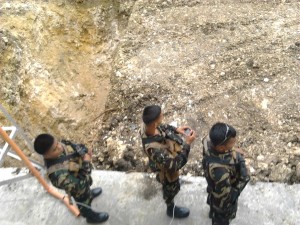
A World War 2 vintage bomb was discovered on November 21, 2012 at a construction site of the auto service shop “Boy Duce” near Calceta Street, Tagbilaran City. Elements of the Army bomb disposal unit who arrived at the scene at around 2PM.
The bomb was successfully detonated at 3:12PM and was witnessed by residents nearby the shop.
Residents, police and army personnel near the bomb disposal site near Boy Duce auto service shop.
A squad of an Army unit tasked to dispose the vintage bomb at Calceta St.
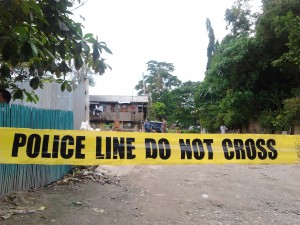
The police line that greeted motorists at Calceta Street near Boy Duce’s auto service shop. The street was closed to traffic due to a vintage WW2 bomb discovered by construction workers.
At about 10:30PM on October 24, 2012, a fire breaks out at the Bohol Quality warehouse for school supplies in Gallares St, Tagbilaran City. The damage is estimated at Php100,000.
The fire was not able to spread out of the concrete building and was put under control shortly by responding firemen.
Investigation is on-going to determine the cause of the fire.
TAGBILARAN CITY, Bohol, September 20, 2012 (PIA)—There’s is more than enough supply of rice stored at National Food Authority (NFA) bodegas even if the national government decided to cut heavily on import volume, assures Bohol NFA manager Maria Fe Evasco.
At the recent Kapihans a PIA, Evasco recalled that the government imported a total of 2.2 million metric tons of rice from the staple producing countries in 2010, one that was drastically cut to 800,000 metric tons by the following year.
This year, the government decided to import only about 500,000 metric tons by securing the 120,000 metric tons from Thailand and Vietnam while allowing private sector participation in the importation pegging a quota of 380,000 metric tons, to supply the country’s need for the staple crop, she said.
But, while non industry people have started airing concerns of possible shortfall in the supply of rice, Evasco assured that none of such will happen here.
She shared that Bohol has a share of the national government procured rice and the supply comes in according to a pre-programmed marketing plan, plus a local procurement program that assures us our bodegas are filled all the time.
“Fortunately, we have a big volume, hold-over inventory plus harvests from palay producing provinces,” that should keep us supplied for a time until the next delivery from out bodegas in Cebu arrive, she added.
Evasco came with NFA Bohol Operations manager Ramon Banluta and acting information officer Jhoel Lim to the Kapihan sa PIA to announce the National Grains Industry Week as well as the NFA’s Anniversary celebrating its 40th year of assuring food security.
To galvanize on the assurance, Banluta used the stir to catapult a plea for Boholano farmers to se their harvests to NFA, which buys their palay at P17.00 or at P17.70 per kilo with premiums for delivered, dried and cooperative member farmer sellers.
The palays also end up milled and stocked at NFA store houses to form part of the local inventory. The same could be mixed with iron fortificants as the government has been into iron supplementation relative to existing laws, according to Jhoel Lim.
These become part of the NFA rice fortification program where the mineral requirement of Filipinos is responded by the I-Rice (Iron fortified), he explained.
The iron fortified rice displays some yellow rice streaks in the pack, please do not sort the yellowish grains out, these are the iron fortified rice that enhances the mineral in your cooked rice, Lim suggests.
Some people might think these are dirty, these yellow colored grains are the ones that are strewn in a bag to increase its iron content, according to Evasco. (30/hd)
TAGBILARAN CITY, Bohol, September 21, 2012 (PIA)—Expect a down curve in the power demand from Bohol’s power distributors as hundreds of households make the switch to compact fluorescent lamps (CFL) from the energy sapping incandescent bulbs since yesterday, September 22.
This as the Department of Energy (DOE) brings to Bohol the second tranche of the National Residential Lighting Program under the Philippine Energy Efficient Project (PPP), which gives out energy efficient CFLS for the energy zapping and inefficient incandescent lamps in households, according to a communications signed by Director Antonio Labios.
According to the DOE, the program also aims to reduce household energy expenditures, which can in turn be used to spend for other priorities.
At the Dampas Barangay Hall Complex here in Tagbilaran City, representatives from Bohol’s congressional districts as well as household recipients attending the program kick-off in the Visayas went home with CFLS after the late afternoon activity attended by Dampas barangay officials led by Chairman Fredison Ingles and DOE Central Visayas.
Also simultaneous on the same day are similar events held at the National Capital region, Camarines Sur, Baguio and Cagayan de Oro in Mindanao.
Funded in part by the Asian development Bank, the activity ultimately seeks to motivate every household in the country to root for the CFLs, which may be a bit costly but usually outlives an ordinary incandescent lamp by almost ten times.
According to Mother Nature Network (MNN), if a 13 watt compact fluorescent lamp and its equivalent- 60 watt incandescent bulb – are lit for 8,000 hours, CFL consumes only about a quarter of the energy used to light the 60 watt incandescent.
The same study used by MNN also shows that it would only need some 104 kilowatts to light the CFL for 8,000 hours while the incandescent lamp would have used 480 kilowatts.
That is also not considering that an incandescent lamp may not last that long, pointing to a fact that CFLs outlast them by about ten times.
The same comparative study by MNN showed that even if every US home replaces one bulb to CFL, the energy savings would be enough to light more than three million homes.
On the other hand, one incandescent bulb in every US home produce enough greenhouse gasses equivaent to 800,000 cars.
Incandescent bulbs’ downside generally is its using only 10% of the energy for lighting while wasting the rest of the 90% in heat which they use to burn atoms and photons, research showed.
This then means that when paying for your bills, a huge part of it is paying for the heat which your appliances emit to operate, one than can be eliminated with the right technology, DOE sources said.
With households and industries continuing to zap power from overly burdened power grids especially by simply picking the incandescent bulbs, the government is now motivating people to simply make the switch and adopt more energy efficient technologies, like the CFL, to save energy enough to stretch the available supply until more power sources are put up. (30/CC)