by admin | Nov 17, 2015 | Headlines, Local News / Bohol Balita
Lawyer Victor de la Serna continues to sow lies after lies, and the latest of which is the alleged P1 billion which he said, was illegally stashed by the Chatto administration from the coffer of the Provincial Government of Bohol.
De la Serna’s orgy of spreading spurious facts and figures has turned into a circus because of its repetitivenes and transformed into a blatant public nuisance over the airlanes which he used as medium.
According to the records from the Provincial finance department , the province has appropriated P1.6 billion budget for this year and if the allegation of de la Serna is true, that is taking P1 billion from the P1.6 billion budget, the province has to stop operating .
The P1.6 billion annual appropriation will go to, Operating Expenses, capital outlays of the different departments, attached offices and devolved hospitals and the salaries and wages of 1,400 regular, contractual and casual employees under the Personnel Services.
Another direct recipient of the annual budget are the different programs of the Province under the HEAT IT BOHOL HELPS LIFE development framework.
The source said, the Province is still in the process of implementing the different Programs, Projects and Activities (PAP) for calendar year 2015.
It said that every transaction of the Province has to pass through several and different layers of internal control measures, which make sure that all collections are recorded and deposited in the bank with expenditures examined as to accuracy, completeness of supporting documents, its propriety and legality.
Reliable sources also pointed out, that if the allegation is true, the province could not have been awarded with Seal of Good Governance (SGLG) from the Department of Interior and Local Government (DILG).
The source stressed that in order for a local government unit to become a recipient of the said award, the LGU must pass all the three core assessment areas, namely Good Financial Housekeeping, Social Protection and Disaster Preparedness which the province had accomplish with flying colors, hence, the award.
The SGLG award symbolizes integrity and good performance of a local government unit.
The source said, each financial transaction of the Province of Bohol, has to pass through different layers of internal control measures such as availability of an appropriation, completeness of supporting documents and availability of cash.
The procedures are designed to prevent and ensure that the resources of the government are not stolen or wasted. (NPS)
by admin | Nov 17, 2015 | Headlines, Local News / Bohol Balita
The influx of business establishments, and the continuing progressive developments introduced by owners of existing business entities in Tagbilaran City and nearby municipalities, are viewed as products of good business climate brought about by better infrastructures such as water and power services.
This was the categorical statement issued by Atty. Jose Samonte who led the legal preparations for the consummation of the Joint Venture Agreement between the Province of Bohol and Salcon Industries in operating the former’s water and light utilities.
Samonte, who worked with the Gold Project of the USAID in 2000 revealed that the USAID took pride of the Provincial Government of Bohol’s Joint Venture Agreement (JVA) with Salcon Industries because it became a model in the country.
Samonte said because of the JVA, many local government units have sought their help for the same purpose in their respective localities.
The agreement was very advantageous to the Provincial government of Bohol because, aside from receiving a windful amount of more than P150 million, the payment of the PPUD outstanding debt of P21 million by Salcon to Land bank, the province remains a part owner with 30 per cent interest of the two utilities.
The agreement liberated the province from the annual subsidy of around P20 million for the operation of the two public utilities Samonte stressed.
Also, the Province has received dividends of more than P50 million and it keeps coming considering that the JVA is now a progressive going concern.
The dividends and the amount supposedly allotted to subsidize the two utilities are now being used for other basic services, such as the construction and repairs of roads , ,medicines and health care services, and agriculture farm implements, among others.
The JVA which became a model, became the subject of research by the Ateneo Graduate School of Economics. (F. Dagohoy III )
by admin | Nov 13, 2015 | Local News / Bohol Balita
With poverty reduction in the Philippines a prime focus of government’s activities, the identification of the felt needs of the targeted communities and sectors at the local level is crucial.
Since its implementation in 2012, the Bottom-Up Budgeting (BuB), also called participatory budgeting, has been a buzzword among civil society organizations (CSOs) all over the Philippines because of the fact that it is different from the usual top-to-bottom planning and budgeting where the high level executives make all the decisions in fund dispensations.
According to the Department of Trade and Industry (DTI), the BUB scheme provides the opportunity for prospective beneficiaries to be involved in setting their own goals and expectations for a given period.
The department adds that this ownership of decisions, motivating them to meet budgetary constraints that otherwise might seem unattainable or unrealistic if they were delivered by someone without understanding of their day-to-day operations.
Using the bottom-up budgeting scheme, the DTI provides funds that municipal governments can use in priming up local industries and help small entrepreneurs become competitive.
The trade department is joined by the Department of Interior and Local Government in implementing the projects by way of providing beneficiary local governments the necessary guidance.
DTI underscored that Local Government Units (LGUs) are the ones that identify their programs or projects into the budgeting approach, program the allocations, recommend the needed interventions and decide on the manner of implementation.
Along with increased participation, DTI points out that the BUB also helps to create a more accurate picture of how much each fund beneficiary needs in order to function effectively, adding that this scheme also promotes good governance at the local level.
In Central Visayas, around Php 15 Million has been allocated by DTI for trade-related projects under the BUB, with a total of 13 LGUs benefiting from 16 identified BUB projects.
DTI narrates that the BUB projects in Region 7 include Rural Micro Enterprise Promotion Program, Industry Clustering Development Program, Price Mapping & Monitoring, Green Growth Initiative, Shared Service Facilities, and One-Town One Product (OTOP) Store Express,
DTI says provincial governments are tapped to help speed up the implementation of the BUB-funded projects, adding that monitoring of the implementation these projects is the responsibility of the LGUs.
Policy guidelines on BUB are jointly issued by Department of Budget and Management (DBM), Department of Interior and Local Government (DILG), the Department of Social Welfare and Development (DSWD) and the National Anti-Poverty Commission (NAPC).
For information on DTI services, visit http://www.dti.gov.ph/
by admin | Nov 12, 2015 | Local News / Bohol Balita
PASAY CITY, Manila November 11 (PIA)—A doppler radar which would be put in southeastern Bohol would immensely bolster the weather bureau’s forecasting capacity especially in accurately tracking storms entering Mindanao sea.
Bohol officer in charge of the Philippine Atmospheric Geophysical and Astronomical Services Administration (PAG-ASA) Leonardo Samar said the Department of Science and Technology is now ironing out the details of the proposal to erect Bohol’s first and possibly only Doppler radar in Basac, Alburquerque.
A Doppler radar is a specialized radar that uses the bouncing targeted microwave signals to a desired target and computing or analyzing how the object’s motion has altered the frequency of the returned signal. This variation gives direct and highly accurate measurements of the radial component of a target’s velocity relative to the radar.
The soon to stand Bohol Doppler radar forms a redundant system that peeps through the interlacing circles of coverage which practically leave no areas in the eastern Philippines blind from approaching weather disturbances which spawn at the Pacific.
Comprised of 6 operational radars now, each one covering some overlapping 400 kilometers, these radars, all located in vantage and strategic points across the country are in Baguio, Subic, Tagaytay, Mactan, Hinatuan and Tampakan.
Typhoon Yolanda has effectively opened a blind spot in the country’s weather vigilance with the Tacloban radar ruined.
With an area remaining the country’s blind spot, a radar set-up in Bohol effectively covers that empty area as well as lend an eye to weather forecasters as soon as a storm passes over Surigao and descends into the Mindanao sea, which the Tampakan and Hinatu-an radars can’t see owing to the tall Mindanao mountains.
Recalling what happened to Seniang, while the PAG-ASA predicted good on the typhoon path after it entered the Philippine area of responsibility, the radars could not accurately pinpoint the storms location as it descends into Mindanao sea, Leonardo Samar of the PAG-ASA Dauis said.
While it becomes a redundant system, the Alburquerque Bohol Doppler, which is now opening its bids could be completed next year, the weatherwatcher said.
This system could enhance weather monitoring in the Visayas, Samar stressed. (rac/PIA-7/Bohol)
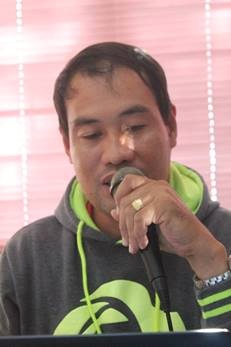
PAG-ASAs Leonardo Samar says a Doppler radar set up un Bohol immensely helps the weather bureau based in Dauis release more accurate forecasts on storms entering the country and descending into the Mindanao sea. (PIA-Bohol)
by admin | Nov 10, 2015 | Headlines, Local News / Bohol Balita
TAGBILARAN CITY, Bohol November 9, (PIA)—The option for organic agriculture could be hard and tedious but, when done right, will produce the same harvest as that of the farms with chemical fertilizers, but puts premium on the environment.
Marissa Tuazon, of the Pambansang Kilusan nga mga Magsasaka (PAKISAMA) pointed out that in farms, the experience of lessening the use of chemical inputs in the farms to save a little on will always have ill effects on the harvest, so they would have to bombard inputs to produce.
This ultimately produces that vicious cycle that would be endlessly binding the farmers to inputs and fertilizers to be able to produce, of a failure in cropping happens, she explained.
We are into local developments in the towns, using the old ways, considering that we have proven it; an organic farmer is now able to harvest 150 cavans per hectare, which, according to Tuazon is equal to the harvest of a farm using chemical fertilizer.
Themselves striving to effect asset reforms in the farms, PAKISAMA starts from issues in social justice to social enterprises, are now into building agri-based social enterprises in Carmen Bohol.
The plan is to help farmers wane themselves from the shackles of inorganic farm inputs so that the investments can be saved for the family.
PAKISAMA as well as other organic agriculture advocates in Bohol, relentlessly push for the return to the adoption of the more environment friendly fertilizers and pesticides or herbicides to make a statement on helping the campaign for climate change mitigation.
It is always survival of the fittest, so when farmers use synthetic herbicides to weed the farm and pesticides to rid the farms of pests, much of the chemicals are retained in the food, which is eaten, or are being washed out during rains, contaminating other farms and the water systems.
Zen Darunday, member of the Bohol Nature Conservation Society (BONACONSO) and a key officer of the Bohol Initiators of Sustainable Agricultural Development (BISAD) shared research that showed that of the 60% of the greenhouse gasses come from agriculture.
These gasses include methane from rotten leaves and animal wastes, nitrous oxides from chemical fertilizers and other soil demineralizers.
She said nitrogen-based fertilizers are 300 times more potent in racking heat, contributing to the climate change.
With chemical fertilizers clearly contributing to climate change despite the fact that it also leads to serious pollution issues which compound environmental destruction, groups like BISAD, PAKISAMA, Hugpong sa mga Mag-uumang Bol-anon (HUMABOL) and BONACONSO push therefore, for a serious organic farming adoption in Bohol.
We need to make true to our adopted green-development agenda, this time, it should not just be a mouthed promise but translated to reality, they urged.
In the advent of ASEAN integration, Tuazon picks on the edge for organic products which would be highly competitive when products from other countries start to flood the local markets.
Organic agriculture is our economic edge, and this helps the environment, so this must be seriously implemented by Bohol, who professes to be a province whose development is guided by the considerations of a sustainable environment, the groups said. (rac/PIA-7/Bohol)
by admin | Nov 10, 2015 | Headlines, Local News / Bohol Balita
TAGBILARAN CITY, Bohol November 9, (PIA)—Either Bohol goes for organic agriculture or it does not.
Organic agriculture advocates in Bohol slam the local implementation of the organic farming here noting that officials are doing a chacha.
Bohol Island State University’s (BISU) Professor Jose Travero, a revered organic farming initiator and known pillar of the Bohol Initiators of Sustainable Agricultural Development (BISAD) bemoaned the current state of the local implementation of the organic farming and agriculture.
Himself into keeping an organic farm and mentoring one that produces Bohol’s only organic papaya from a farm in Sagbayan, Travero picks on Bohol’s forward and backward as to its stand on organic agriculture, thus chacha.
Travero and the members of BISAD, also said they are wondering why Bohol promotes sustainable agriculture through the use of organic agriculture and yet be blunt in promoting hybrid rice.
Moreover, former BISAD executive director Zenaida Darunday, who is a staunch supporter of the move to really make Bohol genetically modified organism free (GMO-free) also added that the introduction of hybrid rice necessitates inorganic fertilizer inputs.
Salvio Makinano, another organic agriculture promoter, pointed out that he was hopeful Bohol would be true to the promise of organic farming promotion after the provincial government put up an annual organic agriculture budget of P1 million under Gov. Erico Aumentado.
By the following years, Bohol allocated under Governor Edgar Chatto some P3 million annual organic agriculture budget, Makinano added.
But, what have we got to show on organic farming? he asked.
He said much of the budget allocated for organic farming is going to research, which he claimed is never a production accomplishment.
“We already have an organic farming technology, so there is no need to do much more research,” professor Travero noted.
“In fact, what is needed is not research but implementation of the technology,” Travero, who teaches and models sustainable agriculture at the province’s only state university divulged.
There is no need to reinvent the wheel, he said even as he, along with BISAD hopes Bohol leadership could finally decide what to do with the move that can slowly wean Bohol farm from the burdens of environmentally destructive chemical fertilizers. (rac/PIA-7/Bohol)

