by admin | Aug 23, 2017 | DTI Updates, National News
PAMPANGA— The Department of Trade and Industry (DTI) engaged export and manufacturing stakeholders during the Generalized System of Preferences (GSP) Consultation Sessions in Clark.
“I urged exporters and manufacturers to fully maximize the Generalized System of Preferences (GSP) privilege of the Philippines by exploring opportunities in trade especially with the United States and with the European Union (EU),” said DTI Secretary Ramon Lopez.
The trade chief shared DTI’s thrust to balance the inflow and outflow of trade as the Philippine export growth is now 16.3 percent while the import is 13 percent. He also acknowledged the efforts of President Rodrigo Duterte in creating new ties with other countries, which opened new export markets to Russia and China. China accounted for the fastest growth rate at 34%. Recent date also showed exports to EU posted strong growth due to greater number of utilization of GSP+ trade privileges where over 6,000 product lines have 0% tariff duty.
Sec. Lopez also shared the continued negotiations of DTI in expanding preferential tariff lines of GSP and GSP+ engaging the US and the EU through dialogues. DTI also extends its efforts in establishing certifications for exporters, such as the recently signed joint Department Order (DO) between DTI and the Department of Labor and Employment (DOLE). Said DO ensures importing companies that Philippine exporters availing GSP preferences will uphold and protect the rights of laborers.
Board of Investments (BOI) Head and DTI Undersecretary Ceferino Rodolfo likewise joined the trade chief in highlighting and discussing the untapped potentials of the GSP privileges of the Philippines. USec. Rodolfo even led a cliniquing session with experts from the DTI-Bureau of International Trade Relations (BITR) and the Bureau of Customs to guide exporters in developing their trade strategies.
The Consultation Sessions on GSP was initiated by Former President and now Pampanga 2nd District Representative Gloria Macapagal-Arroyo with Pampanga Governor Lilia Pineda, in an effort to reinvigorate the export industry in the province specifically in travel goods and garments.
Last June, the US government expanded the coverage of the GSP including 23 tariff lines under travel goods sector, creating a potential of additional USD 200-400 million-worth of export revenues, generating 700,000 additional jobs in the country.
Also in the sessions were the Confederation of Garment Exporters of the Philippines Executive Director Marites Agoncillio, Clark Development Corporation CEO Noel Mananquil and Bases Conversion and Development Authority President Vince Dizon.
by admin | Aug 11, 2017 | DTI Updates, National News
As part of the agency’s thrust to increase awareness on the positive gains of entrepreneurship, the Department of Trade and Industry (DTI) and Technical Education and Skills Development Authority (TESDA) link up to provide TESDA graduates with access to trainings on entrepreneurship to help generate to equip them with the necessary skills on entrepreneurship and employment.
According to DTI Sec. Ramon Lopez, acquired business skills by TESDA trainees from the Skills Training for Employment/Entrepreneurship Program (STEEP) can be used in effectively running their businesses in the future.
“This partnership not only complements our objective to equip our people with the right mindset and basic skills, it also contributes to our national goal to realize inclusive growth towards shared prosperity, powered by smarter Filipino entrepreneurs,” Sec. Lopez said.
STEEP aims provide interventions through skills development by providing access to training on entrepreneurship to graduates of TESDA program for self or wage employment to uplift their economic status.
“Through this partnership, we are glad to help TESDA graduates acquire more skills and development which can give them more opportunities to improve their lives by engaging in vibrant entrepreneurial activities,” said DTI Regional Operations Group Undersecretary Zenaida Maglaya.
Under the agreement, TESDA will provide its list of graduates to DTI from the Special Training for Employment Program (STEP) and other similar scholarship program, assist in the conduct of the entrepreneurship training, and monitor and evaluate the implementation of the project.
Upon assessment and selection of TESDA’s certified STEP graduates, DTI, in turn, will provide entrepreneurship training, assist in availment of the microfinancing facilities, provide them access to start-up capital for micro enterprises, and even facilitate business registration of those who wish to engage in business/sole proprietorship.
“This is the service that we will provide to them,” Maglaya explained, adding that “from giving them the right mindset, to ensuring that they will have assistance until they decided to put up their own business, we will make sure that we are with them every step of their entrepreneurial journey.”
The STEEP agreement with TESDA is one of the Department’s initiatives to sustainably generate employment and further promote entrepreneurship in the country as DTI pushes for its “Trabaho at Negosyo” agenda.
by admin | Aug 11, 2017 | National News
MAKATI—“Partner Philippines and Build Value Together” sums up the latest government campaign to encourage investors to ride on the ongoing Philippine (PH) growth story.
Speaking in a Dutertenomics forum, which includes the country’s economic managers, on 10 August, Department of Trade and Industry (DTI) Secretary Ramon Lopez encouraged investors to partner with PH, which will help in creating additional value for their businesses that will boost income-generation operations.
“The initiatives under Dutertenomics can help support investors by creating an environment where companies can do business swiftly and efficiently,” said Sec. Lopez, stressing that ongoing infrastructure projects strategically link the country’s industries, which will further power the growth of an already strong economic base.
“Build Build Build will facilitate greater trade and investment as it opens up access to new markets, while minimizing trade and logistics cost,” he added.
According to the trade chief, investors can fully recoup their investments as their businesses enjoy the benefits of operating in a fully-industrialized and secure business environment. They can also enjoy PH’s stable macroeconomic fundamentals, the educated English-speaking workforce, the demographic sweet spot that presents an enlarging consumer base, and wider market access thru preferential trade agreements.
“The hallmark of Dutertenomics is to attain growth with equity, that is, addressing inequality while reducing poverty across the regions towards improved quality of life for all,” he added.
Dutertenomics sums up President Rodrigo Duterte’s key 10-point socio-economic commitment to widen the gains of development, to address income gap and to uplift the quality of life of Filipinos.
Under Dutertenomics is the Build Build Build program that aims to develop massive and efficient infrastructure projects to create more opportunities in the countryside by developing more regional growth centers.
According to Sec. Lopez, PH has its greatest asset in its people: a large pool of highly qualified and educated work force that are strongly customer-oriented, highly trainable with fast learning curve, adaptable to universal cultures and with high level of commitment and loyalty.
He also shared with the audience, which includes British businessmen, that the country’s independent foreign policy strengthens Philippine ties with its partners and has opened new market prospects.
Major players Japan, China, Russia, and the Middle East have been involved in various cooperation projects with PH that translated to increased investments and more job and income opportunities. Sec. Lopez also shared the potential of the Regional Comprehensive Economic Partnership (RCEP) as key to open a huge integrated market base of 3.5 billion with ASEAN plus six Dialogue Partners China, Korea, China, Japan, Australia and New Zealand.
“To simplify, we convert trade and investment gains into employment opportunities for Filipinos, helping them move up in life. At the same time, we develop innovative, competitive, job-generating industries where PH has competitive edge,” said Sec. Lopez.
“Manufacturing, agriculture, infrastructure, services and tourism are the country’s critical industries,” he concluded
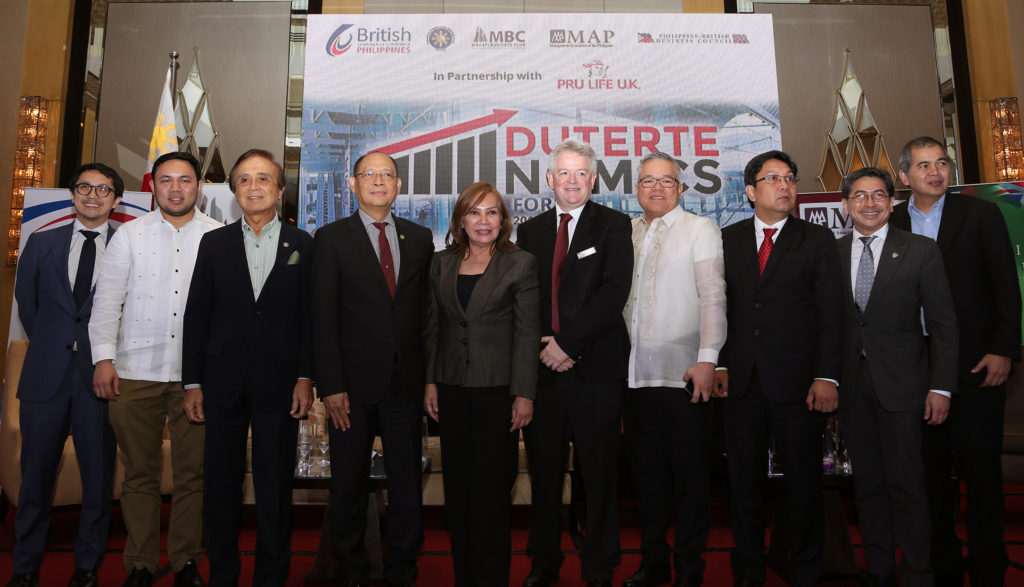
DUTERTENOMICS. The Dutertenomics forum once again gathered the country’s economic managers, including Public Works Secretary Mark Villar (2nd from L), Economic Development Secretary Ernesto Pernia (3rd from L), Budget Secretary Benjamin Diokno (4th from L), Trade Secretary Ramon Lopez (4th from R), Transportation Undersecretary Cesar Chavez (3rd from R), Bases Conversion and Development Authority President Vince Dizon (leftmost) with British Chamber of Commerce Philippines Executive Chairman Chris Nelson (6th from L) and members.
by admin | Aug 10, 2017 | National News, Negosyo Center Updates

The Department of Trade and Industry (DTI) welcomed the growing interest of the public in entrepreneurship as more Filipinos turn to Negosyo Centers for assistance for micro, small and medium enterprises (MSMEs) and aspiring entrepreneurs.
DTI Regional Operations Group (DTI-ROG) Undersecretary Zenaida Maglaya noted that since the inception of Negosyo Centers in 2014, the Department’s assistance to MSMEs spiked a total of 595,573 clients.
Maglaya attributed the “entrepreneurship fever” in the countryside to the agency’s continuing drive to introduce entrepreneurship as a steady source of income, partnerships with other national government agencies, and non-government organizations (NGOs), local government units, and MSMEs.
“This is a very welcome news for us that interest in entrepreneurship among Filipinos is growing. We highly encourage Filipinos, especially our Overseas Filipino Workers (OFWs) to engage in business so we can help our fellow Filipinos and the country’s economy,” Maglaya explained, adding that at least 3,041 OFWs were assisted by Negosyo Centers.
A total of 562 Negosyo Centers have been established since its inception in 2014, 297 of which were launched under the current administration.
Guided by Secretary Ramon Lopez’s 7Ms framework for a successful entrepreneur, the agency has provided assistance in the following areas: mindset, market access, mastery, machines, money, mentoring, and models.
“These programs for our MSMEs, being the backbone of the country’s economy, are surely beneficial. We would like to create more entrepreneurs and more jobs to help alleviate poverty in the country,” Maglaya said.
“At the start of 2017, we’ve targetted to open 200 more Negosyo Centers. But to be able to reach far-flung areas, we would open more so we expect to surpass the 200 centers target,” she added.
The Republic Act No. 10644 or the Go Negosyo Act aims to help micro, small and medium enterprises (MSMEs), promote ease of doing business, facilitate access to grants and other forms of financial assistance, Shared Service Facilities (SSF) and other equipment, and other support for MSMEs through national government agencies (NGAs), ensure management guidance, assistance and improvement of the working conditions of MSMEs; and facilitate market access and linkaging services for entrepreneurs.
by admin | Aug 8, 2017 | National News, Photo Story
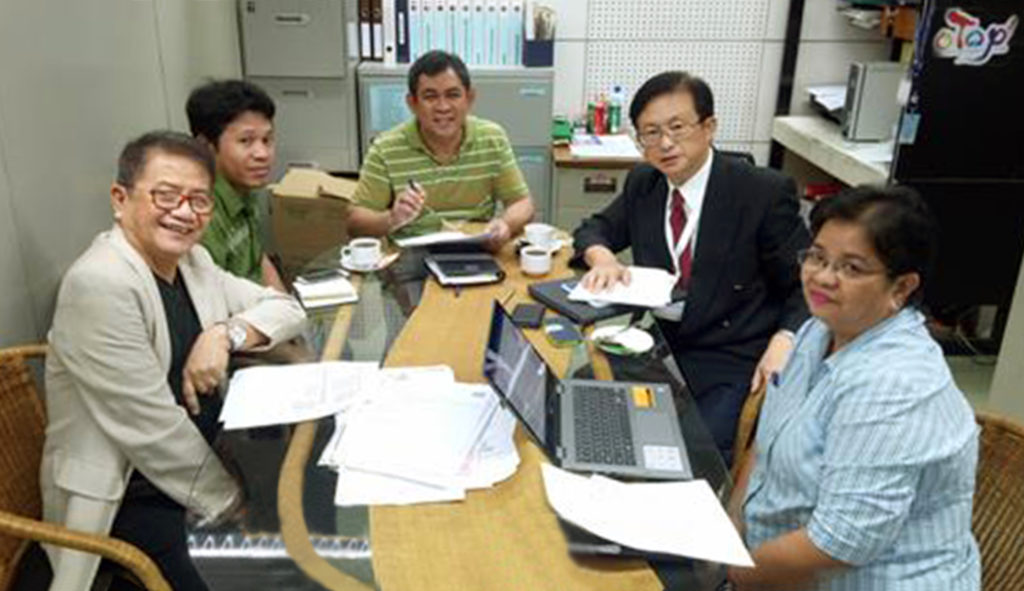
03 August 2017 Manila – The Taipei Economic and Cultural Office (TECO) in a brainstorming session with the Philippine Trade Training Center (PTTC) on the development of training modules for Capacity Building Programs designed for MSMEs. In photo seated from left PTTC Executive Director Nestor Palabyab, OIC for PTTC Training Division Rolan Ynon, OIC for PTTC Business Management Training Services Division Engr. Menandro Ortego, TECO Deputy Director Tony Tsai, and BMTSD Senior Trade and Industry Development Specialist Ms. Genoveva Ancheta11
by admin | Aug 1, 2017 | National News
MAKATI—The Philippines (PH) and the Czech Republic (CZ) forged a joint agreement to boost economic cooperation in trade and investment between the two sides.
Trade Secretary Ramon Lopez and CZ Ambassador to PH Jaroslav Olša, Jr. signed on 31 July the PH-CZ Agreement on Economic Cooperation, which is set to strengthen trade and investment relations between the two countries. Both sides also exchanged views on the concrete ways to lead the relations toward a more strategic direction.
“What we are having here is a milestone between our two countries. The strengths and resources complementarities have long been untapped. It is our desire to be with alternative markets and forge new partnership,” said Sec. Lopez, emphasizing that the industry complementarities of both countries bring increased potential to cooperate on technology-oriented industries, auto and aerospace parts, electronics, agri-based, energy, transportation, and tourism.
“Tourism is the beginning of trade, I say that all the time, because when people come and see how beautiful and interesting things are, they return back and say why don’t you come and do business,” said Ambassador Olša.
Sec. Lopez also encouraged the other side to explore possible cooperation on the development of micro, small, and medium enterprises (MSMEs). He also mentioned other prospects including food and beverage, agriculture and agri-processing, energy, and defense and security solutions.
“I am optimistic that Czech’s industry strengths can be a good start in identifying areas of mutual cooperation,” he added, noting that aerospace development is a viable cooperation area.
The signed agreement means providing PH and CZ to strategically discuss joint initiatives on the mentioned areas of cooperation. In a meeting, it was noted that PH can capitalize on CZ’s industry strengths to implement PH’s Manufacturing Resurgence Program (MRP) and complement activities to address the existing gaps in the implementation of different industry roadmaps.
Specifically, on trade in goods, PH may be able to increase exports of mid-priced apparel to CZ’s rising demand on the product. There is also potential for frozen marine products, dried fruits, and vegetables in the CZ market. These products are eligible under the European Union Generalized Scheme of Preferences Plus (EU GSP+) that allows entry of goods at zero percent tariffs.
Meanwhile, on investments, opportunities for promotion are in the areas of information technology-business processing management (IT-BPM), knowledge process outsourcing (KPO), processed and specialty food, energy, design-driven products and aerospace/aeronautics.
While the PH is pursuing a free trade agreement (FTA) with the EU, PH’s engagement with CZ aligns with the government’s strategy of rebalancing trade relations with non-traditional partners with an independent foreign policy.
Trade Undersecretary Ceferino Rodolfo said that the PH Europe Strategy touches on three pillars: maximizing the utilization of the EU GSP+, negotiating a PH-EU FTA, as well as a PH-European Free Trade Association FTA, which was signed in April 2016 in Switzerland.
Said agreement will also pave the way to the creation of a PH-CZ Joint Economic Cooperation (JEC).
Meeting on an annual basis as a platform to discuss PH-CZ economic cooperation, the JEC will serve as an additional dimension to the trade ties given the ongoing PH-EU FTA negotiations. The 2nd round of negotiations was held in February 2017 in Cebu.
The JEC will also be a venue for the private sector of both countries to be connected and develop a beneficial partnership through business-to-business meetings.
Usec. Rodolfo also noted that the “PH and CZ are two fastest growing economies in their respective regions.”
In 2016, CZ was PH’s 31st trading partner (out of 226); 28th export market (out of 213); and 33rd import supplier (out of 207), with total bilateral trade amounting to USD 283 million.
“More than trade, the longstanding relations between PH and CZ is anchored on shared values and history,” said Trade Undersecretary Nora Terrado, referring to countries’ colonial experience and the shared commitment in upholding the values of freedom and human rights in respective societies.

