by admin | Jun 28, 2016 | Headlines, National News
MANILA, June 28 (PIA)–Upat ka balaod ang gilagdaan ni Presidente Benigno ‘Noynoy’ Aquino III pila ka adlaw sa dili pa siya monaug sa posisyon.
Usa na niini ang R.A 10868 o ang Centenarian Act of 2016 diin nahisulod niini ang paghatag og insentibo sa mga Pinoy nga mag edad 100 anyos pataas og P100,000 cash gawas pa sa ilang mga dugang nga prebelehiyo.
Apil usab sa mga balaod nga gilagdaan ni PNoy niadtong Hunyo 23 ang Republic Act 10865 o ang Mayor Hilarion A. Ramiro Sr. Medical Center Act, apil na ang R.A 10866 o Batanes Responsible Tourism Act.
Gilagdaan usab sa Presidente ang R.A 10867 o ang National Bureau of Investigation Reorganization and Modernization Act.
Apan matud pa ni Presidential Communications Operations Office (PCOO) Kalihim Herminio Coloma Jr., wala naapil sa gilagdaan ang 75 porsiyento nga VAT exemption nga usa sa probisyon nga nahimong hinungdan nga gi-veto kini sa president sa 15th congress version niini.
Ang NBI Act usab bunga sa inter-agency consensus building ug usa sa giduso sa katapusang State Of the Nation Address o SONA sa presidente. (ecb/PIA7-Bohol)
by admin | Jun 27, 2016 | Health and Medicine, Major Events, National News
TAGBILARAN CITY, June 27 (PIA)—With increasing traffic related incidents heaping up cases and bloating crimes logged in municipal police blotters, Bohol Provincial Police Office reports a total of 84 more crimes in May over the previous month.
Reporting for BPPO police barracks chief PSSupt. Dennis Agustin, PCSuperintendent Lorenzo Batuan pointed out that the 217 index crimes in April rose to 224 in May this year.
At the Provincial Peace and Order Council Friday, June 25, Col. Batuan pointed to the usual culprits in the elevation of total crime volume in Bohol.
“As usual, the noted increase is due to road accidents resulting to Homicide, Damage to Properties, and Physical Injuries, he told PPOC members.
On the other hand, for non index crimes, BPPO operations chief also noted that of the crimes in April, Bohol tallied 393, a figure which further drowned with the 470 cases by May.
The police provincial headquarters recorded 610 crime volume in April, which also rose to 694 in May.
Of the 610 crimes logged in April, Col Batuan showed that 178 of the cases, or 34.26% are crimes in the blotter for traffic related incidents.
The figure eased a bit with May’s 694 crimes where 207 of them were traffic related incidents.
Traffic incidents in the blotter in Bohol stations reached 29.8% for May, still a considerable count considering that the 207 cases could have been significantly lower should people get on to it.
To illustrate the point, in April for example, BPPO snags 110 cases of physical injuries, 62 damage to property as well as 6 homicide cases.
When May came, Camp Dagohoy statisticians received total crime volume at 122, 77 of them caused damage to property and 8 cases of homicide.
PPOC Chair Governor Edgar Chatto once picked the good and well paved road networks as a lure for drivers to over-speed which almost always results to accidents.
Also, irregular under the table deals at the Land Transportation Office have been pointed out as largely contributing to the proliferation of incompetent and unskilled drivers.
Drivers who do not want to get in line and undergo the circuitous processing of papers are now paying the examiners at the LTO to obtain a license.
This is despite the fact that traffic enforcers who would dent on the campaign to rid the streets of irresponsible and unskilled, the road-worthy and the ill-maintained, could hardly take off with enforcement people getting embroiled in controversies. (rac/PIA-7/Bohol)
by admin | Jun 27, 2016 | Headlines, Major Events, National News, Tech Talk
The “Geeks on a Beach” (GOAB) international tech and startup conference, which has greatly contributed in empowering Philippine startups, will return for the fourth year in the scenic island of Panglao in Bohol this August 25-26, 2016.
This was announced by TechTalks.ph and the new Department of Information and Communications Technology (formerly DOST-ICTO) which co-organizes the event since 2013 as well as the MVP companies — PLDT SME Nation, Ideaspace, SmartDevNet, PLDT Innolab, Smart Communications — which are co-presenting the event this year.
The 4th GOAB, a unique confab featuring the cutting-edge of the tech world in a laid-back atmosphere, is the first startup event to be held right after President Benigno S. Aquino III signed the bill creating the Department of Information and Communication Technology (DICT) last month.
“Even better days are coming. The Philippine startup community is one of the sectors that have lobbied for the creation of the DICT. We hope DICT will continue to work together with various public-private stakeholders to empower startup communities to drive faster economic growth,” said Mon Ibrahim,Deputy Executive Director.
With the theme “Empowering startups, leading change”, GOAB4 will once more highlight communities of startups or innovation-driven enterprises based on software or apps, which have seen remarkable growth in the Philippines in the last few years.
“We are looking at startups taking the lead in strategically leveraging opportunities offered by a bigger regional market of ten countries with some 617 million people and a combined GDP of US $2.1 trillion opened up by the Asean integration,” added Ibrahim.
He said GOAB can be a platform in putting Philippine startups at the forefront of change by opening doors to investors and capital from within the ASEAN region along with North American, European, Japanese and other big investors.
The first three GOAB confabs have yielded positive results, including the formulation of the Philippine startup roadmap which is now being pursued by the government and the community paving the way for local startups to achieve success.
Earlier this year, the Department of Trade and Industry (DTI) also launched SlingshotPH, a development program that helps startups accelerate their business.
Tina Amper, founder of TechTalks.ph which has been instrumental in conceptualizing GOAB, noted that the conference has grown to attract a bigger and more diverse audience since GOAB’s debut in September 2013 in Boracay.
Amper said those who are into digital technology, web design, and innovation should not miss this opportunity to learn about the latest developments in the industry and meet the key players in the tech startup world.
“The Philippines’ remarkable work-play environment complemented by the famous Filipino hospitality and a unique cultural mix of East and West makes it the natural cultural doorway to the ASEAN for geeks and investors alike,” said Amper.
Organized by TechTalks.ph and the Department of Science and Technology – Information and Communications Technology Office (DOTC-ICTO) and co-presented by PLDT SME Nation, Ideaspace and SmartDevNet, GOAB4 will be held on August 25-26 at the Bellevue Hotel in Panglao, Bohol.
Some of the brightest minds in the industry from the USA and Singapore will be on hand in the 2016 GOAB. Invited to speak in the confab are Techstars co-founder and managing partner David Brown, Startup Weekend co-founder Marc Nager, Chris McCann of Greylock Partners,Crowdsourcing Week founder and CEO Epi Ludvik Nekaj, 500 Startups Managing Partner/Investor Khailee Ng, 500 Startups corporate innovation director Arnaud Bonzom, Zalora Philippines Managing Director Constantine Robertz, PLDT SME Nation head Mitch Locsin, Ideaspace.ph Managing Director Diane Eustaquio, TechTalks chief content officer Robert Cristobal, Citrix principal UX designer Philip McKay, and STAC Silicon Valley president Cristina Laskowski.
GOAB4 is held in partnership with HappyGaraje, Sym.ph, PR Works, Zalora, Mynimo, Teradoor, A Space, USAID-STRIDE, Yoyo Holdings, Eurokloud Corp., and Payoneer.GOAB4 organizational partners are Philippines Software Industry Association (PSIA), National ICT Confederation of the Phils., UP CebuInit.org, CedFIT.org, Game Developers Association of the Phils., Digital Commerce Association of the Phil., Developers Connect, STAC Silicon Valley and GoNegosyo. This year’s GOAB media partners are Auza.Net, Tech in Asia, Geeks in Cambodia, Mytechisland.com, Hubnob.tv, InnoPub Media.
For more information, to sponsor or purchase tickets, visit www.GeeksOnABeach.com; or contact Hello@GeeksOnABeach.com. Facebook: Geeks On A Beach and Twitter @GeeksOnABeach. Avail 20% discount and 40% discount for groups of 5 or more (use promo code “groupof5ormore”). Promo lasts until June 30, 2016
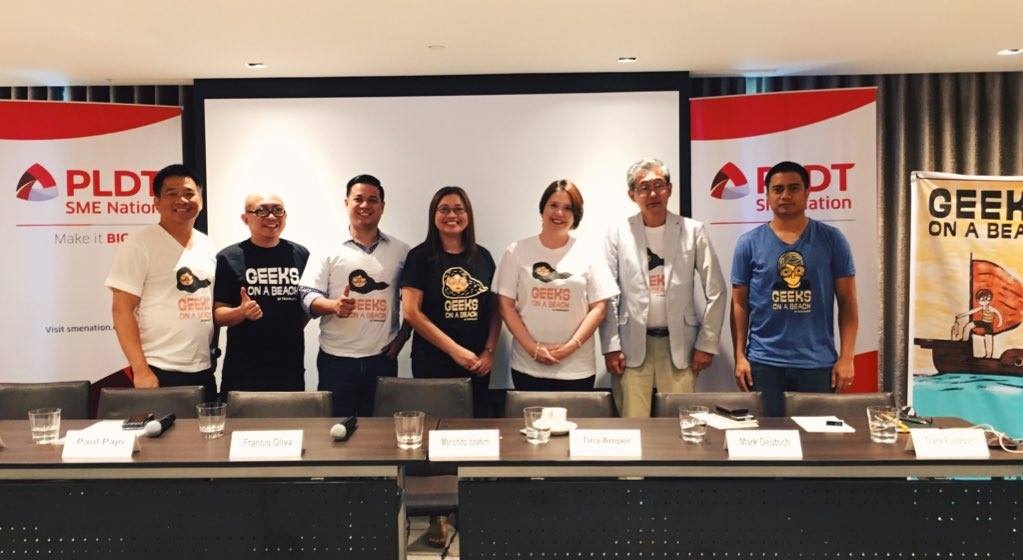
GOAB4 Manila Press Launch Panelists (L-R): Joey Limjap, VP and Head of PLDT ICT Research and Development; Paul Pajo, Developer Evangelist at SMART Communications; Francis Oliva, Community Partnerships Head, PLDT SME Nation; Tina Amper, Instigator, GOAB; Diane Eustaquio, Exec. Dir. IdeaSpace Foundation; Mon Ibrahim, Exec. Dir. DOST-ICT Office; Mark Deutsch, Co-Founder HappyGaraje and Creative Head of GOAB;
by admin | Jun 24, 2016 | Headlines, National News
The Department of Trade and Industry’s Industry Promotion Group (DTI-IPG) urged micro, small and medium enterprises (MSMEs) to follow international product standards to break into the global market – in a seminar conducted at the Waterfront Hotel, Cebu City last June 11 under the Negosyo, Konsyumer, at iba pa (NKATBP) service caravan of DTI.
Participated in by over 200 MSMEs, exporters, would-be exporters, entrepreneurs including local startups and innovators, government trade promotions and business development officers, the seminar dubbed as “Catapulting New Business for the Global Market” held various discussions on how to drive businesses into the growing global market and how government programs and initiatives can assist in finding the right market for their products and services.
The IPG, composed of the Export Marketing Bureau (EMB), Foreign Trade Service Corps (FTSC), Philippine Trade and Investment Center (PTIC), Center for International Trade Expositions and Missions (CITEM), and the Design Center of the Philippines (DCP), takes the lead in developing and implementing programs and activities that promote the Philippines and local entrepreneurs’ products and services in the domestic and international market.
“Our entrepreneurs should go beyond the local market. Most economies today have been aggressive in providing the global market of products and services that provide unique and personalized experiences. The challenge for our exporters now is to expand their market reach by improving the quality of their products and services and explore innovative opportunities for their offerings,” said DTI Industry Promotion Group Undersecretary Nora K. Terrado.
Majority of the participants of the said event are budding entrepreneurs that seek opportunities in the international market. Challenges and obstacles in doing business abroad were also discussed during the said event.
Among the opportunities being tapped today to penetrate mainstream markets is the increasing Filipino communities around the world. At present, in Singapore alone, there are about 180,000 overseas Filipino workers and migrants.
Also dubbed as the “One DTI Services”, the Negosyo, Konsyumer, at Iba Pa (NKATBP) is an initiative of the DTI Regional Operations Group that brings together all services provided by the DTI under one event. The event aims to heighten the awareness of the localities especially micro, small, and medium entrepreneurs (MSMEs) and consumers, about the services offered by the Department.
IPG-led seminars will run through several regions from April to December 2016 under the NKATBP event.
For more information on the services of the DTI, log-on to http://www.dti.gov.ph
by admin | Jun 23, 2016 | Headlines, National News
Technological advancement continues to improve the lives of millions of people around the world. Work gets done faster and resources are utilized more efficiently. These innovations are guided by standards that provide the framework needed to ensure constant growth and improvement. These standards form the backbone of technologies that contribute to the overall reliability and effectiveness of goods and services.
The International Organization for Standardization (ISO) /International Electrotechnical Commission (IEC) define a standard as a document, established by consensus and approved by a recognized body that provides, for common and repeated use, rules, guidelines or characteristics for activities or their results, aimed at the achievement of the optimum degree of order in a given context.
Under the Republic Act No. 4109 also known as the Standardization Law of the Philippines, the Department of Trade and Industry’s Bureau of Philippine Standards (DTI-BPS) supports industries and protects consumers’ welfare through the development and promulgation, implementation and coordination of standardization activities in the Philippines.
The development of these standards are guided by the Directives Part 1, Part 2 and Part 3 issued by DTI-BPS on the principles of standardization, the organization and responsibilities of technical committees, the procedures of technical work, and the structure and drafting of Philippine National Standard. These directives are issued as guides in the development of these standards.
Standards not only provide numerous benefits to individuals by ensuring that the products in the market are safe and reliable, it also promotes business and economic growth as it saves companies’ production time and money, enhances customer satisfaction and increases productivity and competitive advantages. The presence of standards in international market means countries can facilitate in trading goods and eliminate unnecessary barriers to trade. Standards also serve as vehicles for the transfer and application of technology from one country to another.
Standards are prepared either through the Technical Committee (TC) Method or the Fast Track method. Standards prepared through the Technical Committee method undergo a series of deliberations and consultations from concerned stakeholders. In order to achieve the purpose of standardization, transparency and consensus, a technical committee is composed of representatives from several sectors including academe, trade/industry, consumer association, professional, association, research institution, Government agencies and testing institution.
The development process for Philippine National Standards (PNS) follows a sequence of stages with corresponding document associated in each of the stages. Proposal stage (New Work Item Proposal), Committee stage (Committee Draft PNS), Circulation/Enquiry Stage (Draft PNS), Finalization/ Approval Stage (Final Draft PNS), Publication Stage (PNS).
Standards may also be prepared through the Fast Track method. In this process, International Standards shall be given priority. Fast Track procedure for standards development may be applied to international standards which are basic and can be used in standards development such as Guide, Terminology, Vocabulary, Classification and Symbol. This procedure may also be applied for International Standards which at the time of development has been circulated for comments to all sectors concerned. Similarly, this procedure applies to standards developed by other Standards Developing Organizations (SDOs) whose procedures follow the DTI-BPS Directives.
Consistent with its mandated roles and functions, the DTI-BPS shall prioritize standards of national significance such as life, health, safety, national economy and property, environment and efficient use of local resources. With that in mind, the BPS has listed priority areas for standards development and are guided by the Philippine Development Plan (2011-2016); Investment Priorities Plan (IPP); international commitments in the World Trade Organization and WTO Technical Barriers to Trade (TBT) and the ASEAN priorities and work programs under APEC; and standards for products affecting safety for consumer protection.
As of May 2016, there are 9,678 Philippine National Standards developed or adopted, 7,704 (79.60%) of which are already aligned to International Standards.
As the National Standards Body of the Philippines, the DTI-BPS is tasked to develop/adopt, implement and promote Philippine National Standards (PNS) as mandated in the Republic Act (RA) 4109 Series of 1964.
The DTI-BPS is the Philippines’ member to the International Organization for Standardization (ISO) and International Electrotechnical Commission (IEC).
For more info on standards and standardization activities, call the DTI-BPS at 751.4730 or visit the Standards and Conformance Portal – www.bps.dti.gov.ph.
For more information on the services of the DTI, log-on to http://www.dti.gov.ph
by admin | Jun 23, 2016 | Headlines, National News
The Department of Trade & Industry (DTI) DTI Secretary Adrian S. Cristobal, Jr recently signed a Memorandum of Agreement (MOA) with Department of Agriculture Secretary Proceso J. Alcala for the two agencies to jointly facilitate business permits, licenses, and endorsements involving investors applying for registration with the Board of Investments (BOI).
DTI Undersecretary and BOI Managing Head Ceferino S. Rodolfo said that the MOA is expected to improve ease of doing business in the country. “To benefit fully from the ASEAN Economic Community (AEC) and global market access, it is important that we offer a conducive environment to investors, a place where they could quickly set up their business. An important first step is to make it easy for them to comply with government requirements,” he said.
According to Rodolfo, simplifying business processes, coupled with the implementation of the Comprehensive National Industrial Strategy (CNIS), is keyto the development of the agriculture sectorwhich needs to modernize for it to be globally competitive. The CNIS links the manufacturing sector with agriculture and services sectors to mutually reinforce a virtuous cycle of growth.
Figures from the Philippine Statistics Authority show that investments in the agriculture sector slowed down to 4.4 percent in the first four months of 2016, weighed down primarily by the persistent El Niño phenomenon and the need to upgrade from traditional farming to a globally competitive agribusiness sector. Meanwhile, the manufacturing sector retained its momentum, growing by 8.1% during the same period due to improved business and consumer sentiments.
Under the MOA, a BOI representative is now authorized to assist a client to submit and follow up the application for endorsements, certifications, and/or permits with the DA up to the extent permissible by law. The MOA also provides for BOI to assist the DA in disseminating information regarding all relevant rules, guidelines, and standards on matters covering public investments, agricultural development and support services for domestic and export-oriented business enterprises and other related matters.
The MOA also provides for the DA to regularly provide BOI with copies of all relevant rules, guidelines, and standards on matters covering public investments, agriculture development and support services for domestic and export-oriented business enterprises. DA is also expected to provide BOI with a checklist of all requirements on application for accreditation, endorsements, certifications, and permits issued by the concerned bureaus and offices under the agency. DA will also regularly coordinate and cooperate with BOI drafting relevant policies relating to IPP, and other relevant rules, guidelines, and standards affecting investors and investment promotion activities.
Since 2014, the BOI, through the Investment Assistance Service (IAS) has signed five (5) other MOAs with Department of Environment and Natural Resources (DENR), the Securities and Exchange Commission (SEC), Department of Tourism (DOT), Bureau of Food and Drug Administration (FDA), Department of Health (DOH)-Health Facilities Regulatory and Services Bureau (HFRSB) to help businesses set up businesses in the Philippines.
“Clearly, the sustained economic growth of the country benefitted from policy reforms and increased collaboration to improve the ease of doing business in the country. The country’s current investment climate should benefit not only firms – whether foreign and domestic, large or small – but society at large,” Rodolfo concluded.
For more information on the services of the DTI, log-on to http://www.dti.gov.ph

