by admin | Jun 19, 2016 | Headlines, Tech Talk
Balilihan, Bohol – Gov. Edgar M. Chatto hosted the Bohol ICT sectoral discussion at the Balilihan Congressional District Library, Balilihan, Bohol on June 15, 2016. The event was organized by the Bohol Investments Promotion Center under the leadership of Ms. Inday Dominise.
The participants were representatives from Bohol ICT Council, Bohol Chamber of Commerce, DOST, DTI, DepEd, TESDA, BEPO, PPDO, Telco officers, Tagbilaran City LGU, BISU, Geeks on a Beach organizing team, BICTU and other representatives of various offices.
Ms. Lai Biliran presented the opportunities in the IT-BPM Industry and other sectors in the Philippine Digital Economy. Telco representatives discussed the plans of improving the Internet service in the province. The venue also happened to be very challenging area for deploying Internet and telecommunications service being surrounded by high terrain and without wired telco facilities yet.
The organizing committee of Geeks on a Beach also presented the details about the coming international technology conference to be held in Bellevue Hotel in Panglao, Bohol on August 25-26, 2016.
by admin | Jun 4, 2016 | Headlines, Local News / Bohol Balita, Tech Talk
Seven students from Kumon K of C passed the completer tests conducted by Kumon Philippines, Inc. (KPI) in May 2016. Two students took their completer tests on May 28 and five on May 31 at the Cebu office of KPI. The students were accompanied by Chief Instructor Dr. Elva Evasco-Auza and assistan instructors Nuova Fima Maylon and Ma Leslie Pelpinosas.
Bernard Hans Kurt Mortil, a Grade 7 student, enrolled in the math program in June 2015 with starting point B101 and finished math in 12 months. Eunice Chua, a Grade 5 student, enrolled in the math program in June 2015 with starting point B101 and finished math in 12 months. Jesse Biliran, Grade 6 student, enrolled in the math program in September 2014 with starting point of A and finished Kumon in 2.8 years. Jon Lexis Biliran, a Grade 5 student, started Kumon in September 2014 starting point of A and finished Kumon in 2.8 years.
Jeremiah Auza, a Grade 2 student, enrolled in the reading program in June 2013 with starting point of 7A and finished Kumon in 2.11 years. Peter Paul Jabines, a Grade 3 student, enrolled in the reading program with a starting point of 3A in July 2013 finished Kumon in 2.11 years. Jeorgeiann Suaffield, a Grade 7 student, enrolled in the reading program in 2014 and finished in March 2016 with a break in 2015. She only took 7 months in the reading program. Suaffield also took the Math completer test last year and was the first Math program completer from Kumon K of C.
Chief Instructor Auza said that she is proud of the achievements of her students in Kumon K of C. The three completers in the reading program also marked a milestone for Kumon K of C being the first batch of students completing the reading program. Auza said that more students will take completer tests this year. The recent increase in the enrollment will also mean that there will be more completer students next year.
The Kumon method teaches students to be independent learners which is a skill that they will continue to benefit from as they go through their academic life. The “just right” level is assessed individually and students progress through the program at their own pace. Students usually start to advance from their school level after a few months into the program. Earlier in May 2016, Kumon K of C awarded the students who belonged to the Advanced Students Honor Roll (ASHR).
To learn more about the Kumon method, contact Kumon K of C center at +63 38 4110822 during office hours or text at +639178898931.

May 2016 Kumon K of C completer students: Top L-R: Bernard Hans Kurt Mortil, Eunice Chua, Jesse Biliran, Jon Lexis Biliran Bottom L-R: Jeremiah Auza, Peter Paul Jabines, Jeorgeiann Suaffield
by admin | May 21, 2016 | Local News / Bohol Balita, Tech Talk
Owners of startups and MSMEs attended the Forum on Support to Innovation Initiatives on May 19, 2016 at the JJs Seafoods Village, Tagbilaran City. The forum was organized by the Department of Science and Technology – Bohol, the Department of Trade and Industry – Bohol, FabLab, Bohol Island State University and the Bohol ICT Council.
OIC Provincial Director of DTI-Bohol Mr. Jose D. Hibaya gave the welcome remarks while Engr. Marcial C. Tanggaan, DOST Provincial Director spoke to the participants about the initiatives and available programs of DOST for startups and MSMEs. Ms. Lai Biliran of the Bohol ICT Council also talked about the opportunities in the ICT sector that are available to Boholanos as well as the council’s efforts to attract business process outsourcing locators in the province.
Mr. Jovito Gonzales, Division Chief of the Investment and Business Operations Division of the Technology Application and Promotion Institute discussed in detail the available programs of TAPI and DOST that could be utilized by startups and MSMEs in Bohol to help them introduce new products and services and expand operations.
An open forum was held before the program was formally closed.
by admin | May 21, 2016 | Headlines, Tech Talk
The Bohol ICT Council led by Chairperson Ms. Lai Biliran and the Bohol Chamber of Commerce and Industry represented by Vice President Ms. Marietta Gasatan met with reelected City Mayor John Geesnell “Baba” Yap on May 19, 2016 at the city hall. During the meeting, Ms. Biliran highlighted to Mayor Yap that there are at least four brokers of business process outsourcing companies who are interested in locating in Tagbilaran City.
She also spoke about several activities happening in Bohol in the ICT industry and emphasized the opportunity for the city to be known in the international technology scene because an international conference called Geeks on a Beach (www.geeksonabeach.com) will be held in Panglao, Bohol at the Bellevue Hotel on August 25-26, 2016.
On May 24, 2016, one of the biggest brokers for BPOs will visit the city. BICTC and BCCI, together with city and provincial government representatives will meet them and discuss requirements and expectations.
Also present during the meeting with the mayor were Ms. Inday Dominise, from the Bohol Investment Promotions Center, Jerome Auza, the Vice Chairperson of the BICTC and Ben Skelton, a member of the board of trustees of the ICT Council.

L-R: Ms Inday Dominise of the Bohol Investment Promotions Center, Ms. Marietta Gasatan of the Bohol Chamber of Commerce and Industry, Ms. Lai Biliran of the Bohol ICT Council, City Mayor Baba Yap, Jerome Auza of the BICTC, and Ben Skelton of BICTC.
by admin | Apr 23, 2016 | Local News / Bohol Balita, Tech Talk
Click Prio topped the recently concluded Startup Weekend Bohol 2 (SWB2) held last April 15-17, 2016 at the Bohol Island State University in Tagbilaran City. ClickPrio gives patients access to their doctors with a tap of a button. It is an online queuing system specifically designed for hospitals and clinics.
The Startup Weekend is a 54 hour all action event where participants pitch an idea, and teams are formed to work on the ideas that have the highest votes. The SWB2 had 8 teams completing the event out of 8 selected ideas.
At 2nd place is Nice Cat, which is a pet merchandise brand that sells products for cats, cat owners, and cat lovers. With the creation of a lovable brand, a cast of compelling characters, and a business model in reverse to the likes of Disney and Pixar, it hopes to rule the industry with it’s furry goodness.
E-Trike Tours offers a cost-effective, environmentally-friendly, authentically local option to tourists. Standard rates (no overcharging), friendly drivers and your safety assured. They teach drivers the value of doing sustainable business: offering good service, good rates and taking care of their customers.



The teams were advised by the following mentors: Robin Gurney of ANDAKIDZ, Thomas Ridenour, a React Native Mobile Developer, Dan Pantinople, a Creative Lead of Symph, Paolo Rigotti of Gelateria Milano and Sharon Sesaldo of TechTalks.PH.
The judges for the competition are as follows: Albert Padin, Chief Technical Officer of Symph, Pip Cimafranca, a Senior Ops Manger, and Aimee Lim of Gerarda’s.
The event lead organizer is Ashley Uy of Symph and Jay Paul Aying of Bagol Labs, and were assisted by Jane Alcantara of Auza.Net, Ben Skelton, Charles Barette of Fab Lab, Ms. Lai Biliran of The Bohol ICT Council and Zion Campo of Tarsier Times.
The facilitators of SWB2 are Goldy Yancha of Ideaspace and Angel Abella of TechTalks.PH.
by admin | Apr 23, 2016 | Opinion, Tech Talk
By: Jerome Auza
I cringe every time I see a chart on my Facebook wall showing economy indicators “improving” during the Pres. Benigno Aquino administration. The way most of these charts are shown do indicate that a lot has improved in this administration, which is true, by the way. The problem is that these charts are not showing a complete picture and oftentimes fail to show the achievements by the previous administration.
You see, I deal with charts and charts data every day of my professional life. And with the computerized tools currently available for anyone to generate charts and publish them, it is easy to intentionally or unintentionally mislead the readers by showing a chart to highlight an improvement.
So I raise an eyebrow if I see telltale signs that a chart can be misleading. For example, someone declared that “Unemployment, went down consistently. From 7.3% in GMA’s administration, to 5.8% now.” Then the graph in Figure 1 is shown:
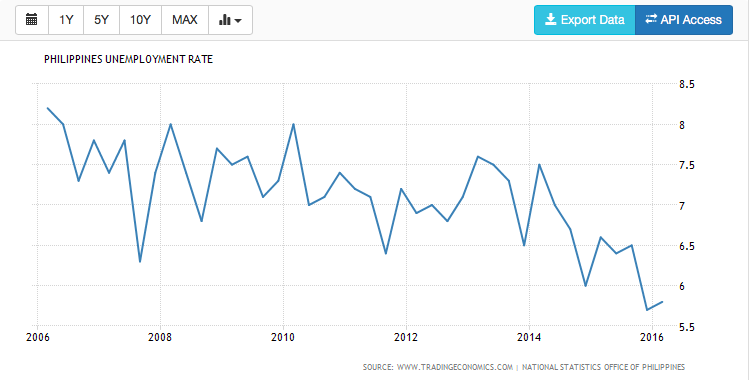
Figure 1. PH Unemployment rate from 2006 to 2016. Source: Tradingeconomics.com, Bureau of the Treasury, Philippines
What’s wrong with this chart is that the percentage numbers shown do not start from zero and thus you see a zoomed in line which shows a downward trend. It shows that the unemployment rate improved in 2010, when Aquino became president. But what if we look at all the data from further back? In Figure 2, we see a longer trend from 1996.
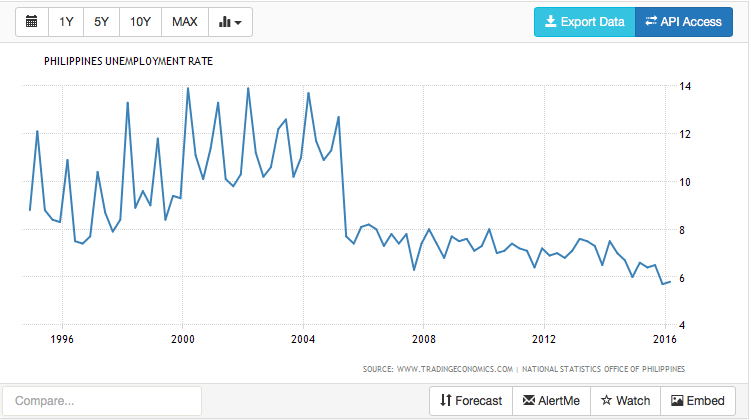
PH Unemployment rate from 1996 to 2016. Source: Tradingeconomics.com, Bureau of the Treasury, Philippines
The biggest drop in unemployment rate happened in 2005. Is this because of GMA’s achievement in generating jobs at that time? It’s hard to say because the unemployment definition was changed at that time. The old definition of unemployed considered only two criteria:
1) Without work and looking for work; or
2) Without work and not looking for work due to valid reasons.
And the current definition consists of persons in the labor force who are reported as (1) without work; and (2) currently available for work; and (3) seeking work or not seeking work because of the belief that no work is available, or awaiting results of previous job application, or because of temporary illness or disability, bad weather or waiting for rehire or job recall. The new definition of unemployed was adopted starting April 2005 per NSCB Resolution No. 15 dated October 20, 2004
One thing is clear though: that from 2005, the unemployment rate is trending down already and towards 2016, it seems to go downward faster. Perhaps if the 2008 worldwide financial crisis didn’t happen, we could have even better unemployment numbers.
So in short, the unemployment number was trending down already prior to 2010 and the Aquino administration maintained the downward trend and possibly increased the downward rate towards 2016. So it is right that the unemployment numbers improved in Aquino’s administration. It should also worth mentioning that the improvement started in GMA’s administration.
We see similar thing happening for GDP. Figure 3 shows the GDP from 2006 while Figure 4 shows GDB from 1960. The GDP rise started in 2002, went down a bit in 2010 and continued the trend upwards after that. If you look only at Figure 3, you will conclude that Aquino did a very good job in improving the GDP. However, if you look at Figure 4, the trend started in GMA’s time and it just simply continued the trend. Also, it seems that in 2014, the trend upwards may have started to slow down. We will know for sure after the 2015 data will be available.
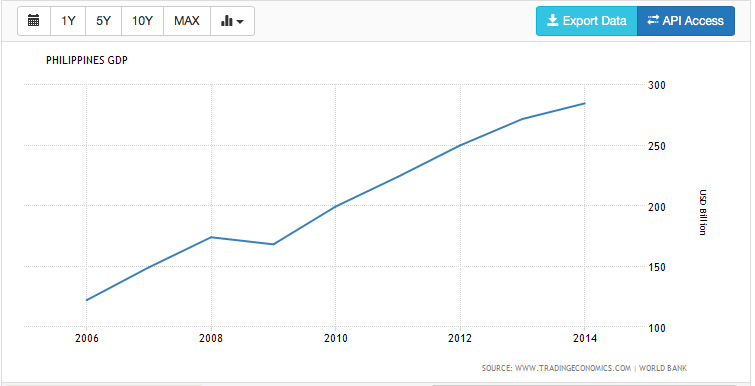
Figure 3. PH GDP from 1996 to 2014. Source: Tradingeconomics.com, Bureau of the Treasury, Philippines
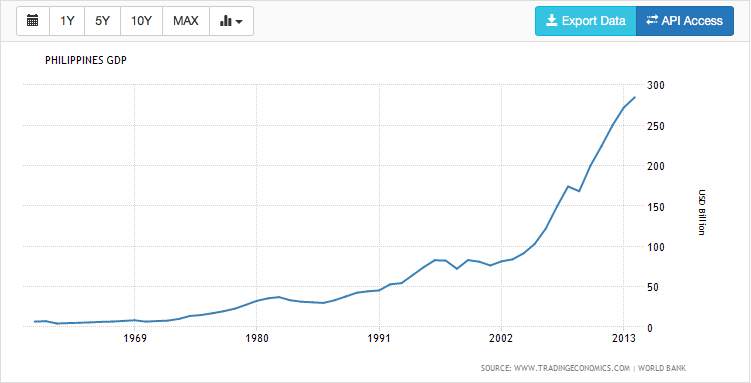
Figure 4. PH GDP from 1960 to 2014. Source: Tradingeconomics.com, Bureau of the Treasury, Philippines
And my last example is the PH Debt to GDP ratio. Figure 5 shows an apparently very significant improvement during Aquino’s administration, approximately 7 points improvement. However, Figure 6 shows that the biggest improvement in that ratio happened in GMA’s administration, around 20 points from the highest point until 2010 and the trend just continued in Aquino’s administration.
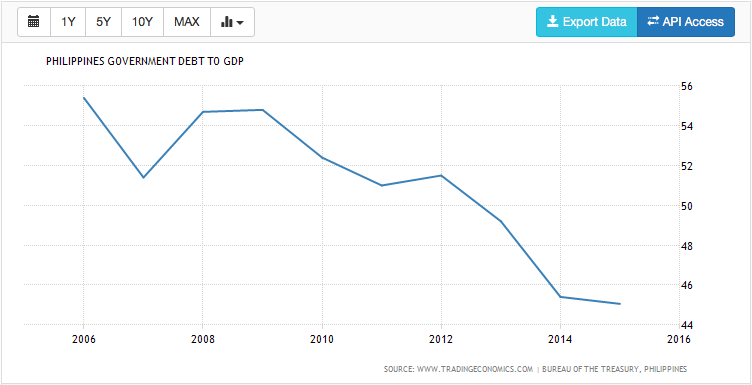
PH Debt to GDP Ration from 1996 to 2015. Source: Tradingeconomics.com, Bureau of the Treasury, Philippines
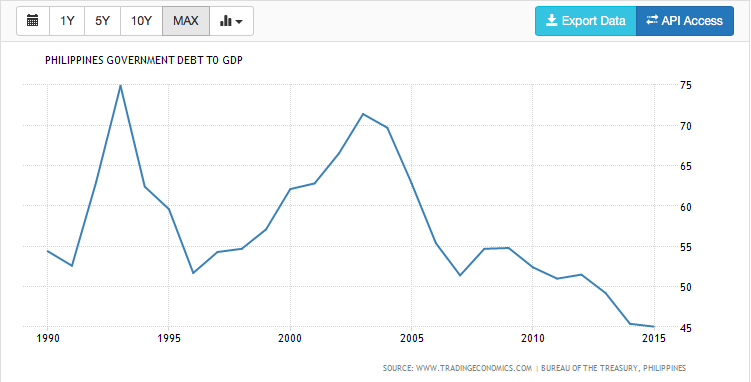
PH Debt to GDP Ration from 1990 to 2015. Source: Tradingeconomics.com, Bureau of the Treasury, Philippines
In summary, one should be careful not to be misled by a chart that do not show a complete picture. Charts are supposed to communicate a lot of information quickly but an incorrectly drawn chart could be misleading. In politics, it is common practice to tout an achievement by showing partial information on a chart. Watch out for zoomed in data as it would be difficult to assess the relative values on the timeline. This is especially true for long term trends like the economic indicators of the country.
In conclusion, it is very obvious that the significant improvements in the economic indicators started to improve significantly during GMA’s term and continued on by the Aquino administration. Both administrations should be commended for successfully improving our economy. Hopefully such trend will continue as the next president takes over later this year.

