by magnolia_eic | Apr 10, 2010 | Election 2010, Opinion, Tech Talk
In a matter of 30 days from today, the Philippines will finally implement an automated counting system for the national and local elections. May 10, 2010 will be a day when our country will finally show the world that we are done with the error-prone and easy to manipulate manual counting of ballots.
Automated counting removes several opportunities to manipulate the election results at the precinct level but it also makes some worry that cheating can be automated, and that a scenario causing a failure of elections like continuous power outage would occur forcing us to go into a constitutional dilemma of having no replacement to officials who will end their terms this year.
While it is easy to imagine scenarios of doom, these are really not that easy to do. In order for the automated counting to fail, any, or the combination of the following scenarios would have to be created:
Total Power Failure throughout the country.
Total power outage that lasts several days or weeks, causing total failure of all communication systems and draining all the battery power that comes with the counting machines. This power outage will have to start well before election day in order to ensure a failure of elections as well as a failure of everything else that requires electricity.
Diesel and gasoline supply cut-off several days before the power outage starts to ensure all backup power systems will run out of fuel.
If this total power failure happens, the elections probably won’t matter anymore.
All telecoms systems are jammed.
Someone shells out a significant amount money to buy enough jamming machines to jam all counting machines. These are expensive and they all have to work 100% until COMELEC gives up and cannot transmit the data. Unfortunately, this is very difficult to do. Even if someone manages to get enough jamming machines to significantly affect the data transmission, all COMELEC has to do is move the counting machines to another location where the jamming signal is too weak to affect it and the data transmission will proceed. Also, even if the machine cannot transmit the data electronically, COMELEC can get the data from the machines on a USB drive and manually upload the data to the central database.
To stop data transmission, the jammers will have to take down all forms of connections to the Internet which is unlikely to happen because the Internet itself, a by-product of the cold war, is designed to be resilient to a nuclear attack by using multiple routes. If a certain route is damaged, the data can still go to its destination through other routes.
Someone with the proper access rights to the data will manipulate the numbers.
This is probably the best way a candidate can cheat but for this to happen, the database administrators and software developers must be persons with questionable integrity. Systems developed for critical applications like the elections have multiple safeguards against data integrity issues. There are audit trails built in into the system so any forced changes can be traced. Unless the administrators and developers are willing to take the risk of being caught, this form of cheating would be hard to do.
Random manual count will not match with automated data count.
Any manual count will likely not match with the machine counted votes. This is because the machine may not accept partially marked votes but a human looking at the ballot might accept it. It would be better if the verification count is done on a another counting machine. The results between the counting machine at the precint and the one used for random checking should match closely.
The final election results can be delayed by political parties by complaining of inaccuracies with the manual verification count. However, people should realize that at the national level, any counting errors due to the normal operation of the machines would be more or less shared equally across all candidates which is the normal behavior of large numbers. A candidate would be embarrassing himself if he complains of cheating due to a few counting errors of some machines. A small amount of error is a natural occurence. A candidate would be wise to ensure he leads by several points in the surveys to ensure naturally occuring error cannot turn the tide against him.
Filipinos and the international community do nothing to stop cheating.
All Filipinos are somehow mesmerized by the turn of events that they cannot or will not do anything to help the COMELEC continue with the elections. And for some reason, the international community will leave us on our own and refuse to provide any form of help. This scenario is highly unlikely though because people would always try to defend to survive and would not simply allow events to happen that are disadvantageous to the public.
Filipinos should give the automated elections a chance to succeed and be vigilant against attempts to compromise the sanctity of their votes. A successful May 2010 elections would give the Philippines huge boost in our performance as a country thus giving the nation more opportunities for the community.
by admin | Mar 30, 2010 | Local News / Bohol Balita, Tech Talk
Auza.Net completed its selection of students who will undergo its Summer 2010 OJT Program on March 31, 2010. More than 30 applicants were screened and interviewed from Bohol Island State University, Holy Name University and University of Bohol.
16 promising students qualified for the program and will start their OJT program on April 5, 2010. The company’s summer OJT program has been a successful project allowing its trainees to be highly qualified job applicants to various IT companies upon graduation.
The students who qualified, in alphabetical order, are:
Alinab, Ivy
Alombro, Jagad Marxcarlo
Balaba, Noel
Bonao, Analyn
Calope, Mary Lee
Corrales, Mark Angelou
Damasin, Anna Rea
Jumila, Mikejun
Naguita, Hanna Harrette
Naquila, Lalaine
Malayao, Glenn Mark
Omalsa, Louraine
Pequino, Catherine
Raut, Mary Jean
Suarez, Sweetenia
Tapuroc, Mark Paul
by magnolia_eic | Mar 22, 2010 | Announcements, Tech Talk
Auza.Net will start conducting interviews of applicants for its Summer 2010 OJT Program on March 23, 2010. Applicants who have already sent their applications will be notified via text or call. Those accepted to the program will go through various training sessions including web services using WordPress, network setup and open source technologies. They will also be involved in breakthrough projects that may become commercial applications later.
The OJT program projects in the past led to various success stories that include the DYRD-AM worldwide broadcast, WiFi authentication system and embedded systems, all of these, among others, are currently being used by Auza.Net for the services it offers its clients. The company believes that exposure to real-world application or system integration will help the trainees gain confidence and experience that will help them qualify for exciting jobs when they graduate. Many graduates who were OJT’s of the company are now hired in various industries. Auza.Net itself hired several of its former OJTs for full time positions for software development and network administration.
Applications are still accepted until March 26, 2010 and the program will start on April 5, 2010, however, due to the volume of applications, the company will evaluate applications on a first come, first served basis. Students must be candidates for graduation during the school year 2010-2011, taking engineering or IT related courses. Students taking other courses may apply provided they are proficient with computers, Internet and IT concepts in general. Please submit your application letter, resume and TOR at the Auza.Net Internet Media Center at the K of C Recreation Center.
by magnolia_eic | Mar 22, 2010 | Announcements, Tech Talk
The research paper “JAVADOME: A Programming Tutorial Site” authored by Mr. Donald Tejano, Mr. Jonathan Rhey Tan and Mr. Joseph Jason King Plaza won the HNU Best Student Research — Computer Science Category for the School Year 2009-2010. The 4th year BSCS Students of Holy Name University topped two other finalists and received their award during their graduation rites on March 20, 2010.
The judging was done last March 17, 2010 at the Academic Conference Room of Holy Name University. The panel of judges was chaired by Mr. Jerome Auza of Auza.net, with members Mr. Oliver Dilao of DissectBuild and Mr. Aris Catan of STI. Also present during the judging were Fr. Francisco Estepa, SVD, HNU President, Ms. Maria Paz Espiritu, Coordinator of the Research Center, Ms. Amie Rosarie C. Caballo, Dean of the College of Computer Science and Ms. Eva Marie Budiongan, Member of the Computer Science Research Area Committee.
by magnolia_eic | Mar 6, 2010 | Local News / Bohol Balita, Tech Talk
Bohol is once again a host to a nationwide gathering of individuals, this time from the IT education sector.
The 12th Philippine Society of IT Educators National Convention was held last February 24-27, 2010 at the Bohol Plaza Resort and Restaurant, Dayo Hill, Mayacabac, Dauis, Bohol. An estimated 250 participants coming from all over Philippines attended the said convention.
A soft opening was held in the evening of February 24, 2010, with a talk from Intel, coupled with dance performances of HNU’s Diwanag Dance Theatre and Cultural Troupe.
The event formally opened in the morning of February 25, 2010 with HNU’s Himig Diwa rendering the invocation, the Lupang Hinirang and Awit sa Bohol. The event was graced with the presence of Atty. Handel Lagunay, the Bohol Provincial Administrator, giving the Welcome Remarks in behalf of Governor Erico Aumentado while the keynote message was given by Mr. Carlo Subido, the Business Development Manager of Intel Philippines.
There were plenary sessions on topics such as Flattening the IT Education Sphere, Addressing ICT Education Gap Through Partnership and Service Science, Management and Engineering (SSME). There was also a presentation on Educating Voters: An ICT Challenge and on the ITE Undergraduate Thesis Project Framework. In between these talks were presentations from the different sponsors of the event. In the evening, the participants were entertained by a serenade from Himig Diwa and dance numbers from Dr. Cecilio Putong National High Sschool’s Bukang Liwayway, headed by Mr. Oscar Real.
The most awaited event was the JEDI (Java Education and Development Initiative) Night, which took place at Flushing Meadows in the evening of February 26, 2010. It has been a yearly activity during national conventions that Sun Microsystems would sponsor one evening filled with fun and surprises. Awards were given to JEDI supporters and to the JEDI Champion.
The convention culminated with a tour on February 27, 2010 to the famous Chocolate Hills and other tourist spots of Bohol, including a Loboc Cruise while taking their lunch.
The event was made possible through the sponsorship of Sun Microsystems, Microsoft, Philippines, Intel Philippines, SAP, UP-ITTC, MacQuarie, EZWare, Globe Business, FastTrack and EC Council to name a few. Locally, Holy Name University, through the College of Computer Science, was the organizing partner of the said event. Special thanks is also extended to the Office of the Governor of Bohol, Bohol Quality Corporation, SLAO Art and Sign, Hangad Art and Design, DTI-Bohol and Auza.net for making the event a success!
by magnolia_eic | Mar 6, 2010 | Local News / Bohol Balita, Tech Talk
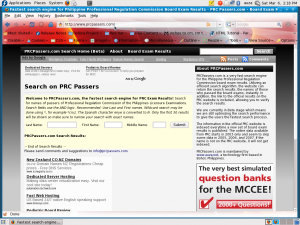
Auza.Net has released another free online service called PRCPassers.com (http://www.prcpassers.com), a fast search engine for names of board examinees who passed the PRC exams. It is still in its beta stage which means there are still improvements being done but the site is already usable by the general public. The service is unique compared to all other websites that publish lists of board exam passers because it is a real search engine where you simply type in the last, first or middle name or any combination of these and the results are shown immediately. The user is no longer required to click several links before finding the list of names which can take quite some time.
PRCPassers.com keeps an index of the board exam passers allowing for a very fast search, while providing the user a link to the official results on the PRC website so the results can be verified. In contrast, the other websites that publish the board exam results simply copy the data and republish them.
The search engine is a customized WordPress plugin that includes a very fast search algorithm developed specifically for this type of index. It also performs the indexing everytime a new list of board exam passers are published by the PRC. Even though the plugin performs complicated functions, the development period was relatively short, a total of 5 working days only. This is because the developer only had to develop the functions that are specific to the search engine. All other functions like authentication and database abstraction are already handled by WordPress (http://www.wordpress.org), a very popular content management system.
Click here to visit www.prcpassers.com

