by admin | Sep 15, 2015 | Headlines, Local News / Bohol Balita
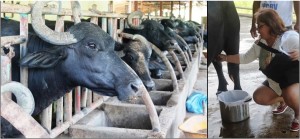
Carabao milk to help increase farmers incomes, this is what the Bohol Dairy Production and Marketing Enterprise is looking at in 2020, and its plan to infuse foreign breeds into the local breeds may increase milk production, a project funded now by the WB-DA PRDP. (rac/PIA-7/Bohol)
TAGBILARAN CITY, Sept 14 (PIA)–From 120,000 liters produced in 2015, Bohol Dairy Processing and Marketing Enterprise (BDPME) taps a P9,227,528.64 loan and equity from local sources to hit close to 200,000 liters of carabao milk in 2020, which will mean between 5-7% annual increase of family incomes from this year onwards.
With a loan from the World Bank at P4.470 million and both P1.490 million from the government of the Philippines, the Provincial Government and another P1.777 million equity, the Bohol Dairy Processing and Marketing Enterprise enhances the present enterprise in Bohol already set up in the National Dairy Farm Complex in Lomangog, Ubay, Bohol.
Still picking up what can be salvaged from the fire that razed its assets and freak accidents that caused substantial losses in capital and manpower, the new pitch relies on the Bohol Dairy Producers Association (Bohol Dairy), according to project brief provided by the World Bank Implementation Support Mission now gathered in Bohol until Wednesday.
The marketing enterprise will do this ambitious plan by procuring raw milk products for the 23 identified clusters to 27 after 4 years, involving some 504 farmer dairy carabao growers to a projected 2424 farmers in 2020.
The plan also intends to expand to other farmers and increase farm animal holding capacity for maximized dairy production.
Now helping farmers set up milk production in 35 barangays in Ubay, Mabini, ALicia, Dagohoy and San Miguel, BDPME aspires from the stock infusion from the nearby Philippine Carabao Center (PCC).
Resting inside the PCC, the dairy processing plant also proposed to ask the PCC to upgrade local carabao breeds via genetic development or cross breeding to increase milk production.
The project then entails milk collection, consolidation of milk collected from farmer members to the association of Bohol Dairy, tolling and processing at the PCC and national Dairy Authority Plant to storage as well as marketing in identified retail outlets, which the NDA plans to be located in tourism areas in Bohol, according to PCC sources.
BDPME is now set for funding by the World Bank-Department of Agriculture Philippine Rural Development Project (WB-DA PRDP) for Investments in Rural Enterprises and Agriculture and fisheries Activity Program (I-REAP) (rac/PIA-7/Bohol)
by admin | Sep 15, 2015 | Headlines, Local News / Bohol Balita
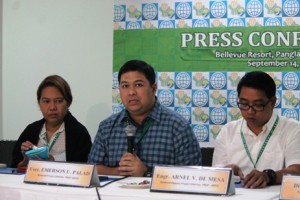
DA undersecretary Emerson Palad explains the WB-DA PRDP and its project components, which include intensified building of infrastructure and logistics for development to carry out the goal of increasing farm family incomes in the six year project term. With him are Carolina Geron World bank Senior Rural Development Specialist and Engr Arnel de Mesa, National Deputy Project Director. (rac/PIA-7/Bohol
TAGBILARAN CITY, Sept 14 (PIA)–Crucial roads that could spur agricultural development in otherwise impenetrable idle areas, reduce hauling costs, cut travel time for basic services and local commute as well as expand employment opportunities: these are but some of the benefits as the government partners with the World Bank (WB) to sets up in Bohol a total of 17.81 kilometers of key farm to market roads.
The total farm access roads development is from four areas which the World Bank partnership with the government of the Philippines and the local government units agreed to fund under the Department of Agriculture’s (DA) Philippine Rural Development Project (PRDP).
Benefitting from the DA PRDP Intensified Building Up of Infrastructure and Logistics for Development (I-BUILD) are the rehabilitation of the 5.9838 kilometers of San Agustin-Canmaya Diot Farm to Market Road (FMR) in Sagbayan, 5.5 kilometers of Alegria-Bugho FMR in Loboc, the 3.54 kilometers Ba-ang-Mahayag Norte FMR in Catigbian and the 2.84 kilometers Del Carmen Weste-Tugbas FMR in Balilihan town.
And all the rehabilitated FMRs now sport the all weather Portland Concrete Cement Pavement, road shoulders, box culverts, cross drains and lined canals for better
The FMR rehab projects cut an average of 51% of travel time in those mentioned areas, cuts 47% of hauling costs for inputs and farm produce, allows the entry of 70% more transport players, develops over 300 more hectares of cogonal lands, increases land valuation and spurs employment opportunities as well as allows easier access of government basic services, according to project proponents.
Developing, upgrading and rehabilitating these named areas cost P 152,368, 179.00 with the WB partnering with the Government of the Philippines, Provincial and Local Governments the governments putting up equity funds, according to project briefers distributed during a press conference September 14.
The Press conference happened a few hours after the First World Bank Implementation Support Mission opened at the Pavilion of the Bellevue Hotel in Panglao.
The PRDP is a 6 year program national project under the DA designed to establish an inclusive climate resilient and market-oriented agri-forestry sector through strategic investments in priority commodity value chains, the press conference showed.
It aims to increase by 50% annual real farm income of beneficiaries, 30% increase in enterprise development from same beneficiaries and some 20% increase in number of farmers and fishers with improved access to agri-services.
PRDP components include investments planning (I-PLAN), I-BUILD, Investments in Rural Enterprises and Agriculture and Fisheries Productivity (I-REAP) and Implementation Support to PRDP (I-SUPPORT).
Along the spread of time, PRDP follows a value chain analysis, which allows stakeholders and communities to get inputs for their commodity investments, explained Engr Arnel de Mesa during the press conference.
DA Regional Director Angel Enriquez also said the baseline study which the project has started could be very useful tool to fit all other future plans for agricultural development.
The projects also use applied geo-tagging to make sure it does not overlap with other similar projects resulting in lost government resources, adopts a document tracking system and puts up a grievance redress mechanism in a flexed effort to make sustainability and empowerment enable communities and expand their opportunities. (rac/PIA-7/Bohol)
by admin | Sep 12, 2015 | Local News / Bohol Balita
The provincial government of Bohol under the leadership of Gov. Edgar Chatto hosts the 2nd Negosyo Center in the province which was formally opened on September 4, 2015 with Sen. Paolo Benigno “Bam” Aquino as guest speaker during the opening ceremonies.
The Negosyo Center is located within the Bohol Investment Promotions Center office at the back of the capitol building. BIPC Head Ms. Inday Dominise along with DTI officials, Gov. Chatto, Mayor John Geesnell “Baba” Yap and various other government officials participated in the blessing ceremonies of the new center. They then proceeded to the Governor’s Mansion for the opening program.
Gov. Chatto lobbied for the realization of the Negosyo Center within the provincial capitol building as this is expected to help ease business registrations due to the Bohol One Stop Shop facility at BIPC. It is also expected to help startups and existing businesses to network with suppliers and buyers as well as financial institutions to help with raising capital.
Dominise said that in the coming months, the Negosyo Center will be the venue for various training sessions open to all business owners who are interested.
by admin | Sep 12, 2015 | Local News / Bohol Balita, Tech Talk
The Department of Science and Technology – Information and Communication Technology Office (DOST-ICTO) will conduct a Home Based Outsourcing workshop on September 23, 2015 at 1:00pm to 5:00pm at the Bohol Cultural Center.
Registration is free and open to anyone interested to learn about how to engage in outsourcing jobs.
The workshop is co-organized by Upwork, a freelance jobs portal and Online Jobs University.
Interested participants are encouraged to pre-register at the Negosyo Center of the Bohol Province (Bohol Investment Promotions Center) or through the Bohol ICT Council Facebook page.
by admin | Sep 12, 2015 | Local News / Bohol Balita
Contributors: Jerome John J. Gabin & Jude Bernard T. Guieb
The Department of Trade and Industry – Bohol Provincial Office (DTI – Bohol), in cooperation with the Bohol Fabrication Laboratory (Fablab) and Bohol ICT Council, is organizing the Bohol Idea to Innovation (BHL i2i) Competition which will commence this coming October 2015. This initiative aims to spark creativity and innovation in the province of Bohol.
The BHL i2i Competition, the first of its kind in the province, is a program that promotes innovation and start-ups through digital fabrication. It aims to support the participants in developing technology-based solutions to local problems. It is an end-to-end approach to develop ideas into minimum viable products through the facilities and technologies available at the Bohol Fablab, the first fabrication laboratory in the country. It will be open to all aspiring students and innovators of Bohol.
The competition is composed of four (4) stages: a) boot camp stage; b) prototyping stage; c) co-creation stage; and 4) the exhibition stage.
The competition will be kicked-off by a Boot Camp, a two (2) day event where competitors will undergo various lectures before they go into the ideation phase, preparation of presentation materials and pitching. Winning ideas will qualify for the next stage and will be supported by DTI in the development of prototypes. Teams may avail of the services and technical support of the Bohol Fablab during the prototyping stage.
An added feature of the competition is the product co-creation process with Japanese mentors before the presentation of the final prototype for judging. Through this process, teams will have the chance to further improve their prototypes through knowledge and technical expertise sharing from Japanese counterparts before the final presentation in March 2016. Winning competitors will have the chance to present their prototype during the Fab Asian Network 3 (FAN3) in 2016 which will be held in India.
For more information and details regarding the competition, interested participants may visit the DTI – Bohol located at 2nd Floor, FCB Main Building, CPG Avenue, Cogon District, Tagbilaran City, Bohol or call (038) 501.8828/ 501.260/ 411 3302 and look for Jerome and Jude.
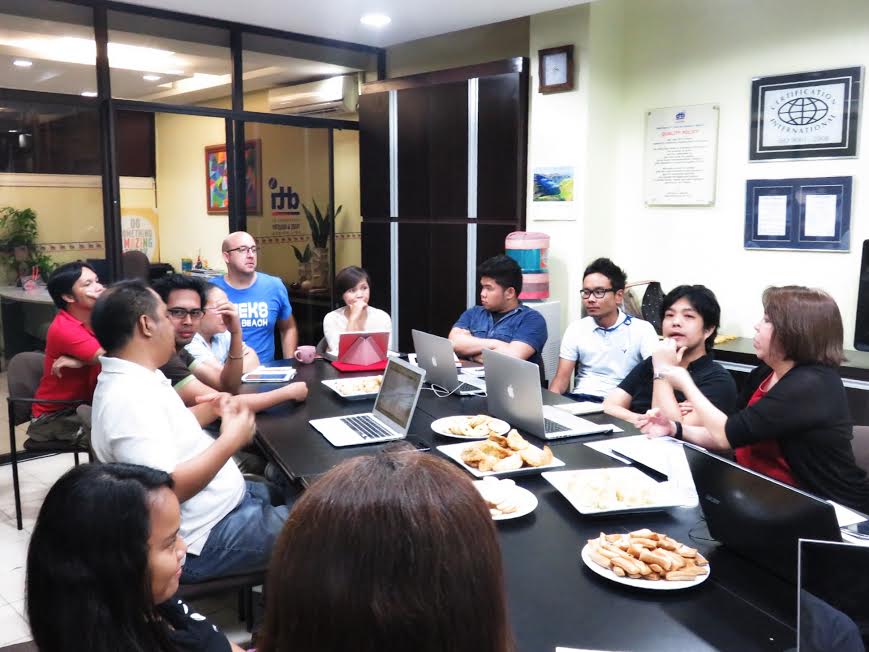
DTI-Bohol Provincial Director Nanette Arbon (right) presides the meeting with stakeholders for the BHL i2i competition. In attendance are the board of directors of the Bohol ICT Council, academe representatives and DTI staff. Mr. Yutaka Tokushima from Keio University and Shiro Takaki of JICA/JOCV are also in attendance.

