by admin | Sep 9, 2015 | Headlines, Local News / Bohol Balita

For whatever reasons, CFO might not accurately pinpoint but when Pilar, Sierra Bullones make it among the Bohol towns with most au pair, influencing friends and neighbors to go abroad might be a good reason why many Boholanos are tagged in the CFO service. (rac/PIA-7/Bohol)
TAGBILARAN CITY, Sept 7 (PIA)–Believe it or not, three towns in Bohol have been tagged by the Commission of Filipinos Overseas (CFO) as having the highest number of “au pair” beneficiaries.
And what is that “au pair”? It is French for, “at par” or equal, and allows a young person to partially work as domestic assistant in a foreign country by taking a share in the host family’s responsibilities, while the other part, is for the person to get to school.
And while au pair has presented to Filipinos a way to study, in exchange for childcare, some light housework, Boholanos from Pilar, Sierra Bullones and Tagbilaran have been most numerous in the CFO list.
Au pairs work but while working light jobs, they take on easy tasks because government regulations allow them to be in the foreign country primarily for reasons of education, said Princess Mayumi Kaye Peralta of the CFO project management division.
So when the name doesn’t ring a bell, it may be because the program, which has been on since 2000, was temporarily suspended owing to the tendency of host families to abuse the good-natured Filipinos, the CFO administrative assistant said.
Then, au pairs who stay in the host families, when they do the laundry, initially offers to include a few until the government realized the candidate was washing all the laundry and has few hours left for studies.
An au pair receives an allowance, and a private room, the usual practice is that au pairs eat with the family most of the time, and join in some of the usual family activities such as outings and trips.
However, host families normally expect to have some private time to themselves, particularly in the evenings, that during this time, au pairs may retire to her room to study, or go out with friends.
To protect their rights, governments impose limits as to how many hours an au pair is allowed to work. Tasks can include taking children to and from school, taking children to after-school activities, cooking, cleaning, ironing, tidying up and babysitting. Each placement varies depending on the host family.
The key operative word is “limited household services”, adds Arthur Joseph Vitasa, emigrant services officer at the CFO.
So, while doing child care to the host family, a Filipino student can study and take on two-year courses, when he is petitioned by the host family to be domestic assistant.
Au pair schemes are subject to government restrictions which specify an age range usually from mid-late teens to mid to late twenties; some countries explicitly limit the scheme to females, according to sources separate from the CFO. (rac/PIA-7Bohol)
by admin | Sep 5, 2015 | Tech Talk
By: Jerome Auza
Discussions with the “slow” Internet speeds in the country would immediately make some people curse at our telco operators. “My connection is slow!”, “I’d be lucky if I can open my favorite website during peak hours.”, “The modem keeps disconnecting.”, “Speed test is only a few KBPS.”
But what do we really need? More bandwidth or better reliability of service?
Unfortunately for most of us, our service contracts with the telcos state “Minimum of 10% of subscribed speed at 80% reliability where available”. So you could be paying for 2MBPS but the commitment of the telco is only 200kbps. And you are signing a contract where it is okay that your connection is down one day a week or 4 hours a day or one minute every five minutes.
I had an opportunity to point this matter to Sen. “Bam” Aquino who was in Bohol on September 4, 2015 to open the Negosyo Center inside the Bohol Investment Promotions Center office at the Provincial Capitol. During his breakfast meeting with the Bohol Chamber of Commerce and Industry, I asserted that 80% reliability is not enough. And given we only have two telcos, even if you subscribe to both providers, at 80% reliability each, there is still a significant chance that both providers would be down in a given period.
Is the problem bandwidth or reliability? My take on this is that the main problem is reliability. Take for example one of my work requirements which is to connect via SSH to a remote server in the US. When I’m using 3G or LTE service and I’m idle for about a minute, the connection would terminate. When I do the speed test, I get 6MBPS. So why is my SSH session disconnected frequently?
On a trip to Taiwan last year, I needed to connect to the US server remotely while we were traveling from Taipei to Hsinchu, about 100kms away. Using 3G service from one of the Taiwanese telcos, we traveled the entire distance without a single disconnect. If you think about it, I have been handed over to several cell sites as we traveled but the remote connection wasn’t disconnected even once. When I did the speed test, I got about 4MBPS.
So why is it that in the Philippines with my 3G service showing more “speed”, it feels much slower than in Taiwan which as slower “speed”?
The answer is reliability. Because the service there was much more reliable, I am able to open pages much quicker and I don’t have to reconnect again and again to complete the work I have to do. Websites load much quicker if the browser doesn’t have to repeat requests frequently.
How do we compare in terms of reliability commitments by telcos in other countries? I’ll try to answer this question in a coming article. I already got a copy of a service contract from a UK company and they are offering at least 99% reliability. If you have a copy of service contracts of providers in other countries, please give me a link or a copy to <a mailto:info@auza.net>info@auza.net</a>.
by admin | Sep 5, 2015 | Local News / Bohol Balita
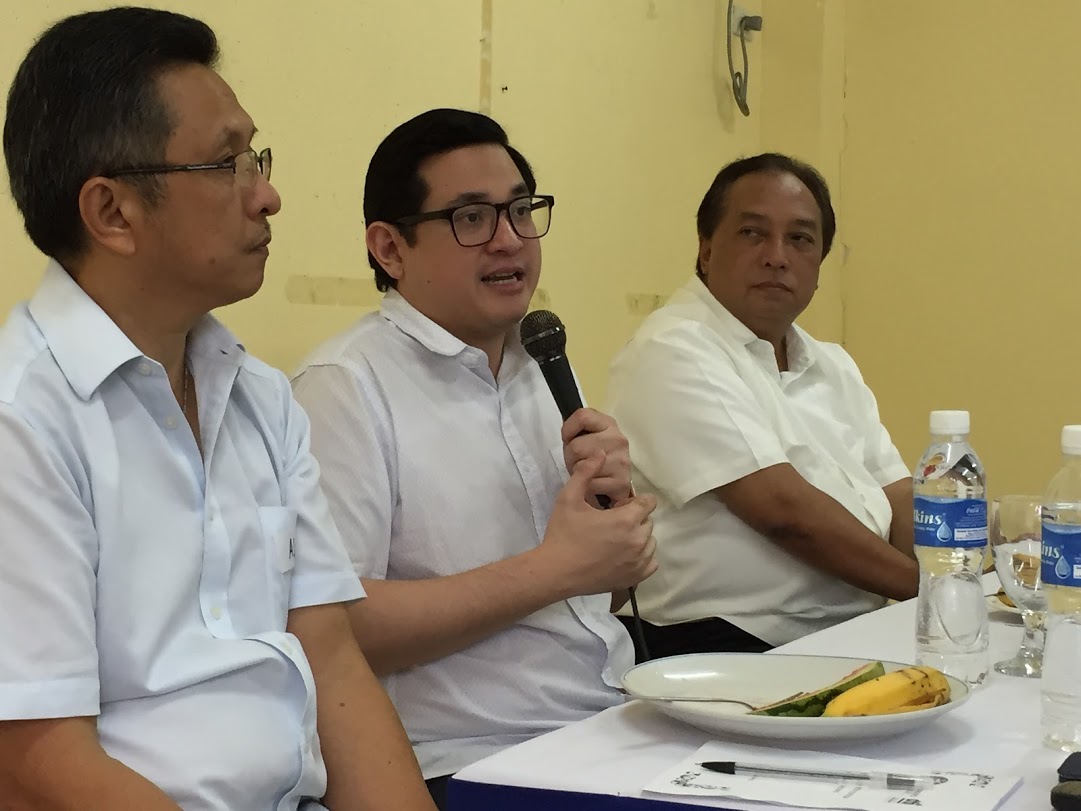
Senator Paolo Benigno “Bam” Aquino met with the Bohol Chamber of Commerce and Industry (BCCI) board of trustees on September 4, 2015 at 9:00AM at the Coralandia Resort for a open agenda meeting. The trustees were led by BCCI President Engr. Al Uy. Bohol Governor Edgar M. Chatto was also present during the meeting.
The senator gave an overview of the Go Negosyo Act (Republic Act No. 10644) which mandates the creation of Pinoy Negosyo Centers, under the Department of Trade and Industry (DTI), in each city and municipality around the country. These Pinoy Negosyo centers are meant to make it easier for entrepreneurs to register and start up their businesses, as well as gain access to sources of financing.
The senator also asked for feedback on some of the programs where his office was involved or have supported.
Among the topics discussed were the proposed tax reforms, tax breaks for startups, and how to enable local manufacturers to compete with established suppliers from outside the province in suppling the tourism industry with various products such as premium soap for hotels. The senator mentioned that our tax law is too complex and the tax brackets are outdated.
The senator also wants to encourage startups which would generate jobs for the country by giving them a tax break for the first two years. Earlier this year, President Benigno
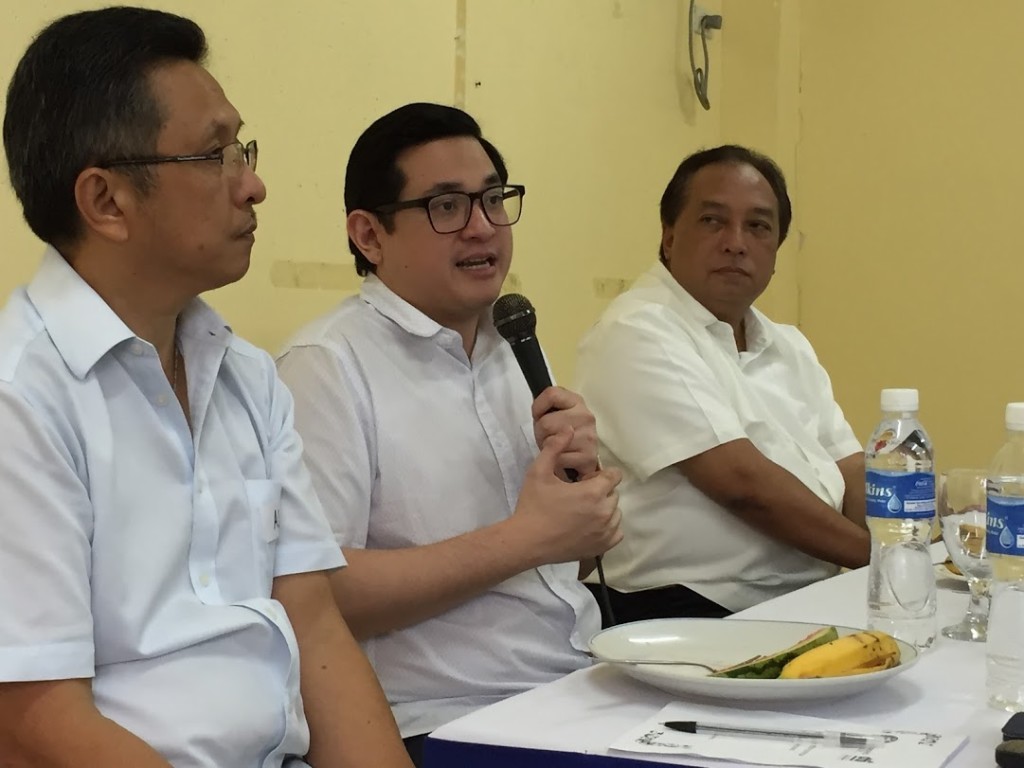
(L-R) BCCI President Engr. Al Uy, Sen. Paolo Benigno Aquino and Bohol Gov. Edgar Chatto during the open agenda meeting with the BCCI.
Aquino signed into law the Youth Entrepreneurship Act or RA10679. The measure creates financial literacy modules in all levels of Philippine education, to inculcate a culture of enterprise development among the Filipino youth.
Also discussed in detail was the matter of the “slow” Internet service in the province and the country in general. Trustee and chairperson of the ICT committee of BCCI Jerome Auza pointed to Senator Aquino that the telcos in the country are committing only to 80% reliability of their services. Auza pointed out that 80% reliability is equivalent to the Internet service being down one day every five days or six days a month. For better service, the reliability commitment must be raised much higher.
BCCI has supported a USAID funded capacity development program to help enable SMEs gain the capability to make funding proposals that will have a good possibility of being approved by funding institutions.
The senator expressed his admiration to Bohol because the province has cultivated a dynamic and productive relationship among the LGUs, government agencies, the private sector, NGOs and religious organizations.
by admin | Sep 5, 2015 | Headlines
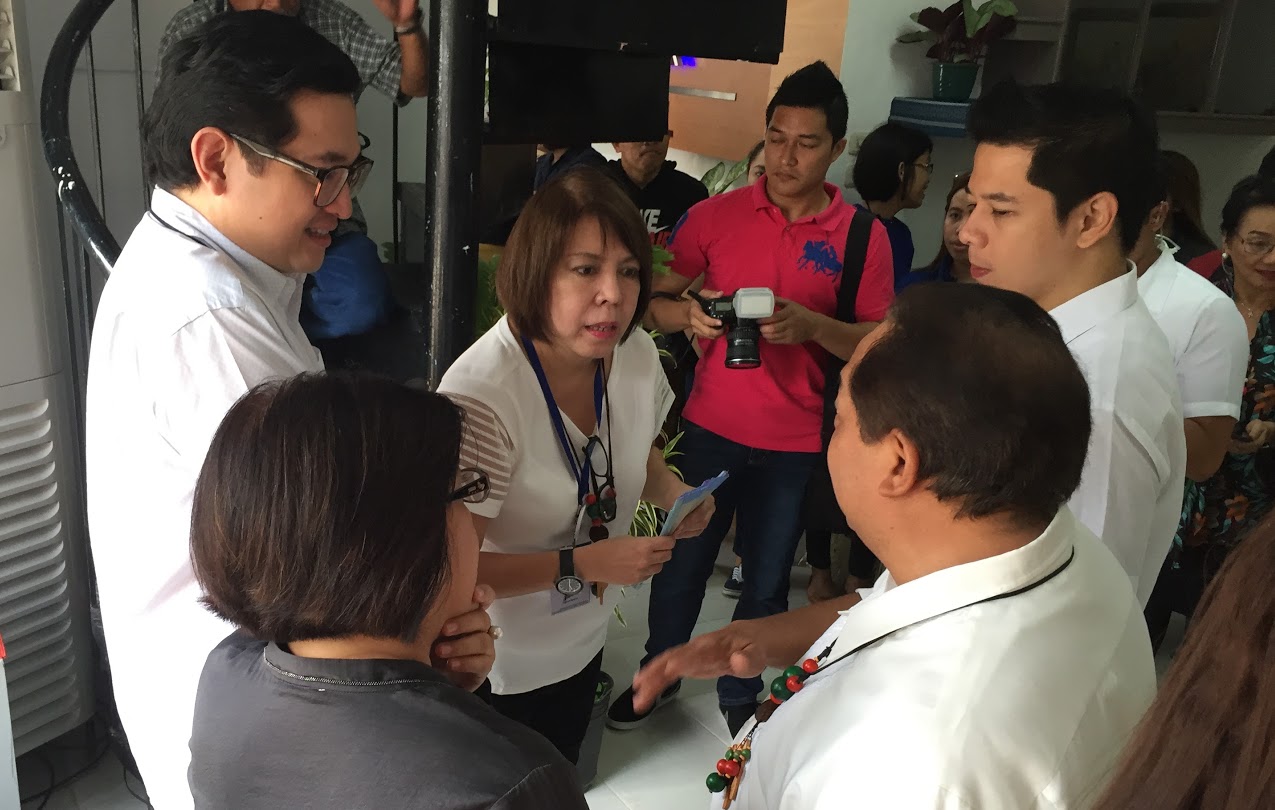
The Department of Trade and Industry Bohol Provincial Office opens its second Negosyo Center at the Capitol Building on September 4, 2015. The opening program was held at the Governor’s mansion shortly after the blessing ceremony. Bohol Governor Edgar Chatto, Tagbilaran City Mayor John Geesnell “Baba” Yap, DTI Bohol Provincial Director Nanette Arbon, DTI 7 Regional Director Aster Caberte and Bohol Investment Promotions Center Chief Inday Dominise were present as well as officers from the Bohol Chamber of Commerce and Industry and various local officials.
Senator Paolo Benigno “Bam” Aquino, co-author of the senate bill legislating the opening of Negosyo Centers throughout the country, was the guest speaker of the program. Earlier in the morning, the senator met with the board of trustees of the Bohol Chamber of Commerce and Industry at the Coralandia Resort for a meeting discussing the enabling environment for SMEs.
The Negosyo Center will become a venue for both existing and new businesses in Bohol to collaborate, share information, explore partnerships and negotiate. The center is mandated by RA #10644 or the Go Negosyo Act to make it easier for Filipinos to register and start up their businesses, as well as gain access to sources of financing. DTI will also organize seminars or learning sessions open to all business owners at the center. Senator Aquino wishes that the center will become a “tambayan” for SMEs. He encouraged businesses to try to source out raw materials, services and products locally in order to have a significant economic impact to the community.
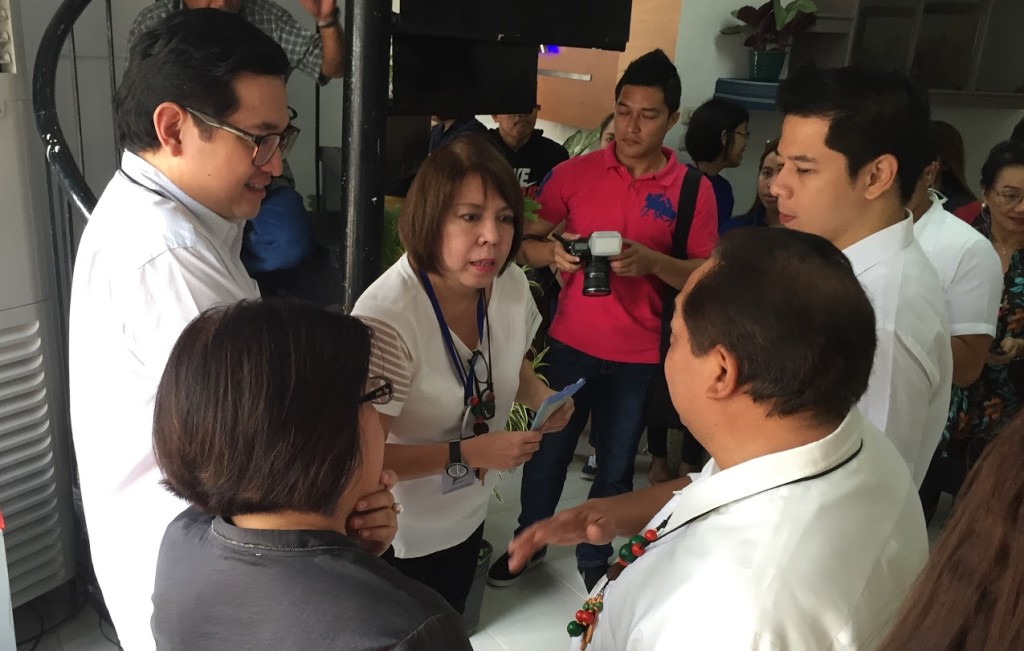
Sen. Paolo Benigno “Bam” Aquino, DTI-Bohol Provincial Director Nanette Arbon, Tagbilaran City Mayor John Geesnell “Baba” Yap, Bohol Governor Edgar Chatto and DTI-7 Regional Director Aster Caberte in a huddle after the blessing ceremony of the 2nd Negosyo Center in Bohol.
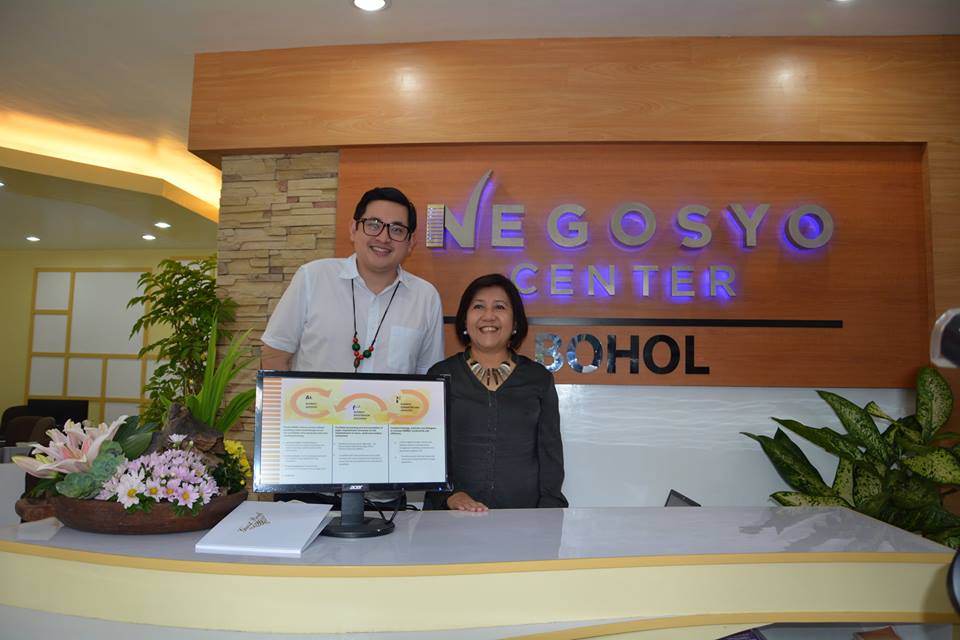
Sen. Paolo Benigno “Bam” Aquino (L) and DTI-7 Regional Director Aster Caberte at the newly opened Negosyo Center at the Capitol Building.