by admin | Aug 24, 2017 | DTI Updates, Negosyo Center Updates
The Department of Trade and Industry (DTI), in partnership with the Association of Development Facilitation and Enterprise Counselors Incorporated (ADFEC Inc.), conducted a Small Business Counselors’ Course on Operations Management (SBCC104) for DTI’s Negosyo Center business counselors on August 14-19 this year at Dohera Hotel in Mandaue City, Cebu.
According to DTI Assistant Regional Director Nelia Navarro, the six-day SBCC training was meant to enable the business counselors to know the intricacies of operations management in order for them to offer relevant information to clients as they counsel new and aspiring entrepreneurs who want to develop their business enterprise.
The recently concluded training participated by Negosyo Center business counselors in Central Visayas also included plant visits to expose them to operations of various companies. After the visits, participants were tasked to produce a report on their observations based on the measures given by the facilitators.
Dir. Navarro explained that the training of business counselors is one significant step to developing the economy in the countryside.
“DTI wants to inspire those living in the provinces to engage in entrepreneurship by having well trained business counselors who can assist them and guide them as they navigate the complex world of business.” ARD Navarro explained.
“We really have to capacitate our business counselors because they are DTI’s frontline staff. Moreover, majority of those they assist through our programs are situated in the countryside.” ARD Navarro added.
After SBCC 104, Dir. Navarro disclosed that the agency is currently preparing to complete the series of trainings for business counselors. “We hope to finish the remaining two sessions before the year ends.”
Negosyo Centers serve MSMEs and promote entrepreneurship in order to generate more job opportunities in the country. The centers also facilitate the access of MSMEs to capacity building programs, technology transfer, production and management training as well as marketing assistance.
by admin | Aug 23, 2017 | DTI Updates, Photo Story
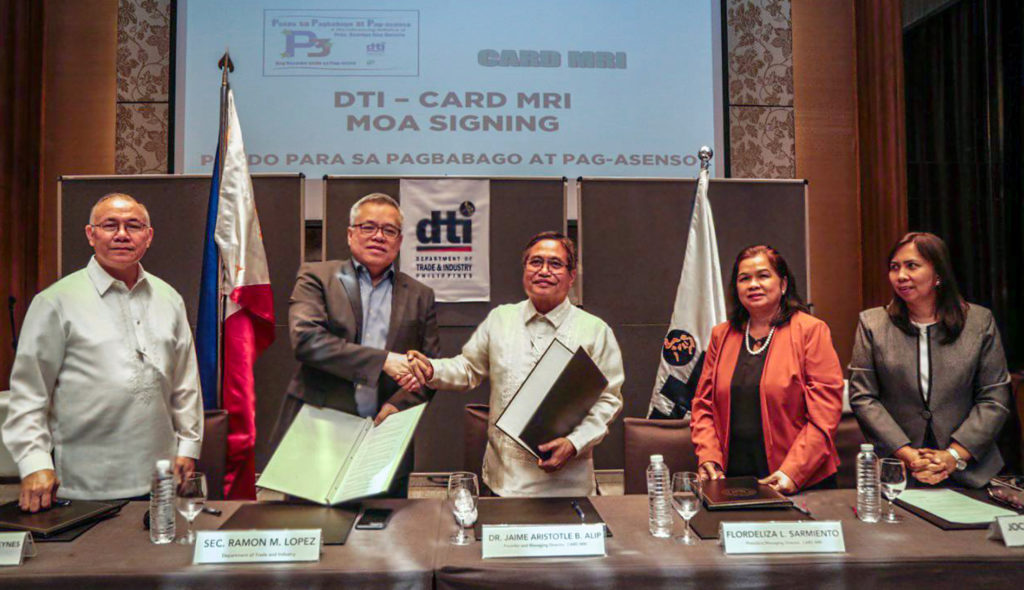
DTI, CARD SEAL PARTNERSHIP FOR THE P3 MICRO-FINANCING PROGRAM. Department of Trade and Industry (DTI) Secretary Ramon Lopez (2nd from L) and Center for Agriculture and Rural Development (CARD), Inc. Founder and Former Managing Director Jaime Aristotle Alip (center) officially inked (18 August) partnership for the Pondo para sa Pagbabago at Pag-asenso (P3) program in Pasig City. DTI and CARD aligned their efforts to provide a community-based microfinancing scheme dedicated for the micro, small and medium enterprises (MSMEs). With a total of 2,601 offices all over 82 provinces, CARD is the biggest microfinancing institution (MFI) lending to over six million borrowers in the country. The newly formalized partnership between DTI and CARD will provide MSMEs the ease of access to financial support. CARD reported that it already took the initiative to disburse a total of PhP 77 million to 5,000 borrowers nationwide, ahead of the availability of the PhP 1 billion fund for the P3 program. Also in the meeting ceremony were Small Business Corporation President Bartholomew Brillo Reynes (leftmost), CARD Managing Director Flordeliza Sarmiento (2nd from R) and Executive Director Jocelyn Dequito (rightmost).
by admin | Aug 23, 2017 | DTI Updates, National News
PAMPANGA— The Department of Trade and Industry (DTI) engaged export and manufacturing stakeholders during the Generalized System of Preferences (GSP) Consultation Sessions in Clark.
“I urged exporters and manufacturers to fully maximize the Generalized System of Preferences (GSP) privilege of the Philippines by exploring opportunities in trade especially with the United States and with the European Union (EU),” said DTI Secretary Ramon Lopez.
The trade chief shared DTI’s thrust to balance the inflow and outflow of trade as the Philippine export growth is now 16.3 percent while the import is 13 percent. He also acknowledged the efforts of President Rodrigo Duterte in creating new ties with other countries, which opened new export markets to Russia and China. China accounted for the fastest growth rate at 34%. Recent date also showed exports to EU posted strong growth due to greater number of utilization of GSP+ trade privileges where over 6,000 product lines have 0% tariff duty.
Sec. Lopez also shared the continued negotiations of DTI in expanding preferential tariff lines of GSP and GSP+ engaging the US and the EU through dialogues. DTI also extends its efforts in establishing certifications for exporters, such as the recently signed joint Department Order (DO) between DTI and the Department of Labor and Employment (DOLE). Said DO ensures importing companies that Philippine exporters availing GSP preferences will uphold and protect the rights of laborers.
Board of Investments (BOI) Head and DTI Undersecretary Ceferino Rodolfo likewise joined the trade chief in highlighting and discussing the untapped potentials of the GSP privileges of the Philippines. USec. Rodolfo even led a cliniquing session with experts from the DTI-Bureau of International Trade Relations (BITR) and the Bureau of Customs to guide exporters in developing their trade strategies.
The Consultation Sessions on GSP was initiated by Former President and now Pampanga 2nd District Representative Gloria Macapagal-Arroyo with Pampanga Governor Lilia Pineda, in an effort to reinvigorate the export industry in the province specifically in travel goods and garments.
Last June, the US government expanded the coverage of the GSP including 23 tariff lines under travel goods sector, creating a potential of additional USD 200-400 million-worth of export revenues, generating 700,000 additional jobs in the country.
Also in the sessions were the Confederation of Garment Exporters of the Philippines Executive Director Marites Agoncillio, Clark Development Corporation CEO Noel Mananquil and Bases Conversion and Development Authority President Vince Dizon.
by admin | Aug 17, 2017 | DTI Updates, Photo Story

Department of Trade and Industry (DTI) and Procter & Gamble (P&G) Philippines partner to help sari-sari store owners. The Department of Trade and Industry (DTI) and Procter & Gamble (P&G) Philippines recently launched the ‘Angat Kita’ program, a micro-entrepreneur development program that aims to assist sari-sari storeowners by equipping them with necessary entrepreneurial knowledge and skills that will help them generate more income. The ‘Angat Kita’ program is in line with the Department’s thrust to assist micro entrepreneurs around the country. In her speech, DTI-Regional Operations Group (DTI-ROG) Undersecretary Zenaida Maglaya noted the increase of Filipinos engaged in sari-sari store business to provide their families steady income. Maglaya added that DTI and Procter & Gamble will provide additional assistance to help sari-sari store owners grow their business into grocery stores. “That is actually what DTI wants to happen to our micro entrepreneurs—our sari-sari store owners. We do not want you to stay that way. If you increase your income, your sari-sari store or grocery will eventually become supermarkets. That’s really what the DTI wants to happen,” Maglaya said. In photo are (L-R) City Mandaluyong City Business Permits and Licensing Department Chief Catherine De Leon Arce, Procter & Gamble Philippines (P&G) General Manager Shankar Viswanathan and DTI-ROG Undersecretary Zenaida Maglaya.
by admin | Aug 11, 2017 | DTI Updates, National News
As part of the agency’s thrust to increase awareness on the positive gains of entrepreneurship, the Department of Trade and Industry (DTI) and Technical Education and Skills Development Authority (TESDA) link up to provide TESDA graduates with access to trainings on entrepreneurship to help generate to equip them with the necessary skills on entrepreneurship and employment.
According to DTI Sec. Ramon Lopez, acquired business skills by TESDA trainees from the Skills Training for Employment/Entrepreneurship Program (STEEP) can be used in effectively running their businesses in the future.
“This partnership not only complements our objective to equip our people with the right mindset and basic skills, it also contributes to our national goal to realize inclusive growth towards shared prosperity, powered by smarter Filipino entrepreneurs,” Sec. Lopez said.
STEEP aims provide interventions through skills development by providing access to training on entrepreneurship to graduates of TESDA program for self or wage employment to uplift their economic status.
“Through this partnership, we are glad to help TESDA graduates acquire more skills and development which can give them more opportunities to improve their lives by engaging in vibrant entrepreneurial activities,” said DTI Regional Operations Group Undersecretary Zenaida Maglaya.
Under the agreement, TESDA will provide its list of graduates to DTI from the Special Training for Employment Program (STEP) and other similar scholarship program, assist in the conduct of the entrepreneurship training, and monitor and evaluate the implementation of the project.
Upon assessment and selection of TESDA’s certified STEP graduates, DTI, in turn, will provide entrepreneurship training, assist in availment of the microfinancing facilities, provide them access to start-up capital for micro enterprises, and even facilitate business registration of those who wish to engage in business/sole proprietorship.
“This is the service that we will provide to them,” Maglaya explained, adding that “from giving them the right mindset, to ensuring that they will have assistance until they decided to put up their own business, we will make sure that we are with them every step of their entrepreneurial journey.”
The STEEP agreement with TESDA is one of the Department’s initiatives to sustainably generate employment and further promote entrepreneurship in the country as DTI pushes for its “Trabaho at Negosyo” agenda.
by admin | Aug 10, 2017 | DTI Updates, Headlines

HLTF-EI Leads from L-R: Deputy Director General Prasith Suon (Cambodia), Director General Iman Pambagyo (Indonesia), Director General Saysana Sayakone (Lao PDR), Secretary General Datuk Jayasiri Jayasena (Malaysia), HLTF-EI Chair and Permanent Secretary Dato Paduka Lim Jock Hoi (Brunei Darussalam), Undersecretary Ceferino Rodolfo (Philippines), Permanent Secretary Loh Khum Yean (Singapore), Deputy Director General Ronnarong Phoolpipat (Thailand), and Director General Luong Hoang Thai (Viet Nam). Also in attendance was AEC Deputy Secretary-General Lim Hong Hin.
Amid the backdrop of steady economic recovery, high-ranking officials from the 10 Member States of ASEAN gathered in the Philippines for the second time this year to finalize recommendations that could further bolster the region’s trade and investment flows.
The High-Level Task Force on ASEAN Economic Integration (HTLF-EI) is composed of trade vice-ministers and serves as the visionary body for progressing the ASEAN Economic Community (AEC). It convened its 32nd Meeting on 1 – 2 August 2017 in Makati City in preparation for the upcoming 49th ASEAN Economic Ministers (AEM) Meeting in September 2017. The HLTF-EI is primarily responsible for ensuring that the 10 ASEAN economies are on-track and on-time with the plans and programs intended to realize regional economic integration and achieve the vision of an AEC. The Philippines was led by DTI Undersecretary Ceferino S. Rodolfo.
Among the issues discussed for Economic Ministers’ consideration include the rapidly changing global economic environment and current technological and scientific advancements brought about by the 4th Industrial Revolution (4IR). The HLTF-EI underscored the need for ASEAN to be well prepared and in a position to maximize the opportunities from 4IR to foster the region’s economic growth, and promote inclusive and equitable economic development.
The HLTF-EI exchanged views on the need to strengthen ASEAN’s centrality and leadership in driving the RCEP negotiations, as well as in working towards the timely completion of the priority economic deliverables set by the Philippines for its Chairmanship of ASEAN 2017.
“As established in the AEC 2025, the region needs to be together to mitigate the changes. Regional economic integration must therefore be strengthened, with the target to narrow down the development gaps and look into raising intra-ASEAN trade and investment,” HLTF-EI Chair Dato Paduka Lim Jock Hoi remarked.
Latest forecasts from the International Monetary Fund and Asian Development Bank indicate that the pickup in global growth remains on track especially in developing economies, with global output projected to grow by 3.5% in 2017 and 3.6% in 2018. Strong economic outlook for ASEAN is also expected with 4.8% GDP growth in 2017 and 5.0% in 2018. The Philippines continues to lead the region with an expected GDP growth rate at 6.8% this 2017.
As global trade growth steadily rebounds from a post-crisis low in 2016, the HLTF-EI discussed the importance of improving the overall trade environment in ASEAN through better institutions and well-designed trade and regulatory policies, particularly by mainstreaming of Good Regulatory Practice (GRP) and addressing the issue of non-tariff measures (NTMs). The HLTF-EI further underscored that NTMs have different regulatory objectives, which often become too extensive and complex that they act as barriers to trade. In order to address this, enhancing transparency was thereby recommended to the Ministers, as well as compliance to ASEAN agreements on notification, effective usage of existing ASEAN tools, private sector engagement, and regional cooperation on developing clearer guidelines to identify and eliminate such trade barrier effect.
“For the Philippines, priority is in pushing for an ASEAN that is driven by inclusiveness and innovation,” PH HLTF-EI Lead DTI Undersecretary Ceferino S. Rodolfo highlighted. “Inclusive, Innovation-Led Growth,” AEC’s thematic priority for 2017, sets the tone for the Philippines’ agenda on increasing trade and investments, integrating MSMEs in the Global Value Chains (GVCs), and developing an innovation-driven economy.
The meeting also tackled updates on the Grand Celebration of ASEAN’s 50th Anniversary on 08 August, as well as other commemorative activities lined up for the remaining months of 2017 to celebrate the region’s Golden Jubilee.
The recommendations of 32nd HLTF-EI Meeting will be submitted for consideration and further discussion at the 49th Meeting of the ASEAN Economic Ministers (AEM), which will chaired by DTI Secretary Ramon M. Lopez, on 4 – 10 September 2017 in Manila, Philippines

