by admin | Aug 7, 2017 | DTI Updates
The Philippine Halal Export and Development Promotion Board led by the Department of Trade and Industry (DTI) recently adopted the implementing rules and regulations (IRR) of the Republic Act 10817 or the Philippine Halal Export Development and Promotion Act of 2016 which sets the direction of the Philippine Halal sectors and takes advantage of the lucrative $3.2 trillion global Halal market.
“As the implementing rules and regulations are now in place, DTI will beef up development and promotional activities for the Philippine halal sector which will open new economic opportunities particularly in the Mindanao region,” said DTI Secretary and Philippine Halal Export Board Chairman Ramon M. Lopez.
The adopted IRR covers the formulation and implementation of a comprehensive Philippine Halal Export Industry Development and Promotion Programs that will increase export, sale, and provision of Halal products, processes, and services aside from ensuring a more competitive Philippine Halal exports through research and product development, quality assurance measures, and value-adding mechanisms.
The DTI through its Export Marketing Bureau (DTI-EMB) has set up its Halal Section that is dedicated to conducting capacity-building activities for and among concerned Halal stakeholders. It also provides necessary assistance to local Halal Certifying Bodies (CBs) about the dynamics of the new Philippine Halal law.
“DTI’s primary role is to promote the sector and ensure that Philippine manufacturers are ready to take part in the existing Halal value chain and ensure compliance to international standards,” explained DTI Export Marketing Bureau Director Senen M. Perlada.
By and large, DTI aims to make the Philippines as an active player in the regional and international markets for Halal. As a way forward, a national strategic planning for Philippine Halal 2022 will involve regional and national government agencies, Muslim religious leaders, private sector and consumers. High on its agenda is the harmonization of existing projects and programs of all relevant government agencies for Halal sector.
The Philippine Halal Export Development and Promotion Board is composed of the DTI as chair, the National Commission on Muslim Filipinos, Departments of Agriculture, Health, Science and Technology, Foreign Affairs, Tourism, the Bangko Sentral ng Pilipinas (BSP), Mindanao Development Authority (MinDA), and two Muslim Filipino professionals.
The IRR is a product of consultations with various stakeholders across the country. The DTI, as lead of the Halal Export Board, spearheaded and continue to lead activities that will uphold Halal awareness.
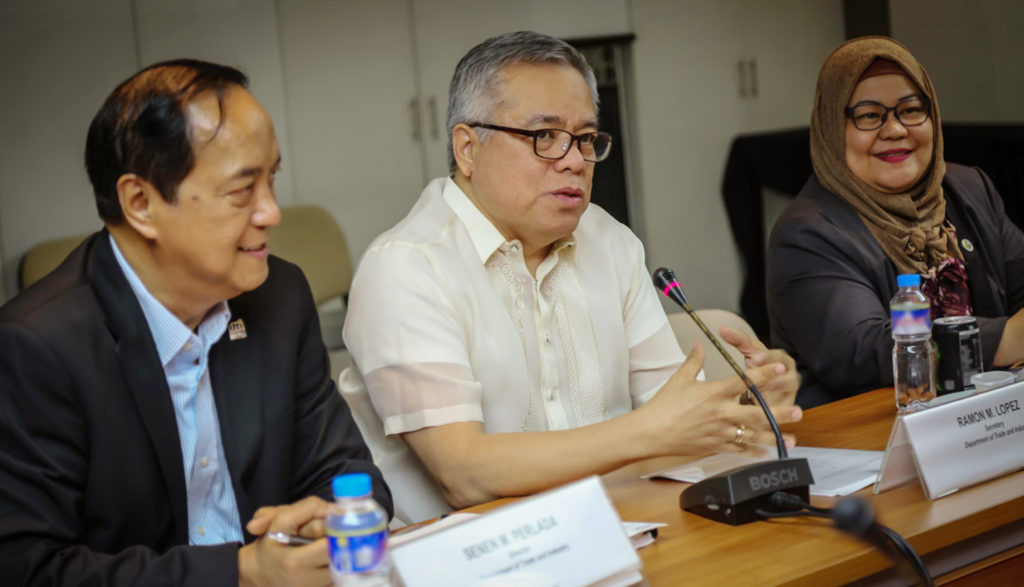
In photo (from left to right): DTI Export Marketing Bureau Director Senen M. Perlada, DTI Secretary Ramon Lopez and National Commission on Muslim Filipinos Commissioner Aisha G. Flores-Malayang during the signing of the Implementing Rules and Regulations (IRR) of the Republic Act 10817 or the Philippine Halal Export Development and Promotion Act of 2016.
by admin | Aug 4, 2017 | DTI Updates, Major Events
KUALA LUMPUR—As ASEAN celebrates its 50th founding anniversary, 2017 marks an opportune time to reflect on what ASEAN has achieved over the past five decades and what it seeks to accomplish ahead.
Speaking at the ASEAN@50 Conference in Kuala Lumpur on 4 August before an assembly of audience representing various stakeholders, ASEAN 2017 Economic Ministers chairman and Philippine Trade Secretary Ramon Lopez said that collaboration and communication are two essential elements to keep ASEAN moving.
“The region has to focus on two Cs, Collaboration and Communication. By engaging multi-stakeholders, ASEAN develops a win-win solution in ensuring that economic opportunities will be equitably felt by all ASEAN citizens,” he said.
Since its inception in 1967, the 10-member regional organization has transformed into a global economic powerhouse, with a population of 622 million and has become one of the world’s fastest growing investment destinations.
ASEAN’s total trade increased by USD 700 billion between 2007 and 2015, with intra-ASEAN trade comprising the largest share. In 2015, ASEAN attracted USD 121 billion of FDI with intra-ASEAN constituting the largest share of inflows. .
Sec. Lopez said that ASEAN should aim to communicate its programs and priorities to the ASEAN citizens, providing them with the right platform to know how they can contribute to the region’s growth story.
“Our communication must be sustained and intensified if we want to reap the benefits of the ASEAN Economic Community (AEC), working towards a deeper regional integration in 2025,” he added.
The trade chief made reference to the ASEAN 2025: Forging Ahead Together as a forward-looking roadmap to prepare the region in the next phase of evolvement, and which charts the pathway for strengthening the ASEAN Community over the next 10 years.
As one of the three pillars of the ASEAN Community, the AEC is a realization of ASEAN’s goal to have an integrated and prosperous economic region with a single market–where there is free movement of goods, services and investments.
“ASEAN’s continuing economic transformation remains an example of how regional integration and cooperation is plausible despite challenges and diversity in size, geography, political background, and culture,” the trade chief said.
AEC reflects connectedness and translates diversity into strength as ASEAN’s variety becomes a source of attraction to global investors, mindful of the region’s stake in open global markets.
According to Sec. Lopez, promoting complementation and cooperation is at the heart of ASEAN integration efforts. Closer trade and enhanced economic cooperation, combined with continued engagement with Dialogue Partners, provides the region with a solid platform to continuously bolster the region’s growth and promote complementation of domestic reforms among Member States.
ASEAN has also become a significant link to the international community because of the dynamism and the huge potential it offers to the world.
“We have engaged our major trading partners namely Australia, China, India, Japan, Korea, and New Zealand in free trade agreements, negotiating as a single ASEAN entity rather than as individual economies discussing bilateral trade arrangements,” Sec. Lopez added.
In 2013, ASEAN initiated negotiations for a Regional Comprehensive Economic Partnership (RCEP), which aims to expand the current ASEAN market to a huge integrated market of 3.5 billion with its six Dialogue Partners China, Korea, Japan, Australia, New Zealand and India.
Sec. Lopez also took the opportunity to present the Philippine agenda as the current ASEAN chair. Under the inclusive, innovation-led growth theme, the country is poised to champion the development and internationalization of micro, small, and medium enterprises (MSMEs) with key strategic measures to increase trade and investment, integrate MSMEs in global value chains and pursue an innovation-led economy.
“ASEAN continues to develop into a pivotal marketplace with its relatively young, growing labor force and emerging middle class,” he said, adding that ASEAN has transformed into a community of dramatic diversity and manifold opportunities.
by admin | Aug 3, 2017 | DTI Updates, Photo Story
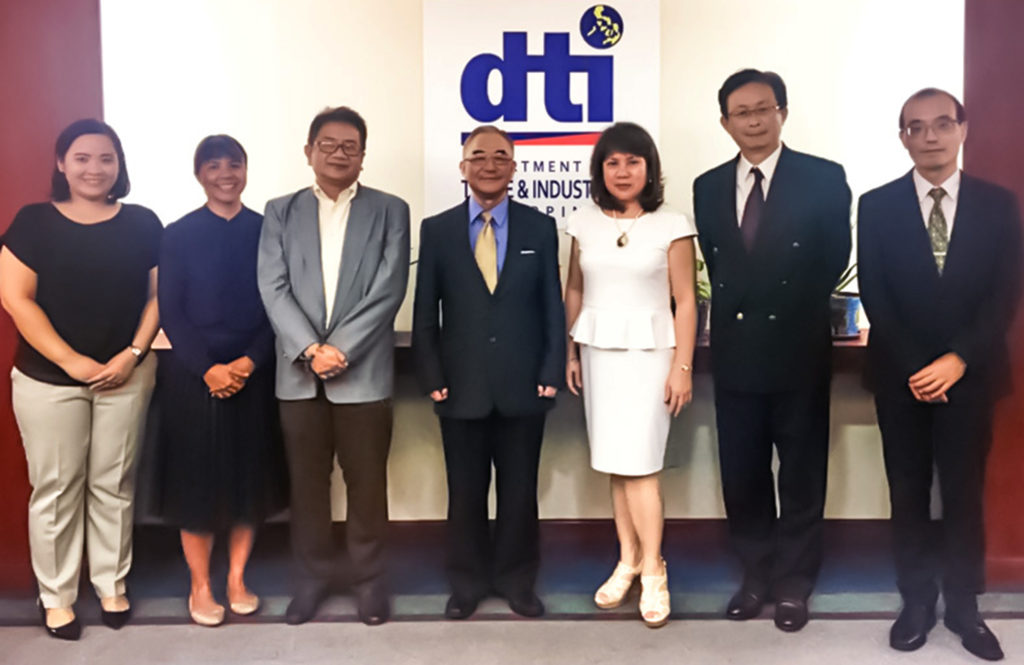
01 August 2017, Makati – The Taipei Economic and Cultural Office in the Philippines offers a partnership with the Philippine Training Trade Center and Design Center of the Philippines as co-developers of its Capacity Building Training programs. The PTTC and DCP are agencies of the Department of Trade and Industry. In the photo: (L-R) Foreign Trade Service Corps Trade Service Officer Charmaine Yalong, Design Center of the Philippines Executive Director Rhea Matute, Philippine Trade Training Center Executive Director Nestor Palabyab, Representative (Ambassador) of Taiwan/ROC Dr. Gary Song-Huann LIN, DTI Trade and Investment Promotions Group Assistant Secretary Rosvi C. Gaetos, TECO Director of Political Affairs Chiang-hwa (Tony) Tsai, and TECO Deputy Director Winsdon J. H. Hsiao
by admin | Aug 1, 2017 | DTI Updates
“Lucent Objects,” is featured in the Craft Trend Book 2018 released by the SUPPORT Arts and Crafts International Center of Thailand (SACICT)
The Design Center of the Philippines continuously explores the potential of indigenous raw materials, its design strengths and assets, to support new product development, especially products crafted and manufactured by the country’s MSMEs to make Philippine products more competitive in the international market in terms of quality and innovation.
DCP’s Materials and Design Research and Development collaborated with multi-awarded and internationally-acclaimed designer and concurrent Head of Product Development for Go Lokal! Stanley Ruiz on “Lucent Objects”, a lamps and lighting special setting shown in last year’s 64th Manila FAME. The materials used for the special settings were developed through a series of experimentation with anabo fiber, corn husk, bakong scrunch, palm husk,pandan leaves, peanut shell, and peepal leaves among others. These materials and Ruiz’ innovative design approach, landed Lucent Objects a spot in the Craft Trend Book 2018 recently released by the SUPPORT Arts and Crafts International Center of Thailand (SACICT).
The Craft Trend Book 2018 gathers information on art, crafts, and design to give insight on future trends on handicrafts and craftsmanship. The 2018 Craft Trend Book gives focus on the concepts of social craft networking, mass exclusivity, and digital detoxing.
The Design Center of the Philippines, an attached agency of the DTI, is committed to the promotion and use of design as a tool for improving the quality and competitiveness of Philippine products.
For more information on Design Center and its programs and services, please log on towww.designcenter.ph. You can also visit the Design Center at the DCP Bldg., CCP Complex, Roxas Blvd., Pasay City or contact them at 832-1112 to 18.

Stanley Ruiz collaborated with the Design Center of the Philippines to give new life to indigenous raw materials.
by admin | Jul 29, 2017 | DTI Updates, Features
TAGBILARAN CITY, July 28, (PIA)–The five day Sandugo regional products showcase better known now as Sandugo Trade Expo closed off Sunday capping a total sales of P12,278,357.00 in five days of selling by some 94 small and medium enterprises from at least six regions.
First started as Bohol Products Trade Fair, the event which has drawn national and international buyers has now gathered the best showcase of the regions which include processed foods, homestyle gifts and toys, furniture, fashion accessories and other crafted products, according to Department of Trade and Industry trade and industry development specialist Blair Panong.
The trade expo coincides with the annual celebration of Boholano brand of friendship celebrated in the July Sandugo Festival which commemorates the historic blood compact between Spanish conquistador Miguel Lopez de Legazpi and Boholano chieftain Sikatuna.
Romping out as topsellers during the trade expo exhibited at the Island City Mall between July 19 to 23, were Cebu’s Maexel Chi-cha bites and Snack Food with P271,530 in cash sales for processed foods, Cebu’s GTH Foundation Inc., OTOP Store and Tindahang Pinoy with P797,000 in cash and under negotiations sales.
For furniture, Region 8’s Naty’s Antique Furniture closed some P829,000.00 in cash and under negotiations sales upon the exhibit’s egress Sunday.
With the Trade expo adopting green economic development themes since three years ago, organizers also handed a special Green Product Award to TAGBTIC.
TAGBITIC is a Tagbilaran City based garbage up-cycling group composed of women groups from Cogon and whose products include recycled plastic and dried leaf materials crafted into home items and accessories
No less than DTI Regional Director Asteria Caberte, Bohol OIC-PD Marisol Balistoy and the newly crowned Miss Bohol 2017, Ms. Pauline Amelinckx handed the awards and citations during the highlights of the expo closing ceremonies.
The DTI, which has been largely involved in the new products diversification and development as well as training workers on production efficiency and greening the value chains said in the expo in Bohol, pushes forward the new products crafted after the DTI handed Shared Service Facilities and cascaded product design development trainings.
Largest groups at the expo are Bohol with 34 exhibitors: Cebu with 32, Negros with 10 and Siquijor with 4 for a total of 80.
Five other exhibitors come from Region 8, including furniture top seller Naty’s Antiques, another 5 more from region 13 (Agusan and Surigao) which brought in processed food.
From Region 11 is Davao del Norte brining in processed food and non-food items.
Each from region 18 (Negros Island region) and Region 6 had one exhibitor.
Presenting the Trade Expo Products which banner the theme “Partnering and Engaging for Change”, the DTI put up a creatively conceptualized “Exquisitely Visayas” fashion show.
According to Panong, models from Cebu and Bohol featured the creations of respected designers in the region while as the models took to the catwalks, fashion accessories picked from participating exhibitors embellished and accessorized them, Panong explained. (rahc/PIA-7/Bohol)

DTI BOHOL OIC Maria Soledad Balistoy, RD Asteria Caberte and Miss Bohol posed with TAGBTIC who was awarded the Green Product Award, as the 12th Regional Trade expo struggles to carve a path to green economic development. (PIA-7/Bohol/Photo by DTI)
by admin | Jul 28, 2017 | DTI Updates
The Philippine National Trade Repository (PNTR) which is a web-based portal that provides a single source of comprehensive, accurate and updated trade information will finally be launched on August 1, 2017. Its establishment is an important component of the government’s trade facilitation strategy. A more transparent trade environment will allow business easier access to information and facilitate their compliance with prescribed regulations. The ultimate effect will be to reduce the amount of time and costs in trade transactions.
The launching will be participated in by the Trade Regulatory Government Agencies (TRGAs), representatives from the private sector and selected importers accredited by the Department of Agriculture.
Expected to grace the event are the EXCOM Members of the Department of Trade and Industry, headed by the Undersecretary of the Industry Development and Trade Policy Group, Dr. Ceferino S. Rodolfo who will provide the keynote speech on behalf of DTI Secretary Ramon M. Lopez.
Dr. Cielito F. Habito, Chief of Party of the USAID- Trade Project is among the guest speakers, together with Mr. Walter Van Hattum, Head of Economic and Trade Section, EU Delegation to the Philippines.
One of the highlights of the event is the MOA signing between the Tariff Commission and the Department of Trade and Industry- Bureau of Import Services. The PNTR’s seamless commodity search function became possible because of the wholehearted cooperation of Chairperson Marilou P. Mendoza of the Tariff Commission. The first three elements of the PNTR, the Tariff Nomenclature, the MFN tariffs and the Rules of Origin are linked to the Enhanced Philippine Tariff Finder (EPTF) of the Tariff Commission.
The formal launching of the PNTR portal will be presented by Mr. Roberto Galang of the International Finance Corporation, the World Bank’s private sector arm. Through support from the Government of Canada, the project team led by Mr. Terence Chapman provided significant enhancements to the portal, in particular on the element of the Non-Tariff Measures and commodity search function.
Atty. Luis M. Catibayan, the PNTR Secretariat Head enjoins everyone to visit the PNTR portal at www.pntr.gov.ph. The PNTR is expected to benefit our stakeholders primarily Micro Small and Medium Enterprises (MSMEs) as the regulations and procedures administered and enforced by various government agencies are made readily accessible thru the internet.
Atty. Catibayan further stressed that the PNTR makes the regulations transparent and contributes to the ease of doing business. The PNTR’s link to the ASEAN Trade Repository will allow MSMEs who are into exports to have accurate and updated information, including regulatory requirements for the movement of goods to and among ASEAN member states, thereby facilitating greater access to the ASEAN market.
For inquiries about the PNTR portal, please send email at info@pntr.gov.ph or visit: www.pntr.gov.ph/ www.dti.gov.ph.

