by admin | Jun 20, 2017 | DTI Updates, Headlines
TAGUIG—The government intensifies its support for the continuous development of the information technology-business process management (IT-BPM) industry, following the industry’s generated revenue of around US$23 billion and direct employment of 1.3 million last year.
Speaking at the office opening of financial institution ING Business Shared Services BV on 20 June, Department of Trade and Industry (DTI) Secretary Ramon Lopez said that ING’s expansion comes at a perfect time when the Philippines is considered the global leader in IT-BPM, having an annual growth rate of 30% over a decade.
Sec. Lopez also mentioned that IT-BMP’s economic contributions surpass remittances of overseas Filipino workers, making the industry more competitive and growth-driven.
“The industry benefits from an enabling policy environment under the administration of President Rodrigo Duterte. I encourage the IT-BMP industry players to continue expanding and specifically take advantage of this moment, when the Philippines is experiencing an economic breakout, as further intensified by efforts to improve ease of doing business,” he said.
The trade chief also highlighted that the country has a qualified, highly-trainable, hardworking work force, with notable English proficiency and fast learning curve.
“Filipinos’ adaptability to universal cultures and their high level of commitment and loyalty prove that the country’s greatest asset has always been its people, who will bring inclusive growth to the rest of the country,” he said.
Globally, the Philippines is competitively positioned in terms of talent, costs, and risks relative to established and emerging offshore destinations. Cities from Metro Manila to Clark, to the cities of Cebu, Davao, Santa Rosa, Bacolod, Iloilo, Dumaguete, and Baguio are listed in the 2016 Top 100 Outsourcing Destinations as reported by Tholons.
While the Philippines is the number one global provider of voice BPM services, it is also rapidly expanding in the value-driven non-voice, complex services segments of the industry.
Non-voice services included range from engineering, health care, legal, financial, creative, and software services for the energy, banking, investment, insurance, shipping, media, and other industries.
DTI has set up Training for Work Scholarship Program (TWSP) for IT-BPM, wherein the government invests on training for students to work in the industry.
DTI also has a partnership with the Commission on Higher Education (CHED) and the IT & Business Process Association of the Philippines (IBPAP) to run the Service Management Program (SMP), a specialized track for business and IT schools to develop skills in students needed to work in the IT-BPM industry.
The first foreign bank that transitioned into a universal bank in the country, ING offers banking insurance, retirement and investments services with global presence in 40 countries.
by admin | Jun 13, 2017 | DTI Updates, Headlines

3rd COMTCP committee review- approved the new structure and eligibility requirements.
(Standing, L-R) Jan Amiel C. de Leon, Engr. Angelito V. Zulueta, Engr. Victoriano V. Lahoz, Engr. Rene E. Fajardo, Anthony Mariano, and Michael John V. Cataquian; (Seated, L-R) Ofelia R. Usigan, Arch. Felicitas A. Pio Roda, Dr. Ernesto S. De Castro, and Bianca S. Martinez.
The Department of Trade and Industry-Construction Industry Authority of the Philippines (DTI-CIAP) thru its human resource development arm; the Construction Manpower Development Foundation (CMDF) will be launching the Enhanced Construction Managers’ Training and Certification Program (ECOMTCP) within 2017 to lead infrastructure developments in the Philippines with capable project managers.
ECOMTCP is the enriched product of industry-led application of lessons from the former COMPTCP, which is CMDF’s pilot program to assure that competent project managers will handle huge and complex projects in construction. ECOMTCP, which is projected to begin pilot run on the 3rd quarter of 2017 will be more acceptable and align itself with Philippine education standards. The goal of the program is to guarantee the competency of project managers by introducing rigorous assessment mechanism and added incentives like earning CPD units, additional credit points for PCAB Contractor’s License, and harmonized requirements to ASEAN Chartered Professional Engineer.
CMDF is working with DPWH to endorse 43 graduates of DPWH’S Project Managers Course for certification to ECOMTCP. The program is the practical answer to the growing demand for competent and certified construction project managers.
ECOMTCP shows the government’s drive to fully support the projected growth of the construction industry by advocating for competent and globally competitive Filipino workforce. DTI-CIAP thru CMDF as mandated by PD No. 1746 continues to run and develop various programs to support construction industry professionals and workers in improving their knowledge and skills and work their way to nation building.
by admin | Jun 13, 2017 | DTI Updates, Tech Talk
The fabrication laboratory (FabLab), a design co-creation platform in Bohol supporting Philippine micro, small and medium enterprises (MSMEs) was cited among the top winners in an annual competition for start-up businesses using science and technology for innovative ideas.
Bohol FabLab won 200,000 yen prize money from THK, a Japanese-listed company in the Tokyo Stock Exchange who will then collaborate with FabLab for a development project involving the latter’s upcycling facility.
The award was among those given in the Tech Planter competition organized by a venture firm based in Japan Leave A Nest Co. Ltd meant for hardware makers that leverage science and technology for innovative business ideas. Same competitions are also held in countries like Japan, Singapore, and Malaysia.
Aside from FabLab’s upcycling project, other winning teams introduced innovations such as using light pigmented ube (purple yam) for commercial use, a mind-based alert system for paralysed patients, and a vending machine for over-the-counter medicines or first aid.
“Winning the competition gives Bohol Fablab and its beneficiaries the opportunity to partner with other companies and scale up its operations,” said Japan Overseas Cooperation Volunteer (JOCV) Shiro Takaki who mentored and coordinated the Bohol FabLab participation in the competition.
The contest saw the potential of Bohol FabLab’s heat press machine, an upcycling equipment developed by Takaki to form new products from waste materials like plastic.
Global luxury brand Louis Vuitton already expressed interest to source materials for the interior designs of their boutique from the FabLab.
Established in 2014, the Bohol FabLab began as a development cooperation initiative of the Japan International Cooperation Agency’s (JICA) JOCV Program, Department of Trade and Industry (DTI)-Bohol, Department of Science and Technology (DOST), and Bohol Island State University (BISU).
About 135 manufacturers in Bohol initially became part of FabLab who benefited from the platform by enabling them to make product prototypes faster, create scale models, illustrate graphic designs, combine local materials, and even mass produce products.
“The award gives FabLab Bohol opportunity to use technology in helping the community and environment through our plastic upcycling project,” said Alfred Vicere, staff of Bohol FabLab.
FabLab technical manager and BISU instructor Jerome Manatad added that ‘the prize will give chance to also commercialize the heat press to benefit more MSMEs and communities.’
Already, a women’s group in Barangay Cogon, Bohol are using the heat press machine to create souvenir items from recycled plastic, a livelihood project supported by another JOCV.
FabLab is a concept that began in Massachusetts Institute of Technology (MIT) to help grassroots communities translate their design ideas into physical forms with help of computers. The concept was such a success that it already has a global network including USA, Kenya, and Afghanistan.
The Bohol FabLab encouraged the Philippine government through DTI to set up more of its kind in other parts of the country as part of MSME development.
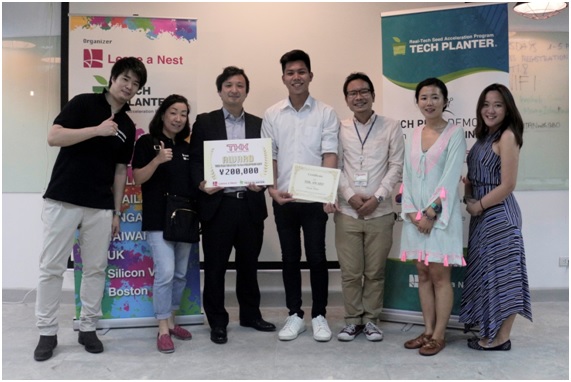
(From left to right) Shohei Maekawa, President of Leave a Nest UK; Kihoko Tokue, President of Leave a Nest Singapore; Yukihiro Maru, Founder and CEO Leave a Nest Co., Ltd.; Jerome Manatad, Fablab Bohol Technical Manager; Shiro Takaki, JICA volunteer; Makiko Deguchi, JICA volunteer; and Katrina Rausa Chan, Director QBO Innovation Hub during the awarding ceremony at the Tech Planter competition
by admin | Jun 10, 2017 | DTI Updates, Photo Story
Manila – Department of Trade and Industry Assistant Secretary Rosvi Gaetos is one of the recipients of the 13th Rotary Tourism Awards in the Tourism and Trade Events Category for her extraordinary contribution in export and tourism promotion and advancement of the tourism industry in the Philippines. The awarding ceremony was held on June 08, 2017 at the New World Hotel in Makati City.
Assistant Secretary Gaetos heads the Program Management Office of TIPG-DTI which oversees the management and operations of the Go Lokal! Stores Project.

Seated 5th from the left is Tourism awardee Department of Trade and Industry Assistant Secretary Rosvi Gaetos, flanked by: seated 4th, former Tourism Secretary Mina T. Gabor, Tourism Secretary Wanda Tulfo-Teo and People Asia Editor in Chief Joanne Rae Ramirez. Standing 2nd from the left: former Tourism Secretary Roberto Pagdanganan, Rotary President Teodoro Ocampo, Tourism Awards Chairman Robert Lim Joseph, extreme right Ivory Coast Vince Carlos and other awardees.
by admin | Jun 9, 2017 | Business, DTI Updates, National News
MARIKINA—Following President Rodrigo Duterte’s instruction to revive and to strengthen the country’s footwear industry, Department of Trade and Industry (DTI) Secretary Ramon Lopez and the members of the Philippine Footwear Federation Inc. (PFFI) identified possible solutions to existing obstacles that hamper the shoe industry’s growth.
“Technological improvement remains an industry concern. While there are patrons who prefer manually-produced shoes citing their durability, still, innovation is crucial for the shoe industry to flourish and expand,” Sec. Lopez said.
In a series of site visits recently (8 June), Sec. Lopez and DTI officials explored ways to level-up current industry practices with PFFI. For one, DTI already has a sustainable Shared Service Facilities (SSF) Project with PFFI that houses machines and equipment that serve as common service facilities for efficient, quality and innovative production.
Among the SSF projects is the High Value Custom-Made Footwear, which intends to capture market that prefers custom-made shoes, featuring new methodologies in shoe engineering, footwear design and manufacturing. It also uses state-of-the-art scanner that automatically produces a 3D model of the foot in seconds for measuring and size estimation.
“Small shoemakers take turn in using the equipment. They need to expand the capacity and add more and newer machines,” Sec. Lopez added.
Within the compound where the SSF is located is DTI’s Negosyo Center-Marikina and the Philippine Footwear Academy that aims to produce job-ready workers for the Marikina footwear industry. The Academy is considered the first and only footwear school in ASEAN.
Meanwhile, the trade chief guaranteed PFFI that DTI remains committed in supporting the Marikina shoe industry from the policy and program level that will improve access to raw materials and supply chain, as well as enjoin government and private sectors to give preference in buying locally-made shoes.
Assistance on design creation through the Design Center of the Philippines up to provision of market access and promotion through the Go Lokal! stores in malls, national and international trade fairs and exhibitions, and the internationally-recognized Manila FAME will also be provided.
Headed by its president Roger Py, PFFI is composed of footwear manufacturers, retailers, cooperatives and allied industries from Marikina, Laguna, Bulacan, San Mateo and Cebu, whose members belong to the sector of micro, small and medium enterprises (MSMEs).
On the same day, Sec. Lopez visited production facilities of Gibi Shoes Manufacturing, Bristol Shoes and micro-enterprises like Ruperta Enterprises, all of which are Marikina-based. He called on industry leaders to initiate the kind of entrepreneurship that is idea-based, demand-driven and innovation-led.
He also visited Marikina’s pride Rolando “Tatay Oly” Santos, the shoemaker, who gave President Duterte a pair of shoes as a gift, which the president wore during his international meetings with heads of state. Sec. Lopez learned the common sentiments of small Marina shoemakers in terms of machines, shoe molds and working capital.
Tatay Oly, who is currently borrowing from 5-6 loan sharks, got emotional when he was assured of working capital assistance from President Duterte’s Pondo para sa Pagbabago at Pag-asenso or the P3 micro-financing program.
The trade chief also talked to some of Marikina’s talented and hardworking designers and artisans, who also serve as trainers in DTI’s SSF project for MSMEs aspiring to take part in reviving Marikina’s shoe industry.
“The Filipino artisanship and craftsmanship in designs, plus the highly-skilled, highly-trainable workforce that showcase ingenuity despite stiffer market competition will help bring back the glory of Marikina as the country’s shoe capital,” he concluded.
by admin | Jun 9, 2017 | DTI Updates, Headlines
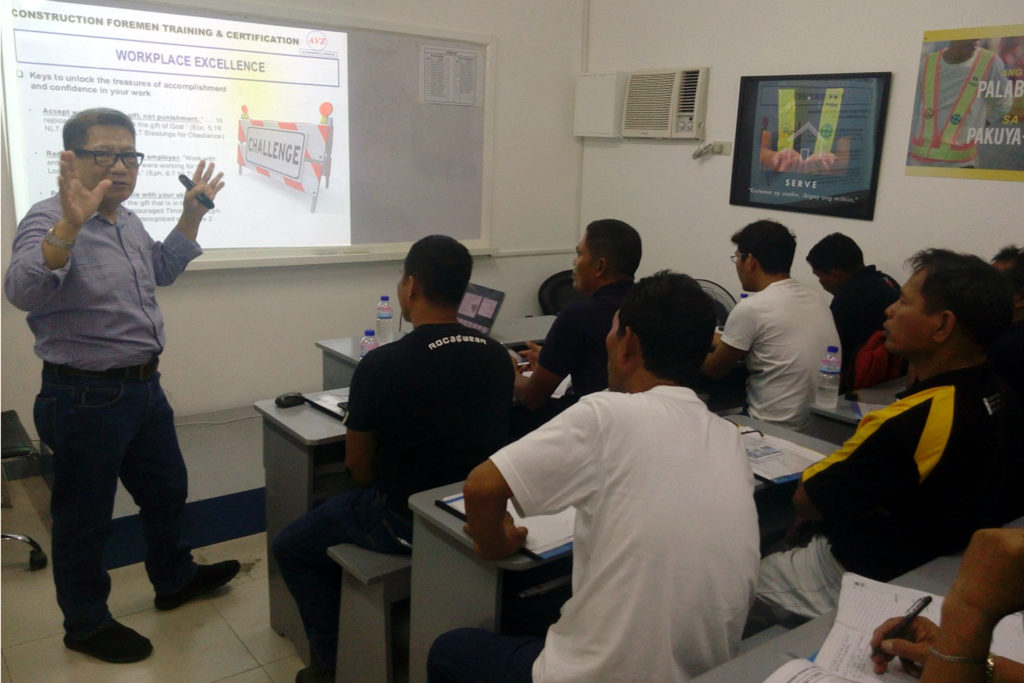
Angelito Zulueta presents a lecture on workplace excellence to FTCP participants
The Department of Trade and Industry-Construction Industry Authority of the Philippines (CIAP) thru its human resource development arm, the Construction Manpower Development Foundation (CMDF) is developing the construction industry’s manpower to be globally competitive.
The Foremanship Training and Certification Program’s (FTCP) pioneer batch began in April and finished in May 2017. CMDF conducted the program with 25 participants in partnership with Makati Development Corporation (MDC). FTCP is designed to develop construction foremen, have them learn skills in teamwork, supervision, communication, problem solving, documentation, labor management relations, work productivity, planning and scheduling, implementation of safety and environmental program and quality assurance, and aims to increase competency and competitive advantage of Filipino foremen. FTCP is a 5-day program where the first 4 days are dedicated to lectures on foremanship and the last day includes a written and oral examination.

