by admin | Jul 12, 2017 | DTI Updates, Headlines
United Coconut Association of the Philippines (UCAP) recently issued a statement clarifying the American Heart Association’s (AHA) advisory against the consumption of coconut oil.
In the statement, UCAP mentioned that the advisory has gone viral with adverse effect on the coconut oil since it is considered a saturated fat. UCAP called on readers and users of coconut oil to be discerning of the said advisory and news articles drawing conclusion that coconut oil is unhealthy.
According to Dr. Fabian M. Dayrit of the Ateneo De Manila University, the AHA adopted a position that ignores the distinction between medium-chain fatty acid (MCFA) and long-chain fatty acid (LCFA) despite the numerous advances in this certain field of science. Coconut oil is mostly medium-chain saturated fats, the healthy type of fat. Detailed comparison of the fatty acid composition shows that coconut oil is very different from animal fat. Hence, studies that assume they are similar are consequently in error.
Furthermore, Asian and Pacific Coconut Community also highlighted in their recent statement the words of Dr. Bruce Fife, a USA Certified Nutritionist and Doctor of Naturopathy Medicine, “You cannot say LDL is bad and HDL is good.” He explained the two types of LDL: one small and dense, while the other is large and soft. The large LDL is the type that is used in making bile, hormones, and Vitamin D, which are all good for one’s health. Dr. Fife further concluded that, “Eating coconut oil (and other saturated fats) increases both HDL and the “good” LDL, thus, lowering the risk of heart disease. This is one of the reasons why populations that eat a lot of coconut oil have the lowest heart disease rates in the world.”
Department of Trade and Industry’s Export Marketing Bureau (DTI-EMB) concurs with the stand of industry associations such as United Coconut Associations of the Philippines, Inc. and the Asian and Pacific Coconut Community that the advisory is misleading as AHA based its findings on limited studies on saturated fats.
“This is not the first time this kind of negative publicity against coconut oil has happened. If we will look closer to historical accounts, this has happened before. It was magnified this time due to social media and technology,” said DTI Export Marketing Bureau Director Senen M. Perlada.
By and large, DTI will continue to support the industry in sharing the good news about coconut and its economic contribution to millions of Filipino farmers and exporters.
Backed by recent studies and firsthand experiences of its consumers around the globe, DTI will help sustain the impressive health and economic contribution of coconut products such as coconut oil, virgin coconut oil, coconut water, coconut sugar, among others, by continued promotion through roadshows in various markets which will eventually bring additional jobs and income opportunities for Filipinos especially in the countryside.
American Heart Association (AHA) issued a Presidential Advisory on Dietary Fats and Cardiovascular Disease (CVD) on 15 June 2017 which recommended a decrease in consumption of products high in saturated fat such as dairy fat (butter), lard (pork), beef tallow, palm oil, palm kernel oil, and coconut oil.
by admin | Jul 3, 2017 | Business, DTI Updates, Photo Story
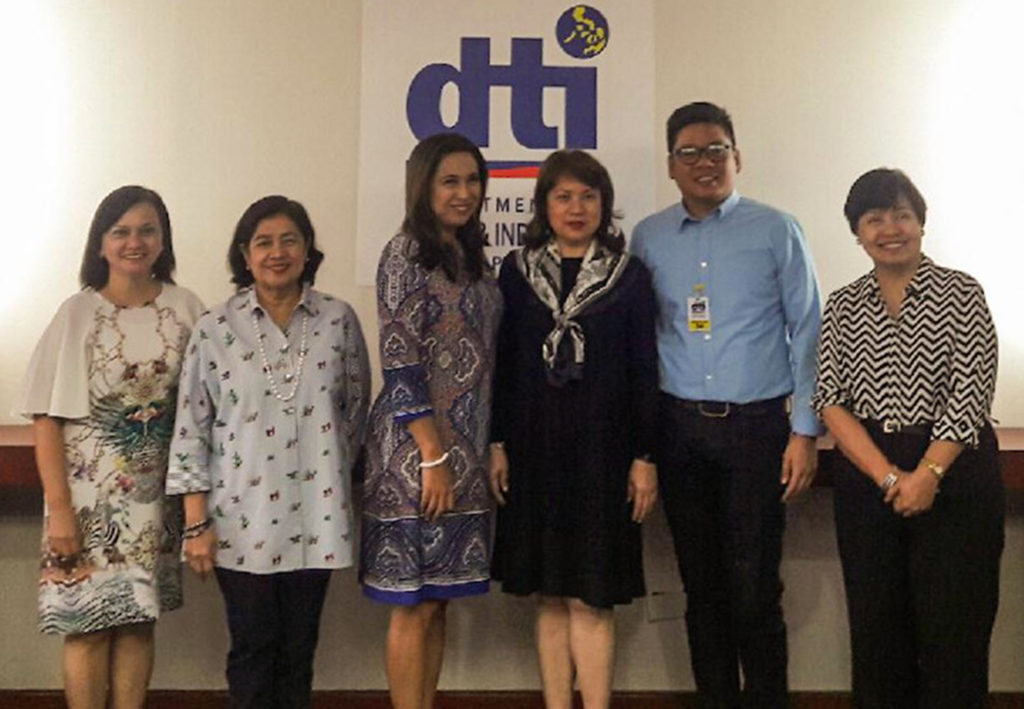
27 June 2017 Manila – The Go Lokal! team led by Department of Trade and Industry Assistant Secretary Rosvi C. Gaetos initiates discussions with Philippine Airlines Inc. on a partnership to promote Go Lokal! products, a Filipino concept store which carries quality and innovative products crafted, designed and manufactured by the country’s micro, small and medium enterprises (MSMEs).
(In photo: L-R) Office of TIPG Assistant Secretary Coordinating Officer Rosario T. Liwanag, Bureau of Domestic Trade and Promotions Director Rhodora Leano, Philippine Airlines Inc. Vice President for Marketing Ria Domingo, DTI-Trade and Investment Promotions Group Assistant Secretary Rosvi Gaetos, (PAL) Romeo “Kit” Javier, and BDTP Assistant Director Marievic Bonoan.
by admin | Jul 3, 2017 | DTI Updates, National News
Department of Trade and Industry (DTI) Secretary Ramon Lopez welcomed the approval of the Office of the United States Trade Representative (USTR) to include Philippine travel goods in its expanded General System of Preferences (GSP) scheme.
Effective 1 July 2017, all US GSP Beneficiary Developing Countries will enjoy duty-free treatment for a number of its travel goods exports to the US. The new GSP program included 23 tariff lines, allowing travel goods such as apparels, bags, wallets and backpacks, luggage, and sport and travel bags made in the Philippines to enter the US market duty-free.
Sec. Lopez pushed for the Philippine advocacy of GSP inclusion and had consistently taken this up with counterparts from the USTR.
“This expansion will boost the local manufacturing industry and eventually provide more employment opportunities for Filipinos, creating 70,000 new jobs and increasing our GDP to 0.5 percent,” he said.
According to the US International Trade Center (ITC), the US imported an estimated total of USD 232 million from the 23 tariff lines of travel goods from the Philippines in 2016, making the country the fifth largest import source of travel goods in the US.
With the new GSP scheme, the duty-free treatment could increase Philippine travel goods exports to the US by USD 100 million annually for the first five years.
“The inclusion of travel goods into GSP will certainly provide benefits to our exporters, particularly micro, small, and medium enterprises (MSMEs) and export-oriented agri-businesses utilizing banana and other vegetable fibers and community based industries in the various regions of the country,” DTI Undersecretary Ceferino Rodolfo said.
Meanwhile, DTI Undersecretary Nora Terrado concurred, noting that maximizing market access opportunities from preferential agreements and arrangements such as GSPs and free-trade agreements (FTAs) are an important pillar of the Philippine export strategy as embedded in the Philippine Export Development Plans (PEDPs).
She added that “DTI will sustain and strengthen its advocacy campaign thru the Doing Business in Free Trade Areas (DBFTA) Program to ensure that Philippine exporters use this access and generate jobs.”
Confederation of Garments Exporters of the Philippines (CONGEP) Executive Director Maritess Agoncillo said the decision of the US government was an outcome of the joint efforts of the Philippine government and the private sector to strengthen the Philippine position on pushing for GSP for travel goods.
Sec. Lopez added that he “looks forward to this positive development as a much needed push for expanding employment opportunities and improving countryside development. This will also help contribute to the Duterte administration’s thrust of pursuing inclusive and sustainable growth thru job generation and entrepreneurship.”
The US GSP seeks to promote economic growth and development in developing countries through preferential and duty-free entry to the US market of products from 122 designated beneficiary countries and territories, including the Philippines.
In 2016, the US was the Philippines’ third major trading partner, the second biggest export market, and third top import supplier. A number of US companies are currently manufacturing travel goods in the Philippines, including Coach, Tory Burch, and Michael Kors
by admin | Jun 22, 2017 | DTI Updates
The Department of Trade and Industry – Construction Industry Authority of the Philippines (DTI-CIAP) in partnership with the Philippine Institute of Construction Arbitrators and Mediators, Inc. (PICAM) recently conducted its first NCR Mediators and Arbitrators Continuing Education (MACE) Program for 2017.
The MACE program which was attended by more than 40 arbitrators and mediators is a project of the Construction Industry Arbitration commission, an administrative body established under DTI-CIAP. The training seminar aimed at keeping its CIAC accredited arbitrators updated on the latest dispute resolution practices, analytical tools, laws, rules and regulations, and jurisprudence for both domestic and international construction contracts.
The morning session was graced by Engr. Salvador P. Castro, who served as a speaker and moderator in the interactive session on Key Contractual Provisions focusing on the following clauses in construction contracts: time bar, fitness for purpose and the standard of care. Among the reactors were Atty. Donemark L. Calimon, Atty. Roberto N. Dio, Atty Victor P. Lazatin, and Atty. Eduardo R. Ceniza on legal aspects; and Engr. Jose I. Ortega, Arch. Felicitas A. Pio Roda, and Dr. Primitivo C. Cal on the technical domain.
The topic was followed by a discussion from Mr. Joven B. Joacquin on the PICAM Code of Ethics for Construction arbitrators and mediators.
The afternoon session proceeded with a presentation from Atty. Jesusito G. Morallos on the construction delays; and from Atty. Mario V. Valderrama, a lecture on the International Bar Association guidelines on conflict of interest.
Atty Ruth B. Castelo, DTI Undersecretary for Competitiveness and Ease of Doing Business and also a CIAC-accredited Arbitrator, participated in the event.
The next leg of the MACE program will be held in the regions on August 18, 2017 in Davao City and in Cebu City sometime in November 2017.
by admin | Jun 22, 2017 | DTI Updates, National News
PASAY—Relevant industry players should continue partnering with the Philippine government in developing further the electronics industry, being one of the primary sources of economic growth today, the country’s trade chief said.
Stressing the robust Philippine economy and a booming global market, Department of Trade and Industry (DTI) Secretary Ramon Lopez outlined government initiatives to strengthen the electronics industry, as well as DTI’s partnership with industry stakeholders.
Said initiatives include projects that will move the industry’s capabilities to higher value activities, as well as help identify products and technologies in the developing sectors of electronics in the next five years. DTI and the Board of Investments (BOI) also have active partnerships with other institutions to forward capacity-building programs and exchange of best industry practices.
In his keynote speech at the 14th Philippine Semiconductor and Electronics Convention and Exhibition (PSECE) on 21 June, Sec. Lopez said that closer industry-academe linkages can lead to a stronger electronics industry that will later on “generate inclusive economic growth, reaching those at the bottom of the pyramid.”
As one of the pillars of the country’s industrial growth and one of the top 12 industry priorities of the current administration, the electronics industry is a top export performer with a 51.3% share of total exports in 2016 (worth USD 28.8 billion). The industry has also generated about 2.6 million direct and indirect employments as of 2015.
He also mentioned that as the Philippines chairs ASEAN 2017, the government’s priority is to lead an inclusive, innovation-led growth, which means working to create an enabling environment to develop micro, small, and medium enterprises (MSMEs), and prepare them to become globally competitive, innovative, inclusive and resilient.
“There is a very strong role that innovation plays in helping and enabling a lot of our countrymen to develop an innovation mindset, culture and capability, for them to also have equal chances to success and move up in life,” Sec. Lopez said.
The trade chief noted the need to focus on key areas affecting MSME growth, including the promotion of productivity, technology, and innovation, as well as making these available and accessible to MSMEs.
“If we are able to broaden the capacity and innovation culture to a larger percentage of our population, then we also increase peoples’ chances of becoming successful,” he added.
Sec. Lopez reiterated that Pres. Duterte’s Dutertenomics aims to narrow development gap and widen the gains of economic growth through creation of jobs and income opportunities for all.
Led by the Semiconductor & Electronics Industries in the Philippines Foundation, Inc. (SEIPI), the 14th PSECE provides an avenue, wherein public and private stakeholders gather to strategically identify possible areas of cooperation and to learn best industry practices.
“As we gain insight and appreciation on the issues affecting the electronics industry, we are confident that whatever we learn will help us in our efforts to create broad-based growth that generates jobs, fosters entrepreneurship, and gives Filipinos more opportunities,” Sec. Lopez said.
by admin | Jun 22, 2017 | DTI Updates, Negosyo Center Updates, Photo Story
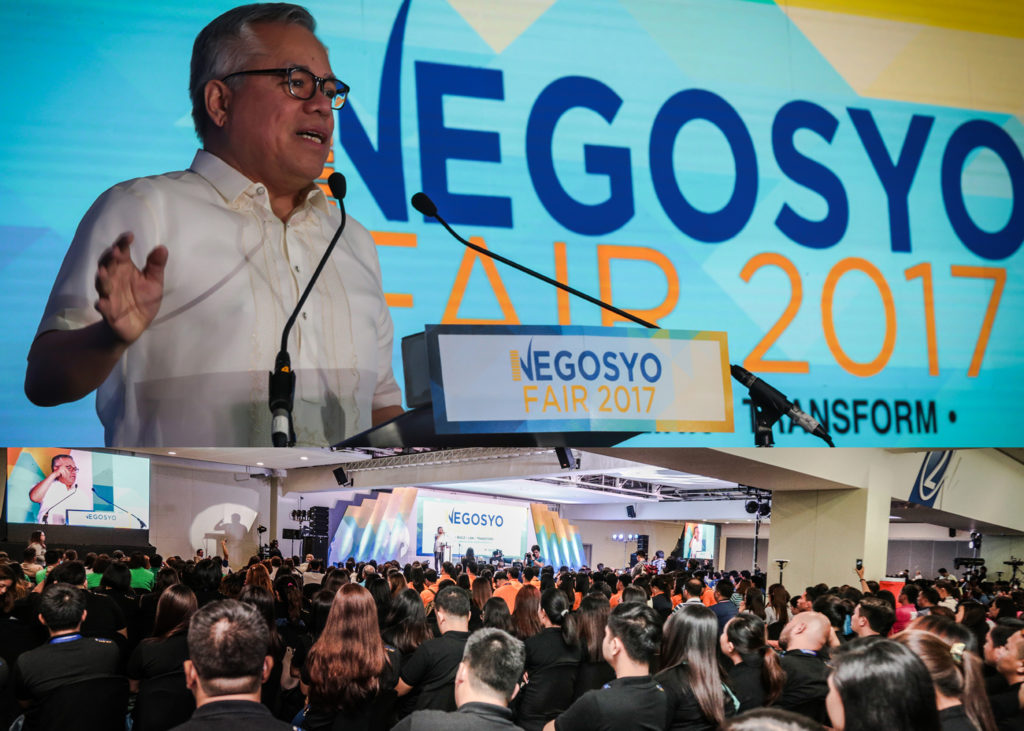
LOPEZ TO NEGOSYO MENTORS: DEVELOP SMARTER PINOY ENTREPRENEURS. Department of Trade and Industry (DTI) Secretary Ramon Lopez recently (20 June) called on almost a thousand Negosyo Center business counsellors to help DTI and the government develop smarter Filipino entrepreneurs. Speaking at the first Negosyo Fair Business Counsellors’ Conference at SM Megamall, Sec. Lopez highlighted the role of business mentors as front liners of the Negosyo Centers, which he considers an important infrastructure of entrepreneurship. “When you inspire, you transform people and give them the positive entrepreneurial mindset,” he said. To date, there are over 500 Negosyo Centers all over the Philippines ready to provide efficient services to existing and aspiring entrepreneurs, including through provision of free business mentoring and coaching services, trainings and information on market and access to finance. DTI continues to empower Filipino entrepreneurs through these Negosyo Centers, thus infusing the right entrepreneurial mindset in a nation of entrepreneurs. The Negosyo Fair 2017 is open to public until June 24 at SM Megamall.

