by admin | Mar 13, 2017 | DTI Updates, Headlines, National News
Department of Trade and Industry (DTI) Secretary Ramon M. Lopez met with senior executives of Japan’s seven major trading houses in Tokyo recently (March 1, 2017) to discuss President Rodrigo Duterte’s economic programs and Japanese Companies investment interests in the Philippines, conservatively valued at Php198.5B.
During a breakfast dialogue, Lopez—together with Transportation Secretary Arthur Tugade and PH Ambassador-Designate Jose Laurel V—got together with representatives of the sogo shoshas or Japanese companies with a broad range of business activities. Companies present at the meeting were Mitsubishi Corporation, Mitsui and Co., Ltd., Sumitomo Corporation, Itochu Corporation, Marubeni Corporation, Toyota Tsusho, and Sojitz.
“Through sound and consistent macroeconomic policies, the country continues to attract serious investments. The fundamentals are there in terms of a fast-growing economy, a 109-million population base, standing trade agreements, and a young, talented, and dedicated work force,” Sec. Lopez said on the Japanese companies’ willingness to investment in the Philippines.
“All these—plus political will and focused trade and investment policies—act as a magnet for foreign investments,” Sec. Lopez added.
The investment interests of the sogo shoshas would cover the period spanning late 2016 to 2020, and include:
- Marubeni willing to invest in additional coal power plants worth Php75B over the medium term;
- Itochu and Sumitomo (through PH subsidiaries Dole and Sumifru respectively) willing to invest an additional Php12.9B through 2018 to expand their integrated farming projects in Mindanao;
- Sumitomo, Sojitz, and Mitsui jointly invested in Coral Bay Nickle Corporation and Taganito High Pressure Acid Leaching (THPAL) Nickle Corporation in Surigao and Palawan, at a cost of Php80B;
- The CARS program, under the DTI-driven Manufacturing Resurgence Strategy, enjoying the support and participation of Mitsubishi, Sojitz, Mitsui, and Toyota Tsusho; and,
- All 7 trading houses expressing interest in the Philippines’ “Golden Age of Infrastructure,” i.e. the Railway and Subway Projects, the Clark Green City Project, the Expanded Port and RoRo Building Programs, and the Airport Development Projects.
“With DTI’s inclusive business model, our resource-based country has the potential to become a major supplier to the world by fostering value chain linkages and partnerships between the MSMEs as suppliers of goods and services, and the large enterprises as buyers,” Sec. Lopez said.
When asked about the Philippine government’s mining and tax policies, Secretaries Tugade and Lopez responded that government reforms are being crafted along balanced and fair consideration of both industry and consumer interests.
They also assured investors that with public sector agencies rigidly adhering to President Rodrigo Duterte’s zero corruption dictum, projects would receive adequate protection and fair treatment.
The two officials likewise encouraged the Japanese trading houses to use their expansive business systems to help in planning an efficient set of economic infrastructure, such as farm-to-market roads, bridges, seaports, airports, railways for cargo, passengers and RORO vessels, and service providers
by admin | Mar 13, 2017 | DTI Updates, Headlines, National News
The Philippine Board of Investments (BOI), an attached agency of the Department of Trade and Industry (DTI), is now finalizing the general policies and specific guidelines of the 2017 Investments Priorities Plan (IPP) following the approval by President Rodrigo Roa Duterte of the plan on 28 February 2017.The IPP, approved through Memorandum Order No. 12, was published in the March 3, 2017 issue of Manila Bulletin and will take effect on March 18, 2017.
The IPP was approved as proposed by the BOI. The submission to the Office of the President on December 29, 2016, three months ahead of the March 31deadline under the Omnibus Investments Code of 1987, and the subsequent approval of the new IPP is a milestone for the agency.
Trade and Industry Secretary and BOI Chairman Ramon Lopez welcomed the early approval of the new IPP saying “this development is concrete proof of the administration’s decisiveness to further propel the growth of investments and job generation in the country and attain sustainable economic growth”.
The IPP is a list of priority investment activities that may be given incentives. With the theme “Scaling Up and Dispersing Opportunities,” the 2017 IPP brings forth significant additions and changes, following the President’s zero + 10-point Socio Economic Agenda, the aspirations embodied in AmBisyonNatin 2040, and the Philippine Development Plan 2017-2022. Broadly these changes include further emphasis on innovation-driven and job-generating businesses; inclusive business for agribusiness and tourism; broadened coverage of manufacturing; information technology (IT) and IT-enabled services for the domestic market and telecommunications services for new market players; environment and climate change-related projects; LGU-initiated PPP projects; drug rehabilitation centers; state-of-the-art engineering, procurement and construction (EPC) services; and the lifting of geographical restrictions for most agriculture and tourist accommodation facilities.
Formulated through a participative, analytical, and multi-sector process, the new IPP is expected to generate more investments to strengthen manufacturing resurgence and create more jobs as targeted in the PDP 2017-2022. The BOI-approved investments grew 20.4 percent in 2016, reaching P441.8 Billion from the P366.7 Billion registered in 2015. This is the second highest since 2000, with the highest registered in 2013 at P466 Billion. The 20.4 percent growth also exceeded the agency’s 7 percent growth target for 2016.
The BOI is set to conduct IPP Roadshows in key cities all over the country to be led by Undersecretary and BOI Managing Head Ceferino S. Rodolfo to inform and promote to the various stakeholders the salient features of the new IPP.
For more information on the services of the DTI, log-on to http://www.dti.gov.ph#
by admin | Mar 11, 2017 | DTI Updates, Edukasyon Updates, Headlines, Internet Service Provider, Tech Talk
TAGBILARAN CITY, March 7 (PIA)–The day after President Rodrigo Duterte approved the Philippine national Broadband Plan to effect a faster and more reliable communications in the country, Holy Name University in Bohol also partners with Smart Telecommunications for a wireless fidelity (wifi) internet access for its students.
And for that, Smart Communications incorporated allocated 100 megabyte per second (mbps) internet bandwidth to the catholic university, giving students some 30 minutes free internet service daily.
Holy Name University President Fr. Francisco Estepa SVD, pointed out that the provision of SmartWifi in the campus is the third among HNU and Smart partnerships.
He told the modest crowd gathered at the covered shed beside the campus Bates Building that HNU also got Smart suite.
Smart Learning Suite is a facility that combines lesson delivery, assessment, student collaboration and game-based learning software via the Smart Notebook, Smart Lab, Smart Response and Smart Amps.
He also said HNU partnered with Smart on Smart Sports.
This time, Smart Communications incorporated again partnered with HNU on the SmartWifi in the campus.
“Our partnership with Smart has been very beneficial to the school, we do hope that we had mutual benefits with Smart,” Fr. Estepa said.
The partnership allows the HNU community to get 30 minutes free wifi access daily, also gets them free infrastructure in cables, access points, 100 MBPS of internet bandwidth, free facility operation and maintenance, while earning a co-branded set service identification (ssid) and leading page, courtesy of Smart.
For partnering with Smart, HNU also commits to shoulder costs of power used by the facility, provide adequate space for the infrastructure, allows the tapping of the facility to HNU emergency power supply, provides security to the facility and its components, as well as allowing the telecommunications company to advertise its services to students.
For students who want more access time, all they need to do is buy access cards from the school canteen to continue using the service after the free provisions, Smart said.
Signing the agreements were Wifi Team Smart Communications head Regina Pineda, and HNU President Fr. Estepa.
Also witnessing the ceremonies were Smart Area Development Manager Lailane Husain, Fr. Vicente Uy SVD and school professors, students and employees.
Other than HNU, Smart has also put up a fast and reliable wifi connection at the Tagbilaran City Airport, and had been asked to provide the same huge bandwidth at the Tagbilaran City Port, Tagbilaran City Hall, the nw Provincial Capitol and some identified public places. (rac/PIA-7/Bohol)
by admin | Mar 11, 2017 | DTI Updates, Headlines, Kontra Droga, Police Reports
TAGBILARAN CITY, March 9 (PIA)—They are back, and while there are stricter parameters for police participation in the government’s anti drug campaign, they come in with a new tenacity.
Now reinforced with the 64 newly graduated members of the Police and the military’s Special Weapons And Tactics (SWAT), the Philippine National Police again rejoins the fray with a resolve: erase the vile left by rogue cops using the drug raids to mask their corruption.
PNP Central Visayas Chief PCSuperintendent Noli Taliño told media that when the police rejoin the anti-drug campaign, those involved would he a team of disciplined and police with a good track service record.
This as the police resume their tasks in the anti illegal drugs campaign with the return of Oplan Double Barrel Alpha Reloaded.
“Unlike then, not all the police in the force can now join the drive,” General Taliño bared during the recent turn-over of the P4.87 million modern police station in Cortes.
Even Department of Interior and Local Government (DILG) Secretary Mike Sueño admitted that when the government started the anti drugs drive, they just accepted those who volunteered, without going for a background investigation.
“That is where we allowed the bad elements to contaminate the program, Sueño candidly admitted during a forum with barangay chairmen in Bohol last month.
Determined not to fall into that same trap, the PNP organization firms up the national Drug Enforcement Unit, PCSupt Taliño, upon which his office also draws guidance from the DILG during operations.
The provinces also form their Provincial Drug Enforcement Team (DET), and so would the towns firm up their Municipal DETs, CSupt. Taliño explained further.
Those who constitute the DETs would be going past a rigorous personality check and background information to make sure they are fit and can be trusted, hinted the police chief for Central Visayas.
He said everyone would be placed under investigation, before getting admitted to run the government anti drug drive in their areas.
Even then, these DETS would still need to coordinate their operations with the Philippine Drug Enforcement Agency (PDEA).
The PDEA is the government agency primarily tasked to head the government anti drug campaign.
Drug operations, like then would need a barangay official, a priest, imam, pastor or any leader of a religious sect in the area, as witnesses.
And to get past that, in its efforts to internally cleanse its organization, the regional chief said they did random drug tests to its 8,000 officers and men in the region, including its non-uniformed personnel.
At the random drug tests, 9 tested positive and are now facing summary dismissal proceedings, he told the modest crowd gathered at the turn-over.
“If found to be truly guilty, I am sure they would be dismissed,” he sternly declared.
On their return to rejoin the drug war, he urged his men: Let’s restore the good support given to us, with a good service.”(rac/PIA-7/Bohol)
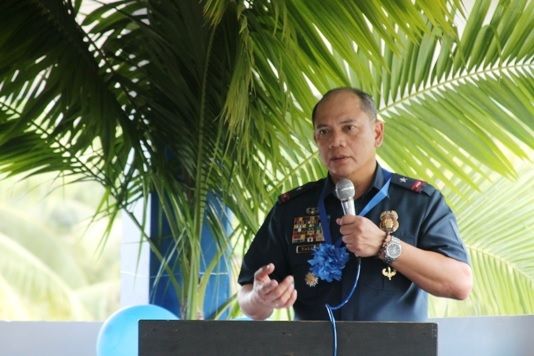
Double Barrel Alpha Reloaded gets its confirmed resumption when PNP Regional Director PCSupt Noli Taliño announced it in Cortes during the recent turn-over of the new police station. Taliño said they will be back, but it would be via a disciplined team of credible officers passing a rigorous test of honesty and courage. (rac/PIA-7/Bohol)
by admin | Mar 11, 2017 | DTI Updates, Fire Bureau Repots, Headlines
Don’t leave your phones to
overcharge, says the BFP
TAGBILARAN CITY, March 6 (PIA)—For those who the habit of unattended charging, fire fighters have a few words: “Anything used in excess is bad.”
Overcharging gadgets and appliances for example, said Deputy Provincial Fire Marshal Fire Inspector Romeo Almiñe has caused so much fires already.
Stressing the need for attention when charging at the weekly Kapihan sa PIA, FInspector Almiñe also dished out information bits in line with March as Fire Prevention Month.
Overcharging chargers are usually low class, these should not be left alone unattended as these are prone to short circuit.
Short circuits generate spark needed to ignite anything combustible nearby, he added, generating even more comment from no less than the city fire marshal.
City Fire marshal Fire Chief Inspector Randy Mendaros went on saying, “like any other gadgets, they have owner’s manuals to guide customers proper care, you just have to follow them.”
At the onset of fires generated by over-charged mobile phones, both fire fighters advise: better make sure you get products with the Import Commodity Clearance (ICC) mark.
The ICC mark assures customers that the product passed through the rigorous tests by the Bureau of product standards of the Department of Trade and Industry.
This mark also assures that the product can perform as expected, but not abused, fire fighters reminded.
The Bureau of Fire Protection has been doing rounds in the communities, but FCInspector Mendaros admitted, it is barely enough.
This year’s fore prevention month picks on the theme: Value Life and Property, Start Fire Prevention in the Family.
Faced with a daunting task of bringing fire prevention information to the grassroots, BFP Bohol said they have barely enough men to do the job of awareness.
But that is not stopping them, asserted the firefighters who have brought their information to the roving government caravans all over Bohol.
HEAT IT Bohol has been a regular venue for the BFP to advertize and campaign for availment of its services, Almiñe said.
We even brought the campaign for household prevention to the schools, thinking that the kids might be the perfect persons to convince their parents on fire consciousness, FChiefInspector Mendaros added.
A simple habit of unplugging appliances or gadgets when they are not in use, and going for simple energy conservation tips also work for us, Castilla, in a talk also interjected.
This develops even as BFP Bohol still relentlessly pushes for the establishment of fire stations in 12 more towns.
About 35 towns in Bohol now have already established fire fighter base stations, adds Fire Officer 3 Sircio Castilla at the forum. (rac/PIA-7/Bohol)
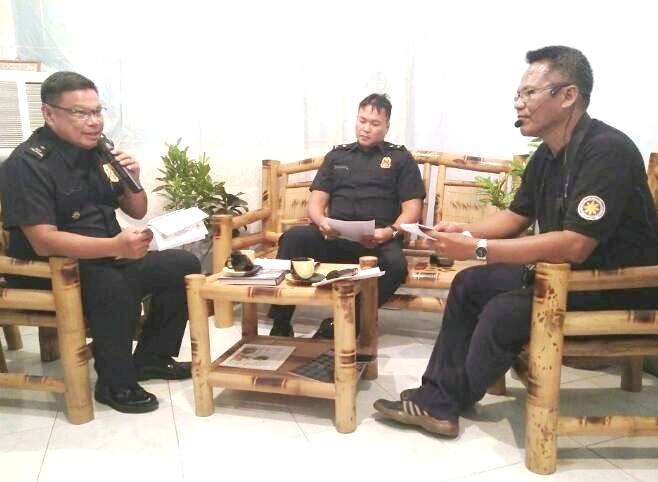
You save your life and property and you can save on your power costs when you unplug your appliances and gadgets when these are not in use, share the Bureau of Fire Protection at the recent Kapihan sa PIA. (ECB/PIA-7/Bohol)
by admin | Mar 10, 2017 | DTI Updates, Headlines, National News
The Department of Trade and Industry sees exports recovering in 2017 as numbers surged in January 2017 with an increase of 22.5 percent with total sales of $5.130 billion from $4.187 billion recorded value in the same period last year according to the Philippine Statistics Authority (PSA) report.
“We are positive that we will continue to drive growth and recovery for the export sector as we increase our efforts in promoting Philippine industries throughout the year in various key markets. We take the consistent growth since the last quarter of 2016 as a sign for positive outlook in the coming months,” said DTI Industry Promotion Group Undersecretary Nora K. Terrado.
Eight out of the top ten Philippine exports reflected growth with articles of apparel and clothing accessories with 270.1% increase as the highest gainer. Other gainers include: coconut oil includes oil and refined (229.6%), chemicals (104.7%), metal components (66.3%), electronic equipment and parts (64.8%), other manufactures (58.8%), machinery and transport equipment (27.9%), and electronic products (10.4%).
Electronic products remain to be the top Philippine export comprising almost 46 percent of the total Philippine exports with total receipts of $2.365 billion for January. On the other hand, non-electronic goods which accounts for 54 percent of exports likewise increased by a hefty 35.19% for that same month.
In terms of commodity groups, manufactured goods went up by 23.1 percent with total export sales of $4.505 billion, accounting for 87.8 percent of the total export receipts while exports from Total Agro-Based Products, with a 7.5 percent share to total exports in January 2017, amounted to $386.46 million. It increased by 33.7 percent compared to $289.12 million in January 2016.
Japan is still the top Philippine export destination with 17.3 percent share to total exports while United States ranks second with 16.5 percent share.
By economic bloc, exports to European Union member countries posted the highest growth with 82.5 percent increase from $491.34 million recorded in January 2016 to $896.69 million for the same period in 2017.
“The increase in our shipments to European Union member countries could be attributed to the impact of EU GSP+ which continues to gain traction for our exports. We wish to further build on this by integrating new strategic measures in promoting the Philippines and our products and services,” explained Undersecretary Terrado.
On the other hand, countries in East Asia received most of Philippine exports accounting for 45.1 percent share to total exports valued at $2.315 billion. It increased by 11.1 percent from $2.085 billion of January 2016.
Exports to ASEAN member countries comprised 14.7 percent of the total exports in January 2017 and was valued at $751.54 million also posted growth which went up by 19.3 percent.



