by admin | Mar 10, 2017 | DTI Updates, Headlines, National News
The Department of Trade and Industry sees exports recovering in 2017 as numbers surged in January 2017 with an increase of 22.5 percent with total sales of $5.130 billion from $4.187 billion recorded value in the same period last year according to the Philippine Statistics Authority (PSA) report.
“We are positive that we will continue to drive growth and recovery for the export sector as we increase our efforts in promoting Philippine industries throughout the year in various key markets. We take the consistent growth since the last quarter of 2016 as a sign for positive outlook in the coming months,” said DTI Industry Promotion Group Undersecretary Nora K. Terrado.
Eight out of the top ten Philippine exports reflected growth with articles of apparel and clothing accessories with 270.1% increase as the highest gainer. Other gainers include: coconut oil includes oil and refined (229.6%), chemicals (104.7%), metal components (66.3%), electronic equipment and parts (64.8%), other manufactures (58.8%), machinery and transport equipment (27.9%), and electronic products (10.4%).
Electronic products remain to be the top Philippine export comprising almost 46 percent of the total Philippine exports with total receipts of $2.365 billion for January. On the other hand, non-electronic goods which accounts for 54 percent of exports likewise increased by a hefty 35.19% for that same month.
In terms of commodity groups, manufactured goods went up by 23.1 percent with total export sales of $4.505 billion, accounting for 87.8 percent of the total export receipts while exports from Total Agro-Based Products, with a 7.5 percent share to total exports in January 2017, amounted to $386.46 million. It increased by 33.7 percent compared to $289.12 million in January 2016.
Japan is still the top Philippine export destination with 17.3 percent share to total exports while United States ranks second with 16.5 percent share.
By economic bloc, exports to European Union member countries posted the highest growth with 82.5 percent increase from $491.34 million recorded in January 2016 to $896.69 million for the same period in 2017.
“The increase in our shipments to European Union member countries could be attributed to the impact of EU GSP+ which continues to gain traction for our exports. We wish to further build on this by integrating new strategic measures in promoting the Philippines and our products and services,” explained Undersecretary Terrado.
On the other hand, countries in East Asia received most of Philippine exports accounting for 45.1 percent share to total exports valued at $2.315 billion. It increased by 11.1 percent from $2.085 billion of January 2016.
Exports to ASEAN member countries comprised 14.7 percent of the total exports in January 2017 and was valued at $751.54 million also posted growth which went up by 19.3 percent.
by admin | Mar 8, 2017 | ASEAN agenda, DTI Updates, Headlines, National News
The 31st High-Level Task Force on ASEAN Economic Integration (HLTF-EI) convened on February 15-16 in Manila, gathering high-ranking ASEAN trade officials to discuss the implementation of the ASEAN Economic Community (AEC) Blueprint 2025.
HLTF-EI Chairperson and Permanent Secretary of the Ministry of Foreign Affairs and Trade of Brunei Darussalam Dato Lim Jock Hoi said that ASEAN needs to remain strong and united as the region navigates and charts its course ahead “collectively as ASEAN.”
Representing the Philippines, Undersecretary for Industry Development and Managing Head of the Board of Investment Ceferino Rodolfo laid down the Philippine priority deliverables for 2017, highlighting the country’s agenda on inclusiveness and innovation with a focus on increasing trade and investments, integrating micro, small, and medium enterprises (MSMEs) in the digital economy, and developing an innovation-driven economy.
“Inclusiveness should be intrinsic to the ASEAN agenda. The AEC Blueprint 2025 development framework will be most effective if it results from inclusive and open multi-stakeholder participation, one that is informed by the perspectives of people, especially the marginalized,” Undersecretary Rodolfo said.
The Philippines is taking the lead in seeking new policy interventions that are practical from the MSME perspective. These are expected to contribute towards helping MSMEs harness the opportunities presented by open and increasingly integrated markets. These initiatives range from free trade and trade facilitation, trade in services, investment, connectivity, and innovation:
– Maximizing the benefits of free trade agreements (Self-Certification for MSMEs, and Substantial Conclusion of the Regional Comprehensive Economic Partnership [RCEP]);
– Fostering a more facilitative and transparent trade in services regime and harnessing the contribution and global competitiveness of the ASEAN services sector (Conclusion of the ASEAN Trade in Services Agreement);
– Strengthening the investment linkages between MSMEs and Multinational Enterprises or MNEs (FAST Action Agenda on Investment, Inclusive Business, Women and Youth Entrepreneurship);
– Enhancing intra-regional connectivity and bolstering socio-economic growth in the regions (Launch of the Davao-General Santos-Bitung route of the ASEAN Roll-on Roll-of Network);
– Supporting an ecosystem of entrepreneurship based on technology and innovation (ASEAN Declaration on Innovation); and
– Introducing more systematic and robust method for AEC compliance monitoring (ASEAN Trade Facilitation Indicators, Review Mechanism for AEC).
Said priorities are in line with the Duterte Administration’s 10-point socio-economic agenda. In particular, these will leverage the global competitiveness of the Philippines’ services sector in order to generate jobs and growth, as well as bring development to the South through rural and value chain development.
The Philippines also delivered to HLTF-EI the collective statement of the ASEAN Civil Society Conference/ASEAN Peoples’ Forum (ACSC/APF) Philippines National Organizing Committee, reflecting the people’s aspirations for an ASEAN that assertspeace and security, human rights, democratization, and broad-based economic, social and ecological justice.
Undersecretary Rodolfo highlighted the potential of civil society organizations as strategic and responsible partners in the process of ASEAN community-building, given their knowledge and reach at the grassroots level and cohesive international network.
Recommendations of the 31st LTF-EI will be the focus of discussions at the 23rdASEAN Economic Ministers’ Retreat and Related Meetings to be held on March 8-10in Manila.
Composed of Trade Vice Ministers from the ten ASEAN Member States (AMS), the HLTF-EI functions as an advisory body to the economic ministers of the AMS, ensuring that all 10 AMS are on-track and on-time with the plans and programs intended to realize regional economic integration and achieve the vision of an AEC.
The AEC Blueprint was crafted to further advance ASEAN economic integration, envisioning a community characterized by the following: a) a highly integrated and cohesive economy; b) a competitive, innovative, and dynamic ASEAN; c) enhanced connectivity and sectoral cooperation; d) a resilient, inclusive, and people-oriented, people-centred ASEAN; and e) a global ASEAN.
ASEAN economies are expected to hold up reasonably well amidst the slowing of global growth, and the uncertain and shifting geo-political and economic landscape.
Forecasts from the Asian Development Bank and the International Monetary Fund place the region as the most dynamic part of the world with strong economic outlook for 2017 at 4.6% to 4.9% of GDP growth rate, vis-à-vis the 3.4% projected for the growth global GDP. The Philippines leads the region with a growth forecast of 6.8% for 2017.
by admin | Mar 7, 2017 | BFAR Advisory, DTI Updates, Headlines
TAGBILARAN CITY, March 7 (PIA)–Clearly at a loss of explanations on the ongoing ban on hunting rare, threatened and species in danger of extinction, Bohol Provincial Peace and Order Council (PPOC) requests the country’s lead agency implementing the ban for enlightenment.
Governor Edgar Chatto, PPOC Chairman and himself a witness to the rampant roadside and market sales of dried “sanga” meat in Jagna town, intends for the council to also be fully appraised of the nuances among banned sanga (giant manta ray), ordinary manta ray species like smoothtail mobulas (pantihan), spinetail mobula (binsowan), the giant pacific devil rays, sting rays and still the smaller species that are cooked and sold as exotic food.
A Pamilacan resident and a PPOC member Engr. Camilo Gasatan also admit that because sanga commands a high price, even the smaller non-banned species are called sanga when dried to fetch a high price.
Those who do not actually know may eat other smaller manta ray meat, sold as sanga, he said.
In fact, many Boholanos still keep an open craving for nilabog sanga, banggis, ang sinugbang buwad sanga despite a ban on hunting, taking, catching, gathering, selling, purchasing, possessing, transporting, exporting, forwarding or shipping out aquatic species listed in the appendices of the Convention on the International Trade in Endangered Species of Wild Flora and Fauna (CITES).
Also included in the ban are those categorized by the International Union for Conservation of Nature and Natural Resources (IUCN) as threatened and endangered as determined by the Bureau of Fisheries and Aquatic Resources.
Incidentally, the giant manta rays (sanga) are listed under Appendix 3 or those which are endangered species close to extinction.
But while the country drafts the ban on manta rays, then Fishery officials thought there is only one kind of giant manta rays here: manta birostris, they put in the ban.
Subsequent research however revealed that aside from manta birostris, a similar specie in the CITES includes the manta mobular and the mobulids that also frequent Philippine waters.
The ban for the other species of mantas and mobulids start this month, fishery officials reacting to FAO 193 revealed.
And because recent scientific assessments show that their population in the wild cannot remain viable under pressure of collection and trade, offenders would face a fine equivalent to three (3) times the value of the species or Three hundred thousand pesos (P300,000.00) to Three million pesos (P3,000,000.00), whichever is higher, and forfeiture of the species.
And upon conviction by a court of law, the offender faces imprisonment of five to eight years and a fine equivalent to twice the administrative fine and forfeiture of the species.
But even then, net fishers in Bohol usually string up long lines and find the banned manta rays as by-catch.
When found entangled in their nets, fishers try to salvage the meat than throw them in the sea.
By possessing the meat, these fishermen now earn the culpability that would get them steep fines and jail time.
The continuing trade of dried meat has also pushed for the patronizing of the illegal product, majority of those who east it, uninformed about the ongoing bans. (rac/PIA-7/Bohol)

Following the apprehension of the persons responsible for transporting over a ton of manta ray meat set for drying, the PPOC needs the BFAR now to elucidate on the ban for taking the giant manta rays, considering that there appears to be a rampant trade of manta rays and sting rays in city and town markets across the province. The ban also incorporates steep penalties for the guilty, fines reaching millions. (rac/PIA-7/Bohol)
by admin | Mar 7, 2017 | DTI Updates, Photo Story
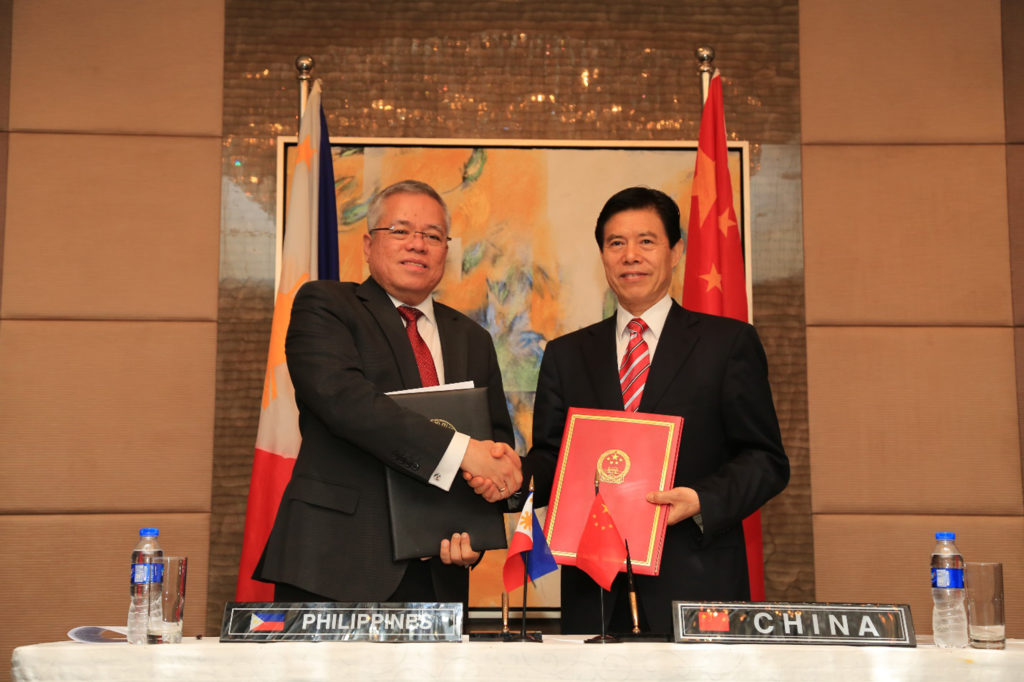
NEW CHINESE TRADE MINISTER MARKS FIRST OFFICIAL VISIT TO PHL. On his first official visit to the Philippines, China’s newly-appointed Ministry of Commerce (MOFCOM) Minister Zhong Shan (R) met with the Philippines’ Department of Trade and Industry (DTI) Secretary Ramon Lopez (L) on 7 March in Makati during the 28th Philippine-Chinese Joint Commission on Economic and Trade Cooperation (JCTEC). Serving as the official bilateral mechanism for discussion of trade, investments and economic cooperation, the JCETC was convened after a five-year hiatus, and serves as a quick follow through of President Rodrigo R. Duterte’s State Visit to China last October 2016. Both sides agreed on important initiatives geared towards improving overall levels of trade and investment between the two countries. Discussion highlights included the Six-Year Development Program for Economic and Trade Cooperation (SYDP) that will serve as the overall framework for economic relations from 2017-2022, the list of priority infrastructure projects to be funded by available Chinese credit facility and potential private sector investments from China on oil downstream projects, aviation industry (including aircraft parts manufacturing), waste to energy through gasification, ship building, and ship repair facility and integrated steel facility
by admin | Mar 7, 2017 | DTI Updates, Headlines, National News
Pagdaraos ng ASEAN Economic Ministers Meeting, kasado na
MAKATI—Determinado at handang isulong ng Department of Trade and Industry (DTI) angtrade agenda ng Pilipinas sa gaganaping ASEAN Economic Ministers Meeting (AEM) Retreat and Related Meetings sa 8-9 Marso 2017.
Ito ang paunang pagpupulong ng mga trade minister o mga kalihim ng komersyo ng 10 ASEAN Member States (AMS) bago ang isa pang pagpupulong sa Setyembre.
Bilang punong ahensya ng ASEAN Economic Community (AEC) pillar, itataguyod ng DTI ang isa sa mga tema ng ASEAN tungkol sa “sama-sama at makabagong pagsulong.” Ang dalawang iba pang pillars ay tumutugon sa usaping pang-seguridad at pang-kultura.
Pagpapataas ng kalakalan at pamumuhunan, pagsali sa micro, small and medium enterprises(MSMEs) sa pandaigdigang halagahan o global value chain at pagsusulong ng innovation o mga makabagong pamamaraan upang mapataas ang kalidad ng ekonomiya ang mga tinuturing hakbang ng pamahalaan upang maisakatuparan ang nasabing tema.
“Nakaayon sa hangarin ng DTI na magtaguyod ng trabaho at negosyo ang interes na isusulong ng Pilipinas sa pagpupulong na ito,” lahad ng kalihim ng DTI Ramon Lopez na siyang ring uupong tagapangulo ng AEM Retreat and Related Meetings.
Sinabi naman ng kalihim na patas ang magiging daloy ng AEM chairmanship ng Pilipinas, kung saan kikilalanin ang mga interes na isusulong ng siyam na iba pang bayan.
Layunin ng pagpupulong na patatagin ang mga ugnayan sa pagitan ng mga AMS upang mapalawig pa ang kaalaman tungkol sa epektibong paggamit ng mga kasunduang pangkalakal o trade agreements, mga probisyon sa pamumuhunan at iba pang benepisyong kalakip ng pagiging miyembro ng ASEAN.
Panawagan ni Sec. Lopez, kailangang maunawaan at maramdaman ng mga ASEAN national, kabilang na ang mga Pilipino, ang mga ganansyang maaaring maiambag ng ASEAN sa pang-araw-araw nilang karanasan bilang miyembro ng organisasyon.
Dagdag pa ng kalihim, pagkakataon din ang pagpupulong upang mapalalim ang kamulatan tungkol sa ASEAN at maitampok ang natatamong pag-unlad ng ekonomiya ng bansa sa ilalim ng administrayon ng Pangulong Rodrigo Duterte.
Ayon sa kalihim, upang maisulong ang kalakalan at pamumuhunan, kailangan ang angkop na polisiya at klimang pang-negosyo, kasabay ng mga programang magpapalakas ng kakayahan ng iba’t ibang negosyo upang lumawak at umunlad.
Para sa sektor ng MSME, ipagpapatuloy ng DTI ang layunin nitong magtalaga ng kapaligirang angkop para matulungan at maihanda ang maliliit na negosyante sa pagsali nito sa pandaigdigang merkado, sa pamamagitan ng e-commerce at iba pang polisiyang magpapadali sa proseso ng pagnenegosyo at magbibigay ng karapat-dapat na pagsasanay o business training.
Pag-uusapan din sa AEM ang digital technology bilang susi upang paigtingin ang kalakalan sa bawat bansa at makapagbigay ng makabagong paraan upang patakbuhin ang negosyo.
“Layunin nating makalap at mapakilos ang publiko at pribadong sektor upang tulungan ang mga taong maramdaman ang mga oportunidad na ibibigay ng AEC,” dagdag ni Sec. Lopez. ###
by admin | Mar 6, 2017 | DTI Updates, Headlines, National News
MAKATI—The Department of Trade and Industry (DTI) is poised to champion the Philippine trade agenda as it takes helm of the ASEAN Economic Ministers Meeting (AEM) Retreat and Related Meetings on 8-10 March 2017 to be participated in by the 10 trade ministers from ASEAN Member States (AMS).
As lead agency for the ASEAN Economic Community (AEC) Pillar, DTI led by Secretary Ramon Lopez will promote one of the current thematic priorities of ASEAN on “inclusive, innovation-led growth” for shared prosperity. The other two pillars touch on politico-security and socio-cultural.
Increasing trade and investment, integrating the micro, small and medium enterprises (MSMEs) in the global value chains and developing an innovation-driven economy are the identified measures to achieve said priority.
“Our strategic measures are consistent with our current agenda to promote employment and entrepreneurship. The AEM is an excellent platform to push for the country’s core thrusts on trade and investment, MSME development and innovation,” said Sec. Lopez, who will serve as the chair of AEM Retreat and Related Meetings.
The trade chief, however, ensured that his meeting’s chairmanship will be “fair, workable, rational and inclusive” among AMS.
The AEM aims at strengthening partnership with stakeholders to expand knowledge and utilization of ASEAN-related free trade and economic agreements, provisions and initiatives, including the benefits that an ASEAN national can receive.
The trade chief aims to give meaning to these highly-technical engagements, in a manner that ASEAN nationals, including the Filipinos, can identify how they can benefit from the opportunities posed by regional integration without fear and hesitation.
“It’s time for us to make people feel that their membership in ASEAN is relevant to their day-to-day experience,” he said, adding that DTI’s hosting also presents good opportunity to raise awareness, to promote understanding on the AEC and the Philippine participation in it, and to re-tell the country’s growth story.
On increasing trade and investment, Sec. Lopez emphasized that the creation of a sound policy environment and the right mix of support programs are crucial to improve the capacity of businesses to expand, upgrade and diversify. He mentioned that the Regional Comprehensive Economic Partnership (RCEP), an agreement involving the 10 AMS and the six Dialogue Partners will expand the ASEAN market from 600 million to 3.5 billion. DTI will be pushing for the substantial conclusion of RCEP by year-end at the AEM, according to him.
On MSME development, Sec. Lopez said that the thrust continues for instituting an enabling environment that allows the sector to develop and internationalize through e-commerce, as well as policies that ease the cost of doing business and provide skills and business training and facilitate the link with the global value chain.
The country will also prod ASEAN to embrace the evolving digital technology as leverage to enhance trade and investment, to provide an e-based business platform and to promote good governance and green technology.
“We hope to gather, harmonize and mobilize public-private efforts towards taking full advantage of opportunities under the AEC,” he concluded.
ASEAN 2017 bears the theme, “Partnering for Change, Engaging the World”, which is in line with President Rodrigo Duterte’s objective to enhance cooperation with global partners, ensuring that ASEAN citizens, including the Filipinos, can live in peace, stability, security and growth, despite cultural diversities.
Following the AEM Retreat and Related Meetings is the ASEAN Summit in April to be chaired by President Duterte. The bigger meeting 49th AEM, meanwhile, is scheduled in September 2017

