by admin | Mar 6, 2017 | DTI Updates, Headlines
Given the pronouncement of President Rodrigo R. Duterte that the administration is gearing to ramp up infrastructure spending to 7% of GDP or a total of Php 8 Trillion in the next five (5) years, the Department of Trade and Industry-Construction Industry Authority of the Philippines (DTI-CIAP) initiated a dialogue with the construction industry and government implementing agencies, to determine the capacity and readiness of the construction industry to face the Golden Age of Infrastructure.
Participating in the dialogue were representatives from the National Economic Development Authority (NEDA), Department of Public Works and Highways (DPWH), Department of Transportation (DOTr), Government Procurement Policy Board (GPPB), Department of Education (DepEd), Philippine Constructors Association Inc. (PCA), National Constructors Association of the Philippines Inc. (NACAP) and the Chairmen of the different Implementing Boards of CIAP.
According to Atty. Ruth B. Castelo, Undersecretary for CIAP, the dialogue also aimed to identify and look into the concerns of our local contractors to encourage them to participate in government infrastructure projects.
During the dialogue, the constructors associations raised several issues encountered in the procurement and implementation of projects specifically in the pre-qualification system, project pricing, payment delays, and levelling of the playing field with the entry of foreign contractors, among others.
On the perception that local contractors do not have enough capacity and inadequate capability to handle big ticket infrastructure projects, PCA President Engr. Dante M. Abando emphasized that the local construction industry is ready, willing and able to face the Golden Age of Infrastructure. Engr. Abando said that the local contractors in the past has demonstrated strong capability by its proven track record of completing the Tarlac-Pangasinan-La Union Expressway Project (TPLEX) thru an organized consortium supported by local financial institutions.
Among others, no doubt that the construction industry, given the chance to demonstrate its capability to design and build major infrastructure project, will accomplish the projects faster, within standard specifications and at a much lesser cost. Undersecretary Castelo said that “the construction industry is excited to build, build and build in the Golden Age of Infrastructure.”
The dialogue marks a strengthened public and private partnership that will help the construction industry prosper and meet the demands of the Philippine Infrastructure Development Plan. Among other measures identified to address the issues are: (a) government to find ways on how to improve and simplify the procurement system, (b) establish a hotline for contractors’ complaints, and (c) continue to hold similar discussions with the industry.
The CIAP is the central authority of the construction industry mandated to promote, accelerate and regulate the growth and development of the construction industry in conformity with national goals.
For more information on the services of the DTI, log-on to http://www.dti.gov.ph
by admin | Mar 4, 2017 | DTI Updates, Major Events, Tech Talk
Everything starts with a dream and a strong commitment, Gov. Edgar Chatto addressed Information Technology Business Process Management (IT-BPM) industry experts and Boholano government, business, academe stakeholders at the three-part forum that was the 5th Visayas ICT Organization (VICTOr) conference, 1st Bohol Education Summit, and 3rd Visayas Creative Congress this week.
The governor along with Usec. Monchito Ibrahim of the Department of Information and Communications Technology (DICT) signed commitment to support Bohol’s bid to become IT-BPM investment haven.
He affixed his signature along with Bohol ICT industry stakeholders in pursuing the IT-BPM industry specific 2017 Education Action Plan.
The gathering of industry experts and stakeholders focused on effective talent development and was aimed at linking education and industry needs in order for Bohol to become a major player in the industry, alongside initiatives to meet requirements on infrastructure and business environment.
The education and industry linkage replicates bridging models for already established economic pillars of tourism and agriculture in the province.
The IT BPM industry specific Education Action Plan for 2017 is comprised of priority programs such as faculty development/industry immersion, curriculum development, equipment and facility improvement and center of excellence/development certification.
Its activities include trainings, industry partnerships, establishment of a business incubator, and accomplishing requirements for center of excellence/development certification as part of achieving academic roadmap to support IT BPM industry needs.
The 2-day conference featured industry best practices through sharing from Visayas ICT councils particularly about strategies on opening up the ICT industry in the province. It also highlighted the Philippine IT BPM roadmap 2022, talent development strategies, cybersecurity and governance with particular spotlight on Bohol.
Industry experts included Stephanie Rosalinde Caragos-president of the National ICT Councils of the Philippines, Dan Reyes-president of the IT Business Process Association of the Philippines, Jonathan de Luzuriaga-president of the Philippine Software Industry Association, Penny Bongato-Talent Development Executive Director of IBPAP, Breyvan Tan-managing director of EC Council Singapore.
It also presented creative industries sharing from Alvin Juban-Game Development Association of the Philippines president, JD Abenaza-CEO of Zeenoh Games, John Dave Duenas-Manager of the Technology Business Incubator Center in Bacolod City, Xteve Abanto-Concept artist and Creative Director of 13Headz Studios, and Genesis Rana-founder of UV New School.
According to Dan Reyes, the IT industry brings in $22billion in revenue with over 1.1 million employed and another 1.5 million unique online workers in the country.
The Philippines has over 650+ IT BPM companies, making it the biggest employer next to government and also holds the distinction of being the contact center destination of the world, he reported.
Bohol ICT Council Lai Biliran stated the conference builds on the gains of Bohol being in the limelight of the digital landscape with the launch of Digital Bohol last year and the holding of major IT conferences such as Geeks on the Beach, (Open Collaboration with East Asia New Champions (OCEAN16). (Leah&Jasmine/EDCOM)
by admin | Mar 3, 2017 | DTI Updates, Infrastraktura, Major Events, World
TOKYO—Philippine-Japanese trade relations remain robust as the Philippine Mission to Japan headed by the Department of Trade and Industry secures over Php 20 B investment commitments from Japanese firms during the three day visit.
In sidelines to the Investment Forum in Tokyo and the 35th annual meeting of the Japan-Philippines Economic Cooperation Committee (JPECC) and Philippines-Japan Economic Cooperation Committee (PHILJECC) 35th Annual meeting, Department of Trade and Industry (DTI) Secretary Ramon Lopez recently (28 February – 3 March) met with to top Japanese Executives who have specified their interest to invest and expand in the Philippines.
Secretary Lopez met with Tsuneishi President Kenji Kawanoto to discuss the expansion plans of the company in the Philippines. “These projects with Tsuneishi involves a 120-hectare ship reuse center in Negros Occidental, a Biomass Fuel Project in Mindanao, and an International Ship Recycling Facility that will be equipped with state of the art green technologies, ” said Secretary Lopez.
The projects with Tsuneishi are projected to generate a total number of PhP 15.2 billion with 32,000 additional direct and indirect jobs in Shipbuilding and Biofuel industry.
Ichijo Co. Ltd, a prefabricated housing components manufacturing company, also discussed with the trade chief about their plans of further expanding their facility in Cavite by building a two-storey warehouse. The facility is estimated to cost nearly Php 2 Billion and generate roughly around 600 additional jobs.
“Ichijo’s competitive operations in the Philippines catapulted its ranking from number 6 in Japan to number 1, alongside Sekisui House,” said the Secretary Lopez highlighting the investor opportunities in the Philippines.
Secretary Lopez also met with Senior Executives of Sōgō Shōsha, Japan’s seven major trading houses namely Mitsubishi Motors, Mitsui & Co., Ltd, Sumitomo Corporation, Itochu Corporation, Marubeni Corporation, Toyota Tsusho and Sojitz Corporation, joined by Department of Transportation (DOTr) Secretary Arthur Tugade and Honorable Jose Laurel V.
The Sōgō Shōsha group expressed interest for further venture on participation in trade partnerships with the Philippines namely in the fields of renewable energy, railway and transportation, water management and Security.
These projects include a coal power plant with an estimate cost of over Php 75 Billion , capacity enhancements of mass transportation namely LRT Line 1 South extension, LRT Line 2 East extension, North-South Commuter Railway Project and possible development of transit systems in Davao, Cebu and Clark, Philippine Coast Guard (PCG) Multi Role Response Vessels (MRRV).
For the latter half of 2016 to 2018, Sōgō Shōsha group of companies (including subsidiaries and affiliates) expressed investment interests amounting to P198.5 billion in the aforementioned segments of the present government’s Philippine economic development plan.
The Philippine Mission to Japan garnered more than Php 200 Billion investment interests, securing over Php 20 Billion worth of commitments from Japanese companies.
“Japanese investor remains confident of business prospects in the Philippines.” said Secretary Lopez. We urge Japanese investors to take the chance to invest in the Philippines as it experiences its momentous economic takeoff in the region” he added
by admin | Mar 3, 2017 | DTI Updates, Photo Story
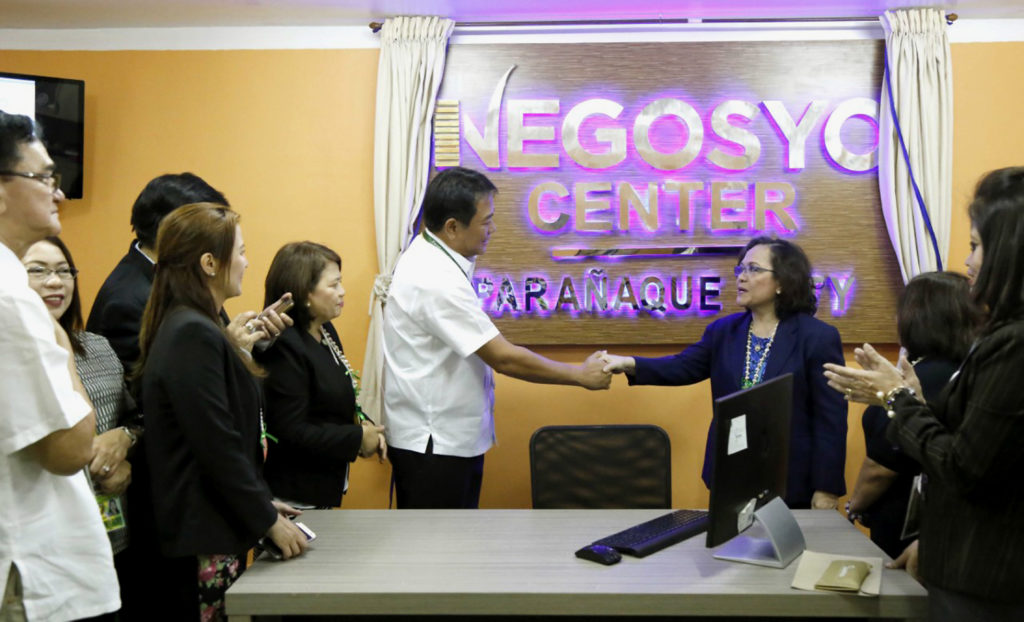
NEGOSYO CENTER OPENS IN PARAÑAQUE. To encourage Filipinos to venture into business, the Department of Trade and Industry (DTI) launched the 10th Negosyo Center in the National Capital Region (NCR) and 452nd nationwide since its inception in 2014. In line with the Republic Act No. 10644 or the Go Negosyo Act, the DTI launched Negosyo Centers nationwide to help MSMEs in providing access to information, business name registration, access to finance, access to market and access to training. In photo are (center-right) DTI-Regional Operations Group Undersecretary Zenaida Maglaya and (center-left) Parañaque City Mayor Edwin L. Olivarez.
by admin | Mar 3, 2017 | DTI Updates, Headlines, National News
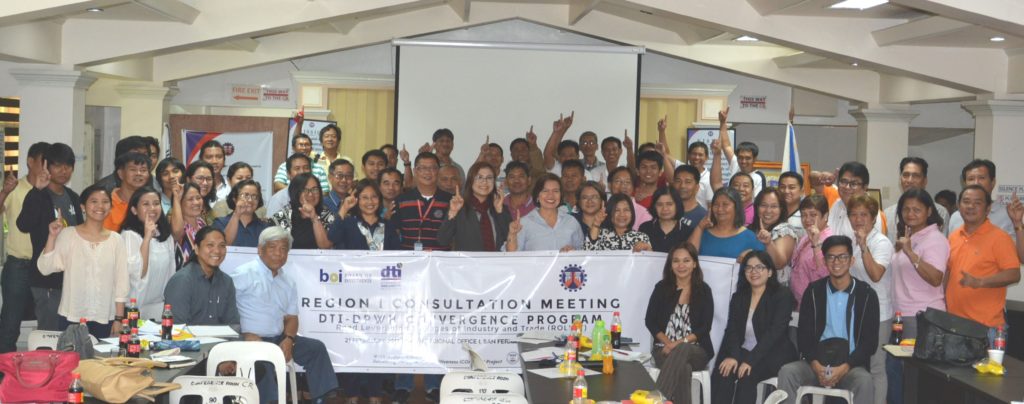
San Fernando, La Union – The Department of Trade and Industry (DTI) and Department of Public Works and Highways (DPWH) Region 1 rolled out the new convergence program that would promote economic growth and infrastructure development in the region.
The Roads Leveraging Linkages for Industry and Trade or ROLL IT Program aims to further the growth of investments and other economic activities in the country through more road projects leading to manufacturing and economic zones.
 5
5
Launched in November 2016, the two government agencies signed a memorandum of agreement (MOA) for the ROLL IT project implementation on road connectivity for industry and trade development. Under the agreement, DTI will identify areas where industry sectors need road facilities and connectivity.
The ROLL IT Convergence Program will be one of the strong platforms of the promise of a Golden Age of Infrastructure for the Philippines, through a target of national infrastructure budget of 7% of Gross Domestic Product, roughly equivalent to around P8.2 trillion.
Present during the ROLL IT launching were representatives from the Board of Investments (BOI), supporting non-government organizations (NGOs), United States Agency for International Development (USAID) Advancing Philippine Competitiveness (COMPETE) Project. A total of 21 project proposals to be enrolled in the program were submitted to USAID-COMPETE for evaluation. Most of proposals concern the conduct rehabilitation and construction of access roads from manufacturing sites to marketing areas.
The ROLL IT Program will further fuel the recent high growth of domestic investments as well as the surge in foreign direct investments of the country, through more road projects funded within 2016-2022.
The ROLL IT program’s goal is to prioritize infrastructure development in the country. It will leverage on the success and experiences of the DOT-DPWH Convergence Program or the Tourism Road Infrastructure Program (TRIP) that lead to the upgrading of roads leading to tourist destinations.
The initiative of DTI and DPWH is intended to contribute in delivering accelerated infrastructure development and inclusive economic growth.
Through better road infrastructure connecting the industries, industrial and regional development strategy can be realized and will further facilitate balanced development, dispersal of industries away from urban areas towards the rural areas, creating more job and income opportunities to more Filipinos.
by admin | Mar 3, 2017 | DTI Updates, Headlines
The 31st High-Level Task Force on ASEAN Economic Integration (HLTF-EI) convened on February 15-16 in Manila, gathering high-ranking ASEAN trade officials to discuss the implementation of the ASEAN Economic Community (AEC) Blueprint 2025.
HLTF-EI Chairperson and Permanent Secretary of the Ministry of Foreign Affairs and Trade of Brunei Darussalam Dato Lim Jock Hoi said that ASEAN needs to remain strong and united as the region navigates and charts its course ahead “collectively as ASEAN.”
Representing the Philippines, Undersecretary for Industry Development and Managing Head of the Board of Investment Ceferino Rodolfo laid down the Philippine priority deliverables for 2017, highlighting the country’s agenda on inclusiveness and innovation with a focus on increasing trade and investments, integrating micro, small, and medium enterprises (MSMEs) in the digital economy, and developing an innovation-driven economy.
“Inclusiveness should be intrinsic to the ASEAN agenda. The AEC Blueprint 2025 development framework will be most effective if it results from inclusive and open multi-stakeholder participation, one that is informed by the perspectives of people, especially the marginalized,” Undersecretary Rodolfo said.
The Philippines is taking the lead in seeking new policy interventions that are practical from the MSME perspective. These are expected to contribute towards helping MSMEs harness the opportunities presented by open and increasingly integrated markets. These initiatives range from free trade and trade facilitation, trade in services, investment, connectivity, and innovation:
Maximizing the benefits of free trade agreements (Self-Certification for MSMEs, and Substantial Conclusion of the Regional Comprehensive Economic Partnership [RCEP]);
Fostering a more facilitative and transparent trade in services regime and harnessing the contribution and global competitiveness of the ASEAN services sector (Conclusion of the ASEAN Trade in Services Agreement);
Strengthening the investment linkages between MSMEs and Multinational Enterprises or MNEs (FAST Action Agenda on Investment, Inclusive Business, Women and Youth Entrepreneurship);
Enhancing intra-regional connectivity and bolstering socio-economic growth in the regions (Launch of the Davao-General Santos-Bitung route of the ASEAN Roll-on Roll-of Network);
Supporting an ecosystem of entrepreneurship based on technology and innovation (ASEAN Declaration on Innovation); and
Introducing more systematic and robust method for AEC compliance monitoring (ASEAN Trade Facilitation Indicators, Review Mechanism for AEC).
Said priorities are in line with the Duterte Administration’s 10-point socio-economic agenda. In particular, these will leverage the global competitiveness of the Philippines’ services sector in order to generate jobs and growth, as well as bring development to the South through rural and value chain development.
The Philippines also delivered to HLTF-EI the collective statement of the ASEAN Civil Society Conference/ASEAN Peoples’ Forum (ACSC/APF) Philippines National Organizing Committee, reflecting the people’s aspirations for an ASEAN that asserts peace and security, human rights, democratization, and broad-based economic, social and ecological justice.
Undersecretary Rodolfo highlighted the potential of civil society organizations as strategic and responsible partners in the process of ASEAN community-building, given their knowledge and reach at the grassroots level and cohesive international network.
Recommendations of the 31st LTF-EI will be the focus of discussions at the 23rd ASEAN Economic Ministers’ Retreat and Related Meetings to be held on March 8-10 in Manila.
Composed of Trade Vice Ministers from the ten ASEAN Member States (AMS), the HLTF-EI functions as an advisory body to the economic ministers of the AMS, ensuring that all 10 AMS are on-track and on-time with the plans and programs intended to realize regional economic integration and achieve the vision of an AEC.
The AEC Blueprint was crafted to further advance ASEAN economic integration, envisioning a community characterized by the following: a) a highly integrated and cohesive economy; b) a competitive, innovative, and dynamic ASEAN; c) enhanced connectivity and sectoral cooperation; d) a resilient, inclusive, and people-oriented, people-centred ASEAN; and e) a global ASEAN.
ASEAN economies are expected to hold up reasonably well amidst the slowing of global growth, and the uncertain and shifting geo-political and economic landscape.
Forecasts from the Asian Development Bank and the International Monetary Fund place the region as the most dynamic part of the world with strong economic outlook for 2017 at 4.6% to 4.9% of GDP growth rate, vis-à-vis the 3.4% projected for the growth global GDP. The Philippines leads the region with a growth forecast of 6.8% for 2017



