by admin | Dec 6, 2016 | DTI Updates, Headlines
The Department of Trade and Industry (DTI) have already surpassed its target of 150 Negosyo Centers for 2016 after continuously launching centers nationwide – with the centers now totaling at 403.
For 2016, there have been 203 Negosyo Centers launched after the Department set a supposed target of 150.
DTI Regional Operations Group Supervising Undersecretary Zenaida Maglaya said that the launching of these Negosyo Centers is in line with the Republic Act No. 10644 or the Go Negosyo Act.
Maglaya said MSMEs or entrepreneurs can visit these centers for access to information, business name registration, access to finance, access to market and access to training.
“We are proud that we have established more Negosyo Centers more than what we have expected to establish. We did not expect to surpass our target of 150 centers for 2016 but we did to support the growth of MSMEs in the country,” Maglaya said, adding that NCs will help in achieving job generation and inclusive growth.
The Republic Act No. 10644 or the Go Negosyo Act aims to help micro, small and medium enterprises (MSMEs), promote ease of doing business, facilitate access to grants and other forms of financial assistance, Shared Service Facilities (SSF) and other equipment, and other support for MSMEs through national government agencies (NGAs), ensure management guidance, assistance and improvement of the working conditions of MSMEs; and facilitate market access and linkaging services for entrepreneurs.
Meanwhile, the DTI – National Capital Regional Office will launch its eight (8th) Negosyo Center in the metropolis, and first Negosyo Center in the City of Malabon on December 6, 2016. Thus, hiking the number of Negosyo Centers to 403.
The center is located at Malabon City Hall Annex Building F. Sevilla Boulevard, San Agustin in Malabon City.
The presence of the Negosyo Center in cities, municipalities and provinces aims to provide better access and more efficient services to MSMEs.
As of December 2, 2016, there are 403 Negosyo Centers nationwide since its inception in 2014. Of the total number of centers, 225 are located in Luzon, while Visayas and Mindanao have 90 and 88 Negosyo Centers, respectively.
With the Negosyo Centers, the Department has assisted a total of 483, 711 clients and conducted a total 6,002 seminars for MSMEs and potential entrepreneurs nationwide.
Meanwhile, a special lane is open to Overseas Filipino Workers (OFWs) at Negosyo Centers to help OFWs who want to stay in the country for good and start a business, with DTI noting the current situation of OFWs, especially those who were repatriated from Saudi Arabia.
Maglaya said these special desks will help OFWs and their families start a business and have the option to either pursue it and remain in the country for good or continue working abroad and leaving the business to their families or relatives
by admin | Dec 5, 2016 | DTI Updates, Major Events
To give due recognition to the best performing Shared Service Facilities (SSF) nationwide, the Department of Trade and Industry (DTI), through its Bureau of Small and Medium Enterprises (BSMED), organized the 2016 Best SSF Project of the Year.
The 2016 Best SSF Project of the Year was awarded to Dangdang-ay di Ibila Cooperative from Cordillera Administrative Region (CAR) for excellently managing a coffee processing facility and was also awarded as the Best SSF Project for Northern Luzon.
Other awards for Best SSF Project for Southern Luzon, Visayas and Mindanao were went to Putsan Ceramics Manufacturers (Philippine Ceramics Arts and Crafts Center (PHILCERAMICS) Facilities Augmentation), Sto. Niño de Plaridel Parish Multi-Purpose Cooperative (Pandan and Bariw Bag Making Shared Service Facility Project), and to San Isidro Upland Farmers Multi-Purpose Cooperative (SSF on Fiber Marketing Expansion), respectively.
The SSF Awards aims to recognize the efforts of SSF project partners and SSF cooperators for taking on the responsibilities of managing the SSF projects, utilizing their manpower and resources, nurturing the beneficiaries, and empowering the people in their communities.
On the other hand, DTI Region 3 bagged the first place as the Best Regional Audio Visual Presentation (AVP) while DTI Region VII placed second followed by DTI Region XI at third place.
The SSF Project is one of the DTI’s strategies to achieve inclusive growth and jobs generation. Specifically, it is aimed at increasing the productivity and improving the competitiveness of the MSMEs by providing them with machinery, equipment, tools, systems, accessories and other auxiliary items under a shared system.
Since its inception, the SSF project has already provided PHP1.081 billion worth of machinery and equipment for 2,099 established projects, provided 52,820 jobs and assisted 91,116 MSME beneficiaries nationwide.
by admin | Dec 5, 2016 | DTI Updates, Local News / Bohol Balita, Photo Story
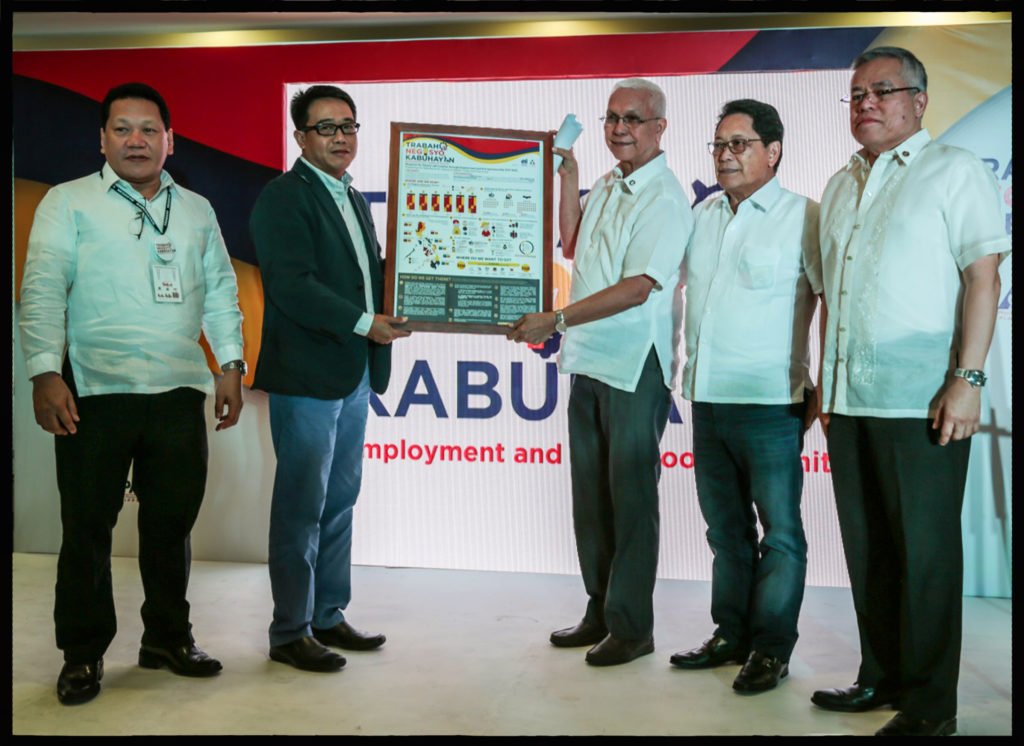
NEW GOVERNMENT BLUEPRINT FOR DECENT EMPLOYMENT. The “Trabaho, Negosyo at Kabuhayan: A Blueprint for Decent Employment and Entrepreneurship 2017-2022” prioritizes decent job creation, entrepreneurship, creativity and innovation, formalization and growth of micro, small, and medium-sized enterprises (MSMEs), youth unemployment reduction, education and training. The Blueprint was signed by Secretaries Ramon Lopez (rightmost) of the Department of Trade and Industry (DTI) and Silvestre Bello III (4th from L) of the Department of Labor and Employment (DOLE) at the Trabaho, Negosyo at Kabuhayan (TNK)-Employment and Livelihood Summit on 2 December in Taguig. The Blueprint, which was presented to Cabinet Secretary Leoncio Evasco Jr. (3rd from L), envisions full employment at 5% unemployment rate by creating 7.5 million jobs, by 2022, mainly in key employment generating sectors (KEGS) such as manufacturing including food processing, construction, tourism, Information Technology-Business Process Management (IT-BPM), transportation and logistics, and retail trade. Also shown here are DOLE Undersecretary Dominador Say (leftmost) and DTI Undersecretary Rowel Barba (2nd from L), who both chaired the Summit’s breakout sessions on livelihood and employment.
by admin | Dec 2, 2016 | DTI Updates, Headlines, National News
envisions 7.5 million jobs by 2022
TAGUIG CITY — A new government blueprint for decent job creation through employment and entrepreneurship from 2017 to 2022 was adopted at the conclusion of the two-day Trabaho, Negosyo at Kabuhayan (TNK)-Employment and Livelihood Summit on 2 December.
Signed by Secretaries Ramon Lopez of the Department of Trade and Industry (DTI) and Silvestre Bello III of the Department of Labor and Employment (DOLE), the “Trabaho, Negosyo at Kabuhayan: A Blueprint for Decent Employment and Entrepreneurship 2017-2022” prioritizes decent job creation, entrepreneurship, creativity and innovation, formalization and growth of micro, small, and medium-sized enterprises (MSMEs), youth unemployment reduction, education and training.
“By 2022, we want to achieve full employment at 5% unemployment rate by creating 7.5 million jobs, mainly in key employment generating sectors (KEGS) such as manufacturing including food processing, construction, tourism, Information Technology-Business Process Management (IT-BPM), transportation and logistics, and retail trade,” Sec. Lopez said.
The commitment is in line with the 2030 Agenda for Sustainable Development, particularly Goals 8 and 9, on the provision of decent work and economic growth, and on building resilient infrastructure, promoting inclusive and sustainable industrialization and fostering innovation, respectively.
The 2017-2022 livelihood agenda envisions the transition of informal and economic units to the formal economy with full respect to fundamental rights and principles at work. It also reiterates the implementation of the Comprehensive National Industrial Strategy to upgrade selected industries that generate employment, integrate manufacturing, agriculture and services, address supply chain gaps, and deepen industry participation in global value chains.
The TNK Summit, participated in by the public and private sectors and some members of the academe wrapped up policy recommendations from previously held sectoral summits to chart a new employment agenda, in line with the administration’s development path.
Sec. Lopez strongly encouraged Summit participants to invest in the Industry and Services sector, as well as in the country’s human capital to help address the perennial problem of skills mismatch and to sustain the growth of Philippines industries.
Policy recommendations from sectoral summits on MSME, manufacturing, construction and IT-BPM fed into the TNK Summit, which carried the theme, “Malasakit at Pagbabago Tungo sa Kaunlaran at Katiwasayan,” preparing the workforce for the industry’s current and future needs.
by admin | Dec 1, 2016 | DTI Updates, Headlines, National News
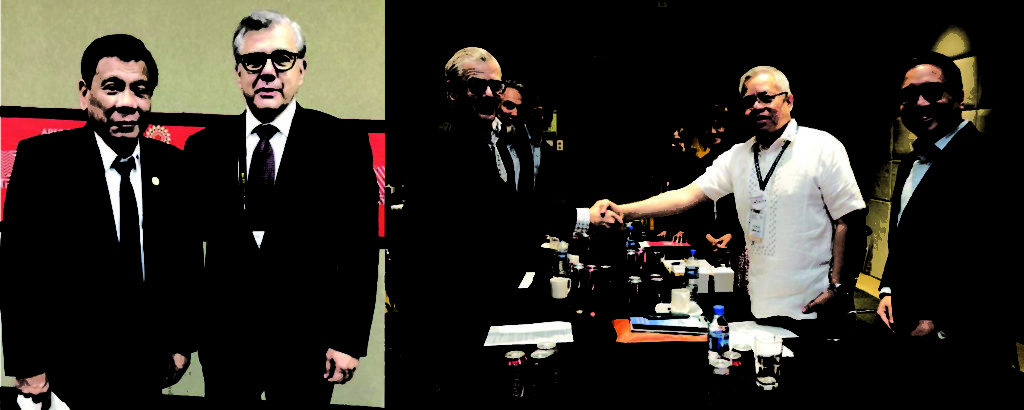
TAGUIG CITY—Following the meeting between President Rodrigo Duterte and Coca-Cola FEMSA Director General and CEO John A. Santa Maria at the sidelines of the Asia-Pacific Economic Cooperation (APEC) meeting held in Lima in November (left photo), Department of Trade and Industry (DTI) Secretary Ramon Lopez met with CEO Santa Maria at the sidelines of the Trabaho, Negosyo at Kabuhayan-Employment and Livelihood Summit (1 December) (right photo). The meetings resulted in a commitment from Coca-Cola FEMSA, a Mexico-based company, to invest USD 1 billion over the next five years in its Philippine operations. This is in addition to the approximately USD 1 billion, which has already been invested by Coca-Cola FEMSA in the country since 2013. Gearing towards long-term investment and placing strong investor confidence in the Duterte administration, Coca-Cola FEMSA’s capital infusion will go towards expanding and strengthening the company’s supply chain and commercial footprint throughout the country, therefore generating substantial employment and creating more micro-business opportunities. Objectives of this new commitment are in line with the government’s poverty alleviation and inclusive growth agenda.
by admin | Dec 1, 2016 | DTI Updates, Headlines, National News
TAGUIG CITY—The Trabaho, Negosyo at Kabuhayan (TNK)-Employment and Livelihood Summit piloted yesterday (1 December) aimed at wrapping up policy recommendations from previously held sectoral summits to chart a new employment agenda, in line with the administration’s development path.
Sectoral summits, whose recommendations feed into the TNK-Employment and Livelihood Summit include the Micro, Small and Medium Enterprises (MSME) Summit, the Manufacturing Summit, Construction Congress and Information Technology-Business Process Management (IT-BPM).
“We want to identify the strategies to increase employment levels, improve access to employment opportunities, and address our skills requirement,” said Department of Trade and Industry (DTI) Secretary Ramon Lopez.
The government, through DTI and the Department of Labor and Employment (DOLE), gathered the public and private sectors and members of the academe to develop a national employment program, a strategic plan that supports the National Development and Security Strategy geared towards the Philippine Development Plan 2017-2022.
The trade chief strongly encouraged the meeting to invest in job generating industries such as those in Industry and Services sector, specifically manufacturing, construction, IT BPM, retail trade, and tourism.
“Government is cognizant that we should make these industries attractive to investors hence, the action plan will allow us to prioritize,” he said.
He also called on participants to invest in the country’s human capital to help address the perennial problem of skills mismatch and to sustain the growth of Philippines industries
The two-day TNK Summit with the theme “Malasakit at Pagbabago Tungo sa Kaunlaran at Katiwasayan,” also aimed at preparing the workforce for the industry’s current and future needs.
The government aspires to draw a “shared agenda on employment creation and livelihood development that will contribute to the development of the President’s socio-economic agenda,” said DOLE Sec. Silvestre Bello III, adding that DOLE will continue implementing a “responsive, enabling and equitable labor policies, law and regulations.”
On the first day, the National Economic Development Authority (NEDA) discussed the country’s employment situation.
DTI reported specific recommendations from the Manufacturing Summit held on 28-29 November, and shed light on the Manufacturing Resurgence Program, inclined to generate decent jobs and promote inclusive growth. It also reported on the results of the Philippine Construction Congress for Employment Generation held on 23 November.
The Department of Public Works and Highways (DPWH), meanwhile, discussed public investments in infrastructure sector and its impact on employment. The National Housing Authority (NHA) tackled strategies on creating jobs through mass housing, while the Department of Tourism presented the Tourism Roadmap 2022.
The Philippine Retailers Association stressed the potential of retail trade as major source of employment, while the IT-Business Process Association of the Philippines on IT-BPM’s future direction.
On the second day, the meeting is expected to focus on the development of global MSME, industries, labor, export and entrepreneurship.
“We hope that together, government, business and the academe, can craft an action agenda that we can all pursue at the start of next year,” Sec. Lopez said.
Outcomes of the TNK-Employment and Livelihood Summit will be submitted to President Rodrigo Duterte, for his consideration. The Cabinet Secretary, through Undersecretary Gloria Mercado, showed support for the Summit, adding that similar initiatives are aligned with the government’s “collaborative, participative poverty reduction strategy.”
###

