by admin | Nov 29, 2016 | DTI Updates, Headlines
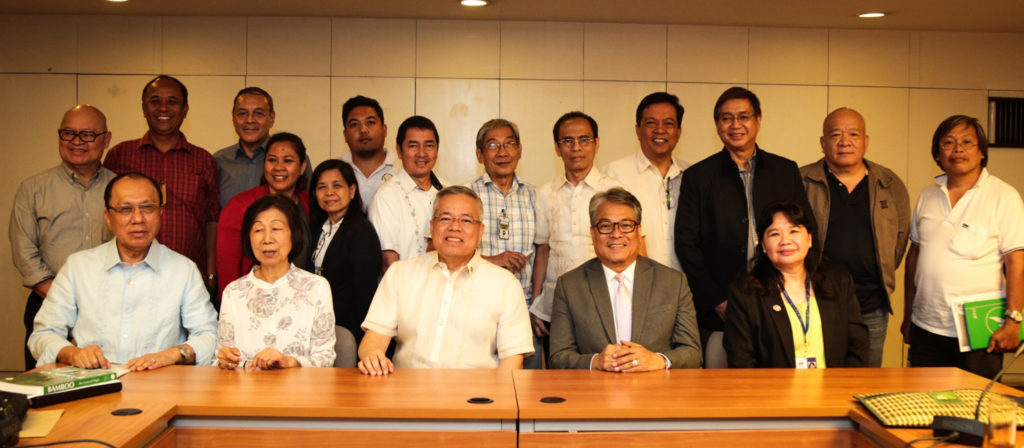
TOWARDS A SUSTAINABLE PHL BAMBOO INDUSTRY. Department of Trade and Industry (DTI) Secretary Ramon Lopez (Front, 3rd from L) met on 28 November Ilocos Sur 1st District Congressman Deogracias Victor Savellano (Front, 4th from L) and member representatives of the Philippine Bamboo Industry Development Council (PBIDC) to discuss the future direction of the Philippine bamboo industry, one of government’s key priority industries. As a high potential growth sector that can attract bigger investments and generate more jobs, the bamboo industry roadmap aims at realizing a progressive, dynamic, productive and globally competitive bamboo industry with a sustainable resource base. Roadmap strategies for 2016-2020 include research and product development, which covers inventory and resource mapping, plantation enhancement, tissue culture and propagation on commercial bamboo species, shoots production management and e-bamboo production, among others that will supply large requirements from bamboo processors of re-engineered bamboo panels, boards, poles, textiles, food, beverage and medicines. Sec. Lopez also serves as the PBIDC chairman.
by admin | Nov 29, 2016 | DTI Updates, Headlines
Recognizing the critical role of the country’s micro, small and medium enterprises (MSMEs) in achieving inclusive growth, the government said it remains committed in pushing further the growth and development of MSMEs.
“MSMEs play a vital role in the realization of a prosperous Philippine economy as the sector comprises the great majority of businesses. The Department of Trade and Industry (DTI) will continue to create a culture and mindset of innovation, and secure an environment enabling all the MSMEs to help them face the challenges and opportunities that lie ahead as we enter an increasingly global and competitive market,” said Trade and Industry Secretary Ramon Lopez during his speech at the National MSME Summit 2016 on 11 November at the SMX Davao Convention Center in Lanang, Davao City.
The National MSME Summit is a concrete expression of DTI together with various partners and stakeholders in an effort to promote inclusive growth by empowering small business entrepreneurs to become more competitive and innovative fostering opportunities in participating in the global market.
The DTI chief cited some of the Department’s initiatives such as Shared Service Facility (SSF), Negosyo Centers, Kapatid Mentor Me, and SME Roving Academy that push further growth of MSMEs in the country.
Through the SSF program, the DTI, thru its SSF program, has already provided PHP1.082 billion worth of machinery and equipment and assisted 91,116 MSME beneficiaries nationwide. The SSF project provides tools and equipment for the common use of MSMEs belonging to business organizations and cooperatives, already providing 52,820 jobs to poor Filipinos.
As of October 2016, DTI, together with certain Local Government Units, have established 355 Negosyo Centers nationwide to provide registration facilitation, greater access to finance and business information, as well as access to market linkages.
In collaboration with the Philippine Center for entrepreneurship (PCE) – Go Negosyo, DTI has also rolled out 11 Kapatid Mentor Me program nationwide to help MSMEs scale up their businesses thru the weekly coaching and mentoring by business owners and practitioners on different functional areas of entrepreneurship.
In carrying out its SME Roving Academy program, DTI conducted 7,293 sessions, benefitting 301,737 beneficiaries nationwide. Through the academy, the entrepreneurs are equipped with the right entrepreneurial attitude and mind-set, enhanced managerial capabilities, appropriate knowledge on marketing preference, technology and lifestyles to help them establish and grow their businesses.
“Currently, the DTI is crafting a financing program for MSMEs known as Pondo Para sa Pag-asenso (PPP) to help MSME owners optimize their potential and achieve major growth through alternative sources of funding. By helping the Filipino entrepreneurs grow their businesses, the program aims to provide accessible, fast, and hassle-free business loans tailor fit to each entrepreneur’s needs, goals, and cash flows,” DTI Secretary Lopez added.
These DTI programs will continuously develop MSMEs to help them become more competitive in the domestic and international markets thereby increasing their contribution to the country’s GDP and total employment.
With the theme “Growing Global MSMEs,” the National MSME Summit is organized by DTI, through the Micro, Small and Medium Enterprise Development Council (MSMEDC) and in cooperation with the PCE – Go Negosyo.
###
by admin | Nov 28, 2016 | DTI Updates, Headlines, National News
MAKATI—To create globally competitive, value adding, innovative and inclusive industries is the main objective of the country’s new industrial strategy, the trade and industry chief declared.
Speaking on the first day of the Manufacturing Summit 2016 yesterday (28 November), Department of Trade and Industry (DTI) Secretary Ramon Lopez emphasized that the new strategy focuses on industries where the Philippines has existing and potential comparative advantage to generate employment and promote entrepreneurship.
The new strategy’s top five industry priorities include manufacturing, agribusiness, information technology-business process management (IT-BPM), tourism and infrastructure and logistics.
“This industrial strategy is the best way to uplift the lives of Filipinos towards the goal of sustainable inclusive growth and shared prosperity for all. This is needed not only to generate jobs and reduce poverty but also to take advantage of market opportunities,” said Sec. Lopez.
Citing the country’s positive economic outlook as the fastest growing economy in Asia with sustained strong macroeconomic position at 7.1% recorded growth in the third quarter of 2016, the trade chief shared that the Philippines outpaced other countries like China (6.7%) and Viet Nam (6.4%) and fared above average consensus forecast of 6.8%.
While services industry was the main driver of the country’s growth in past decades, the manufacturing industry has been playing an important role, and has been contributing substantially to economic growth since 2013, according to him. In the third quarter of 2016, manufacturing grew by 6.9% or more than one percent point higher that the rate posted in 2015 at 5.8%.
He also said that the manufacturing sector presents opportunities to provide productive jobs to low-skilled, medium-skilled and highly-skilled workers, and further emphasized the need to shift from traditional agriculture to more modern agribusinesses, as well as the relevance of tourism as source of income and jobs.
The new industrial strategy is DTI’s key response to sustain today’s high level growth, while addressing the issue of unemployment, where the bulk are young with ages ranging from 15 to 24 years old, 61% are male and 40% have high school education, while 36% have college education.
“Given these characteristics of our workforce, our industrial strategy focuses on labor intensive industries such as food and resource-based manufacturing, tourism, garments and construction,” said Sec. Lopez, adding that it will also focus on high-tech industries like electronics, aerospace, automotive and chemicals.
Consistent with DTI’s Trabaho at Negosyo agenda, the strategy also focuses on strengthening linkages between micro, small and medium enterprises (MSMEs) and large domestic and multinational enterprises to make growth more inclusive.
Meanwhile, Sec. Lopez also called on stakeholders to take advantage of preferential free trade agreements, where the country may benefit. Specifically, he referred to those with ASEAN, as having over 100 million population, a growing middle class, rising consumer and business confidence.
“Huge export markets could be tapped in the ASEAN Economic Community with a population of over 600 million, and as we forge the Regional Comprehensive Economic Partnership (RCEP), this grows further to over three billion people representing 45% of the world’s population,” he added.
Taking into account external factors such as economic slowdown in US, Japan, Europe and China, opportunities from participating in global value chains and emerging new business models, the DTI chief said that the current strategy would require “climbing the industrial ladder and moving into higher value added activities” in specific sectors.
These sectors include electronic manufacturing services, semiconductor manufacturing services, auto manufacturing, aerospace, chemicals, furniture, garments, shipbuilding, food and resource-based processing and IT-BPM.
“As an enabler, the government pursues an industrial policy strengthening our industrial base and removing the most binding constraints, but to be strategic, we are focusing our efforts by identifying and prioritizing the most binding constraints,” explained Sec. Lopez.
The summit participants, composed by representatives from the private and the public sector, labor, civil society, the academe and some international development partners, were divided into groups to identify such constraints, formulate recommendations to address them and determine the most appropriate intervention.
Sec. Lopez called on the participants to ensure that the recommended policy measures bring “the most significant impacts on and benefits for the development of globally competitive, value adding, innovative and inclusive manufacturing linked with agriculture and services industries.”
The two-day Manufacturing Summit is in partnership with the DTI and the Board of Investments (BOI), in cooperation with the United States Agency for International Development (USAID) and the Japan International Cooperation Agency (JICA).
by admin | Nov 24, 2016 | DTI Updates, Headlines, Local News / Bohol Balita
TAGUIG CITY—DTI’s shared service facilities (SSF) beneficiaries on coffee processing, native bag making, and fiber marketing were the recipients of the first-ever Kapatid Awards at PLDT’s MVP Bossing Awards 2016 on 23 November.
SSFs on coffee processing from Mountain Province, Cordillera Administrative Region (CAR), on pandan and bariw bag making from Leyte, Region VIII and on fiber marketing expansion from Agusan del Norte, CARAGA received awards for exhibiting sustainable and inclusive growth models that contribute to the improvement of the quality of lives in said communities.
Receiving the awards were representatives from SSF cooperators Dangdang-ay di Ibila Cooperative from CAR, Sto. Niño de Plaridel Parish Multi-Purpose Cooperative from Region VIII and San Isidro Upland Farmers Multi-purpose Cooperative from CARAGA.
The SSF Project is a key component of the Department of Trade and Industry (DTI)’s initiative to capacitate micro, small and medium enterprises (MSMEs) by providing them appropriate machinery, equipment, tools, systems, skills and knowledge under a shared system.
As backbone of the Philippine economic growth, composed of 99.6% of locally registered businesses, generating over one million job a year, MSMEs have become the government’s current priority, with the DTI placing MSME development at the forefront of regional development and at the front and center of the trade agenda.
“Aside from keeping the country moving towards a more strategic direction at the backdrop of regional development, the government, through the DTI, vows to pursue meaningful growth that is truly inclusive, the one that reaches the bottom of the pyramid,” said DTI Secretary Ramon Lopez, who was also one of the recipient of the MVP Bossing Awards in government service.
DTI’s thrust towards MSME development is anchored on President Rodrigo Duterte’s 10-point socio-economic agenda to attain a quality of growth that will result in shared prosperity among Filipinos, according to the trade chief.
As of October 2016, a total of 2,099 SSFs have already been established across the country.
In partnership with Go Negosyo and DTI, the Kapatid Awards is an offshoot of the Kapatid Program, which has advocated MSME development through training and partnering with big businesses to mainstream and integrate MSMEs and their products and services into the bigger value chains.
“Across the country, there are already successful micro, small and medium scale players who, even in advance of the Government’s call, have created sustainable growth models that bring employment to the sectors of society that need it,” PLDT Vice President Mitch Locsin was quoted in a statement. (END)
by admin | Nov 19, 2016 | DTI Updates, Features, Headlines, Local News / Bohol Balita
The Department of Trade and Industry (DTI) – Bohol Provincial Office- a frontrunner in the field of commerce, will be conducting Franchising Orientation Seminars in the province. This is designed to provide guidance on prospective franchisee on relevant information on possible franchising opportunities. A number of franchisors from Manila who already committed to be part of this activity, will be coming to Bohol.
This seminar will be managed by the Philippine Franchise Association (PFA) and is part of the DTI Small and Medium Enterprise Roving Academy (SMERA)- a continuous program for the development of the micro, small and medium enterprises (MSMEs) to become competitive in the domestic and international markets.
One leg will be done on November 24, 2016 at JJ’s Seafood Village, Tagbilaran City while another leg will be done on November 25, 2016 at the Watergate Inn and Restaurant, Talibon, Bohol. It will run from 10:00AM to 4:00PM. Limited slots are available on a first-come, first-served basis.
For further information regarding the event, please feel free to contact 501-8828/ 501-8260 and look for Mr. Rey Anthony Regis or Blair Panong or call 0909-943-8983 and look for Emily Ocangas.
by admin | Nov 18, 2016 | DTI Updates, Headlines, National News
The Department of Trade and Industry’s Philippine Trade and Investment Center Los Angeles (PTIC-LA) confirmed that Malagos Premium Chocolates, a chocolate produced in the Philippines, will now be available in the United States. This was further to the announcement made by the Davao-based Malagos Agri-Ventures during their recent participation at the North West Chocolate Festival in Seattle, Washington on November 12 -13, 2016.
The Malagos line of chocolates has received acclaim from international fine food and chocolate award-giving bodies in Europe for its premium qualities. The products are single-origin, having been manufactured fully on-site on its farm in Davao, Philippines.
Mr. Jojie Dinsay, Trade Representative of the Philippines for the US West Coast and Head of the Philippine Trade and Investment Centers in Los Angeles and San Francisco said that this is another success story for the promotions efforts of premium food products in the US market as a result of the partnership between government and the private sector. “We are very happy and proud to have another premium product from the Philippines enter this market” Dinsay said. “The Philippine Trade and Investment Centers as part of our mandate will continue to support companies like Malagos in promoting their products all over the world”.
Featuring 110 exhibitors, the Northwest Chocolate Festival is known to be among the top shows for artisan chocolates in the world today with around 12,000 visitors. Malagos Premium Chocolates, a multi-awarded Philippine chocolate from Davao, was introduced not only to choco-loving consumers but to traditional and artisan chocolatiers, chefs and baristas present at the show.
Malagos Agri-Ventures’ participation at the NW Chocolate Festival was supported by the DTI’s Export Marketing Bureau (DTI-EMB). Prior to this, assistance from the DTI regional office in Davao was also recognized by Malagos.
The Malagos brand is also expected to be introduced by Ampac International Inc., its importer in the United States, to UNI-MART Niles in Niles, Illinois and UNI-MART Hoffman in Hoffman Estates.
According to Mr. Rex Puentispina, Sales and Marketing Head of Malagos Agri-Venture, joining the Festival validates his belief that their chocolates can match the quality and taste of US and other international brands. “We have received a lot of good feedback from chocolate lovers visiting our booth” said Puentispina. “There were even some who say that this is one of the best they have ever tasted,” added Puentispina.
In 2015 at the International Chocolate Awards, Malagos 65% Dark Chocolate was named one of world’s best drinking chocolates. In the same year, it won at the Academy of Chocolate Awards when its 100% Unsweetened Chocolate won the Bronze Award for Best Unflavored Drinking Chocolate.
In 2016, its Premium 100% Unsweetened Chocolate won the Silver at the Drinking Chocolate competition of the Academy of Chocolate’s Eighth Golden Bean Awards in London. It also won that year a blind-taste competition when its Unsweetened Chocolate earned two of the maximum three stars awarded by Great Taste, the world’s most prestigious food accreditation body.
The company continues to invest in equipment and technology, producing its premium, single-origin chocolate products such as Malagos 100% Pure Unsweetened Chocolate, Malagos Roasted Cocoa Nibs, Malagos 65% Dark Chocolate, Malagos 72% Dark Chocolate, and Malagos 85% Dark Chocolate.
With its expansion in the United States, Malagos is expected to generate more jobs for Filipinos back in the Philippines.

