by admin | Nov 16, 2016 | DTI Updates, Headlines, National News
Department of Trade and Industry (DTI) Secretary Ramon Lopez challenged the Philippine Association of Legitimate Service Contractors (PALSCON) to police its ranks to ensure the effective implementation of the so-called “win-win structure” involving legitimate service providers (SPs), companies and workers.
Speaking at PALSCON’s 6th National Forum on 14 November, Sec. Lopez reiterated that the “win-win” structure that upholds workers’ security of tenure is not a departure from, but an improvement of what has already been provided by the law on legitimate contracting.
The Labor Code and Department of Labor and Employment (DOLE) Department Orders 10 (Series of 1997), 18-02 (Series of 2002) and 18-A (Series of 2011) guarantee legitimate contracting or subcontracting arrangements.
Consistent with the unchanged position of President Rodrigo Duterte to put a stop on end-of-contract (endo) schemes, the trade chief maintained that as added value to the full and strict implementation of legitimate contracting, the win-win structure carries two specific provisions that safeguard workers’ tenure rights, specifically by making workers regular and permanent, as well as by affording them mandatory retirement benefits.
The DTI-proposed structure also allows companies to either directly employ workers or source workers from legitimate SPs.
Sec. Lopez said that the critical role of the association of legitimate SPs in effectively carrying out the win-win structure is to patrol its ranks to ensure that workers receive appropriate benefits.
“What is critical now is the compliance of legitimate SPs in giving full benefits to the workers,” said Sec. Lopez, adding that the proposal received positive response from President Duterte.
The PALSCON audience showed support to Sec. Lopez’s statement that legitimate contractors’ failure to comply will result in getting blacklisted by client-companies.
Removing contracting and subcontracting arrangements will lead to an immediate reduction of employment, with some foreign investments pulling out, according to him, pointing out the vital link between investment creation and job generation.
He also shared that at least three potential foreign investors in the Philippines began expressing this sentiment in his most recent meeting in Japan this month.
“Changing the ball game now, we will lose investments and miss out on opportunities instead of generating more jobs,” Sec. Lopez added.
According to DTI, it must be recognized that there are certain parts of operations in a company that are best carried out through a service provider mainly due to the seasonality of work or the function-specific nature of some projects, which are deemed to be better handled by a third party, allowing the principal company to focus on growing the business.
Scheduled to hold consultations with another set of labor groups soon, DOLE, with recommendation from DTI, is expected to reach an “effective, legal and mutually beneficial position” on the matter within the year.
“Our fear has always been about losing jobs. To start with, if there are no available jobs, there will be no forms of employment to be discussed today,” Sec. Lopez concluded.
The DTI introduced the win-win structure that is premised on the need to have a business policy environment that creates and encourages job and income generation.. #
by admin | Nov 15, 2016 | DTI Updates, Headlines, National News
PASIG CITY—Department of Trade and Industry (DTI) Secretary Ramon Lopez challenged the Philippine Association of Legitimate Service Contractors (PALSCON) to police its ranks to ensure the effective implementation of the so-called “win-win structure” involving legitimate service providers (SPs), companies and workers.
Speaking at PALSCON’s 6th National Forum on 14 November, Sec. Lopez reiterated that the “win-win” structure that upholds workers’ security of tenure is not a departure from, but an improvement of what has already been provided by the law on legitimate contracting.
The Labor Code and Department of Labor and Employment (DOLE) Department Orders 10 (Series of 1997), 18-02 (Series of 2002) and 18-A (Series of 2011) guarantee legitimate contracting or subcontracting arrangements.
Consistent with the unchanged position of President Rodrigo Duterte to put a stop on end-of-contract (endo) schemes, the trade chief maintained that as added value to the full and strict implementation of legitimate contracting, the win-win structure carries two specific provisions that safeguard workers’ tenure rights, specifically by making workers regular and permanent, as well as by affording them mandatory retirement benefits.
The DTI-proposed structure also allows companies to either directly employ workers or source workers from legitimate SPs.
Sec. Lopez said that the critical role of the association of legitimate SPs in effectively carrying out the win-win structure is to patrol its ranks to ensure that workers receive appropriate benefits.
“What is critical now is the compliance of legitimate SPs in giving full benefits to the workers,” said Sec. Lopez, adding that the proposal received positive response from President Duterte.
The PALSCON audience showed support to Sec. Lopez’s statement that legitimate contractors’ failure to comply will result in getting blacklisted by client-companies.
Removing contracting and subcontracting arrangements will lead to an immediate reduction of employment, with some foreign investments pulling out, according to him, pointing out the vital link between investment creation and job generation.
He also shared that at least three potential foreign investors in the Philippines began expressing this sentiment in his most recent meeting in Japan this month.
“Changing the ball game now, we will lose investments and miss out on opportunities instead of generating more jobs,” Sec. Lopez added.
According to DTI, it must be recognized that there are certain parts of operations in a company that are best carried out through a service provider mainly due to the seasonality of work or the function-specific nature of some projects, which are deemed to be better handled by a third party, allowing the principal company to focus on growing the business.
Scheduled to hold consultations with another set of labor groups soon, DOLE, with recommendation from DTI, is expected to reach an “effective, legal and mutually beneficial position” on the matter within the year.
“Our fear has always been about losing jobs. To start with, if there are no available jobs, there will be no forms of employment to be discussed today,” Sec. Lopez concluded.
The DTI introduced the win-win structure that is premised on the need to have a business policy environment that creates and encourages job and income generation.
###
by admin | Nov 14, 2016 | DTI Updates, Headlines, National News
The Philippine Board of Investments (BOI) is expecting a further upsurge in investments registration in the coming months with the anticipated approval of about 44 more projects in the pipeline worth Php52.03 billion.
Trade Secretary and BOI Chairman Ramon Lopez said this positive development augurs well with the administration’s socio-economic agenda of uplifting the lives of the Filipino people. “More investments mean more jobs, ensuring economic development from the bottom of the pyramid,” he said.
“The continued growth of the investments is a testament of the country’s sound economic fundamentals and sustained investor confidence,” said Trade Undersecretary and BOI Managing Head Ceferino Rodolfo adding that investments coming in are insectors that will elevate the country’s competitiveness, such as in various resource-based sectors.
“What we are seeing in the real sector that relies on fundamentals of the economy, the fundamental strengths of the economy, is that growth is being sustained or even accelerated,” said Undersecretary Rodolfo.
Already been evaluated and checklisted by the BOI’s Industry Development Services, these projects for registration will be coming from the energy sector (Php29.57 Billion or 57 percent of total investments); manufacturing sector (Php7.77 Billion or 15 percent share); agriculture sector (Php6.58 Billion or 12 percent share); real estate activities sector (Php6.37 Billion or 12 percent share); logistics or water transport (Php1.07 Billion or 2 percent share); and other varied sectors (Php665.30 million or 1 percent share).
Last month, the BOI reported that investments registered with the agency reached Php51.03 Billion in September 2016, up by 193 percent from only Php17.41 Billion generated in the same month in 2015.
The increase in investments for the month was due to the approval of two big ticket projects namely the Light Rail Manila Corporation’s Php30.37 Billion Public-Private Partnership project for the operations and maintenance of the Manila Light Rail Transit 1 Integrated Railway System-Cavite Extension and the Energy Development Corporation’s Php16.42 Billion wind energy resources project in Iloilo.
Undersecretary Rodolfo said this development will greatly uplift the lives of the Filipino people. ”The mass transport project for example, will be a big help for the commuting public while the renewable energy projects will improve and sustain the quality of life of the people,” he said.
On a year-on-year basis, BOI-approved investments grew 49 percent in the first nine months of the year to Php286.44 Billion compared with the Php192.39 posted the same period last year. The investment pledges were generated from 255 projects with total estimated job generation of 46,716 at full operations.
The largest share of approved investments from January to September 2016 is intended to finance projects in the power sector which accounted for 48 percent share to total approved investments during the period. The other sectors that topped the list of investment approvals include construction with Php62.27 Billion or 22 percent; real estate activities including the mass housing sub-sector with Php36.68 Billion or 13 percent share; the manufacturing sector with Php21.02 Billion or 7 percent share; and transportation and storage sector with Php14.31 Billion or 5 percent share.
Major manufacturing sub-sectors, based on their respective shares to total investment approvals from January to September 2016 include food products (Php8.99 Billion or 43 percent share); motor vehicles/ trailers (Php7.80 Billion or 37 percent share); fabricated metal products (Php1.98 Billion or 9 percent share); wood products (Php1.48 Billion or 7 percent share); and other manufacturing sub-sectors (Php763.18 Million or 4 percent share).
Topping the list of foreign country investors in the first nine months of 2016 is Singapore with investments worth Php12.90 Billion or 26 percent share to total approved foreign investments. Netherlands came in second with investments amounting to Php8.00 Billion (16 percent share), followed by Japan with Php6.83 Billion (14 percent share), South Korea with Php6.42 Billion (13 percent share), and United Kingdom with Php2.34 Billion (5 percent share) and the balance shared by various country investors such as British Virgin Islands, Germany, U.S.A., India, China, Canada, Taiwan, etc.
While the National Capital Region tops the list of regional investments worth Php74.13 Billion or 26 percent share to total approved investments, other regions are likewise gaining headway particularly Region 3 which came in second with committed investments worth Php45.16 Billion, accounting for 16 percent. Significant investments were also directed to Region IVA (Php32.95 Billion or 11 percent share); Region VII (Php20.78 Billion or 7 percent share); and Negros Island Region (Php19.26 Billion or 7 percent share).
For more information on the services of the DTI, log-on to http://www.dti.gov.ph
by admin | Nov 12, 2016 | DTI Updates, Headlines, Local News / Bohol Balita, Major Events
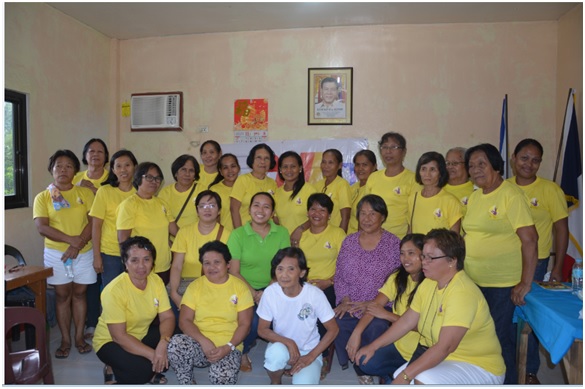
A group picture of Looc Women’s Association during the Business Planning Workshop last November 8-9, 2016 at Looc Barangay Hall, Panglao, Bohol conducted by the Department of Trade & Industry. From L-R (seated: Birly Ingking – Association Manager, Yoradyl E. Israel – Food Sector Manager, DTI – BPO, Fidela G. Del Pilar – Association President, Lucrecia Vicente – Association Member).
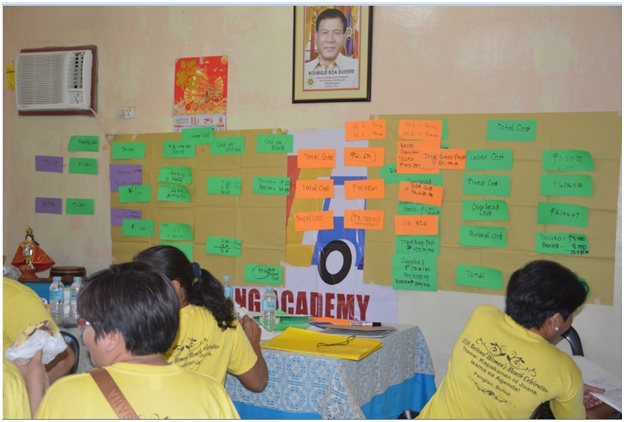
Brainstorming about pricing and costing for the processed meat products of Looc Women’s Association last November 8-9, 2016 at Looc Barangay Hall, Panglao, Bohol.
Business Planning Workshop for Looc Women’s Association
To ensure competitiveness and sustainable development of the meat processed products of the Looc Women’s Association of Panglao, Bohol, the Department of Trade and Industry with the support of the Local Government Unit of Panglao, conducted Business Planning Workshop to the members of the association. It was a two-day workshop last November 8-9, 2016 held at Looc Barangay Hall, Panglao Bohol. It was attended by the LGU DSWD Head, President of the Association and its members. Yoradyl E. Israel, Food Sector Manager, DTI-BPO together with Maribel R. Arbasto, Business Counselor- Negosyo Center facilitated the workshop.
The first day of the workshop tackled about the vision-mission of the association, the organizational structure and its duties & responsibilities and the work instruction for all processes. The second day focused on business planning wherein the participants were able to determine the market and the pricing and costing of their meat products.
At the end of the workshop, the members of the association were able to identify the importance of business planning in the business operation.
by admin | Nov 7, 2016 | DTI Updates, Headlines, National News
The insatiable desire of the Filipino contractors, consultants, and construction industry players to continuously discover and explore construction business opportunities around the globe, they are now attempting to enter the Melanesia Region in the countries of Fiji, Solomon Islands, and Papua New Guinea. These countries identified to be rich in natural resources remained unexploited and undeveloped in their infrastructure and construction projects which Filipino contractors and consultants can aggressively take advantage.
In preparation for the expansion of their activities in the three (3) identified countries of the Melanesia Region, the Philippine Overseas Construction Board (POCB) of the Construction Industry Authority of the Philippines (CIAP) conducted its 5th Philippine Overseas Construction Symposium on 20 October 2016 at the Hotel Jen Manila in Roxas Boulevard to assist and support these Filipino construction industry players in penetrating the Melanesia market.
The welcome address and the assured government support relayed by the new Undersecretary for CIAP, Atty. Ruth B. Castelo, created an atmosphere of sincerity and genuine concern for the participants. It was matched with the inspiring words from the POCB Chairman of the Board and President & CEO of the DMCI Holdings, Engr. Isidro A. Consunji, stimulating the participants to remain motivated and keep interested on improving and adding value to their construction business through networking and business matching like actively participating in construction outbound missions being conducted by the POCB, this time in the Melanesia Region.
The symposium was highlighted by the attendance of one hundred forty-five (145) high ranking officers from the Filipino construction contractors, consultants, suppliers, and other industry players who spent their precious time listening to speakers, networking with each other, exchanging ideas and experiences with their colleagues in the construction industry throughout the day, establishing links and forging comprehensive cooperation amongst themselves.
Director Levinson C. Alcantara of the Marketing Branch of the Philippine Overseas Employment Administration (POEA) arose awareness and interests among the participants in the construction labor market and other construction business opportunities including construction outlooks and investments in the countries of Fiji, Solomon Islands, and Papua New Guinea.
The pioneer and expert in overseas construction activities Engr. Salvador P. Castro, Jr., the Chairman and President of SPCastro, Inc. promoted and underlined the Filipino capability in doing construction projects in Brunei Darussalam, Abu Dhabi, and other ASEAN countries, the challenges encountered, the ways and means of overcoming challenges, identifying and capitalizing on ones strengths as well as recognizing and building on ones weaknesses, and the unending quest for an improved and more innovative construction skills and practices.
Experts in the fields of the holistic global practice of Engineering, Procurement, and Construction (EPC), Engr. Hambe Vargas, the Manager in Projects Operations of JGC Philippines, Inc. and the globally competitive, Mr. Joseph Leland D. Sarmiento, Authorized Managing Officer of Whessoe Philippines Construction, Inc. educated the participants and get them familiarized with the process, best practices, benefits and challenges in implementing EPC not only in overseas projects but also in local projects; prompting them to continuously build on their existing capacities and undertaking calculated risks in undertaking overseas projects.
The participants were likewise oriented on the Quadruple A category of the Philippine Contractors Accreditation Board (PCAB) interestingly presented by Engr. Rene E. Fajardo, the Acting Executive Director of the Construction Manpower Development Foundation (CMDF) and Head of the Technical Division of PCAB, as the new PCAB Category allowing 100% foreign-owned companies with at least P1.0 Billion capital to undertake privately-funded infrastructure projects besides projects under the Build-Operate-Transfer (BOT) and the Public Private Partnership (PPP) schemes.
An equally important highlight of the symposium and in line with the continuous effort of the CIAP-POCB to improve the delivery of its services, the Corporate Export Information System (CEIS) was launched and introduced by the Project Manager of Asiagate Networks, Inc., the service provider for the Information Technology, Ms. Jahnine A. Baliao. The CEIS is the POCB’s information system which automates its processes particularly the on-line filing of applications, and the eventual integration of databases with the PCAB licensing and registration to facilitate the process in securing the license.
The symposium was successfully concluded with clamor from the participants to continue the program and to continuously promote and develop the Philippine Overseas Construction.
by admin | Nov 4, 2016 | DTI Updates, Headlines, National News
Eight out of 10 Filipinos know their consumer rights, according to the latest Pulse Asia survey. Data showed that level of consumer awareness for the month of September was recorded at 78 percent, the highest recorded since 2012 for the months of September.
“The result should not be a source of complacency, but instead a motivation to improve even more our service to our consumers,” said Department of Trade and Industry (DTI) Secretary Ramon Lopez, adding that recent findings are a good testament that DTI is on the right track in fulfilling its mandate.
Respondents in the same survey were asked whether or not prices of basic goods like canned fish and bread have been reasonable so far.
In September 2015, only 32 percent found the price of canned fish reasonable. This figure rose to 41 percent in September 2016. There was also notable increase in the percentage finding the price of bread reasonable from 34 percent in September 2015 to 49 percent in September 2016. For all months of September since 2012, this year’s figures have been the highest recorded percentages.
“The challenge is for us to continue the momentum, if not improve the positive trajectory,” said Sec. Lopez.
An average of 73 percent of respondents also said that products and services available in the market today are safe, according to the same survey.
The DTI has been commissioning Pulse Asia to monitor public perception on prices, and safety standards, as well as level of consumer awareness since 2012 as part of the Ulat sa Bayan survey. Survey period was from September 25 to October 1, with a margin of error of +/- 3 % at the national level, at 95% confidence level.

