by admin | Sep 8, 2018 | Headlines
The Department of Trade and Industry in Bohol launches the Kapatid Mentor Micro Entrepreneurs (KMME) program on September 7, 2018 in Talibon, Bohol.
KMME is an initiative of DTI and the Philippine Center for Entrepreneurship (PCE) which aims to help the country’s micro and small enterprises (MSEs) through a ten-module coaching and mentoring series where well-known industry experts teach micro and small enterprises the different aspects of business operations.
In her opening message, RD Caberte said that this is the third batch for the province and is the first out-of-town rollout, since the first two batches were held in Tagbilaran City.
“This is an opportunity for those in the second district of Bohol to gain access to expert advice and inputs from various mentors across the country, especially with the full support of Congressman Aris Aumentado, who is so optimistic about bringing the KMME program closer to his district,” Caberte said.
Present during the launching are PCE Visayas Coordinator Virgilio “Noy” Espeleta, PCE Programs Development Associate Mark Eugene Eudela, DTI Bohol OIC Provincial Director Maria Soledad L. Balistoy and Cong. Erico Aristotle Aumentado, who gave a very inspiring message to the thirty one (31) mentees.
Also present during the launch are Talibon Mayor Restituto Auxtero, Talibon Chamber of Commerce President Judge Avelino Puracan, Bohol Chamber of Commerce and Industry Trustee Dominic Butalid, Dr. Ed Escalona of Breads Edge Corporation, Engr. Arnold Labunog of Jojie’s Bakeshop and Duke Miñoza of Buenaventurada Farms who each gave inspiring messages to the mentees.
Mr. Rey N. Calooy, CEO of RNC Marketing and Mr. Ardy Roberto, Co-Founder of Salt and Light Ventures Corporation and Inspire Leadership Consultancy. (vligan)

Crowd shot of the KMME Launching event in Talibon, Bohol. (Photo by Tamara)
by admin | Sep 3, 2018 | Headlines
Employment authorities organizing the Jobs Fair August 24 scored 19.07% placement and hiring rate for the day-long jobs matching activity held at the Bohol Cultural Center.
According to a post event report, Bohol Employment Placement Office (BEPO) through its officer in charge Maria Vilma Yorong said, of the 409 individuals who registered to the jobs fair, 78 of them were either hired on the spot or placed.
Also, of the 401 registered job applicants, 356 were qualified, BEPOS shared.
A total of 7 establishments who participated were seeking for the right worker for their job local vacancies, while 6 establishments joined to fill in the need for workers for overseas posts, she added.
The jobs fair, TESDA’s Cua said, opened for construction related skills and information communication and technology as well as tourism establishment related services, TESDA’s Rosemarie Bañol earlier announced at the Kapihan sa PIA.
The jobs fair, coincided with the Technical-Vocational Week, which Technical Education and Skills Development Authority (TESDA) took the lead role in commemorating, according to Marichu Cua, TESDA information officer.
That same activity generated 1863 job vacancies where 477 were for local placement while 1,386 job vacancies were for overseas placement.
Department of Labor and Employment (DOLE) Information Officer Liezl Pizaña also pointed out that of the 409 applicants from morning to the closing hour, 181 of them were women.
But while that is so, as to the hiring rate, 60 of the 78 Hired of the Spot (HOTS) were also women who were directly hired to man the vacant slots at the Mitsumi microchip assembly lines in Danao City, Cebu.
Initially, TESDA said the jobs fair was intended to help their training graduates land a decent job.
TESDA keeps a 50% hiring rate policy for graduates of their accredited training institutions or they could not get training allocations for the coming school year.
But even with the, the country’s technical education authority still admits that holding bridging fairs like the Jobs Fair, could help their graduates pick the establishments that is right for their obtained tech-voc skills. (rahc/PIA-7/Bohol)
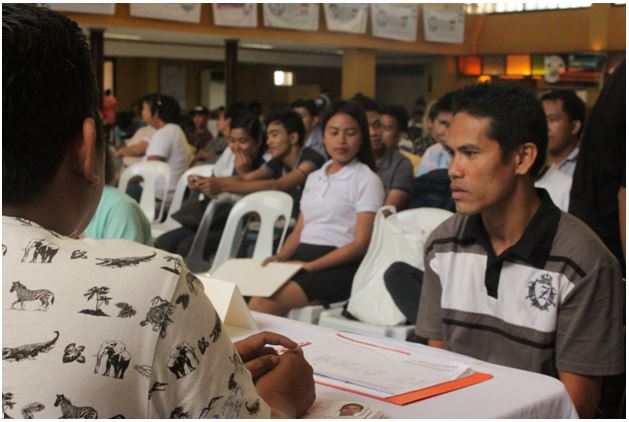
The recent TESDA led Jobs Fair hired nearly 30% of those who sought work for ICT, Engineering and law. (PIA-7/Bohol/
by admin | Sep 1, 2018 | Headlines, Sports
TAGBILARAN CITY, Bohol, September 1 (PIA)—Three cross country mountain bikers in the 30-39 age category raced to a spectacular finish to get the edge seconds from each other in the notoriously tough to race two-abreast single trails of Mahayahay in Carmen, August 26.
Consummate athleticism played to the smallest cogs on the uphill assault to the finish line was how spectators described the three bikers who were so glued to each other’s rear wheels that midway into the race, the spacing distance among the three mountain bikers never reached beyond five meters.
Bike Joey Magsayo (racing number 41) crossed the finish line at 11:25:04 seconds, barely two seconds before his pursuer Anthony Rabida (#46) who crossed the finish line, rear cogs midway as he kept the pumping pace to finish second at 11:25:06, while making sure the rider in pursuit does not use the cleared trail to sprint into his determined finish.
Two second later, and gears slamming to the maximum spinning race to the finish was Jobier Visto on bid number 49, on very close third.
Three minutes later came in Ricky Durano (#42) at 11:28 and John Phillip Burra, 5th at 11:32.
Magsayo finished the entire course in 1:25:04.
The 30-39 race category finished the entire race course in almost two hours, riders taking the sprinting advantage only along the barangay roads of Poblacion Sur before the painful sprint drains what resolve is left up the almost 2 kilometers technical ascent to the muddy trail to Taytay.
The race, called the First Mahayahay Mountain Bike Cross Country Race, August 26, started off at Mahayahay, Villarcayo, Carmen, threaded through 24 kilometers of mostly single track trails, crossed creeks, off-saddle bamboo bridges, barangay roads and grinds through punishing uphill climbs from Poblacion Sur Carmen to the plateau in Taytay, through oil palm plantations and thickets in secondary forests.
“It would have been a lot easier, had it not rained the day before the race,” golden category race guide Joel Torrefranca shared.
“Rain or shine, the Mahayahay trail, is never really that easy for the hobbyist mountain bikers, its technical sections are cruel at the very least, but rideable so it challenges you,” a biker from Cebu admitted.
In the Elite category, it was a race among top power-bikers of Bohol.
Nicho Lumay, wearing racing bib no 02 crossed the finish line well ahead of anyone in all categories running the 24 kilometers course.
Lumay nailed the fastest time in the race at 1:21:00, according to race tabulations provided by hosts Taga Bukid Cyclists under Rey Embradura, president.
He completed the 24 kilometer tricky course in 1:17 minutes, flying through the heavily rutted trails and stone piled paths, and getting into a minor accident, slamming himself and his bike into a grazing cow.
After Lumay whizzed through the finish line Victor Biongcog (#01) some four minutes later.
Another Boholano acclaimed strong and endurance biker Adelino Buligan (#03) trailed Biongcog some three minutes later to occupy the third place in the winners’ podium.
Eight minutes later, came in Deven Valderoza (04) followed by Jesryl Almasin (#05) 16 minutes past Valderoza.
In the 29 and below age category, Franklin Nolasco, wearing no 32 crossed the line at about 10:55 to top the category.
Biker Archie Enad (#24) came in second at 10:57, or two minutes later. Three minutes after Enad crossed #28 Neil Arado at 11:00 to place third.
Biker #27 Ralph Felisco arrived fourth in the category followed by Joseph Baldon Jr., (21) to complete the top 5 honors.
In the 40-49 age group, rider (#62) Roger Torreon completed the race course in 1:31 minutes crossing the line by 11:09 in the race that started 9:38 AM.
After him was Roberto Saniel (#58) who came in at 11:13, then Remie Magsino at 11:14, barely a minute after Saniel.
Paseo de Loon seed rider (#63) Milo Melon came in at 11:28 to place fourth while Harry Jumamoy (59) completed the 5th post in the podium.
Mahayahay MTB XC also opened up its trails for the full suspension bikers whose forks can manage 140 mm travel. This is necessary to safely surmount the technical endure-rated downhill slopes of the race course, Embradula explained.
Calape rampage trained endure riders led by Vanzie Gubot (#98) led his Calape Team to the podium honors completing the 14 kilometer course in 1:05 minutes.
After Gubot was #94 biker Edu Josol who completed the race and crossed the finish at 10:57 to place second.
Third, meanwhile was young rider Kyle Roluna, who crossed the end line at 11:11 followed by Arcel Asinero for fourth place finish (#89) a minute later. On his heels was Jovan Sumalinog crossing the finish line at 11:12.
The race which also had Golden age category or those aged 5- and above had biker Venancio Amora (#70) to a pedaling victory crossing the line at 10:53.
After Amora was Cebu biker #71 Martin Tambien, who completed the 14 kilometer course by 10:58.
Boholano biker Concordio Bernales (#79) came third finishing by 11:04 followed by Doods Lagumbay (#73) at 11:30 and (#72) Ervie Visarra by 11:33.
The Mahayahay MTB XC race also coincided with the sitio Mahayahay Fiesta and was sponsored by Paul Mesagrande, LGU Carmen and TBC sponsors.
Mountain Biking, a relatively new sports tourism feature in Bohol has recently made young riders conquer race courses across the country, putting up good competitive show in the Danao XTerra race months back.
Already an activity with a huge tourism potential, mountainbiking through the trails that crisscross Bohol also offer spectacular views, scenic spots and off-road challenge of international race caliber.
As to Mahayahay, it was nothing of the hayahay, as the name suggests, bikers who joined the race agree. (rahc/PIA-7/Bohol)

After 20 kilometers of rough technical trails, the trio never separated as they blazed through the last technical downhill to finish a spectacular race August 26 in Carmen, Bohol. (rahc/PIA-7/Bohol)
by admin | Aug 25, 2018 | Headlines
TAGBILARAN CITY, Bohol, August 24 (PIA)—Bohol may not look far when it comes to seeking a stable supply of cheap fish, it can be easily found here.
Experts at the Bureau of Fisheries and Aquatic Resources (BFAR) think a strong support to mariculture and engaging big ticket investments along this line would make flooding fish in Bohol literally at arms’ reach.
Now scampering to stabilize what many believe as an artificial manipulation if only to dictate the local prices of fish, the Department of Agriculture (DA) has stepped in.
DA Secretary Emmanuel Piñol weeks ago, promised to treat the situation by bringing in fish from different regions through his department’s TienDA.
TienDA is DA’s version and actualization of the “farmer’s market” concept, by putting up a venue for farmers and fishers to be able to directly sell their produce, and for consumers to be able to access these products at its farm gate price.
Opened at the Bohol Agricultural Promotion Center (BAPC) last August 16 and 17, the first batch of TienDA’s Bohol Fish Market Bohol brought to Bohol a wide option of fish for the Boholano table, marine resources which were priced way below those found at local markets and travelling peddlers.
Data shared during the tow day selling event bared that the fish market allowed nearly 20 tons of cheap fish and sea products to Boholanos.
Further assuring Boholanos that the TienDA is not just temporary supply spiking to disrupt a local aberration in pricing, Sec Piñol announced: August 16-17 TienDA is just the start of similar farmer-fishers and consumers engagements.
Last August 24, the second TienDA Bohol Fish market reopened for a day at the BAPC.
But instead of the bulk of fish supply, local consumers were in for a disappointment: Zamboanga, which earlier assured to bring the huge bulk of fish supply for the one day selling event refused.
Bohol fish dealers who earlier took a huge supply from Zamboanga did not pay, resulting in the stalling of the supply flow.
Just as BFAR facilities in Calape and Regions 8 and 10, the second Bohol Fish Market managed less than 5 tons, to the dismay of DA officials and consumers here.
It was not known of local officials stepped in to patch the situation, but BFAR fisheries experts said Bohol need not look far.
“We brought in 2.1 tons of milkfish (bangus) from Region 10,” BFAR 10 Aquatechnician Jejomar Grupo said.
The supply, which BFAR 10 arranged to bring in, came from only one source: a fish cage operator in Lopez-Jaena, Misamis occidental.
The supply, Grupo, added, is only from one module of a 10 cubic meters (cu m) by 10 cum by 8 meter-deep cage in a mariculture project. The operator owns many modules.
In Bohol, Talibon resident, regional mariculture expert and now Cebu BFAR Fisheries Officer Edgar Delfin, Bohol Fishery Officer Leo Bongalos and BFAR Panggangan Calape Facility chief Dionisio Colantro altogether believe these is still something Bohol can do: take a second hard look at mariculture as a local source of fish supply.
Delfin, whose office monitors fisheries supply in Cebu admit: a fish cage in Tambo Island in Talibon with an investor from Cebu, grows fish and harvests tons and tons but for Cebu markets.
And while the Tambo fish cage is settled in possible Foreshore Lease Agreement, there are instances when local officials can make arrangements that a certain percentage of the regular harvest would be supplied to Bohol markets, hinted Colantro, whose facility in Calape breeds bangus fingerlings for distribution to government and private commercial fish growers and fishpond owners.
Delfin said building a 10 x10 x 8 cum, using bamboo floaters, nets and mooring buoys, would only cost about P150K to P160K, while a 6 feeding regimen a day for 3 months of operation would cost about P500K.
But with a stocking density of 30 fingerlings in a cubic meter, a 15,000 fingerling seeded, at least 30% mortality, a modular cage can still harvest 5 tons.
With multiple modules, an investor with 10-12 modules or a capitalization of P10 million can easily supply 10 tons of fish every month.
Delfin cited the favorable waters and sheltered bays in Bohol as ideal for fish cages and mariculture parks.
Bohol PFO Bongalos also recalled that the BFAR used to put up about five mariculture parks in Bohol, but now, only two have remained, and these are not even sustainable as these are just single modules enough to transfer the technology to local fishers who could be support workers for investments in the area.
BFAR said these facilities were placed in Maribojoc, Mabini, Candijay, Talibon and Calape.
“We had 5 mariculture parks, but it is sad to say that we have not engaged enough large scale private investors. What we had are small scale investors who could hardly recoup operational expenses,” Delfin lamented, further explaining the economies of scale.
And from these, only in Talibon did an investor, who keeps over 54 modules with alternating fish stocking pattern that a weekly harvest of over 10 tons happen, the bulk of the fish getting to Cebu.
At 29.8% fish sufficiency in Bohol citing Philippine Statistics Authority survey in 2017, an influx of locally supplied fish from mariculture parks, a weekly bulk supply can easily plus stricter marker regulations can dent upon the issue, experts propose.
In Candijay for example, the main bulk of the fishery harvest is dedicated to local markets and only the excess is shipped out, Bohol PFO Bongalos shared.
In fact, there is nothing more Bohol can ask, we have hatcheries that provide over 1.3 million fingerlings in Panggangan, multi-species hatcheries in Sinandigan Ubay, Clarin brackish water nursery and Bentig facility in Calape, BFAR authorities said.
Over this Colantro, who has 38 years of fisheries expertise under his belt proposed more investments in good storage facilities to keep supplies stable even in times of pinch.
He picked emergency harvest situations in fish cages especially amidst threat of impending typhoons, this time, in an oversupply of fish, prices go sagging down, but with storage facilities, everything can be kept to stabilize local prices.
While Bohol boasts of being among the most investor friendly province, questions as to why there are no takers for large scale marine investments, unlike less investor friendly provinces, kept bugging people.
As to its answer, local officials must work harder as the daily influx of tourists all the more put a strain on the local fish consumption, fisheries experts pointed out. (rahc/PIA-7/Bohol)
by admin | Aug 25, 2018 | Headlines
TAGBILARAN CITY, Bohol, August 25 (PIA)—If you have this luxury of whiling your time in an extended weekend August 27, basking in the holiday sun, frolicking in some unmapped beach of simply in a hammock under the palm-fringed beach, thank a Boholano, who pounded a grand event which would make the first National Heroes Day distinct from a similar holiday in November.
But did you know that this holiday used to be commemorated on a Sunday?
The first celebration of the National Heroes Day had then Secretary of Education Cecilio Putong, a Boholano, taking charge to make the celebration grand, after breaking off from a seemingly similar celebration on November 30.
November 30 then was in the memory of Andres Bonifacio and those who knew how to sacrifice the interests of self and the rich pleasures of living for the sake of the dignity and welfare of the greatest number.”
This then makes it a duplicate with the holiday on the last Sunday of August.
It was accordingly in the American Colonial Period that the celebration of the National Heroes day began, a celebration pegged every last Sunday of August.
By Act 3827, the Philippine Legislature first enacted the holiday into law declaring the last Sunday of August of every year as a national holiday, in honor of unnamed heroes who have braved death, persecution for home, nation, justice and freedom.
The Act however appears to be a duplicate of the holiday in November 30 by virtue of Act 2946 which celebrates Bonifacio Day and of Filipino heroes. This was in 1943.
In fact, to make matters even more confusing, then President Jose P. Laurel signed Executive Order No. 20, which set the National Heroes Day on November 30, placing celebrations in Mount Samat in Bataan, which commemorates the bravery of the Filipinos and the Americans who fought it out with the Japanese Imperial forces in Corregidor and Bataan.
A decade later, President Elpidio Quirino reverted the holiday to the last Sunday of August, and appointed Boholano Education Secretary Cecilio Putong to head the committee to take charge of the National Heroes Da, which at that time fell on August 31, 1952.
And just as the country got used to the holiday falling on the last Sunday of August, President Corazon Aquino’s Executive Order 292 adopted the Administrative Code which lists the national holidays and special days but presented a manner of modifying these by law, order or proclamation.
On July 24, 2007, using the provision to modify the holidays, by President Gloria Macapagal-Arroyo’s holiday economics to reduce work disruptions by moving holidays to the nearest Monday or Friday of the week, allowing for longer weekends and boosting domestic leisure and tourism, Republic Act 9242 amended the Administrative Code and placed the National Heroes Day on the last Monday of August.
The holiday has since then stuck to the last Monday of August.
2019 holidays
Meanwhile, President Rodrigo Duterte has signed Proclamation 555, dated August 15, 2018 which declared the regular and special (non-working) days for 2019.
Regular holidays for 2019 are January 1 (Tuesday) as New year’s Day, April 9 (Tuesday) Araw ng Kagitingan, April 18 (Thurday) Maundy Thursday, April 19 (Friday) Good Friday, May 1 (Wednesday) Labor Day, June 12 (Wednesday) Independence Day, August 26 (Monday) National Heroes Day, November 30 (Saturday) Bonifacio Day, December 25 (Wednesday) Christmas Day and December 30 (Monday) Rizal Day.
Special (Non-Working) Days in 2019 are February 5 (Tuesday) Chinese New Year, February 25 (Monday) EDSA Peoples Power Revolution Anniversary, April 20 (Saturday) Black Saturday, August 21 (Wednesday) Ninoy Aquino Day, November 1 (Friday) All Saints Day, December 8 (Sunday) Feast of the Immaculate Concepcion, December 31 (Tuesday) Last Day of the year, and additional non-working days: November 2 (Saturday) and December 24 (Tuesday).
Also to be declared national holidays are Eid’l Fit’r and Eid’l Adha, which dates can only be determined in accordance with the Islamic calendar and with the recommendation of the National Commission on Muslim Filipinos to the Office of the President. (rahc/PIA-7/Bohol)
by admin | Aug 24, 2018 | Headlines
The Committee on Tariff and Related Matters (CTRM), Chaired by Department of Trade and Industry (DTI) Secretary Ramon Lopez, together with Department of Agriculture (DA) Secretary Emmanuel Piñol and other member-agencies, proposed supply-side interventions to minimize the impact of inflation and lower the prices of agricultural commodities.
“Based on the report of Tariff Commission, modifying the tariff rates will not have a significant impact on the prices of agricultural products because many of these have relatively lower tariff base already, or would have landed costs lower than local prices. After consulting with various stakeholders as well as the current status of tariff rates, there’ll be minimum movement if we bring the tariff to 5 percent. So, this would not be the solution. Instead, we focus on supply-oriented actions and volume enhancements that would have immediate impact,” said Sec. Lopez.
During the CTRM meeting on 15 August, potential solutions to reduce inflation as well as the results of the public hearing on the proposed tariff modification on meat, edible offal, fish, edible vegetables, feed wheat, and corn were discussed.
It was concluded that the reduction on most favored nation (MFN) rates will not significantly reduce prices as the agricultural products are already being sourced from Free Trade Agreement (FTA) partners under lower preferential rates.
“We need to focus our efforts in finding realistic and practical solutions to lower the prices while balancing the interests of both consumers and producers,” Sec. Lopez added.
Meanwhile, the DA had issued a Certificate of Necessity allowing a maximum 17,000 MT of galunggong to be imported by accredited fish importers. The articles will only be unloaded in Bureau of Fisheries and Aquatic Resources (BFAR)-accredited cold storage facilities and will be sold in Navotas Fishport.
“We’re also amending the Fisheries Administrative Order No. 195 to allow the sale of imported fish in wet markets,” said Sec. Piñol.
DA also requested the Bureau of Customs to temporarily suspend of the imposition of Special Safeguard Measures on chicken meat imports.
In the case of pork supply, it was reported that MAV certificate holders utilize 50% only of their allocations. Sec. Piñol directed MAV certificate holders to utilize their allocations, otherwise, these can be cancelled and rebidded to others.
DTI and DA will also be conducting regular inspection of commodity importers’ warehouses to establish level of inventory. Likewise, arrival and distribution of NFA rice imports will also be monitored.
The CTRM meeting was attended by the departments of Finance (DOF), Budget and Management (DBM), Foreign Affairs (DFA), Labor and Employment (DOLE), Agrarian Reform (DAR), and Transportation (DOTr). Representatives of the Office of the Executive Secretary, Bangko Sentral ng Pilipinas (BSP), Tariff Commission, Board of Investments (BOI), and National Economic and Development Authority (NEDA) were also present.

