by admin | Aug 17, 2018 | Headlines
The National Competitiveness Council recognizes the most competitive local government units in the Philippines during the 6th edition of the Regional Competitiveness Summit held on August 16 this year at the Philippine International Convention Center, highlighting the results of the Cities and Municipalities Competitiveness Index (CMCI).
Quezon City retained the top spot as most competitive highly-urbanized, a distinction it has held for three consecutive years now. Manila likewise remained on the second spot, while Pasay City obtained the third place.
Completing the top 10 for the most competitive highly-urbanized cities in the country are Cagayan de Oro at fifth place, Makati at sixth, Pasig at seventh, Bacolod at eighth, Cebu at ninth, and Muntinlupa at tenth.
Meanwhile, CMCI 2018 named Rizal as the most competitive province in the country; Legazpi, Albay as most competitive component city; and Cainta as the most competitive municipality
It is worth noting that Bohol managed to capture the 12th spot in survey list of top most competitive provinces in the country this year.
The CMCI measures the competitiveness of a local government in terms of four pillars: economic dynamism, or the activities that create stable expansion of business and industries and higher job creation; government efficiency, or the quality and reliability of government services and support for effective and sustainable productive expansion; infrastructure, or the physical building blocks of a locality that enable the provision of goods and services; and resiliency, or the capacity of a locality to facilitate industries and raise productivity despite the shocks and stresses it encounters.
These pillars are aligned with the competitiveness indicators used by IMD Competitive Survey, International Finance Corporation (IFC) Doing Business Survey, and the World Economic Forum (WEF) Global Competitiveness Index.
The 2018 Central Visayas top performers, based on the four competitiveness pillars, are as follows:
- Most Competitive Province in Central Visayas
Bohol (at 12th place out of 75 qualified provinces in the Philippines)
- Most Improved LGUs
a. Most Improved Highly Urbanized Cities – Cebu City (8thplace)and Mandaue City (2ndplace)
b. Most Improved Component Cities – Talisay City, Cebu (3rd place), Naga City,Cebu (5th place), Dumaguete City (7th place), Tagbilaran City,Bohol( 17th place)
c. Most Improved 3rd & 6th Class Municipalities – Carmen, Cebu (7th place), Bindoy, Negros Oriental (9th place), Pilar, Cebu (18th place)
- Economic Dynamism
a. Top Performing Highly Urbanized Cities – Cebu City(6th place)and Mandaue City(7th place)
b. Top Performing Component City – Tagbilaran City, Bohol (9th place)
c. Top Performing 1st and 2nd Class Municipalities – Talibon (7th place) and Loon, Bohol (9th place)
d. Top Performing 3rd to 6th Class Municipalities – Jagna,Bohol(2nd place), Antequera,Bohol(3rd place), Corella,Bohol(7th place), San Remigio,Cebu(17th place), Carmen.Cebu (18th place).
- Government Efficiency
a. Top Performing Highly Urbanized City – Mandaue City,Cebu(20th place)
b. Top Performing Component Cities – Dumaguete City,Negros Oriental (2nd place), Tagbilaran City, Bohol(6th place)
c. Top Performing 3rd to 6th Class Municipalities – Valencia, Bohol (11th place), Trinidad, Bohol (18th place)
- Infrastructure
a. Top Performing Highly Urbanized Cities – Cebu City(8th place), Lapu-lapu City,Cebu(20th place)
b. Top Performing Component City – Tagbilaran City,Bohol (9th place)
c. Top Performing 3rd to 6th Municipalities – Tabogon,Cebu (5th place), Albuquerqque, Bohol (13th place), San Remigio,Cebu(14th place)
- Resilience
a. Top Performing Highly Urbanized City – Cebu City(5th place)
b. Top Performing 1stand 2nd Class Municipalities – Mabinay, Negros Oriental(12th place), Tuburan, Cebu (14th place)
c. Top Performing 3rd to 6th Class Municipalities – Sierra Bulones,Bohol (2nd place), Batuan,Bohol(8th place), Badian,Cebu(13th place)
6. Overall Competitive Cities and Municipalities
a. Overall Competitive Highly Urbanized Cities – Cebu City (9th place), Mandaue City ,Cebu (13th place)
b. Overall Competitive Component City – Tagbilaran City,Bohol (8th place)
c. Overall Competitive 3rd to 6th Class Municipalities – Jagna,Bohol (4th place), San Remigio,Cebu(8th place), Corella,Bohol(11th place), Antequera,Bohol(12 place), Sierra Bullones,Bohol(16th place)
The Cities and Municipalities Competitiveness Index is an annual ranking of Philippine cities and municipalities developed by the National Competitiveness Council through the Regional Competitiveness Committees (RCCs) with the assistance of the United States Agency for International Development. #
by admin | Aug 11, 2018 | Headlines
Energy Secretary Alfonso G. Cusi takes steps to address slowing growth and high commodity prices by tapping the Philippine National Oil Company-Exploration Corporation (PNOC-EC) to import low-priced fuel.
PNOC-EC acquired in December last year, a trading function to generate added income for the government.
“PNOC-EC will source low-priced petroleum products particularly diesel, to mitigate the impact of volatile oil prices,” Sec. Cusi said.
The measure is expected to have a ripple effect on taming the prices of basic commodities, thus controlling inflation. The resulting price relief would ease the plight of consumers.
Under the project, the trading function of PNOC-EC will be employed in the acquisition of low-priced fuel which will mainly come from state deals.
The PNOC-EC Board chaired by the Energy Chief is drafting the trading procedure and policy safeguards for the public on the proposed importation.
The products bought at a special price will be made available to dealers, operators and independent petroleum players under a Memorandum of Agreement.
EURO-II COMPLIANT DIESEL
The Department of Energy (DOE) also issued a Memorandum Order requiring oil companies to provide Euro-II compliant automotive diesel oil to help reduce fuel prices.
“Pursuant to existing Philippine National Standards on Diesel Fuel Quality and in accordance with the provisions of Republic Act 8479, otherwise known as the Downstream Oil Deregulation Law, Republic Act 8749, otherwise known as the Philippine Clean Air Act and for the purpose of reducing the impact of rising petroleum prices in the world market, all industry players are hereby directed to provide at the retail level Euro-II compliant automative diesel oil as a fuel option for the transport and industrial customers,” the Memorandum Order stated.
It also directed oil companies offering Euro-II compliant diesel to submit a monthly compliance report, indicating the list of participating retail outlets.
According to Sec. Cusi, the sale of said diesel will be subjected to close monitoring by the DOE.
by admin | Aug 9, 2018 | Headlines
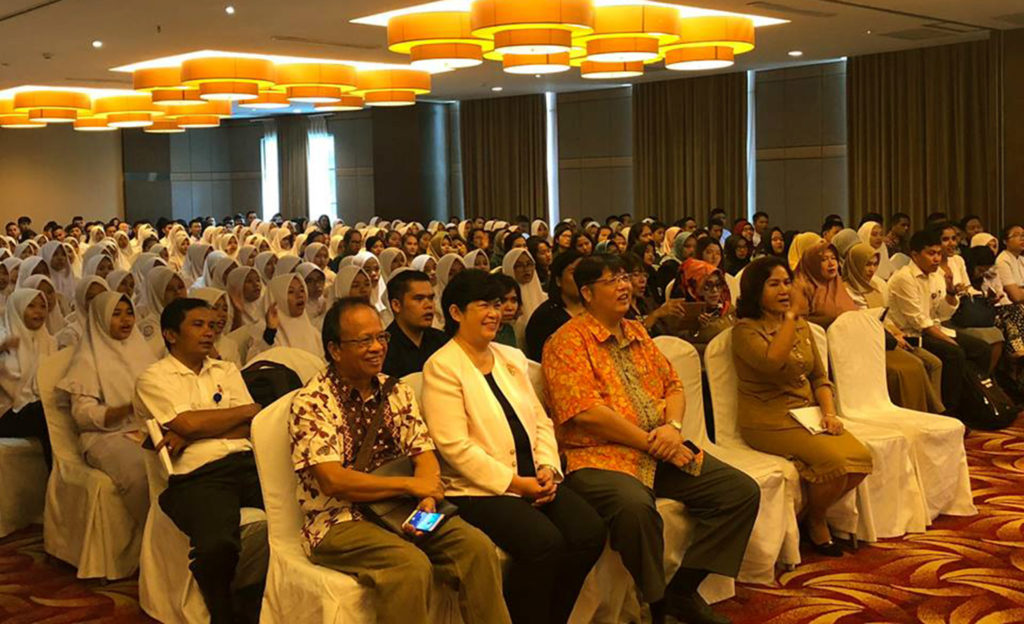
PH EDUCATION SERVICES IN INDONESIA. Participants during the two-day education fair in Medan, Indonesia last 30-31 July 2018
The Department of Trade and Industry through its Philippine Trade and Investment Center in Jakarta (PTIC-Jakarta) and the Embassy of the Philippines together with the top Philippine universities and accredited institutions in the field of nursing successfully co-organized the Nursing Education Fair last 30-31 July 2018 in Medan, Indonesia.
Participated in by more than three hundred Indonesian students, faculty, and school administrators from Medan and North Sumatra, the event provided an opportunity for Philippine nursing schools to assess the Indonesian space for expansion as well as forge academic partnerships, student exchange, and capacity building for faculties.
PTIC Jakarta shared that part of its strategic initiatives in Indonesia is the promotion of Philippine education services through school visits and roadshows.
Top Philippine nursing schools joined the fair include University of Sto. Tomas (UST), Centro Escolar University (CEU), Far Eastern University (FEU), San Pedro College – Davao (SPC), University of Perpetual Help Dalta (UPHD), and Saint Louis University (SLU).
During the two-day event, some of the participating schools like UST and CEU have established partnerships with Indonesian universities. Matching sessions among Philippine nursing universities, Indonesian schools, and associations were also conducted at Sari Mutiara University for prospective students and possible memorandum of understanding (MOU).
“The fair aims to further the cooperation between the Indonesian and Philippine nursing educational institutions. By promoting the educational services sector, we hope to provide more opportunities in the country that will eventually lead to job generation,” said PTIC Jakarta Commercial Attaché Jeremiah Reyes.
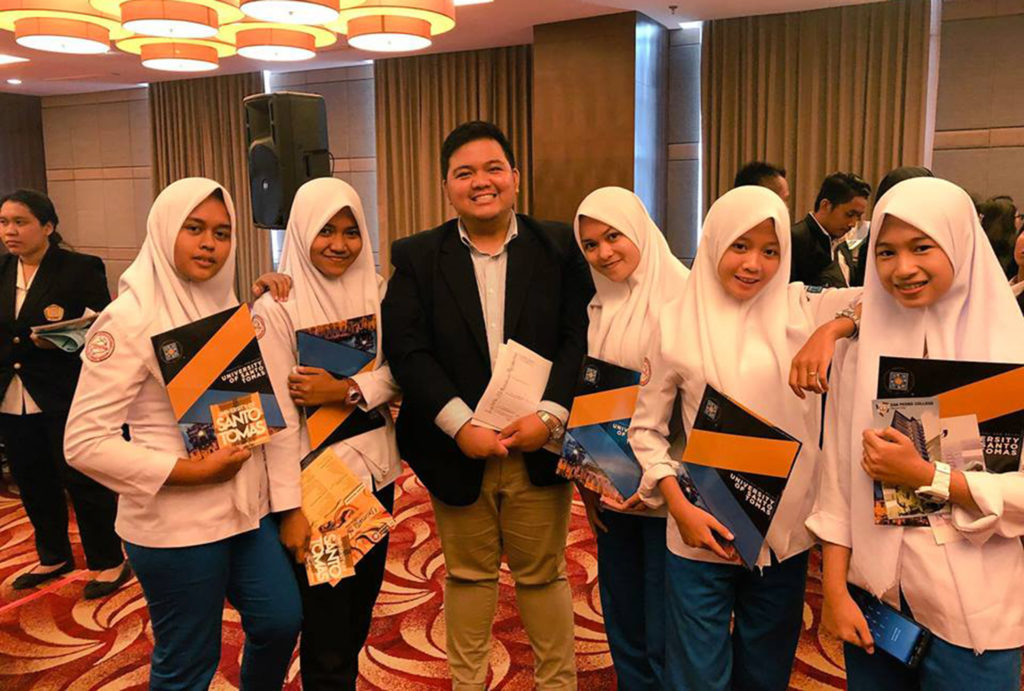
PTIC-Jakarta Commercial Attache Jeremiah Reyes with some of the participants during the nursing education fair.
by admin | Aug 8, 2018 | Headlines
In an effort to deepen relationships with local startup ecosystem players in Cebu and Davao and complete the ecosystem assessment of the two cities for the Startup Genome Project, the Department of Trade and Industry-Export Marketing Bureau (DTI-EMB) organized the conduct of a Focus Group Discussion (FGD) in Cebu and Davao on 18 and 20 July 2018, respectively.
Startup Genome Project aims to increase the success rate of startups and improve the performance of startup ecosystems across more than 30 countries, including the Philippines. The DTI-EMB facilitated the Philippines’ first-time participation in the Startup Genome Project, which released the 2018 Global Startup Ecosystem Report in April this year. The 2018 GSER featured strategic start-up, investment and policy insights from over 10,000 founders in 45 cities, including Manila.
Attended by some 100 startups, technology business incubators (TBIs), accelerators, business support organizations (BSOs), academe, and government agencies, the FGD was facilitated by Startup Genome Director of Research Arnobio Morelix and Manager of Research Pranav Arya in Harolds Hotel in Cebu City and The Pinnacle Hotel and Suites in Davao City.
With assistance from DTI-VII OIC Assistant Regional Director Ma. Elena C. Arbon and DTI-XI Industry Development Division Chief Marie Anne J. How, the FGD focused on the challenges Cebu and Davao startups face, the strengths of their ecosystems, and the recommended solutions to address their key concerns.
“In addition to getting a better understanding of the local startup scene and ultimately work together with you to increase your exposure and improve your performance, this FGD also aims to elicit your commitment to be Ecosystem Partners in the research through sharing of your expertise and supporting data collection, learn from your insights to complete the Ecosystem 360 Rubric, and ask you to complete the Organization Assessment,” Morelix said.
Morelix also reported to the participants the Manila Ecosystem Findings, which he also presented to Trade and Investments Promotion Group (TIPG) Undersecretary Nora K. Terrado, DTI-EMB Director Senen M. Perlada, EMB-Knowledge Processing Division (KPD) Chief Vic Soriano, EMB-KPD Assistant Division Chief Angie Brosas, Kaye Mendoza of EMB-KPD, and Brian Jay Ambulo from the Office of TIPG Undersecretary.
Based on Startup Genome’s analysis, Manila is currently in Activation Phase in terms of experience levels, ecosystem size (startup output), and resource attraction. While Manila’s overall startup experience is close to Activation Phase average, the ecosystem needs more sizable exits, the Report said.
The Report also noted that output growth in Manila shows that the ecosystem is expanding rapidly and that overall global resource attraction is higher than the phase average.
However, Manila ecosystem needs to improve in terms of funding and number of experienced engineers. It added that Manila has not been able to create a series of $100M+ exits in the ecosystem, which are a must for resource attraction. Focus must be on driving valuations and achieving multiple $100M+ exits to enter next phase, the Report said.
The Report also pointed out that market reach is the single metric most closely related to ecosystem production of scaleups and exits. Manila startups, the Report noted, have lower global market reach than most of their peers in the Activation Phase.
“Startups with higher global market reach early on see their revenue grow two times faster and are more likely to become scaleups,” Morelix stressed, adding that global market reach is driven by global connectedness.
“Notably, ecosystems’ focus should be on building connections with top ecosystems,” he said.
The Report concluded that Manila startups have more potential to strengthen global market reach.

In photo: Startup Genome Director of Research Arnobio Morelix (left) assists a participant complete the survey during the Focus Group Discussion (FGD) held at Harolds Hotel, Cebu City on July 18, 2018 while Startup Genome Manager of Research Pranav Arya (3rd from left) looks on. The same FGD was also conducted at the Pinnacle Hotel and Suites for Davao City startups on July 20, 2018.
by admin | Aug 3, 2018 | Headlines
As the temporary secretariat of the Anti-Red Tape Authority, the Department of Trade and Industry-Competitiveness Bureau (CB) urged all government agencies to start the review of their systems and processes starting with their existing Citizen’s Charter, to comply with the Ease of Doing Business and Efficient Government Service Delivery Act of 2018.
Speaking before the officials of the Bangko Sentral ng Pilipinas (BSP), Assistant Secretary Pacheco cited Section 5 of Republic Act 11032, calling for the reengineering of their systems and procedures.
“The EODB Act took effect last June 17 and under the law, all LGUs and NGAs are directed to initiate review of existing policies and operations and commences with the reengineering of their systems and procedures, even without the IRR (Implementing Rules and Regulations). We urge you to update your Citizen’s Charter.” DTI Assistant Secretary Mary Jean Pacheco told the participants of Anti Red Tape Task Force Meeting at the BSP.
Under the new law, the reduced processing time for simple transactions is now 3 days, while for complex transactions is 7 working days. Highly technical transactions should be processed within 20 working days. Applications and request for license, clearance, permit, or authorization which require the approval of local Sangguniang Bayan, Sangguniang Panlungsod, or Sangguniang Panglalawigan should only take 45 working days, which could be extended for another 20 working days. Likewise, the law also reduced the number of signatories to only three, further facilitating business-related transactions.
The EODB law also mandates all government agencies to setup the most current and updated Citizen’s Charter, the service standard which shall detail the following information:
- a) a comprehensive and uniform checklist of requirements for each type of application or request;
- b) the procedure to obtain a particular service;
- c) the person/s responsible for each step;
- d) the maximum time to complete process;
- e) the documents to be presented by the applicant or requesting party, if necessary
- f) the amount of fees, if necessary; and
- g) the procedure for filing complaints
The act of requiring additional documentary requirements and fees not listed in the agency’s Citizen’s Charter shall be punishable by six months suspension (administrative liability) for the first offense, and dismissal from public office, and forfeiture of retirement benefits and imprisonment of 1-6 years with a fine ranging from PhP 500,000 to PhP 2,000,000 (administrative and criminal liability) for second offense.
Assistant Secretary Pacheco highlighted the importance of establishing an updated Citizen Charter as it will serve as a useful reference for the public when transacting with frontline services. Reengineering the systems is needed to reduce bureaucratic red tape and processing time.
“For the government agencies to effectively put EODB Law at work, we should reengineer our systems and procedures, by undertaking cost compliance analysis, time and motion studies, evaluation and improvement of transaction systems, and initiate review of existing policies and operations, in compliance with the provisions of the RA 11032.” Asec Pacheco added.
by admin | Jul 28, 2018 | Headlines
The Philippines (PH) continues to improve its global ranking with the latest World Bank Logistics Performance Index (LPI) 2018 edition. From 71st spot in 2016, the country leaped to 60th among 160 countries ranked according to their trade logistics performance.
“We are now reaping the fruits of the government’s reforms and these are seen globally. Guided by President Rodrigo Duterte’s mandate for a better and more comfortable life for our countrymen, we have developed a program to improve logistics services in the country to address related issues, foster more investments, and generate more jobs,” said Trade Secretary Ramon Lopez.
PH recorded a 2.9 LPI score in 2018 compared to 2.86 score in 2016. The country posted increases in four out of six indicators:
1. International shipment indicator – measures the ease of arranging competitively priced international shipments
2. Tracking and tracing – ability to track and trace consignments
3. Infrastructure – evaluates the quality of trade and transport-related infrastructure
4. Logistics competence – competence and quality of logistics services
The Transport and Logistics sector is one of the 12 industry priorities under the Inclusive Innovation-led Industrial Strategy (I3S) of the Department of Trade and Industry (DTI). The agency has been active in promoting the sector to attract investments and has initiated reforms to address reliability, high logistics cost, as well as customs procedures.
“We are now focusing on facilitating solutions to issues on port congestion and high shipping cost,” said Competitiveness and Ease of Doing Business Undersecretary Rowel Barba.
The DTI-Competitiveness Bureau (DTI-CB) is collaborating with the private sector to transform the logistics services sector through regulatory reform, assurance of quality, communication, and knowledge management (TRACK program).
Under the DTI TRACK program, several projects benefitting the logistics services sectors are lined up. These include: the establishment of a supply chain and logistics observatory; an online resource tool that will contain relevant supply chain and logistics data; standards development; marketing and promotion; and logistics planning for Micro, Small, and Medium Enterprises (MSMEs).
“The recent LPI score is proof that the Philippine government’s efforts to level up our logistics industry are now being acknowledged by global industry players. And while the quality of the country’s infrastructure facilitates faster and more efficient way of transporting goods through the “Build, Build, Build” program, government transactions are now being simplified and streamlined with the recent enactment of the Ease of Doing Business law,” Usec. Barba added.
The Logistics Performance Index 2018, published by the World Bank, measures performance along the logistics supply chain within a country and offers domestic and international perspectives. An online survey was conducted between September 2017 and February 2018, involving logistics professionals from multinational freight forwarders and express carriers.

