by admin | Apr 7, 2017 | DTI Updates, Headlines, National News
As the Philippines chairs the ASEAN Economic Ministers’ Meeting (AEM) and Related Meetings for this year, Department of Trade and Industry (DTI) Secretary Ramon Lopez is determined to advance ASEAN’s objective to engage Japan on innovation and inclusivity of micro, small and medium enterprises (MSMEs), during the AEM Roadshow to Japan from 6 to 8 April 2017.
ASEAN economic ministers will also call on Japan’s top leaders and government officials in a consistent bid to strengthen bilateral relations between ASEAN and Japan. The AEM Roadshow will include site visits to some Japanese companies in Tokyo, Kyoto, Osaka, and Wakayama. “ASEAN is keen to engage with Japan on the theme of innovation and on how this can strengthen not only industries but MSMEs,” said Sec. Lopez, chair of AEM, whose domestic advocacy on developing MSMEs through innovation aligns with ASEAN’s intention.
The ASEAN delegation with ASEAN Secretary-General Le Luong Minh is set to meet Japanese Prime Minister Shinzo Abe and Minister Hiroshige Seko of the Ministry of Economy, Trade and Industry (METI), as well as some public officials. “Given Japan’s stature as one of ASEAN’s worthy trading partners and the continually growing trade between the two, we cannot stress enough the importance of this Roadshow in further strengthening relations between ASEAN and Japan,” he added.
The trade chief also noted that during the first Roadshow in 2016, ASEAN economic ministers were impressed at what they witnessed in the showcase of Japanese resilience and human resource development. Likewise, the ASEAN Member States (AMS) gained a deeper understanding of the importance of regional efforts on disaster resiliency, according to him. “Japan is regarded as a leader in innovation for the past 50 years and is home to widely-recognized companies.
Economic ministers are eager to see this innovation at work in Japan not only to gain new perspectives to be applied in their respective countries, but also to better implement the AEM priority on inclusive, innovation-led growth towards shared prosperity for the region,” explained Sec. Lopez. ASEAN will also discuss with the Japanese side ways to strengthen ASEAN-Japan economic relations, as well as the ongoing negotiations with the Regional PH to push
ASEAN’s bid to engage Japan on innovation & MSME inclusivity-Lopez 2 | P a g e Comprehensive Economic Partnership (RCEP). ASEAN is confident that with the support of Japan, the negotiations on the basic RCEP parameters will be concluded within the year.
by admin | Apr 6, 2017 | DTI Updates, Headlines, National News
MAKATI—Department of Trade and Industry (DTI) Secretary Ramon Lopez recently (5 April) convened the National Price Coordinating Council (NPCC) to closely evaluate the price and supply situation of basic necessities and prime commodities during the first quarter of this year.
During the meeting, DTI discussed its stand to deregulate the setting of Suggested Retail Prices (SRP) on certain commodities to reduce bureaucratic red tape in the system, while it continues to closely monitor the movement of prices of products and ensure fair trade in the market.
DTI clarified that there will still be SRPs on manufactured products but it can be set by the companies themselves for guidance of the supermarkets and consumers. These SRPs will still be closely monitored by DTI.
“We can let the companies set the SRPs because products with competitive market players and several brands, both locally produced and imported, have their ‘self-correcting mechanism’ on their prices,” said Sec. Lopez.
“In fact, prices of brands and commodities that do not pass the approval system of DTI before remained stable and some are even declining because of competition” he added.
Sec. Lopez believes that liberalizing price setting would help spur competition among industries and would further improve their product quality.
“DTI would prioritize the protection of the consumers by ensuring that industries have a competitive business environment that allows entry of brands and players in the market and give the consumers the widest range of choice,” the trade chief said.
“We will continue to closely monitor the prices of basic goods, and will have the oversight function to enforce regulation of irregular price increases,” added Sec. Lopez, ensuring commitment to consumer protection.
The NPCC will work with DTI on analyzing the industry structure and streamlining the process of price regulation to create a more efficient and effective system for both manufacturers and consumers. DTI would also be working with the Philippine Competition Commission (PCC) to continuously review the industries’ structure, and the play of competitive forces, that will ensure optimum competition and best options for quality products/services and affordable price points for consumers.
by admin | Apr 5, 2017 | DTI Updates, National News, Photo Story
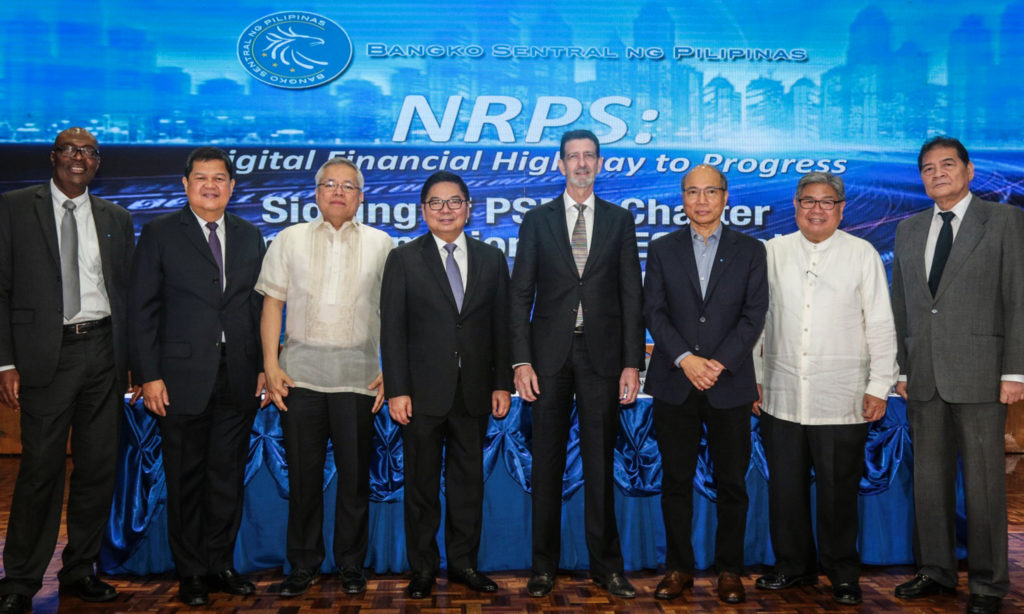
DTI SUPPORTS BSP FOR NEW E-PAYMENT SOLUTIONS. Department of Trade and Industry (DTI) Secretary Ramon Lopez (3rd from L) with USAID Philippines Acting Office Director Dr. Stephen Andoseph (leftmost), Malaya Rural Bank, President Antonio Pasia(2nd from L), Union Bank Philippines Chairman Mr. Justo Ortiz (center R), PayMaya Philippines President Orlando Vea (3rd from R) and Wealth Development Bank President Mr. Gregorio Anonas III (rightmost) recently (31 March) extended support for the National Retail Payment System (NRPS) during the ceremonial signing of the Payment System Management Body (PMSB) Charter in Manila. The PSMB will pave way to the for the creation of two E-Retail Payment Systems, PESO Net and InstaPay, which aim to provide ease of access to credit and spur the growth of the E-commerce industry in the country by providing safe, reliant and efficient online payment system. “This continuous innovation by the Bangko Sentral ng Pilipinas (BSP) helps not the economy but more importantly the micro, small and medium enterprises (MSMEs) sector,” said Secretary Lopez, adding that the NRPS will provide a technology that is more accessible to all, including the MSMEs. This will lead to financial inclusion and, more importantly, will promote efficiencies and lower cost of doing business. The ceremony was opened and led by BSP Governor Amando Tetangco (center L) and Deputy Governor Nestor Espenilla Jr.(2nd from L).
by admin | Apr 4, 2017 | DTI Updates, Headlines, National News
The Philippines, through the Department of Trade and Industry’s Export Marketing Bureau (EMB) and Philippine Trade and Investment Center (PTIC) – Kuala Lumpur, is set to take part at the Malaysia International Halal Showcase (MIHAS) 2017 on 5-8 April in Kuala Lumpur, Malaysia.
After years of absence at MIHAS, the Philippines is back with 30 Philippine companies that will showcase Halal-certified products at the Philippine Pavilion. Joining the business delegation are companies from the food (27) and non-food (3) sectors.
Products to be showcased will vary from food and beverage, processed meats and snacks, to cosmetics and personal care. With its Philippine Export Industry development program, Philippines’ participation at the said trade show is the biggest to date.
“The Philippines takes this opportunity to introduce itself as a major supplier of Halal compliant products to the world. We are here to take part in the global Halal initiative and to bring about innovative products that will complement the global Halal ecosystem. The Philippines brings together the strong collaboration of Halal stakeholders in the Philippines with the deliberate approach under the recently passed Philippine Halal Export Promotion and Development Law (Republic Act 10817),” said DTI EMB Director Senen M. Perlada.
DTI-EMB confirmed the participation of San Miguel Purefoods Company, Inc., Mega Global, Century Pacific Food Inc., and Palmstore, among others.
The PTIC – Kuala Lumpur has also expressed confidence in the success of the Philippine’s participation, especially with the keen interest shown by businessmen in Malaysia to visit the Philippine Pavilion and meet the companies.
“We have gained recognition in the industry with businesses and business organizations, culinary schools, hotels, food manufacturers, and wholesalers alike, expressing excitement to see what the Philippines can offer in terms of Halal,” said PTIC Kuala Lumpur Commercial Attache Katrina Banzon.
Philippine Halal products to Malaysia is estimated to be around USD 86.7 Million in 2016, with a five year compound annual growth rate (CAGR) of 26.80%.
MIHAS is considered the world’s largest Halal event. It offers networking and business proposition for Halal exhibitors and buyers. According to its records, it welcomed over 22,000 trade visitors from more than 70 countries and generated record sales beyond RM1 Billion for 600 exhibitors.
MIHAS is hosted by Ministry International Trade and Industry, organized by Malaysia External Trade Development Corporation (MATRADE) in association with Halal Industry Development Corporation (HDC) and Department of Islamic Development Malaysia (JAKIM).
Philippines’ DTI EMB and PTIC-Kuala Lumpur invite everyone to visit the Philippine Pavilion at MIHAS 2017.
For more information on the services of the DTI, log-on to http://www.dti.gov.ph
by admin | Apr 4, 2017 | DTI Updates, Features, Headlines, National News
QBO Innovation Hub, an established partnership between the public and private sector including the Department of Trade and Industry (DTI), Department of Science and Technology (DOST), IdeaSpace Foundation, and J.P. Morgan, opened its startup enablement programs to help speed up growth and learning for Philippine startups and entrepreneurs.
“We are excited to create success stories that will inspire Filipinos to start their own companies instead of pursuing opportunities overseas,” said QBO and IdeaSpace President Butch Meily.
QBO will start offering programs and services to startups including access to QBO’s networking events such as classes, workshops, mentorship, feedback sessions, and use of its co-working space.
Available services also include professional consultations on legal, accounting, marketing and design, corporate and government partner resources referrals, incorporation assistance, business registration, intellectual property filing, and investors and potential partners pitching.
“DTI hopes that with our partners from industry, academe, and other government agencies such as DOST and DICT, our initiatives will help advance the development of our local startup ecosystem and increase the number of high-growth oriented enterprises that will bring the Philippine brand in a global scale,” emphasized DTI Trade and Investments Promotions Group Undersecretary Nora K. Terrado.
Through QBO, startups will also have an opportunity to join J.P. Morgan’s Incubation Program, a stage agnostic module that will be available to select and high-potential startups all year round. It initially plans to enroll 15 startups by the end of 2017.
“As one of the world’s leading financial institutions, J.P. Morgan celebrates new ideas and we are committed to supporting entrepreneurs in the country, especially those with underserved backgrounds. Engaging with Micro, Small and Medium Enterprises (MSMEs) at their early stages is critical and we are excited about the tremendous opportunities they will bring to developing sectors and generating jobs, which are both vital in promoting prosperous and thriving communities,” said Roberto L. Panlilio, Senior Country Officer, J.P. Morgan Philippines.
To avail the said services, startups need to have an initial interview with the QBO team and undergo initial assessment. Through this, a customized plan will be designed to match with the resources needed by the startup.
QBO was launched in 2016 with DTI Secretary Ramon Lopez and PLDT Group Chair Manny V. Pangilinan. It aims to link innovators, explorers, investors, academic institutions, start-up mentors, funders and enablers as well as a broad spectrum of partners and stakeholders from both public and private sectors to convene in constructive interaction.
“The Philippine startup ecosystem is growing incredibly quickly, fueled by a young population engaged in the internet and digital, and more importantly, by entrepreneurs that demonstrate incredible determination and commitment. By continuing to develop ideas into innovative products and technologies, startups can evolve to become great companies that positively impact the future of the Philippines” said DOST Undersecretary for Research and Development, Dr. Rowena Cristina L. Guevara.
QBO is the first innovation hub in the country, pioneering the first public-private effort to establish an innovation ecosystem in the Philippines following success stories of Silicon Valley in the United States, BLK 71 in Singapore, and MaGIC in Malaysia.
by admin | Apr 4, 2017 | DTI Updates, National News
The Department of Trade and Industry – Regional Operations Group (DTI-ROG) continues to serve micro, small and medium enterprises (MSMEs) and create entrepreneurs through its Negosyo Centers.
DTI – ROG Supervising Undersecretary Zenaida Maglaya said Negosyo Centers throughout the country will help MSMEs scale up their businesses through its services.
There have been 760,230 MSMEs assisted by these Negosyo Centers since its inception in 2014, Maglaya said. Likewise, these centers have also created 125,066 entrepreneurs.
“A total of 760,230 MSMEs assisted and 125,066 created entrepreneurs is quite a feat for us. Rest assured that we will continue increasing our Negosyo Centers in far-flung areas to create and serve more entrepreneurs, and provide employment to Filipinos,” she added.
As of March 28, 2017, the Department has already established 470 Negosyo Centers throughout the country.
“We are proud that we have established more Negosyo Centers more than what we have expected to establish. In 2016, we surpassed our target of 150 centers. Hopefully this year we can do the same to support the growth of MSMEs in the country,” Maglaya said, adding that Negosyo Centers help in achieving job generation and inclusive growth in support of the administration’s Trabaho at Negosyo agenda.
She added that for Business Name Registration alone, a total of 438,619 clients – 52,284 in 2015, 283,487 in 2016, and 134, 390 in just 3 months in 2017 – were assisted.
The Republic Act No. 10644 or the Go Negosyo Act aims to help micro, small and medium enterprises (MSMEs), promote ease of doing business, facilitate access to grants and other forms of financial assistance, Shared Service Facilities (SSF) and other equipment, and other support for MSMEs through national government agencies (NGAs), ensure management guidance, assistance and improvement of the working conditions of MSMEs; and facilitate market access and linkaging services for entrepreneurs.

