by admin | Jan 24, 2015 | Opinion
By: Jerome Auza
On January 24, 2015, the date of release of the Nurse Licensure Examination results for the November 2014 examination, the Professional Regulation Commission (PRC) website crashed and inaccessible to the public. It remained down for almost 24 hours.
In cases like this, websites like www.prcpassers.com, Rappler and other websites that post PRC results, become alternate source of information of the list of passers.
It is really disappointing that PRC could not even provide enough computing resource to support the website traffic whenever it releases licensure examination results. With all the cloud computing technology available, the PRC could perhaps utilize extra servers to handle the load during the time they release examination results to the public.
There are a few things PRC could do to improve the website service to the public without spending much. One is to change the way their website operates in publishing news. Since news items do not really change much at all, these should be published as static files which would load faster and with smaller computer resource consumption.
Another thing they could do is compress the downloadable list of users to reduce the amount of website traffic since the users need to download the list in order to check if they passed.
With all the fees paid to PRC by examinees and professionals all over the Philippines, it is an embarrassment to this government agency to have a service that becomes unusable when people would like to look up for information if they pass an exam or not.
by admin | Jan 17, 2015 | Opinion
By: Jerome Auza
The year started with a “bang” for me at the office. Right on the first working day, the to-do list was already long and getting longer every day. I zip through the whole world via VPN and other means of remote access to accomplish many tasks of an IT practitioner.
When Pope Francis arrived, I only got to see his homilies and speeches online but not during the live broadcast.
It was quite obvious to me that “Lolo Kiko”, as the Pope was nicknamed by many Filipinos, is a very charismatic leader. It was also quite easy to see his sincerity to be with the poor, the unfortunate and the traumatized. The theme of his trip was “Mercy and Compassion” and what a fitting theme it is.

The arrival of tropical storm “Amang” coincided with the scheduled activities at Tacloban City in Leyte on January 17 and thus the Pope and the faithful had to deal with the heavy rain and strong winds. What coincidence, or perhaps God really timed the events, such that Pope Francis would experience a storm along with the victims of Typhoon Yolanda. It is perhaps the best way for the him to be with us, and to experience what many of us suffered on November 8, 2013.
When the Pope Francis said that he “decided to come here” after watching the aftermath of the catastrophe of Typhoon Yolanda, I was touched by his words. I may be miles away from him, but through technology, he seemed to have reached out to me, and somehow tell me that everything will be okay.
Thank you, Pope Francis! We will brave all storms, from weather to relationships to life itself, knowing that, as you have said, Jesus will not let us down.
by admin | Dec 6, 2014 | Opinion
Update: December 6, 2014, 11:00HRS PHT: www.pagasa.dost.gov.ph now redirects to kidlat.pagasa.dost.gov.ph. Maybe the article below helped give the administrators an idea how to put a workaround or someone finally was given the time to implement it. Nevertheless, this should have been done 3 days ago.
By: Jerome Auza
Where is PAGASA when you need it most?
Our well criticized weather agency PAGASA added another reason for Filipinos to criticize the underfunded and undermanned agency. It main website has been down for the past few days when many netizens are searching for information about typhoon Ruby. It probably has overworked personnel, especially in times when a major storm is approaching the country and thus couldn’t take time to repair their website.
I have been providing updates on www.boholnewsdaily.com about the storm track forecast of typhoon Ruby (HAGUPIT) and sadly, it was easier to get information from the Japan Meteorological Agency and the Guam Weather Forecast Office rather than from our own weather agency.
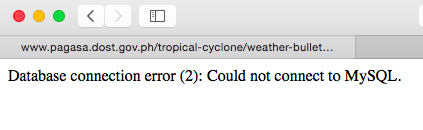
We need someone good at MySQL in this country to help PAGASA.
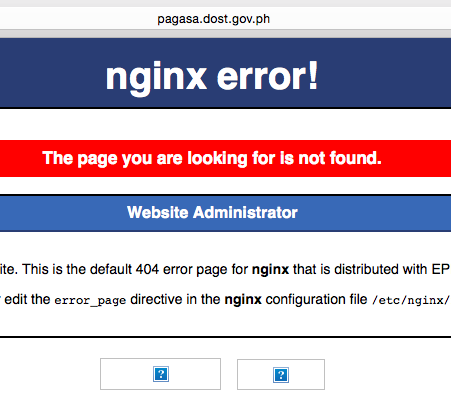
It would be such a bummer if the PAGASA website will still be down and the typhoon is bearing down on the Philippines.
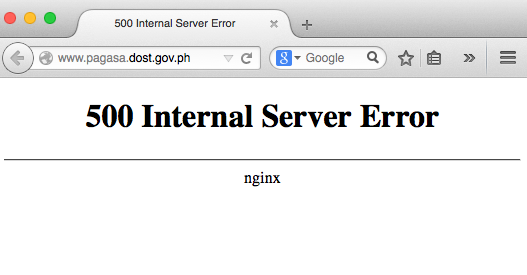
PAGASA website still down less than 24 hours from the expected landfall of typhoon Ruby.
While it is true that the PAGASA website has a mirror site on kidlat.pagasa.dost.gov.ph, the average Internet user would never know about it since most of the search engine results point to the main website www.pagasa.dost.gov.ph. As a web site hosting service provider, I know how simple it is to redirect hits to the main website to the mirror site in case the main website fails. But PAGASA never did that. They briefly showed an error page with the correct links after being down for 24 hours last Thursday but that page is gone late Friday afternoon.
The website was intermittent prior to Thursday.
Fortunately PAGASA personnel has a Facebook page where they are currently posting typhoon Ruby updates as well as other weather updates around the country. I am not sure though if it is official. It probably is.
PAGASA should really put the proper resources to keep its website alive especially during times when people would like to know more information about upcoming severe weather. Or maybe the agency’s budget from the General Appropriations Act is only a miniscule amount compared to what is being primed for use during the coming election campaign. If that’s the case, there’s probably little the personnel can do.
To help keep up with huge data traffic, PAGASA can invite volunteers to mirror its content so that in case the main site is out, there are still many mirror sites that can continue providing information to the public.
PAGASA’s website is a very efficient means of disseminating information to the public. But it is useless when it is down and doesn’t redirect users to the mirror site.
by admin | Dec 4, 2014 | Opinion
Update: Dec 4, 08:00HRS PHT. At least some improvement on the error message but the website is still down.
It would be such a bummer if the PAGASA website will still be down and the typhoon is bearing down on the Philippines.
How can PAGASA effectively and efficiently communicate updates on Typhoon Ruby when its website keeps crashing? At 8:45AM, December 4, 2014, I could not get any information from the PAGASA website because of a database error. Seriously? No one can fix that at PAGASA? I have seen it several times yesterday and thought that should get fixed immediately. But with typhoon Ruby coming and the citizens of its possible path should be getting updates, the website is still down today.
We need someone good at MySQL in this country to help PAGASA.
I’ll get my updates from Guam and Japan for now.
by admin | Aug 27, 2014 | Opinion
By: Jerome Auza
The popularity of social media sites like Facebook, Instagram and Twitter makes an exciting platform for journalists and bloggers to quickly share stories and newsworthy events. The thrill of getting a story to go viral, however, sometimes blurs the line between proper reporting and disrespectful and tasteless posts.
Last week was a good example of how one can forget that social network sites like Facebook are open to the public and when a user opens his Facebook account, it is likely that other family members may be around to view the screen. Imagine my shock when several pictures of dead or dying people with blood and brain splattered on the ground showed up on my timeline. News of terrorism in the Middle East as well as local news on the campaign against the drug trade abound on the social media.
My kids aged 2, 5 and 6 were expecting to see photos of their parents enjoying a short vacation. I had told them that I uploaded some pictures of their Daddy and Mommy when we went to Cebu. I mumbled an excuse as I hid the blood splattered posts from my timeline.
Immediate reporting is one thing and it is good so that we are aware of what’s happening in the society. We should draw a clear, thick line though of how much do we show to the public. This is because we have little control of who can see our social media posts. We can still report the whole truth without being gross.
I think it is sufficient to say in words that the suspect was fatally wounded on the head as policemen gunned him down while attempting to flee after firing at and wounding some police officers. One does not have to show a picture of a barely recognizable human head with bits of brain on the side and bright red blood all over the place. As if the gross pictures were not enough, someone posted a video of the same bloody image, making it at least ten times more gross. Terrorists in the Middle East post images and videos of beheaded people and these appear on your Facebook timelines when shared by someone close enough to your network of friends.
Being a blogger myself, I thought that I should read on the code of ethics covering journalists. I am, in a way, a journalist, for about an hour or so a week. The best one I found is the Code of Professional and Ethical Conduct of the Philippine Press Institute. I think one doesn’t need to be a member of this organization to follow this code. A journalist, blogger or even just a normal social media user trying to share something newsworthy and publicly visible should follow it.
One paragraph strikes me as very relevant to the matter last week: “We shall avoid at all times language, photographs, visuals and graphics that are racist, sexist, insensitive and disrespectful of men, women and children; the religious denominations, cultural communities, and gender and political preferences.”
Even if the victim was a known criminal, he still deserves the respect we give to the dead. If not him, then at least his family and friends are entitled to it. Just imagine if you had an accident and your head gets severely deformed and injured beyond recognition. As your soul leaves your body, you see this journalist taking close up photos of your head, seemingly trying to focus on an eyeball that almost popped out. Unfortunately there’s nothing you can do at that point. If that journalist doesn’t follow any code of ethics then your bloody picture would likely end up on Facebook. All your friends and relatives will know about your demise in the most inappropriate manner. Add to that some grey matter providing contrast to the bright red color on the background. Ewwww.
Let us be respectful of the dead, no matter how allegedly “bad” they had been when they were alive. Let us be mindful that not everyone enjoys seeing full color pictures of people killed or wounded in an accident or shootout and refrain from posting such pictures in public. Let us be aware that kids and minors may be viewing their parents’ (and even their own) timelines and that they should not be exposed to shocking and violent images.
We should consider the audience of the posts we make and share. Let us not add to the impropriety that already exists online.
by mikocanares | Feb 12, 2013 | Opinion
 For the last half of 2012, I was desperate to find a decent bank willing to lend me money to finish my house at an interest rate that I can afford. My wife, another Certified Public Accountant in the house besides myself, went through an options analysis including the Home Development Mutual Fund (HDMF) and a few commercial banks that promise interest holidays, or low interest rates, or fast processing and so on and so forth. She found out that when one borrows from HDMF at an amount beyond Php750,000, the interest rates converge with that of commercial banks so we decided to apply a housing loan from both PS Bank and Bank of Commerce.
The experience was not that pleasant. Both banks were slow at responding to request for information and failed several times to get back to us as to the status of our applications. PS Bank, for example, treats us as miserable clients, not worthy to be lent some money despite our positive and highly liquid cash position, because our access road is not yet developed though it exists. In an age of cash-flow lending, its lending system is stuck to collateral issues that despite our explanation, our application got disapproved twice. They told us we need to pave our access road so that our loan will be approved. That time they did this assessment, our house was already 60% complete.
Bank of Commerce, on the other hand, eventually lent us the money, but not without making us feel miserable as well. They said that after application, we will be able to get the approval we need and the first release in a month’s time. After two months and after exhausting our savings, nothing happened. All promises and a string of requirements; not until I burst in anger towards the close of 2012 did we get a positive response. Both my wife and I felt that the bank employees enjoyed our powerlessness; they enjoyed hearing our pleas for consideration.It made us realize that banks exist not for financially insignificant people like my wife and me. But we continued pleading to almost the point of losing our sense of dignity. Had we the choice, we would not go through the same experience again.
Banks, or financial access to banks, are just for the rich. I should say. Or with our case, the persistent poor who got angry towards the end.
In Abhijit Banerjee’s and Esther Duflo’s book, PoorEconomics, they posited the argument that “credit constraints are likely to be much tighter for very poor borrowers than for somewhat richer ones”. However, they also presented cases, where capable, educated people, with strong business models were never trusted by banks. They also presented cases that those that lent to the poor are not your banks – these are micro-finance institutions like Yunus’ Grameen in Bangladesh, Padmaja’s Spandana in India, or TSKI in the Philippines. Banks are not for the poor. When the world’s largest micro-finance institutions start to behave like banks, they might also start to lose the advocacies that in the first place, gave birth to their existence. Microfinance institutions then, are the options for the poor, as these institutions offer lesser interest rates than usurious money lenders, but less stringent in terms of requirements as compared to banks.
But where will those in the middle range of the income spectrum, like me, go? Surely, banks find us less bankable and more risky. Microfinance institutions will also find us ineligible.There are limited options for us, as there are limited options for the poor. In one study we conducted at the end of December 2012 in 11 agricultural barangays in Batuan, Duero, Guindulman, Pilar, and Sierra Bullones, we found out that the poor could not access banks, not even microfinance institutions as indicated in the graph below:

When I talked with a friend who teaches at a local university here in Tagbilaran as to her sources of credit, she mirrored the results of the community study as depicted in the graph above. Banks have not granted her loan. If she needs immediate cash, she goes to her friends and family. For bigger requirements, she borrows from the employee’s cooperative to which she is a member. But at one time in her life, she wanted to put up a business venture but failed to do so because no single bank would finance her business and she was rated “not credit worthy”.
Banerjee and Duflo’s book, while not necessarily referring to the middle income group said that these borrowers “run the risk of being too large for the traditional moneylenders and microfinance agencies but too small for the banks”. Funding this set of people with financing needs will remain a challenge.
So you’re planning to go to the bank for your financing needs? Think again.
This post is written by Michael P. Cañares. This is also available at http://www.boholanalysis.com.


