by admin | Nov 14, 2015 | Tech Talk
Google released its machine learning library called TensorFlow as open source software last week. The code may be downloaded from the website www.tensorflow.org.
TensorFlow is the company’s artificial intelligence engine currently in use now on may of Google’s customer facing services like search, Gmail and Google Photos. TensorFlow is used to automate detection of patterns and enabling the services to present options to users that are relevant to their data or usage patterns.
By releasing the source code to the open source community, Google hopes to accelerate development of machine learning or artificial intelligence as more developers and users can be involved in testing, experimenting and developing the machine learning library.
Open source development has been instrumental in producing software technologies that are widely used on the Internet today. The Linux operating system, the most popular open source operating system is being used not only on desktops and servers but also on mobile devices. The Android operating system for mobile devices is based on Linux.
40% of websites around the world runs on the Apache HTTP server which is open source software. 25% of all websites run on the open source content management system WordPress. Such is the impact of open source software development and Google hopes similar progress will be done on TensorFlow by making it open source.
by admin | Nov 14, 2015 | Tech Talk
Apple Inc. will shut down the service Beats Music on November 30, 2015 after buying the company for US$3B in May 2014. This was an expected move since Apple has its own music service called Apple Music. Beats Music stopped accepting new signups since June 2015.
Beats music subscribers has an option to move into the Apple Music service with all their music preferences and playlists included. The official post on the Beats support page read:
“Beats Music ends on November 30. Your subscription will be cancelled, but you can move your picks and preferences over to Apple Music right now.
All the pros that curated music for you are still crafting more amazing experiences. Plus, on Apple Music, you’ll get even better recommendations based on music you already listen to and love, 24/7 global radio with Beats 1, exciting material from your favorite artist, and more.”
The Beats purchase by Apple is one of the large tech purchases in recent years.
Beats also sell products like headphones and speakers and these will still continue to be available after the shutdown of Beats Music.

The Beats Studio headphones won the C|NET Best Bluetooth Headphone of 2015. Photo credits: Beats website at www.beatsbydre.com.
by admin | Nov 7, 2015 | Tech Talk
San Miguel Corporation, the potential joint venture partner of Australian firm Telstra, holds an ace up its sleeve. It currently owns 90% of the 700MHz frequency range that is said to be the ideal frequency for mobile data service.
The 700MHz frequency allows the service provider to use lesser cell sites because the signals at this frequency can travel further compared to the higher frequencies used by the existing large mobile data players Globe and Smart.
In 2005, Globe requested the National Telecommunications Commission or NTC for an allocation of the 700MHz frequency but was denied. Just recently, PLDT joined the call for redistribution of the 700MHz frequency through an auction. Globe reiterated their request for allocation this year.
This is probably why Telstra was confident in its announcement last month that if the joint venture with SMC will push through, they would be able to provide much better service than Globe and PLDT.
However, some netizens interpret this move by Globe and PLDT as an attempt to prevent a 3rd player to compete. Others say that such requests are just excuses of the poor service provided by the two telcos. Others commented that Globe and Telco should just reduce advertising expense and spend the money instead on better infrastructure.
by admin | Oct 24, 2015 | Tech Talk
Solar Philippines introduces its Do-It-Yourself plug-and-play solar power generation system which is intended for residential application for houses that consume about Php3,000 worth of electricity per month. The 500W system is grid-tied and includes everything needed to setup the system. It is estimated to save about Php700 per month in electricity consumption.
At Php57,000 per system, the savings will pay off the system in less than seven years. Solar systems, when installed and used properly, are expected to last 20 years.
The kit includes everything needed to setup the system:
2pcs – 250W Solar Panels
1lot – mounting structure (V-type)
4pcs – 6mm2 solar DC wire complete with MC4
1pc – 500W microinverter
1pc – kiloWatt-hour meter (single phase, two-wire)
1pc – heavy duty male plug
After installation and connecting the wires, the system is plugged into an electrical outlet and will automatically connect to the grid and supply electricity to the house. When there is brownout, the system doesn’t produce electricity, which is a safety feature to avoid accidentally electrocuting electricians who may be doing maintenance.
To know more about the system, visit the webpage at http://www.solarphilippines.ph/do-it-yourself/
by admin | Oct 10, 2015 | Headlines, Tech Talk
The Department of Trade and Industry – Bohol Province held the first Bohol Idea to Contextualized Innovation (BHLi2i) Competition held at the Bohol Cultural Center last October 5-6, 2015. Ten (10) out of the thirty two (32) teams who registered were selected to proceed to the 2nd phase of the competition.
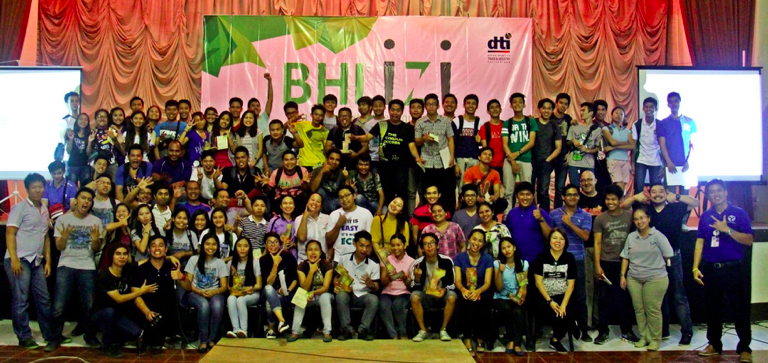
The participants, organizers and guests at the first Bohol Ideas to Contextualized Innovation Boot Camp.
These teams represent the different schools, colleges and universities in the province. The following ideas that qualified for the 2nd phase (prototyping stage) are: Bus Monitoring System (BMS), Bantay Palay “Grain Saver”, ACCRE, eGO, Heat Laptop Charger, e-Gen Light, PleteE, Drainage Inspection Machine (DIM), Rapid Testing Device (RTD), and Cocobot.
In the next stage, DTI will support the teams in the development of their ideas into actual prototypes using the facilities of the Bohol Fabrication Laboratory (FabLab), the first of its kind in the country. This will start on the 3rd week of October until the last week of November. Teams will learn 3D or 2D data preparation and undergo training on the use of digital fabrication equipment available at the Bohol FabLab such as the 3D Printer, Laser Cutter, Large and Small Format CNC Milling Machines, media printers and embroidery machine.
Prior to the pitching of ideas, all 150 individual participants were fortunate enough to be assisted by different mentors during the ideation process. Mentors included Carlo Calimon (CEO of MobKard); Dave del Rosario of Ideaspace Foundation; Prim Paypon of Dream Project PH; Andy Rapista (Founder of Watson Institute Philippines), Raphael Mijeno of SALT; and Artie Lopez (BrainSparks Philippines).
All prototypes developed will again undergo selection process in November. Qualified teams will proceed to the next phase, the co creation stage, wherein teams will have the chance to work on their prototypes with Japanese counterparts.
The BHL i2i Competition, the first of its kind in the province, is a program that promotes innovation and start-ups through digital fabrication. It aims to support the participants in developing technology-based solutions to local problems. This competition is organized by the Department of Trade and Industry – Bohol together with its local partners: Bohol ICT Council, Provincial Government of Bohol, City Government of Tagbilaran, Bohol Island State University and the Japan Internation Cooperation Agency.
by admin | Sep 26, 2015 | Headlines, Tech Talk
With reports from Leah Marchil
The DOST ICT Office in coordination with the Provincial Government of Bohol through the Bohol Investment and Promotion Center and the Bohol ICT Council held a Rural Impact Sourcing Forum for IT and Business and Accounting students from UB, BISU, Cristal E, STI, Mater Dei College, BIT, as well as students from DCPNHS, BWS, and TCSHS. The forum presented opportunities for livelihood and employment through freelance work on the Internet.
Speakers of the forum included DOST ICTO Deputy Executive Director for eInnovation Monchito Ibrahim, Team Lead Jielyn Joy Jocson, Upwork Philippines representative Olivia Briones and Online Jobs University Founder and CEO Genesis Reonico.
Testimonies were also presented from those in the Impact Sourcing Industry. Alwyn Rosal (web services), Joseph Ingking (Graphics Design), Nelson Buena (Social Media Marketing), and Gemela Castro (Teaching) shared advantages of freelance work on the Internet.
The promotion of Impact Rural Sourcing is seen as an important step in opening up the IT industry in the province, with IT considered as one of major development pillars and a growth propeller. Provincial Administrator Ae Damalerio represented Gov. Edgar Chatto while City Administrator Edi Borja represented Mayor Baba Yap in welcoming participants of the forum, both underscoring province and city efforts to build the IT industry in the province, gearing programs towards a healthy investment climate as well as strong human resource.
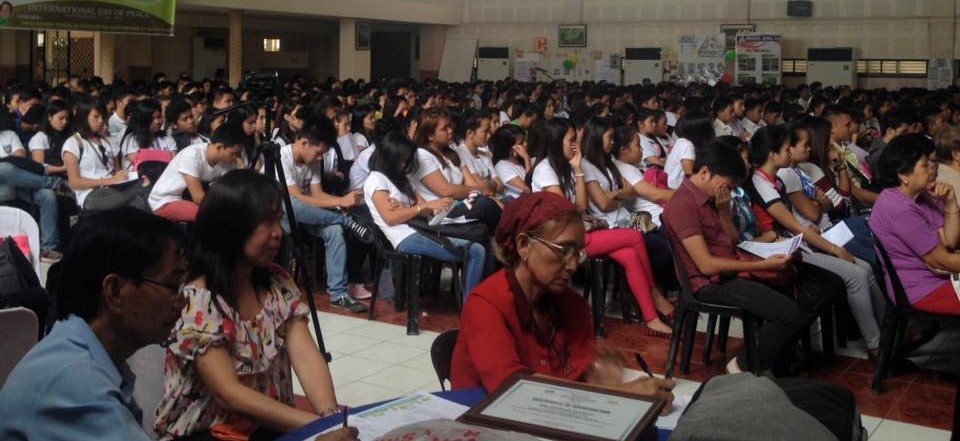
Participants of the Rural Impact Sourcing workshop at the Bohol Cultural Center.

